




No CrossRef data available.
Article contents
Conscious content generated by unconscious action-related adjustments
Published online by Cambridge University Press: 24 November 2016
Abstract
As mentioned in the target article by Morsella et al., the motor program's contents as a whole do not influence each other in the conscious field; however, research shows that some of their generated aspects could be sensitive to the context of the behavior. Such motivational “context-contamination” leads to voluntarily “turn off” of negative states. Taking place out of the conscious field, these adjustments would have critical influence on behavior, such as aggression.
Information
- Type
- Open Peer Commentary
- Information
- Copyright
- Copyright © Cambridge University Press 2016
References
Andreou, E. (2000) Bully/victim problems and their association with psychological constructs in 8- to 12-year-old Greek schoolchildren. Aggressive Behavior
26:49–56.3.0.CO;2-M>CrossRefGoogle Scholar
Bargh, J. A. (2014) Our unconscious mind. Scientific American
30:30–37. doi:10.1038/scientificamerican0114-30.Google Scholar
Bargh, J. A. & Chartrand, T. L. (1999) The unbearable automaticity of being. American Psychologist
54(7):462–79.CrossRefGoogle Scholar
Bargh, J. A., Chen, M. & Burrows, L. (1996) Automaticity of social behavior: Direct effects of trait construct and stereotype activation on action. Journal of Personality and Social Psychology
71:230–44.CrossRefGoogle ScholarPubMed
Bargh, J. A. & Pietromonaco, P. (1982) Automatic information processing and social perception: The influence of trait information presented outside of conscious awareness on impression formation. Journal of Personality and Social Psychology
43:437–49.CrossRefGoogle Scholar
Baron, R. S., Inman, M. L., Kao, C. F. & Logan, H. (1992) Negative emotion and superficial social processing. Motivation and Emotion
16:323–46.CrossRefGoogle Scholar
Berkowitz, L. (1993) Toward a general theory of anger and emotional aggression: Implications of the cognitive-neoassociationistic perspective for the analysis of anger and other emotions. In: Advances in social cognition, vol. 6, ed. Wyer, R. S. & Srull, T. K., pp. 1–46. Erlbaum.Google Scholar
Bjorklund, D. F. & Pellegrini, A. D. (2002) Child development and evolutionary psychology. Child Development
71(6):1687–708. doi:10.1111/1467-8624.00258. PMID 11194266.CrossRefGoogle Scholar
Bodenhausen, G. V., Kramer, G. P. & Süsser, K. (1994) Happiness and stereotypic thinking in social judgment. Journal of Personality and Social Psychology
66:621–32.CrossRefGoogle Scholar
Boulton, M. J. & Smith, P. K. (1994) Bully/victim problems in middle-school children: Stability, self-perceived competence, peer perceptions and peer acceptance. British Journal of Development Psychology
12:315–29.CrossRefGoogle Scholar
Carver, C. S. & Scheier, M. F. (1999) Themes and issues in the self-regulation of behavior. In: Advances in social cognition, vol. 12, ed. Wyer, R. S. & Srull, T. K., pp. 1–105. Erlbaum.Google Scholar
Chen, M. & Bargh, J. A. (1997) On the automaticity of self-fulfilling prophecies: The nonconscious effects of stereotype activation on social interaction. Journal of Experimental Social Psychology
33:541–60.CrossRefGoogle Scholar
Cross, S. E. & Markus, H. R. (1990) The willful self. Personality and Social Psychology Bulletin
16:726–42.CrossRefGoogle Scholar
Devine, P. G. (1989) Stereotypes and prejudice: Their automatic and controlled components. Journal of Personality and Social Psychology
56:680–90.CrossRefGoogle Scholar
Freud, S. (1915)
The unconscious
. In: The Standard Edition of the Complete Psychological Works of Sigmund Freud. Vol. 14: On the history of the post psychoanalytic movement, papers on metapsychology and other works, ed. Strachey, J. & Freud, A. , pp. 159–204. The Hogarth Press.Google Scholar
Greenwald, A. G. & Banaji, M. R. (1995) Implicit social cognition: Attitudes, self-esteem, and stereotypes. Psychological Review
102(1):4–27.CrossRefGoogle ScholarPubMed
Izard, C. E. & Ackerman, B. P. (2000) Motivational, organizational, and regulatory functions of discrete emotions. In: Handbook of emotions, 2nd edition, ed. Lewis, M. & Haviland-Jones, J. M., ppp. 253–65. Guilford Press.Google Scholar
James, W. (1890/1983) Principles of psychology. Holt. (Original work published in 1890).Google Scholar
Pahlavan, F. & Arouss, M. (2015) Executive regulation of anxiety and aggression. Journal of Behavioral and Brain Science, Special Issue on “Emotion, Cognition, and Behavior.” 6:53–80. doi: http://dx.doi.org/10.1017/S0140525X15000643
CrossRefGoogle Scholar
Pahlavan, F., Bonnet, P. & Duda, D. (2000a) Human motor responses to simultaneous aversive stimulation and failure on a valued task. Psychological Reports
86:232–42.CrossRefGoogle ScholarPubMed
Pahlavan, F., Duda, D. & Bonnet, P. (2000b) Direction of human motor responses by men and women to aversive stimulation. Psychological Reports: Perceptual and Motor Skills
90:415–22.Google ScholarPubMed
Pahlavan, F. & Lubart, T. (2005) Negative affective states' effects on perception of affective pictures. Consciousness and Emotion
1:57–79.CrossRefGoogle Scholar
Pahlavan, F. & Lubart, T. (2007) Motivational effects of success versus failure feedback. Psychological Reports
100:585–603.CrossRefGoogle Scholar
Pahlavan, F., Mouchiroud, C. & Nemlaghi-Manis, E. (2012) Does experience of failure decrease executive, regulatory abilities and increase aggression?
Global Journal of Health Science
4(6):60–87.CrossRefGoogle ScholarPubMed
Posner, M. 1. & Rothbart, M. K. (2000) Developing mechanisms of self-regulation. Development and Psychopathology
12:427–41.CrossRefGoogle Scholar
Schachter, D. L. (1987) Implicit memory: History and current status. Journal of Experimental Psychology
13:501–18.Google Scholar
Schelling, F. (1800/1978) System of transcendental philosophy, trans. Heath, P.. University Press of Virginia. (Original work published in 1800).Google Scholar
Smith, P. K., Bowers, L., Binney, V. & Cowie, H. (1993) Relationships of children involved in bully/victim problems at school. In: Learning about relationships. Understanding Relationship Processes Series, vol. 2, ed. Duck, S., pp. 184–215. Sage.Google Scholar
Srull, T. K. (1997) The vicissitudes of social behavior and mental life. In: The automaticity of everyday life: Advances in social cognition, vol. 10, ed. Wyer, R. S. Jr., pp. 203–16. Erlbaum.Google Scholar
Sutton, J. & Smith, P. K. (1999) Bullying as a group process: An adaptation of the participant role approach. Aggressive Behavior
25:97–111.3.0.CO;2-7>CrossRefGoogle Scholar
Todorov, A. & Bargh, J. A. (2002) Automatic sources of aggression. Aggression and Violent Behavior
7:53–68.CrossRefGoogle Scholar
Wegner, D. M. & Bargh, J. A. (1998) Control and automaticity in social life. In: Handbook of social psychology, 4th edition, ed. Gilbert, D., Fiske, S. T. & Lindzey, G., pp. 446–96. McGraw-Hill.Google Scholar
Zelli, A., Cervone, D. & Huesmann, L. R. (1996) Behavioral experience and social inference: Individual differences in aggressive experience and spontaneous versus deliberate trait inference. Social Cognition
14:165–90.CrossRefGoogle Scholar
Zelli, A., Huesmann, L. R. & Cervone, D. (1995) Social inference and individual differences in aggression: Evidence for spontaneous judgements of hostility. Aggressive Behavior
21:405–17.3.0.CO;2-N>CrossRefGoogle Scholar
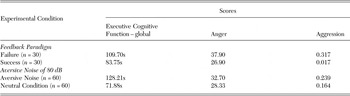
Table 1. Observed differences for global executive functions and aggressive tendencies (anger and aggression) mean scores in function of experimental condition.
 You have
Access
Created by Schelling (Reference Schelling and Heath1800/1978), Freud developed the concept of the unconscious mind in his tripartite model of mind, using the analogy of an iceberg to describe the three levels of mind: conscious mind at the top, unconscious mind at the base, and preconscious mind in the middle of the iceberg. Considered a primary source of human behavior, the unconscious mind, like an iceberg, is the most important part of the mind, hidden because it is unacceptable to the conscious mind (Freud Reference Freud, Strachey and Freud1915).
In spite of initial skepticism, the idea or modern notion of unconscious processes is now an important focus of psychology, in terms of automatic (Bargh & Chartrand Reference Bargh and Chartrand1999), implicit processing of information (Greenwald & Banaji Reference Greenwald and Banaji1995). However, empirical research in psychology has its own limits, often being subject to alternative interpretations. Indeed, empirical research of unconscious processes underestimates the roles of conscious processes and their significant regulatory effects in processing unconscious contents. In addition, the view that unconscious processes control individuals' everyday experience underestimates the individual-context dynamic. Hence, as rich as the research of unconscious processes has become, interpretation of related results reveals some difficulties. For example, in the case of temporary accessibility, the assumption of privileged access to the mind of negatively valenced information (Bargh & Pietromonaco Reference Bargh and Pietromonaco1982; Wegner & Bargh Reference Wegner, Bargh, Gilbert, Fiske and Lindzey1998), such as aggressive words or stereotypes (Devine Reference Devine1989), and their conceptual replications (Bargh Reference Bargh2014; Bargh et al. Reference Bargh, Chen and Burrows1996; Chen & Bargh Reference Chen and Bargh1997), is not clearly established. In fact, other studies found rather contextual limits of so-called privileged access (Baron et al. Reference Baron, Inman, Kao and Logan1992; Bodenhausen et al. Reference Bodenhausen, Kramer and Süsser1994; Carver & Scheier Reference Carver, Scheier, Wyer and Srull1999; Pahlavan & Lubart Reference Pahlavan and Lubart2005; Reference Pahlavan and Lubart2007).
Assertions about automatic evaluation of aggressive stimuli and automatic aggressive-goal-pursuit can also be explained in terms of construal levels of elaboration of goal-directed behaviors. For Srull (Reference Srull and Wyer1997), association between situational features and goals is possible if the goal and the situation are both elaborated at equivalent levels of abstraction. In this sense, exposure to negatively valenced stimuli should trigger anger as well as fear constructs as predicted by the cognitive-neoassociationistic model (Berkowitz Reference Berkowitz, Wyer and Srull1993), activating two parallel behavioral tendencies (flight/fight). In fact, in terms of behavior adjustment, the results of numerous aggression studies show that individuals “fight” only when there is little or no chance for “flight” (Izard & Ackerman Reference Izard, Ackerman, Lewis and Haviland-Jones2000).
Considering adjustment as mere modifications of cognitive knowledge, for individuals living in a changing environment, expectation–reality matches are an essential life-task motivation in order to feel secure. Adjustment process may therefore bring expectation and reality into accord based on prior new insight of reality through attentional effortful control. As long as reality meets individuals' expectations, attention will bring pleasure; otherwise, displeasure (Posner & Rothbart Reference Posner and Rothbart2000; Schachter Reference Schachter1987). However, adjustment processes are highly context-dependent (Bjorklund & Pellegrini Reference Bjorklund and Pellegrini2002). Empirical research supporting these assumptions (Pahlavan & Arouss Reference Pahlavan and Arouss2015; Pahlavan et al. Reference Pahlavan, Mouchiroud and Nemlaghi-Manis2012) shows how negative situational characteristics could alter executive performance in persons with dysexecutive syndrome and in healthy adults, with consequences for aggressive tendencies, using a feedback paradigm (see Table 1).
Observed differences for global executive functions and aggressive tendencies (anger and aggression) mean scores in function of experimental condition.
The same results were found with healthy French/Syrian adults using an aversive noise. For all participants, increases in negative reactivity due to negative feedback or aversive noise were concomitant with an inability to focus individuals' attention on ongoing tasks.
Therefore, in addition to objective experiences, adjustment processes are accompanied by subjective experiences, based on individuals' prior knowledge of the matter of adjustment. The interplay among different cognitive processes with which new-information is processed, past-knowledge recalled, … gives rise to different influences from past-present experiences, changing the conclusions drawn from same experiences.
An automatic/unconscious view of aggression follows quite similar conceptual logic. However, as mentioned by Wegner and Bargh (Reference Wegner, Bargh, Gilbert, Fiske and Lindzey1998), even in the unintended, unaware, difficult-to-control or -inhibit situational influences on behavior investigated in classic social psychology, it is believed that individuals successfully control some situational aspects. Trying to respect their implicit contract, participants consciously deal with felt conflicting pressures. Other studies, relevant to research on heuristic processing of aggression (Zelli et al. Reference Zelli, Huesmann and Cervone1995; Reference Zelli, Cervone and Huesmann1996) demonstrate that individuals with chronic accessibility of aggressive constructs spontaneously interpret and encode the ambiguous behaviors as aggressive, unless they make deliberate inferences about the target's behaviors. This last finding suggests the inadequacy of measures of deliberate controlled inferences to reveal differences between aggressive/nonaggressive individuals (Todorov & Bargh Reference Todorov and Bargh2002). In line with these suggestions, other studies (Pahlavan et al. Reference Pahlavan, Bonnet and Duda2000a; Reference Pahlavan, Duda and Bonnet2000b) showed that compared to an individual performing long voluntary movements (30 cm) of pushing/pulling cued by an aversive stimulation, those executing the same but shorter movements (12 cm) took more time for pulling than pushing. This negative priming reveals that the participants successfully ignored automatic movements triggered by aversive stimulation when they had enough time to deliberately control and adjust their voluntary movement (pulling instead of pushing).
For Bargh (Reference Bargh2014), automatic processes may take-over the regularities in one's life. Unaware of the underling motives of their behavior, individuals fail to see that their biased behaviors are harmful to other people. Lack of knowledge about the true instigating cause (non-conscious) leads to rationalization and attribution of reprehensible behavior to socially desirable motives (Todorov & Bargh Reference Todorov and Bargh2002). In this view, aggressive behavior is considered to be a result of biased automatic control processes, without taking into account conscious regulatory processing of human aggression. This assumption ignores the results of the studies showing uniqueness of self-related processes and social interaction as a function of roles taken on by individuals in their social relationships (Andreou Reference Andreou2000; Boulton & Smith Reference Boulton and Smith1994; Smith et al. Reference Smith, Bowers, Binney, Cowie and Duck1993; Sutton & Smith Reference Sutton and Smith1999). Hence, although there is no doubt that contexts automatically cue behavior, actions such as aggressive behavior implying mental representations of “Self” can occasionally be highly adaptive, and rarely unconscious (Cross & Markus Reference Cross and Markus1990; James Reference James1890/1983).
The use of the construct “automatized unconscious goals” risks leading to some dangerous reductionism in viewing behavior. People often pursue multiple goals (Carver & Scheier Reference Carver, Scheier, Wyer and Srull1999), and it is natural to assume that some of them result from automatic processes cued by situational features. At the same time, it is natural to assume that these processes are occasionally consciously mediated, particularly those with potential significance for self. Thus, even though the experience of emotions is a necessary factor for keeping people in pursuit of their specific goals, affective, cognitive, and motivational processes of action control are engaged whenever decisions are self-relevant. Self-knowledge is a significant regulator of the individual's social perception and behavior, leading to more readily encoding ambiguous interpersonal situations as personal affronts, or to cognitive reconstitution of the event, in order to make reprehensible conduct personally and socially acceptable. Therefore, people do not automatically remove all expectation/reality discrepancies (Carver & Scheier Reference Carver, Scheier, Wyer and Srull1999); rather, human self-motivation relies on managing discrepancies by exerting proactive control as well as reactive feedback control. By setting themselves valued or challenging standards, they create states of disequilibrium and then mobilize their efforts to reach them.