Bentley et al. present a two-dimensional map allowing a categorization of decisions dependent on the amount (and precision) of information about payoffs and the degree to which some larger group is influencing agents. Among other applications, they discuss the applicability of this model to friendship networks and language use. However, both situations imply some kind of interaction with others. We therefore think that the model has to be extended and discussed for decisions made in games. In games, final outcomes are determined by the decisions taken by more than one player.
While the north–south dimension is easily extended to games where payoffs are either known or ambiguous, we have to be specific as to what the east–west dimension would mean. Bentley et al. consider the east as the “social” quadrants where J
t
is high, with J
t
denoting a “social-influence parameter that the fraction of people […] in an individual's peer group […] has on the person” (target article, sect. 2, para. 2). If we are talking about games, these social links will influence behavior through two different channels. On the one hand, decisions might be influenced by the behavior that is observed by others. On the other hand, decisions will be influenced by the specific social link agents have with their interaction partner. While the first point is more or less equivalent to the impact discussed by the authors for individual decisions, we think that the second part needs to be included in the model.
If an agent is interacting with someone from his peer group where J
t
is high, his own behavior will be influenced by how much individuals care about the outcomes to the group and by considerations of “what everybody should do for the best of the group.” We call this the impact of “social ties” on behavior. This impact can be modelled as follows in the case of a two-agent interaction. Let us consider a strategic game with two agents i and j in which, as usual, S
i
and S
j
respectively denote agent i’s set of strategies and agent j’s set of strategies, and U
i
and U
j
respectively denote agent i’s utility function and agent j’s utility function over the set of strategy profiles S
i
× S
j
. Moreover, let us assume that the degree of the social tie between agent i and agent j is a numerical value k
ij
in the interval [0,1]. The following equation models how much the existing social tie between agent i and agent j influences the utility of a certain strategy profile 〈s
i
, s
j
〉 for i, U
i
ST
(s
i
, s
j
) being the transformed utility of the strategy profile 〈s
i
, s
j
〉 for agent i which integrates the influence of the social tie between i and j on i’s current motivations:
The idea of our model of social tie is that, in the presence of a social tie between two individuals i and j, agent i will be motivated to maximize the benefit of the group, represented by collective utility U
{i,j}(s
i, s
j
′), assuming that agent j is also motivated to maximize the benefit of the group {i, j}. In particular, when the strength of the social tie between agent i and agent j is maximal (i.e., k
ij = 1), i and j do not face a strategic problem anymore. Indeed, the utility of the strategy profile 〈s
i
, s
j
〉 for agent i becomes independent of player j’s part in this strategy profile (i.e., s
j
). The model is agnostic as to how the collective utility function U
{i,j} should be computed, as it might be defined either in terms of a utilitarian notion of global efficiency, for example:
or in terms of a Rawlsian criterion of fairness, for example:
or in terms of equality, for example:
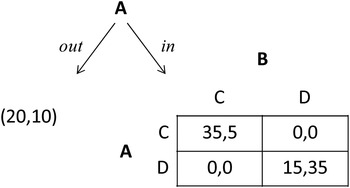
To illustrate the importance of different strengths of social ties on behavior, we studied the following asymmetric coordination game with outside option (see our Figure 1). In this sequential game, A moves first and chooses between an outside option or entering a second stage that consists of playing a coordination game with B. Entering the game (choosing IN for player A) is only interesting if he or she believes that coordination will be achieved in the second stage of the game. One way to achieve coordination is by a “forward induction” argument that implies that since A chose IN, player B knows that player A will choose option C. However, coordination can also be achieved if both players agree that the D/D outcome is the best for the group and if they both know that they care about the group.
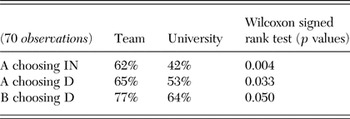
To test whether players play this game differently when they are more or less tied to their opponent, we proposed this game to participants that were either interacting with a member of a sports team of which they were also members (team) or with another student from their university (university) (Attanasi et al. Reference Attanasi, Hopfensitz, Lorini and Moisan2013). While in both cases partners belong to the same group, participants from the same team are much stronger socially tied than students from the same university. And, indeed, we see that a significantly larger proportion of participants decide to enter the game when they interact with a fellow team member and that a larger proportion coordinates in this case on playing D (see Table 1).
Table 1.
Experimental results for interactions by sport-team members and students from the same university
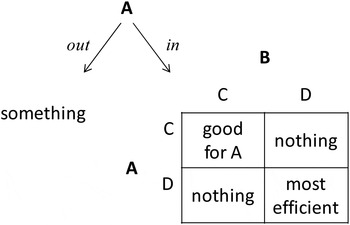
Now imagine the same game played for the southern part of the map where payoffs are ambiguous. This can be achieved by not having precise payoffs but some general information about the characteristics of each outcome, as Figure 2 shows. By obscuring the precise payoffs, coordination might now become easier for socially tied individuals since it is clearer what the optimal outcome is for the group. We would therefore expect that in such games coordination and thus efficiency will be increased when we move to the south of the map. Thus, while Bentley et al. consider the south–east of their map as a region of “herding” that will not reach any efficient outcome if everybody is just following the others, we think that the south–east, if interpreted as a region with very ambiguous payoffs but where players are strongly tied, can lead to more efficiency than the north.
Figure 1.
Coordination game with outside option and known payoffs.
Figure 2.
Coordination game with outside option and ambiguous payoffs.





 You have
Access
Bentley et al. present a two-dimensional map allowing a categorization of decisions dependent on the amount (and precision) of information about payoffs and the degree to which some larger group is influencing agents. Among other applications, they discuss the applicability of this model to friendship networks and language use. However, both situations imply some kind of interaction with others. We therefore think that the model has to be extended and discussed for decisions made in games. In games, final outcomes are determined by the decisions taken by more than one player.
While the north–south dimension is easily extended to games where payoffs are either known or ambiguous, we have to be specific as to what the east–west dimension would mean. Bentley et al. consider the east as the “social” quadrants where J t is high, with J t denoting a “social-influence parameter that the fraction of people […] in an individual's peer group […] has on the person” (target article, sect. 2, para. 2). If we are talking about games, these social links will influence behavior through two different channels. On the one hand, decisions might be influenced by the behavior that is observed by others. On the other hand, decisions will be influenced by the specific social link agents have with their interaction partner. While the first point is more or less equivalent to the impact discussed by the authors for individual decisions, we think that the second part needs to be included in the model.
If an agent is interacting with someone from his peer group where J t is high, his own behavior will be influenced by how much individuals care about the outcomes to the group and by considerations of “what everybody should do for the best of the group.” We call this the impact of “social ties” on behavior. This impact can be modelled as follows in the case of a two-agent interaction. Let us consider a strategic game with two agents i and j in which, as usual, S i and S j respectively denote agent i’s set of strategies and agent j’s set of strategies, and U i and U j respectively denote agent i’s utility function and agent j’s utility function over the set of strategy profiles S i × S j . Moreover, let us assume that the degree of the social tie between agent i and agent j is a numerical value k ij in the interval [0,1]. The following equation models how much the existing social tie between agent i and agent j influences the utility of a certain strategy profile 〈s i , s j 〉 for i, U i ST (s i , s j ) being the transformed utility of the strategy profile 〈s i , s j 〉 for agent i which integrates the influence of the social tie between i and j on i’s current motivations:
The idea of our model of social tie is that, in the presence of a social tie between two individuals i and j, agent i will be motivated to maximize the benefit of the group, represented by collective utility U {i,j}(s i, s j ′), assuming that agent j is also motivated to maximize the benefit of the group {i, j}. In particular, when the strength of the social tie between agent i and agent j is maximal (i.e., k ij = 1), i and j do not face a strategic problem anymore. Indeed, the utility of the strategy profile 〈s i , s j 〉 for agent i becomes independent of player j’s part in this strategy profile (i.e., s j ). The model is agnostic as to how the collective utility function U {i,j} should be computed, as it might be defined either in terms of a utilitarian notion of global efficiency, for example:
or in terms of a Rawlsian criterion of fairness, for example:
or in terms of equality, for example:
To illustrate the importance of different strengths of social ties on behavior, we studied the following asymmetric coordination game with outside option (see our Figure 1). In this sequential game, A moves first and chooses between an outside option or entering a second stage that consists of playing a coordination game with B. Entering the game (choosing IN for player A) is only interesting if he or she believes that coordination will be achieved in the second stage of the game. One way to achieve coordination is by a “forward induction” argument that implies that since A chose IN, player B knows that player A will choose option C. However, coordination can also be achieved if both players agree that the D/D outcome is the best for the group and if they both know that they care about the group.
To test whether players play this game differently when they are more or less tied to their opponent, we proposed this game to participants that were either interacting with a member of a sports team of which they were also members (team) or with another student from their university (university) (Attanasi et al. Reference Attanasi, Hopfensitz, Lorini and Moisan2013). While in both cases partners belong to the same group, participants from the same team are much stronger socially tied than students from the same university. And, indeed, we see that a significantly larger proportion of participants decide to enter the game when they interact with a fellow team member and that a larger proportion coordinates in this case on playing D (see Table 1).
Experimental results for interactions by sport-team members and students from the same university
Now imagine the same game played for the southern part of the map where payoffs are ambiguous. This can be achieved by not having precise payoffs but some general information about the characteristics of each outcome, as Figure 2 shows. By obscuring the precise payoffs, coordination might now become easier for socially tied individuals since it is clearer what the optimal outcome is for the group. We would therefore expect that in such games coordination and thus efficiency will be increased when we move to the south of the map. Thus, while Bentley et al. consider the south–east of their map as a region of “herding” that will not reach any efficient outcome if everybody is just following the others, we think that the south–east, if interpreted as a region with very ambiguous payoffs but where players are strongly tied, can lead to more efficiency than the north.
Coordination game with outside option and known payoffs.
Coordination game with outside option and ambiguous payoffs.
ACKNOWLEDGMENT
Funding through the Agence Nationale de la Recherche (ANR: 010 JCJC 1803 01) is gratefully acknowledged.