


1. Introduction
All living species evolve links between their natural habitats and their natural habits. This paper focuses on human populations, their stresses in cold and hot seasons, and their use of money as an adaptational tool. The main idea is that needs-based stresses, goals, means, and outcomes are shaped differently in poor areas with demanding winters or summers (threatening habitats), in poor and rich areas with undemanding climates (comforting habitats), and in rich areas with demanding winters or summers (challenging habitats). Reinterpreting, organizing, and extending prior evidence, I attempt to relate collective stresses, goals, means, and outcomes in these three types of habitats to collective freedoms, which vary dramatically around the globe down to the point of unconcealed repression.
Freedoms are defined here as opportunities to be able to make and implement autonomous choices of goals, means, and outcomes. In addressing collective freedoms of choice, the Universal Declaration of Human Rights and the United Nations Development Programme (2000) share basically the same objectives. Both reflect a common motivation to advocate and secure freedom in all societies on earth, notably including freedom from want; freedom from fear; freedom of expression and participation; freedom from discrimination; and freedom to develop and realize one's human potential. More or less all of these freedoms are also insightfully addressed in the work of major philosophers and lawyers considering human rights (e.g., Donnelly Reference Donnelly2006; Dworkin Reference Dworkin1978; Kanger Reference Kanger1985), and in the work of economists and political scientists concentrating on human development (e.g., Inglehart & Welzel Reference Inglehart and Welzel2005; Sen Reference Sen1999). Indeed, there is broad consensus about what important freedoms are and about the advantages of making free choices to meet human needs.
The human-rights approach is driven by a normative perspective on freedoms to meet human needs, the human-development approach by an action perspective on freedoms to meet human needs. Both perspectives place freedoms in the foreground and needs in the background. The complementary perspective in this paper reverses foreground and background by putting human needs on stage with human rights and human development in the wings. A need, that is “a deprivation that energizes a drive to eliminate or reduce the deprivation” (Van de Vliert Reference Van de Vliert2009, p. 37), is considered fundamental if it applies to all human beings and seeks to redress a stressful deprivation of a basic freedom of choice. In terms of classic hierarchies of fundamental needs (Alderfer Reference Alderfer1972; Maslow Reference Maslow1943), freedom from want satisfies immediate physiological needs, freedom from fear satisfies safety needs, freedom of expression and participation satisfies needs to relate to others, freedom from discrimination satisfies needs for esteem and respect, and freedom to develop and realize one's human potential satisfies needs for self-actualization and personal growth.
More parsimoniously formulated in Alderfer's (Reference Alderfer1972) trichotomy, fundamental freedoms satisfy existence needs (physiology, material safety), social needs (social safety, love, social esteem), and growth needs (self-esteem, self-actualization). Building on Kenrick et al.'s (Reference Kenrick, Griskevicius, Neuberg and Schaller2010) renovated hierarchy of fundamental needs, I propose that these needs and related freedoms are listed here in the order they are likely to first appear developmentally. The fact that existence needs, social needs, and growth needs are thought to be developed roughly in this sequence does not imply, though, that they fully replace each other. Rather, earlier-stage needs, complemented with later-stage needs, continue to be ready for activation by a wide variety of exogenous and endogenous cues. Notably, all fundamental needs drive collectives to adaptively respond to environmental necessities and opportunities in order to cope with deprivation stresses and increase freedoms of choice.
Section 2 in this target article proposes an explanation of geographic variations in collective freedom, which uses needs-based stress appraisals as conceptual linkages between climato-economic habitats and freedoms of choice. In section 3 I discuss methods for measuring climatic demands, monetary resources, and fundamental freedoms. Section 4 then applies this theory and methodology to analyzing freedoms while uncovering cross-national and cross-regional support for the existence of climato-economic origins of inequalities in fundamental freedoms. Special attention will be paid to freedom from discrimination because climato-economic theorizing can help clarify the causal order of ingroup favoritism and outgroup derogation in explaining large-scale conflict. In section 5, the climato-economic covariations of freedom in 2012 are used to cautiously forecast freedom in 2112 for 104 countries. Section 6 rounds off with discussions on theoretical implications, methodological concerns, and practical applications.
2. Climato-economic explanation of freedoms
The climato-economic theory of culture (Van de Vliert Reference Van de Vliert2009; Reference Van de Vliert2011a; Reference Van de Vliert2011b; Reference Van de Vliert, Gelfand, Chiu and Hong2013) belongs to a family of demands-resources theories. Across the disciplines of psychology (e.g., Bandura Reference Bandura1997; Lazarus & Folkman Reference Lazarus and Folkman1984; Skinner & Brewer Reference Skinner and Brewer2002; Tomaka et al. Reference Tomaka, Blascovich, Kibler and Ernst1997), sociology (e.g., Ormel et al. Reference Ormel, Lindenberg, Steverink and Vonkorff1997), and the organizational sciences (e.g., Karasek Reference Karasek1979), it is widely believed that demands placed on people are a double-edged sword. Greater demands in interaction with insufficient resources to meet the demands increase closed-mindedness and risk aversion, whereas greater demands in interaction with sufficient resources increase open-mindedness and risk seeking.
Climato-economic theorizing similarly posits that the demands and the resources of the human habitat influence each other's impact on the needs, stresses, and choices shared by inhabitants (shared culture is discussed in sect. 2.4.2). Greater climatic demands in interaction with poor monetary resources eventually promote avoiding ambiguity by making relatively unfree choices that are necessary and routine rather than autonomous and adventurous. Greater climatic demands in interaction with rich monetary resources eventually promote seeking ambiguity by making relatively free choices that are autonomous and adventurous rather than necessary and routine. This explanation of cultural management of ambiguity and free choice is presented here in subsections describing main effects of climatic demands, interactive effects of monetary resources, differential effects of cold and heat, and shared psychobehavioral adaptations.
2.1. Main effects of climatic demands
Like all warm-blooded species, humans have to maintain constant levels of high body temperature. In consequence, they have evolved a U-shaped dependence of body heat production or rates of metabolism on ambient temperature (Parsons Reference Parsons2003; Scholander et al. Reference Scholander, Hock, Walters, Johnson and Irving1950). In an intermediate range of ambient temperatures, the thermoneutral zone, the metabolic rate required for the body to maintain a core temperature of approximately 37°C, is both minimal and independent of the ambient temperature. Below the thermoneutral zone, metabolism increases to generate enough heat (e.g., by shivering) for the body to maintain its temperature and survive. Above the thermoneutral zone, metabolism increases to support active cooling (e.g., by sweating or panting). Thus, the biological costs of maintaining body temperature and integrity increase on both sides of the thermoneutral zone.
The U-shaped dependence of heat production on ambient temperature equips humans with existence needs for thermal comfort, nutrition, and health (Rehdanz & Maddison Reference Rehdanz and Maddison2005; Tavassoli Reference Tavassoli, Wyer, Chiu and Hong2009; Van de Vliert Reference Van de Vliert2009). Temperate climates are relatively undemanding by offering thermal comfort, abundant nutritional resources owing to the rich flora and fauna, and comparatively healthy habitats. Colder winters and hotter summers require more and better clothing, shelter structures, and heating or cooling systems, increasing investments of time and effort in the pursuit of foods and drinks, and more measures to safeguard family health, also because acclimatization through long-term adjustment in anatomy and physiology has negligible compensating effects (Parsons Reference Parsons2003).
In sum, satisfying existence needs is progressively demanding in climates with increasingly colder-than-temperate or hotter-than-temperate seasons, thus creating more leeway for influence of the inhabitants' resources on their needs, stresses, and choices. Overlooking the interactive role of resources, Hippocrates, Ibn Khaldun, Montesquieu, Quetelet, and other classic scientists have all creatively tried to myopically and exclusively relate climate to culture (Feldman Reference Feldman1975; Sommers & Moos Reference Sommers, Moos and Moos1976). In a similar vein, at the beginning of the twentieth century, proponents of the geographical school have argued that climate straightforwardly determines health, human energy, mental efficiency, insanity, crime, and suicide (Sorokin Reference Sorokin1928; Tetsuro Reference Tetsuro1971). Only gradually and recently have climate-culture researchers uncovered the complicating role played by money in collectively coping with climatic demands.
2.2. Interactive effects of monetary resources
Humans became more distinct from other warm-blooded animals when they started to obtain and store property. With the advent of agriculture, property became more important when people began keeping stores of food and domesticated animals. Property allowed trading. Trading led to the invention of money, which can be stored longer and more easily than agricultural products and creates more room for implementing free choice. Money has a crucial part to play also in coping with bitter winters and scorching summers (Parker Reference Parker2000; Sen Reference Sen1999; Van de Vliert Reference Van de Vliert2009). Owning, saving, earning, buying, and selling can help prevent and dispel discomfort, hunger, thirst, and illness by satisfying existence needs. Liquid assets (cash) and illiquid assets (capital) can alter the effects of adverse winters and summers through investments in climate-compensating goods and services, including clothing, housing, heating and cooling, transportation, meals, and medical cure and care.
Thus, the greater biological costs of keeping alive and well on both sides of the thermoneutral zone can be compensated for by using cash and capital, in fact creating greater freedom of choice. Articulating the way this is visible in modern human communities, families in richer nations spend up to 50% of their household income on climate-compensating goods and services, a figure that rises up to 90% in poorer nations (Parker Reference Parker2000, pp. 144–47). If more demanding winters or summers are insufficiently compensated for by the availability of monetary resources, detrimental consequences for psychobehavioral functioning, including unfree choices, eventually follow. If they are sufficiently compensated for by monetary resources, beneficial consequences, including free choices, follow. As briefly discussed next, two competing scientific principles color this picture differently: theoretical parsimony emphasizes that income-dependent consequences of harsher winters and summers are similar; theoretical accuracy emphasizes that those consequences are dissimilar.
2.3. Differential effects of cold and heat
Colder-than-temperate and hotter-than-temperate conditions pose divergent problems. Different hardships typically require distinct psychobehavioral adaptations (e.g., Cottrell & Neuberg Reference Cottrell and Neuberg2005) and different uses of monetary resources as adaptational tools (Parker Reference Parker2000; Sachs Reference Sachs, Harrison and Huntington2000; Sen Reference Sen1999; Van de Vliert Reference Van de Vliert2009). Money is more of a sine qua non for heating and eating in colder regions and months, but it is more for preventing and recovering from diseases produced by substances, germs, bacteria, and insects in hotter regions and months. Also, money is not utilized identically when coping with frostbite, pneumonia, asthma, rheumatism, gout, influenza, and common colds in arctic conditions as compared to coping with malaria, yellow fever, schistosomiasis, trypanosomiasis, ochocerciasis, Chagas' disease, and filariasis in the tropics. Overall, as reflected in the World Bank's poverty lines (www.worldbank.org), life is a bit more expensive in cold compared with hot climates.
In this burgeoning phase of climato-economic theorizing, priority is given to parsimony over accuracy by emphasizing similarities rather than dissimilarities of the greater biological and financial costs of adaptations on the cold and hot sides of the thermoneutral zone (for less parsimonious and more accurate three-way interaction effects of winter demands, summer demands, and monetary resources on subjective well-being, self-expression, individualism, and democracy, see Van de Vliert Reference Van de Vliert2009; Reference Van de Vliert, Gelfand, Chiu and Hong2013). Hence, throughout this article, psychobehavioral adaptations at the population level are parsimoniously traced back to only three types of habitats: (a) demandingly cold or hot habitats with poor monetary resources, (b) undemanding temperate habitats in poor or rich areas, and (c) demandingly cold or hot habitats with rich monetary resources.
2.4. Shared psychobehavioral adaptations
2.4.1. Primary and secondary appraisals
Demands-resources theories state that humans continuously appraise their environmental situation with respect to its significance for well-being (e.g., Drach-Zahavy & Erez Reference Drach-Zahavy and Erez2002; Lazarus & Folkman Reference Lazarus and Folkman1984; LePine et al. Reference LePine, LePine and Jackson2004; Skinner & Brewer Reference Skinner and Brewer2002; Tomaka et al. Reference Tomaka, Blascovich, Kibler and Ernst1997; Van de Vliert Reference Van de Vliert2009). Primary appraisal assesses to what extent the situation is stressfully demanding because needs cannot be satisfactorily met; secondary appraisal assesses to what extent a stressfully demanding situation is threatening or challenging given the available resources to meet the demands. In climato-economic theorizing, primary appraisals assess to what extent winters and summers are comforting or stressfully demanding; secondary appraisals assess to what extent stressfully demanding winters or summers are threatening or challenging given the monetary resources. Although threatening and challenging habitats are both more stressful than comforting habitats, subjective livability in threatening habitats is worse than in comforting habitats, whereas subjective livability in challenging habitats may be experienced as even better than in comforting habitats.
Appraisals as cognitive-affective adaptations to objectively threatening, comforting, or challenging habitats are almost indistinguishably integrated with choices in behavioral adaptations to these habitats. Needs-based stress appraisals and choices of goals, means, and outcomes are not interrelated in a strictly sequential way, but are assumed to be continuously and simultaneously in flux, converging into a pattern of psychobehavioral adaptations characteristic of the inhabitants of a given habitat. The embedded behavioral choices can be more or less necessary and routine, thus unfree, versus more or less autonomous and adventurous, thus free. The main target of section 2.4 is to propose needs-based stress appraisals as conceptual linkages between objective climato-economic habitats and increasing freedoms of choosing goals, means, and outcomes in subjectively threatening, comforting, and challenging habitats, respectively.
2.4.2. Threat appraisals, comfort appraisals, and challenge appraisals
An important criterion for the primary appraisal of climatic comfort versus stress is the satisfaction of existence needs for thermal comfort, nutrition, and health. It is a broadly relevant criterion as unmet existence needs tend to proliferate into frustration of social needs and growth needs (Alderfer Reference Alderfer1972; Herzberg Reference Herzberg1966; Kenrick et al. Reference Kenrick, Griskevicius, Neuberg and Schaller2010; Maslow Reference Maslow1943). In the absence of harsher-than-temperate climates, comfort appraisals will not motivate people much to give primacy to working for extrinsic satisfaction and meeting existence needs, nor to give primacy to working for intrinsic satisfaction and meeting growth needs (Van de Vliert Reference Van de Vliert2009). In consequence, social needs may gain in relative importance and may be more easily comforted in more temperate climates.
A critically relevant criterion for the secondary appraisal of the available monetary resources to meet climatic demands is the purchasing power of one's household income (Parker Reference Parker2000; Sen Reference Sen1999). The climato-economic theory proposes that climates with demanding winters or summers are appraised as threatening in poor populations but as challenging in rich populations (Van de Vliert Reference Van de Vliert2009; Reference Van de Vliert2011a; Reference Van de Vliert2011b; Reference Van de Vliert, Gelfand, Chiu and Hong2013). Threat appraisals are thought to emphasize inevitable necessities in unfree choices, whereas challenge appraisals emphasize free choices inherent in stimulating opportunities and autonomous adventures. As a consequence, overall freedom may be expected to be relatively low in threatening habitats and relatively high in challenging habitats, both compared to the intermediate baseline level of overall freedom in comforting habitats.
No matter how much focal attention processing is involved, habitat appraisals are collective in nature. Exposed to the same winters, summers, and standard of living, all inhabitants are assessing and discussing these living conditions frequently, and are gradually pushing and pulling each other toward a predominantly shared culture, defined here as a shared pattern of needs and stresses, and embedded goals, means, and outcomes at the place of residence. Leading cross-cultural psychologists (Hofstede Reference Hofstede2001; House et al. Reference House, Hanges, Javidan, Dorfman and Gupta2004; Leung & Bond Reference Leung and Bond2004; Schwartz Reference Schwartz2006; Triandis Reference Triandis1995) view goals as manifestations of values, means as manifestations of agency beliefs, and outcomes as manifestations of behavioral practices and consequences. In addition to goals, means and outcomes, the underlying needs and stresses, too, are viewed here as elements of subjective culture that become patterned around a central theme into a cultural syndrome (Triandis Reference Triandis1995, p. 6). Figure 1 visualizes threat appraisals, comfort appraisals, and challenge appraisals as three central themes that link climato-economic habitats to broader cultural patterns of needs, goals, means, outcomes, and embedded fundamental freedoms.
Shared psychobehavioral adaptations to three types of climato-economic habitats, and embedded fundamental freedoms.

Evidence for the ecocultural existence and construct validity of threat syndromes, comfort syndromes, and challenge syndromes may be inferred from the results of a secondary analysis of clustered data about mental ill-being (Fischer & Van de Vliert Reference Fischer and Van de Vliert2011). Across 58 countries, burnout, depression, anxiety, perceived ill health, and unhappiness appeared to be most prevalent in poor populations residing in climates with more demanding winters or summers (e.g., Iranians and Serbs), intermediately prevalent in populations residing in undemanding climates irrespective of income per head (e.g., Hongkongers and Sri Lankans), and least prevalent in rich populations residing in climates with more demanding winters or summers (e.g., Finns and Swiss). This pattern of findings is elegantly compatible with threat appraisals, comfort appraisals, and challenge appraisals as thematic categorizations of the cultural syndromes in Figure 1.
2.4.3. Survival goals, easygoing goals, and self-expression goals
Stress appraisals activate objectives varying on a bipolar continuum from closed-minded goals (aimed at avoiding ambiguity by making unfree choices that are necessary and routine) to open-minded goals (aimed at seeking ambiguity by making free choices that are autonomous and adventurous) (Gelfand et al. Reference Gelfand, Raver, Nishii, Leslie, Lun, Lim, Duan, Almaliach, Ang, Arnadottir, Aycan, Boehnke, Boski, Cabecinhas, Chan, Chhokar, D'Amato, Ferrer, Fischlmayr, Fischer, Fülöp, Georgas, Kashima, Kashima, Kim, Lempereur, Marquez, Othman, Overlaet, Panagiotopoulou, Peltzer, Perez-Florizno, Ponomarenko, Realo, Schei, Schmitt, Smith, Soomro, Szabo, Taveesin, Toyama, Van de Vliert, Vohra, Ward and Yamaguchi2011; LePine et al. Reference LePine, LePine and Jackson2004; Richter & Kruglanski Reference Richter, Kruglanski, Schaller and Crandall2004; Ryan & Deci Reference Ryan, Deci, Chirkov, Ryan and Sheldon2011; Schaller & Murray Reference Schaller and Murray2008; Reference Schaller, Murray, Gelfand, Chiu and Hong2011). Threat appraisals activate closed-minded goals, comfort appraisals activate neither closed-minded nor open-minded goals, and challenge appraisals activate open-minded goals. Isomorphically, over extended periods of time, climato-economic threats are thought to promote closed-minded repression of free choices; comfort appraisals of nearly thermoneutral climates are expected to evolve neutral-mindedness and negligible effects on making free choices; and climato-economic challenges are thought to promote open-minded reinforcement of free choices.
As elaborated in earlier publications (Van de Vliert Reference Van de Vliert2007; Reference Van de Vliert2009), closed-mindedness, neutral-mindedness, and open-mindedness may be conceptually integrated with the World Values dimension of survival versus self-expression cultures. Figure 1 projects closed-mindedness into survival goals (left pole), neutral-mindedness into easygoing goals (midpoint), and open-mindedness into self-expression goals (right pole). The ecocultural validity of this three-part dimension of collective goal setting is apparent from the finding that poor populations in demanding climates pressurize themselves with closed-minded goals of formalization and centralization, whereas rich populations in demanding climates pressurize themselves with open-minded goals of informality and decentrality; by contrast, poor and rich populations in undemanding climates enjoy relatively pressure-free goals in between these two extremes (Van de Vliert Reference Van de Vliert2009; Reference Van de Vliert, Gelfand, Chiu and Hong2013).
2.4.4. Ingroup agency, convenient agency, and individual agency
Of course, goals can be reached in multiple ways using multiple means. A crucially important issue is whether people give primacy to achieving goals by means of their own groups or by means of oneself, that is, whether they are collectivist, individualist, or a mixture of both (Brewer & Chen Reference Brewer and Chen2007; Gelfand et al. Reference Gelfand, Bhawuk, Nishii, Bechtold, House, Hanges, Javidan, Dorfman and Gupta2004; Hofstede Reference Hofstede2001; Triandis Reference Triandis1995). Choosing ingroup agency is in essence creating positive discrimination and negative discrimination at the same time by treating ingroups more favorably than outgroups. Each choice of ingroup agency destroys some future freedom to ignore ingroup interests or to give outgroup interests priority over ingroup interests. By contrast, choosing individual agency is in essence creating some freedom from both ingroups and outgroups in favor of some personal freedom to act as one chooses. Conveniently adopting mixed agency is a third possibility; a telling example is the use of ingroup cooperation against an outgroup to create joint gains in order to subsequently claim these ingroup gains individually (Van de Vliert Reference Van de Vliert, Gelfand, Chiu and Hong2013).
Continuous choices between relatively unfree ingroup agency and relatively free individual agency, or a mixture of both, may be expected to be influenced by the environment. Existential threats such as climatic and economic hardships set in motion collective processes of culture building in directions of closed-mindedness, ingroup commitment, and ingroup favoritism, whereas the opposite processes endow people with a high enough degree of open-mindedness “to venture out on their own into the ambiguous, uncertain, and often risky realm of individualism” (Richter & Kruglanski Reference Richter, Kruglanski, Schaller and Crandall2004, pp. 115–16). Gelfand et al. (Reference Gelfand, Raver, Nishii, Leslie, Lun, Lim, Duan, Almaliach, Ang, Arnadottir, Aycan, Boehnke, Boski, Cabecinhas, Chan, Chhokar, D'Amato, Ferrer, Fischlmayr, Fischer, Fülöp, Georgas, Kashima, Kashima, Kim, Lempereur, Marquez, Othman, Overlaet, Panagiotopoulou, Peltzer, Perez-Florizno, Ponomarenko, Realo, Schei, Schmitt, Smith, Soomro, Szabo, Taveesin, Toyama, Van de Vliert, Vohra, Ward and Yamaguchi2011), for example, have provided evidence that greater environmental threats and a greater dearth of resources promote cultural tightness with clearer norms and stronger sanctions for nonconformity, which are characteristic also of collectivist societies (Carpenter Reference Carpenter2000; Triandis Reference Triandis1995).
From a sociopolitical perspective, Inglehart and Welzel (Reference Inglehart and Welzel2005) similarly sketch close empirical associations between survival goals, ingroup orientation, and low freedom; and between self-expression goals, individual orientation, and high freedom. Integrating these findings with the above climato-economic explanation of culture, I expected collectivistic ingroup agency to be most prevalent in poorer societies with threatening winters or summers, somewhat prevalent in poorer and richer societies with comforting climates, and least prevalent in richer societies with challenging winters or summers. The reverse prediction holds for individual agency. In Figure 1, mixtures of ingroup agency and individual agency expected for inhabitants of undemanding climates are termed convenient as they will be suited to particular circumstances other than the climato-economic environment.
2.4.5. Autocratic organizing, laissez-faire, and democratic organizing
In his classic book on obedience to authority, Milgram (Reference Milgram1974, pp. 123–24) has convincingly argued that “the formation of hierarchically organized groupings lends enormous advantage to those so organized in coping with dangers of the physical environment.” Indeed, in threatening circumstances, such as climato-economic hardships, “group members' need for closure may soar and a group culture will emerge that centers around an autocratic leadership” (Richter & Kruglanski Reference Richter, Kruglanski, Schaller and Crandall2004, p. 113). By striking contrast, the cultural syndrome of open-mindedness, self-expression goals, and individual agency, which characterizes challenging climato-economic habitats, provides a “social force that operates in favor of democracy, helping to establish democracy where it does not yet exist, and strengthening democracy where it is already in place” (Inglehart & Welzel Reference Inglehart and Welzel2005, p. 299).
In Figure 1, mid-range outcomes between autocracy and democracy are expected to typically occur in comforting climato-economic habitats. Building on leadership work (Alvesson & Sveningsson Reference Alvesson and Sveningsson2003; Hinkin & Schriesheim Reference Hinkin and Schriesheim2008), these outcomes are labeled laissez faire, which should not be misunderstood as passively doing and achieving nothing. Laissez-faire in this case should be understood as actively choosing mixed outcomes because it is impossible for people to suppress hundreds of autocratic and democratic reflexes and actions, because punishments and rewards are often minimized on purpose, and because laissez-faire choices reflect appropriate responses to low tides of necessities and opportunities in undemanding climates.
2.5. Conclusion
Climato-economic theorizing proposes that (a) shared primary appraisals of climatic demands assess to what extent winters and summers are stressful; (b) shared secondary appraisals of monetary resources assess to what extent existence needs are threatened, social needs can be comforted, and growth needs are challenged; and (c) adapted action streams of goals, means, and outcomes covary with shared degrees of fundamental freedom. Freedom is expected to be lowest in poor populations threatened by demanding winters or summers, intermediate in poor and rich populations comforted by undemanding temperate climates, and highest in rich populations challenged by demanding winters or summers.
3. Measuring climatic demands, monetary resources, and fundamental freedoms
3.1. Level of analysis
Shared psychobehavioral adaptations to climatic demands and income per head require a higher than individual or small-group level of analysis. Accordingly, all studies reported in section 4 are regressions at the level of countries, with the exception of cross-regional examinations of differences in discrimination within China and within the United States.
3.2. Climatic demands
The average temperature in a nation has typically been used as a predictor of local culture (e.g., Georgas et al. Reference Georgas, Van de Vijver and Berry2004; Hofstede Reference Hofstede2001; House et al. Reference House, Hanges, Javidan, Dorfman and Gupta2004). But this seems insufficiently accurate as such averages (a) neglect the existence of a thermal optimum (4°C and 40°C both pose existential problems), (b) overlook the impact of year-round variations in temperature (small and large differences between winters and summers may have the same average), and (c) are negatively correlated with year-round variations in temperature (higher latitudes have both lower averages and larger variations). Viewed through a human-needs lens, an appropriate indicator of a country's climatic demands should therefore take account of winter and summer deviations from a biologically optimal point of reference.
As has become customary in this burgeoning line of research, 22°C (about 72°F) is adopted as a point of reference for optimal climatic livability, not only because 22°C is the approximate midpoint of the range of comfortable temperatures (Parsons Reference Parsons2003), but also because existence needs for nutrition and health are met more easily in temperate climates varying around a base range of, say, 17°C to 27°C (Cline Reference Cline2007; Fischer & Van de Vliert Reference Fischer and Van de Vliert2011; Parker Reference Parker2000; Tavassoli Reference Tavassoli, Wyer, Chiu and Hong2009). Climates are more demanding to the extent that their winters are colder than 22°C and their summers hotter than 22°C. Climatic demands are operationalized across each country's or region's major cities, weighted for population size, as the sum of the absolute deviations from 22°C for the average lowest and highest temperatures in the coldest month and in the hottest month (source: Van de Vliert Reference Van de Vliert2009). Mongolia, for example, with its cold winters (|−44°C −22°C|+|1°C −22°C| = 87), and hot summers (|−6°C −22°C|+|36°C −22°C| = 42), has a climatic-demands score of 129. Winter demands and summer demands worldwide have identical medians (Mdn = 25), and only slightly different means (M = 30 for winters; M = 24 for summers) (Van de Vliert Reference Van de Vliert2009).
Criticisms of this measure include the neglect of precipitational climate and 22°C as a questionable point of reference for temperate seasons. However, rainfall and snowfall do not appear to alter the impact of thermal climate on culture, and somewhat lower or higher reference points than 22°C always yield almost identical research results (Van de Vliert Reference Van de Vliert2007; Reference Van de Vliert2009). The climatic-demands index has also been criticized because of the inadequacy of a single score for large countries spanning multiple climatic subzones. But adjusting for error-inducing temperature variations within nations, or even excluding large countries, strengthens rather than weakens the effects (Fischer & Van de Vliert Reference Fischer and Van de Vliert2011; Van de Vliert Reference Van de Vliert2009; Reference Van de Vliert2011a; Reference Van de Vliert2011b). Consequently, the empirical results in section 4, which refer to both smaller and larger countries, may be interpreted as conservative estimates of support for the climato-economic theory.
3.3. Monetary resources
Income per head is measured with reference to the capacity of a country's currency to buy a given basket of goods and services (purchasing power parity in Geary-Khamis dollars, log transformed to reduce the skewed cross-national distribution; source: United Nations Development Programme 2004). Monetary resources and climatic demands are negligibly overlapping predictors of freedom (r = .37, n = 175, p < .001; Van de Vliert Reference Van de Vliert2011a), thus minimizing the potential problem of multicollinearity.
3.4. Fundamental freedoms
Guided by the theoretical framework in Figure 1, the gist of low, intermediate, and high levels of fundamental freedom is captured with mutually overlapping measures of needs (existence vs. growth), stresses (threats vs. challenges), goals (survival vs. self-expression), means (ingroups vs. individuals), and outcomes (autocratic vs. democratic). To guarantee that regression estimates of freedom reflect a shared reality within each population, aggregations of individual-level measures are used only in case of significant differences between groups.
4. Climato-economic covariations of freedom
4.1. Freedom from want: To enjoy a decent standard of living
Freedom from want emphasizes that humans are not sticks or stones but a warm-blooded species that survives by ceaselessly satisfying existence needs. In human-rights and human-development activities, freedom from want refers to the absence of homelessness, malnutrition and underweight, lack of access to safe water, inadequate sanitation, and early mortality (Sen Reference Sen1999; United Nations Development Programme 2000; 2002; 2004). Infant mortality as a core indicator of broader societal misery, including child labor and school absenteeism, is highest in the poorest countries with the hottest climates (e.g., Central African Republic, Chad, Guinea-Bissau, and Niger). Main effects of heat demands (12%) and poverty (32%), together with interaction effects of heat demands and poverty (19%), account for 63% of the cross-national differences in under-5 mortality (Van de Vliert Reference Van de Vliert2009). Child misery is much lower in poor and rich countries with undemanding climates; negligible, in rich countries with demanding climates.
These figures are in general agreement with the adaptations of needs, stresses, and goals to climato-economic habitats visualized in Figure 1. Yet, they fail to empirically confirm the pivotal notion that enjoying a decent standard of living predicts enjoying freedom of choice. Gallup World Poll data reported by the United Nations Development Programme (2010) do indicate that populations satisfied with their financial standard of living tend to be also satisfied with their freedom of choice (r = .66, n = 137, p < .001). But unknown is whether, in support of climato-economic thinking, this relationship is weaker in undemanding climates than in demanding climates. This I checked by examining the breakdown correlations for objectively threatening, comforting, and challenging habitats.
Satisfaction with the financial standard of living appears to predict satisfaction with freedom of choice better in poor populations threatened by demanding thermal climates (r = .69, n = 46, p < .001), and in rich populations challenged by demanding thermal climates (r = .79, n = 46, p < .001), than in populations comforted by undemanding climates irrespective of income per head (r = .46, n = 45, p < .01; z = 1.57, p < .058 for .69 versus .46; z = 2.63, p < .004 for .79 versus .46). These differences are compatible with the line and direction of thought. Monetary resources creating freedom of choice tend to be more critical and influential in habitats where either existence needs or growth needs are under stress, than in more comforting habitats where existence needs and growth needs are relaxed, allowing social needs to elbow to the fore.
4.2. Freedom from fear: With no threats to personal security
No other aspect of human security is as vital as freedom from fear of death of oneself or one's beloved (cf. infant mortality in sect. 4.1). But the Universal Declaration of Human Rights does not stop there: “No one shall be subjected to torture or to cruel, inhuman or degrading treatment or punishment” (Article 5). As a member of the Bergen Bullying Research Group, I have participated in two climato-economic studies of international violations of this broader human right to freedom from mistreatment. Bullying as an infringement of personal security refers to protracted social conflict whereby a more powerful perpetrator persistently harasses, attacks, arrests, or even kills a less powerful victim, who perceives to have little recourse to retaliate in kind (Einarsen et al. Reference Einarsen, Hoel, Zapf and Cooper2011).
In the first study, Ståle Einarsen, Morten Nielsen, and I (Van de Vliert et al. Reference Van de Vliert, Einarsen and Nielsen2013a) measured and analyzed harassment among 44,836 employees from 44 countries. Highly significant parts of the variations in 22 ratings of exposure to being ignored, humiliated, ridiculed, or intimidated (1 = never; 2 = now and then; 3 = monthly; 4 = weekly; 5 = daily) were the result of country residency. Stronger support for the climato-economic predictions of stresses was found for more severe harassment acts. Notably, even with societal collectivism controlled for, climatic demands (0%), monetary resources (6%), and their interaction (13%) still accounted for 19% of the cross-national variation in “threats of violence or physical abuse or actual abuse.” Victims of these threats and abuses were most prevalent in poor populations threatened by demanding thermal climates, moderately prevalent in populations comforted by undemanding climates irrespective of income per head, and least prevalent in rich populations challenged by demanding thermal climates. The Gini coefficient of income inequality in a country, religious participation and value, and ethnic heterogeneity could not predict this pattern of results.
The second study addressed another of the world's vexing problems: that journalists in many places are murdered, imprisoned, censored, threatened, and similarly bullied. Reporters Without Borders (source: www.rsf.org) annually measures freedom from fear among press people in 155 nations. In 2005, 2006, and 2007, partner organizations in all continents and a network of more than 130 journalists and correspondents answered 50 questions, including the following: How many journalists and media assistants were … murdered (5–15 points); murdered with the state involved (5 points per case); arrested or sent to prison (3–15 points); currently in jail and serving over a year of sentence for a media-related offence (3–20 points); physically attacked or injured (2–6 points); personally threatened (1–4 points)? How many media outlets were censored, seized, or ransacked (3–12 points)?
Using this crude press repression index, the climato-economic predictions of threats to survival were confirmed year after year (Van de Vliert Reference Van de Vliert2011a). In the most recent year (2007), climatic demands (11%), monetary resources (17%), and their interaction (8%) accounted for 36% of the variation in press repression. Rival explanations in terms of state antiquity, past violence, communist past, population diversity (language, religion, ethnic), and societal inequality (income, gender, power) could be ruled out statistically. As illustrated in Figure 2, press people were bullied most in poor populations threatened by demanding thermal climates (e.g., China, Sudan, Turkmenistan, and Uzbekistan), to a moderate extent in populations comforted by undemanding climates irrespective of income per head (e.g., Barbados, Honduras, Singapore, and Seychelles), and least in rich populations challenged by demanding thermal climates (e.g., Canada, Estonia, Slovakia, and Sweden). From this narrower subject of press repression, I now turn to the broader issue of free expression.
Opposite effects of climatic demands pushing and pulling toward press repression in poorer countries (bow ties and downward slope; b = −.30, p < .001), but toward press freedom in richer countries (circles and upward slope; b = .27, p < .001).

4.3. Freedom of expression and participation
World Values Surveys researchers (www.worldvaluessurvey.org; Inglehart & Baker Reference Inglehart and Baker2000; Inglehart et al. Reference Inglehart, Basáñez, Díez-Medrano, Halman and Luijkx2004) have found a bipolar dimension ranging from survival goals that meet existence needs to self-expression goals that meet growth needs. Self-expression values and goals emphasize that priority should be given to self-realization and quality of life over physical and economic security. Individuals must have much control over their own life, including signing petitions and taking part in boycotts (Inglehart & Baker Reference Inglehart and Baker2000). Clearly, “freedom of thought and speech and to participate in decision-making and form associations” (United Nations Development Programme 2000, p. 1) is minimal at the survival pole, moderate at the easygoing midpoint (see sect. 2.4.3), and maximal at the self-expression pole of the dimension of goal setting.
In common with international organizations, the World Values Surveys group assumes that poor societies endorse survival goals, whereas rich societies endorse self-expression goals. According to the framework of shared psychobehavioral adaptations to climato-economic habitats, this is an incomplete understanding of reality. Income differences are thought to be less relevant in undemanding climates. Additionally, colder-than-temperate and hotter-than-temperate climates are expected to increase the salience and valence of unfree survival goals in poor populations, but to increase the salience and valence of free self-expression goals in rich populations. The question whether survival goals, easygoing goals, and self-expression goals as a unidimensional proxy of repression versus freedom of expression and participation covary with climato-economic conditions was investigated in (a) a cross-sectional analysis of climatic demands and national income per head covering 77 countries, (b) a cross-sectional analysis of climatic demands and personal household income covering 66 countries, and (c) a longitudinal analysis of climatic demands and economic growth covering 38 countries.
In the first analysis, climatic demands (0%), monetary resources (52%), and their interaction (20%) accounted for 72% of the variation in survival versus self-expression goals (Van de Vliert Reference Van de Vliert2009). As predicted, survival goals prevail in poorer populations threatened by more demanding thermal climates (e.g., Armenians and Latvians); easygoing goals prevail in populations comforted by undemanding climates irrespective of income per head (e.g., Ghanaians and Singaporeans); and self-expression goals prevail in richer populations challenged by more demanding thermal climates (e.g., Canadians and Swedes).
The second analysis addressed the strength of the positive within-country correlations between personal household income and personal endorsement of the above goals for 62,172 wage earners in total. Only for members of poorer populations residing in more demanding thermal climates (e.g., Belarusians and Moldovans) did a person's own household income make a difference: they appeared to endorse survival goals over easygoing goals and self-expression goals to the extent that they earned less (R 2 = .42, p < .001; Van de Vliert Reference Van de Vliert2007). Apparently, higher household incomes push and pull people away from unfree survival goals and meeting existence needs, but do so only in miserable climato-economic habitats with considerable livability problems.
The longitudinal analysis (Van de Vliert Reference Van de Vliert2009) looked at the annual percentage of change in goal setting, computed from 107,388 citizen responses during 8- to 19-year periods between 1981 and 2002. Again in support of the theory, even with national income controlled for, populations in more demanding thermal climates appeared to have moved more toward unfree survival goals to the extent that they were exposed to economic decline rather than economic growth (R 2 = .59, p < .001). As a noteworthy case in point, Estonians, Latvians, Lithuanians, and Russians all moved toward unfree survival goals after the collapse of communist rule and the subsequent economic decline – an average of minus 5% per year at the end of the twentieth century. Given the view of most theorists that cultures are rather stable over time, this significant degree of covariation of climato-economic change and culture change is striking for the limited span of time investigated.
Taken together, national income, household income, and economic growth all seem to alter the link between climatic demands and goal setting in full agreement with the goal adaptations proposed in Figure 1. The analyses revealed that people residing in climates with more demanding winters or summers have no other choice but to endorse relatively unfree survival goals at the expense of moderately free easygoing goals and relatively free self-expression goals to the extent that their societies are economically deprived in terms of national income per head, household income, and economic growth.
4.4. Freedom from discrimination: By race, ethnicity, gender, religion, etc.
Positive discrimination or ingroup favoritism and negative discrimination or outgroup derogation tend to occur in tandem (Brewer Reference Brewer1999; Hogg Reference Hogg2007), which has inspired social psychologists to address the inherent problem of causality. “Findings from both cross-cultural research and laboratory experiments” seem to support the hypothesis “that much ingroup bias and intergroup discrimination is motivated by preferential treatment of ingroup members rather than direct hostility toward outgroup members” (Brewer Reference Brewer1999, p. 429; see also Halevy et al. Reference Halevy, Weisel and Bornstein2012). If negative outgroup discrimination is, in many cases, an epiphenomenon of positive ingroup discrimination, it follows that a better understanding of ultimate roots of freedom from discrimination must be primarily sought in sources of ingroup favoritism.
At the population level, ingroup-outgroup discrimination is better known as ethnocentrism or, broader still, collectivism (Brewer & Chen Reference Brewer and Chen2007; Gelfand et al. Reference Gelfand, Bhawuk, Nishii, Bechtold, House, Hanges, Javidan, Dorfman and Gupta2004; Hofstede Reference Hofstede2001; Triandis Reference Triandis1995). Collectivism is contrasted with individualism – a pattern of needs, stresses, goals, means, and outcomes that minimizes both positive ingroup discrimination and negative outgroup discrimination (see sect. 2.4.4). Single-factor explanations of cultural collectivism versus individualism have been sought in parasitic disease burden (Fincher & Thornhill Reference Fincher and Thornhill2012; Schaller & Murray Reference Schaller, Murray, Gelfand, Chiu and Hong2011), voluntary settlement in frontier regions (Kitayama et al. Reference Kitayama, Ishii, Imada, Takemura and Ramaswamy2006; Reference Kitayama, Conway, Pietromonaco, Park and Plaut2010), and economic development (Inglehart & Baker Reference Inglehart and Baker2000; Inglehart & Welzel Reference Inglehart and Welzel2005). Going beyond single-factor explanations, the climato-economic contextualization of collectivism versus individualism seeks to even better understand the inevitably complex phenomenon of societal variation in ingroup-outgroup discrimination.
The climato-economic theory predicts that (a) inhabitants of threatening habitats give more primacy to achieving goals by means of their own groups, often at the expense of other groups, (b) inhabitants of comforting habitats give more primacy to convenient mixtures of agency, and (c) inhabitants of challenging habitats give more primacy to achieving goals by means of oneself, thus less primacy to both ingroup favoritism and outgroup derogation. Note that greater climatic demands lead to more discrimination in poorer populations (upward slope) but less discrimination in richer populations (downward slope). These predictions were put to the test, first for ingroup discrimination across 121 poorer and richer countries, then for upward sloping ingroup discrimination across regions within 1 large poor nation vis-à-vis downward sloping ingroup discrimination across regions within 1 large rich nation, and finally for outgroup discrimination across 85 poorer and richer countries.
4.4.1. Positive ingroup discrimination across countries
The 121-nation study considered preferential treatment of members of the nuclear family, relatives at large, and fellow nationals. Middle managers' participative observations of values and practices of familism (n = 17,370), top executives' judgments of nepotism practices (n = 10,932), and citizens' self-reported norms of compatriotism (n = 104,861) were analyzed. Familism, nepotism, and compatriotism were strongly expressed in poorer populations threatened by more demanding thermal climates, intermediately in poor and rich populations comforted by undemanding climates, and weakly in richer populations challenged by more demanding thermal climates (Van de Vliert Reference Van de Vliert2011b; Van de Vliert & Postmes Reference Van de Vliert and Postmes2012). Climatic demands (4%), monetary resources (33%), and their interaction (10%) accounted for 47% of the variance in the composite index of ingroup discrimination, which appeared to peak in poor countries with cold winters and hot summers. Competing explanations having to do with state antiquity, language diversity, and ethnic heterogeneity were statistically excluded. In addition, longitudinal analysis offered no support for reversed causality.
4.4.2. Positive ingroup discrimination within countries
The large number of rival predictors of familism, nepotism, and compatriotism arising from cross-national differences in state formation, demography, governance, etc., can be reduced by zooming in on a single country with many climatic regions. We therefore compared climate-discrimination relations across regions of a predominantly poor and collectivist country (China), and of a predominantly rich and individualist country (United States). Huadong Yang, Yongli Wang, Xiao-peng Ren, and I (Van de Vliert et al. Reference Van de Vliert, Yang, Wang and Ren2013b) administered a 14-item collectivism questionnaire to 1,662 Chinese, aggregated scores for the 15 provinces in which they lived and worked, and gathered data on climatic demands, income per head, population density, and percentage of minorities from publicly available sources. Collectivism scores for all 50 states of the United States were taken from Vandello and Cohen (Reference Vandello and Cohen1999); climatic demands across each state's major cities (source: www.census.gov/compendia/statab) were averaged and then aggregated per state; and state-level indicators of income per head, population density, and percentage of minorities were retrieved from the same source.
The climato-economic theory predicts that more demanding regional climates will produce more positive ingroup discrimination across the 15 Chinese provinces as representations of relatively poor populations, but less positive ingroup discrimination across the 50 United States as representations of relatively rich populations. Inspection and comparison of the two panels of Figure 3 reveal that this is the case. Within China, greater climatic demands in more northern provinces are associated with more positive ingroup discrimination (r = .86); within the United States, greater climatic demands in more northern states are associated with less positive ingroup discrimination (r = −.72); and these significant opposite tendencies are significantly different from each other (z = 6.80, p < .001).
Opposite effects of climatic demands pushing and pulling toward positive ingroup discrimination within a poorer country (China; r = .86, p < .001), but against positive ingroup discrimination within a richer country (United States; r = −.7 2, p < .001).

Multi-level analysis of the individual-level data from China further showed that positive ingroup discrimination is stronger in poorer Chinese provinces with more demanding thermal climates than in richer Chinese provinces with more demanding thermal climates. Controlling for the effects of gender, age, marital status, educational status, and professional status at the individual level, and population density and minority percentage at the provincial level, did not change the results. However, when cultural collectivism at the provincial level was then entered into the equation, it appeared to be the only significant predictor, accounting for 17% of the individual-level variation. Apparently, exposed to the same winters, summers, and financial standard of living, residents of Chinese provinces are gradually pushing and pulling each other toward a shared culture – a collective rather than an individual process.
Obviously, multi-level analysis of the state-level U.S. data is impossible. A multiple regression analysis did reveal, however, that the negative impact of climatic demands on cultural collectivism in the 50 states is quite robust when controlling for rival predictors. Income per head (ΔR 2 = .02, b = −.80, p = .55), population density (ΔR 2 = .04, b = .01, p = .23), minority percentage (ΔR 2 = .60, b = .51, p < .001), and climatic demands (ΔR 2 = .03, b = −3.26, p < .05) accounted for 69% of the variation in cultural collectivism. Similarly, state-level personality differences (ΔR 2 = .11; source: Rentfrow et al. Reference Rentfrow, Gosling and Potter2008) in extraversion (b = −.05, p = .63), agreeableness (b = −.06, p = .55), conscientiousness (b = −.10, p = .37), neuroticism (b = −.16, p = .06), and openness (b = .06, p = .52), and climatic demands (ΔR 2 = .47, b = −8.15, p < .001) accounted for 58% of the variation in cultural collectivism.
These findings allow four conclusions about the hypothesis that climato-economic habitats shape ingroup discrimination. First, the positive climate-discrimination link across poor countries also holds across regions within a poor country, which is home to the largest collectivist civilization on earth. Second, the negative climate-discrimination link across rich countries also holds across regions within a rich country, which is home to the largest individualist civilization on earth. Third, this two-nation replication (Fig. 3) of the results of the 121-nation study (sect. 4.4.1) minimizes rival explanations of the geographic spread of positive ingroup discrimination in terms of genetic make up, historical factors other than the climatic and economic past, language differences, religious heritage and diversity, educational and political regimes, and the like. Fourth, the opposite latitude-discrimination tendencies within two countries with similar latitudes do not support strongly latitude-related origins of positive ingroup discrimination, including magnetic field, average temperature level, seasonal cycles, day-night cycles, and parasitic disease burden.
4.4.3. Negative outgroup discrimination across countries
Switching from ingroup discrimination to outgroup discrimination, I conducted a further analysis, the results of which are reported here for the first time. Outgroup discrimination was derived from the latest wave of the World Values Surveys (Inglehart et al. Reference Inglehart, Basáñez, Díez-Medrano, Halman and Luijkx2004; www.worldvaluessurvey.org). In face-to-face interviews covering 85 countries, at least 1,000 adults per country were asked: “On this list are various groups of people. Could you please sort out any that you would not like to have as neighbors? … People of a different race … Immigrants/foreign workers … Homosexuals … People who have AIDS … People with a criminal record” (0 = not mentioned; 1 = mentioned).
For each outgroup category, the country percentages are listed in Electronic Supplement 1. These five internally consistent indicators (Cronbach's α = .79) were standardized and then averaged to represent the dependent variable of negative outgroup discrimination. Also listed in Electronic Supplement 1 are three predictor variables. Climatic demands and monetary resources served as independent variables (for their computation, see sect. 3). Ingroup discrimination (source: Van de Vliert Reference Van de Vliert2011b) was included in order to better single out effects of threatening, comforting, and challenging habitats on outgroup derogation and ingroup favoritism. As might be expected, negative outgroup discrimination and positive ingroup discrimination are indeed entwined phenomena (r = .57, n = 85, p < .001).
As reported in Electronic Supplement 2, climatic demands (2%), monetary resources (35%), their interaction (5%), and ingroup discrimination as an epiphenomenal control variable (4%) account for 46% of the cross-national variation in discrimination of potential neighbors. Freedom from outgroup discrimination is weakest in poorer populations threatened by more demanding thermal climates, intermediate in populations comforted by undemanding climates irrespective of income per head, and strongest in richer populations challenged by more demanding thermal climates. However, when ingroup discrimination is first controlled for (33%), the climato-economic interaction term (1%) does not reach significance anymore, indicating that ingroup discrimination mediates the joint impact of climatic demands and monetary resources on outgroup discrimination.
When negative and positive discrimination change places, so that outgroup discrimination serves as a predictor of ingroup discrimination, the picture is different (see Electronic Supplement 2). With outgroup discrimination controlled for (33%), climatic demands (3%), monetary resources (7%), and their interaction (11%) continue to have their above-observed influence, indicating that outgroup discrimination does not mediate the joint impact of climatic demands and monetary resources on ingroup discrimination. Apparently, ingroup favoritism in real-life situations leads to outgroup derogation, rather than the other way round.
4.4.4. Interim conclusion on freedom from discrimination
Taken together, the results of the three studies seem to support the propositions that (a) climato-economic hardships drive ingroup favoritism (as the model in Fig. 1 would have it); (b) ingroup favoritism in turn drives outgroup derogation (as Brewer Reference Brewer1999 and others would have it); and (c) individual agency tends to create freedom from both forms of discrimination (as sect. 2.4.4 would have it).
4.5. Freedom to develop and realize one's human potential
“Everyone has duties to the community in which alone the free and full development of his personality is possible.” This sentence from the Universal Declaration of Human Rights implies that each human right generates a human duty to increase one's own and others' opportunities to be able to make and implement free choices of goals, means, and outcomes. Personal growth seems to have become an internationally endorsed ideal, whose realization may be obstructed by fear, repression, exploitation, discrimination, etc. The next paragraphs focus on intrinsically motivating work and democratic organizing because the preceding subsections have shed insufficient light on the international distribution of these relevant conditions of realizing people's potential.
Employees work for extrinsic reasons to meet existence needs and for intrinsic reasons to meet growth needs by achieving and learning things (Herzberg Reference Herzberg1966; Kasser & Ryan Reference Kasser, Ryan, Schmuck and Sheldon2001). The relative weights of extrinsic and intrinsic work motives vary not only from person to person, but also from population to population (Hofstede Reference Hofstede2001; Inglehart et al. Reference Inglehart, Basáñez, Díez-Medrano, Halman and Luijkx2004; Lynn Reference Lynn1991). In a 38-nation study among 30,687 employees, I showed that managers, professionals, and manual workers all tailor their reasons for working to their climato-economic habitat (Van de Vliert Reference Van de Vliert2009). Extrinsic motives were represented by the option “A good income so that you do not have any worries about money”; intrinsic motives, by the option “Doing an important job which gives you a feeling of accomplishment.” Climatic demands (10%), monetary resources (36%), and their interaction (16%) accounted for 62% of the cross-national differences in work motivation. In support of the climato-economic prediction of existence needs versus growth needs, the relative weight of realizing one's personal potential was lowest in the poorest countries with the coldest climates (e.g., Azerbaijan and Macedonia), intermediate in poor and rich countries with undemanding climates (e.g., Singapore and Tanzania), and highest in the richest countries with the coldest climates (e.g., Norway and Switzerland).
Turning from work motives to work management, the above pattern of results was replicated for autocratic versus democratic leadership in the target industries of food processing, financial services, and telecommunications services, using data from research into Global Leadership and Organizational Behavior Effectiveness (House et al. Reference House, Hanges, Javidan, Dorfman and Gupta2004). Climatic demands (4%), monetary resources (13%), and their interaction (14%) accounted for 31% of the variation in autocratic, mixed laissez-faire, and democratic leadership among more than 17,000 managers from over 900 organizations in 60 societies (Van de Vliert Reference Van de Vliert2009). The perceived effectiveness of democratic leadership was lowest in poor populations threatened by demanding thermal climates, intermediate in populations comforted by undemanding climates irrespective of income per head, and highest in rich populations challenged by demanding thermal climates.
It is widely believed that democratic governance empowers people by helping them to realize their potential (United Nations Development Programme 2000; 2002). If so, civil liberties and political rights may reflect roughly the same cross-national distribution as democratic leadership in industrial organizations. To examine whether this is the case, one must go over a plethora of ratings of democratic practices across polities in terms of civil liberties, elections, party competition, citizen participation, and the like. As each of these measures has different strengths and weaknesses, Pemstein et al. (Reference Pemstein, Meserve and Melton2010) used a Bayesian latent variable approach to synthesize the Unified Democracy Scores (UDS). We (Van de Vliert & Postmes Reference Van de Vliert and Postmes2012) chose the UDS over other indices because of the breadth of its domain, its reduction of measurement error, and its internal consistency (intercorrelations of the ten subscales range from .60 to .95; M = .79; SD = .09).
Across 174 nations, climatic demands (6%), monetary resources (22%), and their interaction (7%) accounted for 35% of the variation in autocratic versus democratic governance. Specifically, the interaction effect pictured in Figure 2 was replicated for the autocratic, mixed laissez-faire, and democratic outcomes in Figure 1, while controlling for parasite prevalence as a known predictor of democratization and liberalization (Thornhill et al. Reference Thornhill, Fincher and Aran2009). When the prevalences of human-to-human transmitted nonzoonotic diseases, animal-to-human transmitted zoonotic diseases, and their interaction, were first controlled for, climato-economic habitat still accounted for the largest part of the variation in democratic freedom (ΔR 2 = .21; total R 2 = .35). However, when climato-economic habitat was first controlled for, parasitic disease burden could not additionally account for any variation in democratic freedom (ΔR 2 = .00; total R 2 = .35; Van de Vliert & Postmes Reference Van de Vliert and Postmes2012). Sociopolitical freedom necessary to meet needs for personal growth is lowest in poorer populations threatened by demanding thermal climates, intermediate in populations comforted by undemanding climates irrespective of income per head, and highest in richer populations challenged by demanding thermal climates.
4.6. General conclusion and evaluation
Accumulating evidence suggests that climatic demands are associated with degrees of fundamental freedom, but that these effects can be observed only if we distinguish between poor and rich populations. Across studies, climatic demands (M = 5%) always accounted for considerably less variation in freedom than both monetary resources (M = 27%) and the climato-economic interaction term (M = 13%). All in all, repression of freedom is most likely in poorer populations that had to adapt to threatening colder-than-temperate or hotter-than-temperate climates, intermediately likely in poor or rich populations that had to adapt to comforting temperate climates, and least likely in richer populations that had to adapt to challenging colder-than-temperate or hotter-than-temperate climates. The strength that this conclusion is based on studies addressing different freedoms and using different samples and methods comes with the weakness that the results do not provide independent evidence. Rather, the results concern slightly different manifestations of overall freedom, loosely patterned around the central themes of threat appraisals, comfort appraisals, and challenge appraisals (for empirical evidence, see Electronic Supplement 3).
5. Projections of freedom in 2112
In section 4 we looked backward to create climato-economic equations that can predict levels of freedom. In section 5 we look forward by using these equations to model changes in freedom as a result of two huge threats humanity faces today: global warming and local poverty. The accuracy of predictions of freedom necessarily depends on the quality of climatic and economic forecasts, with the consequence that predictions need to be made carefully and that results should not be overinterpreted. Nevertheless, it would be foolhardy not to use insights from research on the recent past to make predictions of the further future that might help locate, diagnose, and potentially mitigate freedom-related problems. Therefore, the worldwide distribution of freedom in 2112 is estimated here for 104 relatively small countries listed in Electronic Supplement 4.B, for which both climato-economic projections and comparative freedom-data in 2012 are available for analysis.
5.1. Climato-economic simulations
The Intergovernmental Panel on Climate Change (IPCC 2001; www.ipcc.ch) has developed climatic and economic projections for the end of this century along the lines of four scenarios at the regional level. Scenario A1 emphasizes globalization and economic prioritization; A2, regionalization and economic prioritization; B1, globalization and environmental prioritization; and B2, regionalization and environmental prioritization (see Electronic Supplement 4.A for details). Crossing the four temperature projections (A1, A2, B1, B2) with the four income projections (A1, A2, B1, B2) yields 16 classes of regional projections. However, as discussed next, more detailed country-level projections are available only for A2 temperature forecasts crossed with A1, A2, B1, and B2 income forecasts.
IPCC temperature projections, refined by the Center for Global Development (Cline Reference Cline2007) and adopted here, have been detailed only for the worst climate scenario (A2) that does not play down global warming. Cline (Reference Cline2007) reported average temperature projections across six General Circulation Models. The expected average temperatures in the coldest and hottest months over the 2070–2099 period were used to compute the customary indicator of a country's climatic demands (see Electronic Supplement 4.B).
Projected monetary resources at the beginning of the twenty-first century, taken from Van Vuuren et al. (Reference Van Vuuren, Lucas and Hilderink2007), are predictions of national income per head based on algorithms that take into account base year, relation between level of income and economic growth rate, regional income convergence, population size, and age profile of the population. Unlike the temperature projections, which are restricted to scenario A2, projections of national income per head are available for all four scenarios. In order to increase the accuracy of the predictions, each of the economic prospects under the scenarios A1, A2, B1, and B2 (see Electronic Supplement 4.B) were combined with the climatic prospect under scenario A2 to create four simulations of each country's climato-economic habitat by late in this century.
5.2. Assessment of freedom
5.2.1. Measured freedom in 2012
Freedom from positive ingroup discrimination (sect. 4.4.1), from press repression (sect. 4.2), and from political autocracy (sect. 4.5) were standardized and then averaged to represent overall freedom in 2012 (Cronbach's α = .87). These indicators were chosen because each has strong climato-economic linkages (R 2 = .47, .36, and .35, respectively), rests on at least three componential measures, and is available for more than 75% of the countries in the sample. Evidence for how well this cross-national index represents the nine indicators of current freedom reviewed in section 4 is presented in Electronic Supplement 3. Detailed information about the construction of the index is provided in Electronic Supplement 4.B.
5.2.2. Forecasted freedom in 2112
For each of the four climato-economic simulations (A1, A2, B1, B2), each country's three components of freedom in 2112 (discrimination, press repression, political autocracy) were predicted using the regression equations obtained (sources: Van de Vliert Reference Van de Vliert2011a; Van de Vliert & Postmes Reference Van de Vliert and Postmes2012). Despite the differences between the four simulations, the four averages for discrimination, press repression, and political autocracy are not significantly different from each other (paired-samples tests, ts ≤ ±1.27, df = 103, ps ≥ .21) and are highly intercorrelated (range .87 to .97; M r = .90). The 12 estimates were therefore standardized and then combined into a single cross-national index of freedom in 2112 (for the index and its computation, see Electronic Supplement 4.C).
5.3. Relative changes in freedom: 2012–2112
To visually explore the existence of changes in freedom, measured freedom in 2012 was plotted against forecasted freedom in 2112. Because of the way they were constructed, the unstandardized indices approximated a standardized distribution, with the consequence that it made no difference whether unstandardized or standardized indices were plotted. In the plot with standardized indices, included as Figure 4, countries on the dotted diagonal undergo no relative changes in freedom; countries above or below the diagonal move up or down on the international ladder of freedom, respectively. Overall, a significantly hockey-stick-shaped curve of relative increases in freedom surfaced that accounted for 45% of the changes, and generally indicated that populations with little freedom in 2012 are expected to have moved up the ladder of freedom by the year 2112.
Relative changes in freedom between 2012 and 2112 forecasted for 104 countries on the basis of their climato-economic livability under current projections of global warming and economic development (R 2 = .45; ΔR 2 = .30, b = .46, p < .001 for the upward linear component; ΔR 2 = .15, b = .28, p < .001 for the U-shaped quadratic component).

The left part of the curve in Figure 4 indicates that especially poor populations in Asia whose habitats will become less threatening will gain relative levels of freedom. The Turkmens, the Uzbeks, and the Kazakhstanis, for example, will even surpass the Britons, the New Zealanders, and the Dutch in fundamental freedoms. The lower middle part of the curve predicts that Afghans and Pakistanis, and the great majority of Africans (e.g., Somalis, Nigerians, Burkinabe, and Sierra Leoneans) will lose rather than gain freedom. Unless climate protection and poverty reduction prevent this from happening, the relative demandingness of their climates increases without compensating increases in income. Finally, the right part of the curve visualizes the slightly worrying prospect of inhabitants of several rich countries who have to defend current freedom rankings against relative decreases in both climatic demands and monetary resources during the remainder of this century. In increasingly less challenging climato-economic habitats, their predispositions to freedom tend to weaken.
Self-evidently, these forecasts of freedom on the basis of estimates of climato-economic livability in 100 years from now are informed guesses at best. Freedom from discrimination, freedom from press repression, and freedom from political autocracy are influenced by multiple factors outside the IPCC scenarios, including unforeseen discoveries, major disasters, mass violence, and public health emergencies. What sections 4 and 5 do suggest, however, is that creeping changes in climato-economic habitats may well drive creeping changes in freedom, with the possible consequence that scientific engineering of freedom comes within reach, a topic to be discussed in section 6.3.
6. Theoretical implications, methodological concerns, and practical applications
6.1. Theoretical implications
The novel insight that climatic demands and monetary resources influence each other's impact on three patterns of needs, stresses, and freedoms goes beyond purely economic explanations of human culture (e.g., Halman et al. Reference Halman, Luijkx and Van Zundert2005; Inglehart & Baker Reference Inglehart and Baker2000; Inglehart & Welzel Reference Inglehart and Welzel2005; Marx Reference Marx1973; Sen Reference Sen1999). In addition, this climato-economic explanation goes beyond mutually independent effects of climatic and economic conditions on human functioning advocated by adherents of the ecocultural framework (e.g., Berry Reference Berry, Van de Vijver, Chasiotis and Breugelmans2011; Georgas et al. Reference Georgas, Van de Vijver and Berry2004). Finally, the theoretical matrix of demands, resources, and adaptations in Figure 1 also goes beyond earlier climato-economic works (Fischer & Van de Vliert Reference Fischer and Van de Vliert2011; Van de Vliert Reference Van de Vliert2009, Reference Van de Vliert2011a; Reference Van de Vliert2011b; Van de Vliert & Postmes Reference Van de Vliert and Postmes2012) by organizing hitherto unorganized research results. The columns in Figure 1 interrelate and help explain needs, stresses, goals, means, outcomes, and freedoms in terms of climatic demands and monetary resources, whereas the rows systematically describe and compare threatening, comforting, and challenging habitats from six psychobehavioral viewpoints.
The climato-economic explanation of freedoms integrates dissociated areas of knowledge into an overarching perspective on psychobehavioral adaptations to ecological exigencies. The theoretical connections made between the U-shaped dependence of heat production on ambient temperature (biology), existence needs, social needs, and growth needs (psychology), primary and secondary appraisals of demands and resources (social psychology), and multiple components of freedom (sociology and politicology) may generate new cross-disciplinary hypotheses and investigations. For example, a more refined explanation may be developed concerning the possibly differing impact of comfort appraisals by inhabitants of poorer and richer islands in the Caribbean on their easygoing goals, convenient agency, laissez-faire leadership and governance, and intermediate degrees of fundamental freedoms.
Coming back to ecological origins of inequalities in fundamental freedoms, psychobehavioral adaptations to climate are a sensitive subject given their history of single-factor determinism (Feldman Reference Feldman1975; Sommers & Moos Reference Sommers, Moos and Moos1976), even to the point of proposed effects of climate on the inferiority of some races (Huntington Reference Huntington1945; Taylor Reference Taylor1937). It is therefore notable that climatic demands have negligible main effects on goals, means, and outcomes. Distancing oneself even further from climatic determinism, one could argue that creating freedom of action is inherent to all demands-resources theories (Bandura Reference Bandura1997; Karasek Reference Karasek1979; Lazarus & Folkman Reference Lazarus and Folkman1984; Ormel et al. Reference Ormel, Lindenberg, Steverink and Vonkorff1997; Skinner & Brewer Reference Skinner and Brewer2002; Tomaka et al. Reference Tomaka, Blascovich, Kibler and Ernst1997). Indeed, resources are intelligently used to transform threatening constraints of demands into challenging freedoms of action, and transforming demanding and undemanding climato-economic habitats into levels of fundamental freedom, may well showcase the generalizability of this principle.
The further generalizability of cash and capital as adaptational tools for coping with environmental demands other than winters and summers may be an innovative avenue for future research as it continues to move us beyond single-factor determinism. Are there psychobehavioral adaptations to interactions of income per head and demandingness of, for example, natural disasters, nutritional deprivation, disease prevalence, population density, domestic political violence, or territorial threats from neighboring nations? Does the climato-economic explanation of needs, stresses, and freedoms survive tests against these alternative demands-resources interactions? If the climato-economic covariations of psychobehavioral functioning survive this kind of disconformatory testing, one next question is how climato-economic habitats are related to evolutionary processes.
Evolutionary biologists (e.g., Odling-Smee et al. Reference Odling-Smee, Laland and Feldman2003), psychologists (Baumeister Reference Baumeister2005; Reference Baumeister2008; Buss Reference Buss2005; Kenrick et al. Reference Kenrick, Griskevicius, Neuberg and Schaller2010; Plotkin Reference Plotkin2002; Yamagishi Reference Yamagishi, Gelfand, Chiu and Hong2011), and anthropologists (e.g., Boyd & Richerson Reference Boyd and Richerson2005) may want to read section 4 as extra evidence for the validity of models of niche construction, that is, constructing a stable set of needs-based stresses, goals, means, and outcomes within a given habitat. Cash and capital were gradually constructed as ingenious tools that exist independently of place, time, and items they can buy, thus increasing the ability to make and implement free choices. In turn, these tools are now intensively used to shape the environment by altering direct and indirect impacts of adverse winters and summers on meeting existence needs, social needs, and growth needs. All of these niche-construction activities might lead to new feedback cycles and become the basis for continuous further adaptation, as the recent financial crisis may have vividly demonstrated. In undemanding temperate climates, where life is relatively easy, monetary resources may be relatively unimportant for niche construction. In climates with demanding winters or summers, however, cash and capital seem to be indispensable tools for continuously trying to turn threatening habitats into challenging habitats.
6.2. Methodological concerns
In an ideal field experiment, one would randomly manipulate climatic demands and monetary resources in one hemisphere of the earth, use the other hemisphere as a control condition, and demonstrate that fundamental freedoms in the two hemispheres start to diverge as predicted by climato-economic theorizing. Convenience sampling of geographic areas and cross-sectional analysis of only the most recent climatic and economic histories cannot provide such proof of causality. Notably, remote exogenous resources may interact with climatic demands in producing confounding effects on monetary resources and through it on fundamental freedoms. Therefore, I made certain that geographic resources (see Electronic Supplement 5.A), natural land and marine resources (see Electronic Supplement 5.B), and natural security resources (see Electronic Supplement 5.C) do not have climate-dependent effects on monetary resources. Conversely, no evidence surfaced that fundamental freedoms as cultural resources interact with climatic demands in producing monetary resources (see Electronic Supplement 5.D on reverse causation).
As a result of treating independent countries as if they represent independent observations, there is also the risk that imaginary climatic, economic, and political boundaries between adjacent countries have biased the results by violating the statistical assumption of independence. This risk has been examined assuming that a country is more similar historically to other countries if it is sharing more physical borders with other countries (1 = island; 2 = borders < coastlines; 3 = borders > coastlines; 4 = landlocked; source: Parker Reference Parker1997). Electronic Supplement 5.E shows that the impact of this kind of spatial dependence on overall freedom in 2012 (ΔR 2 = .05) is dwarfed by the climato-economic impacts (ΔR 2 = .55). The degree of spatial dependence does not seem to alter the initial conclusions about the interactive effects of climatic demands, monetary resources, and their interaction on freedom from discrimination, press repression, and political autocracy.
These supplementary analyses tentatively suggest that imperfections in the sampling and analyzing procedures have biased the results only to a negligible extent. The robustness of the climato-economic observations across freedom domains may also point toward a sufficiently solid theoretical and empirical foundation to support not only further climato-economic theorizing, but also prospective thinking about strategic interventions for monitoring, forecasting, and improving freedom.
6.3. Toward scientific engineering of freedom?
This article opened with the predominant human-rights perspective of philosophers and lawyers (e.g., Donnelly Reference Donnelly2006; Dworkin Reference Dworkin1978; Kanger Reference Kanger1985), and the predominant human-development perspective of economists and political scientists (e.g., Inglehart & Welzel Reference Inglehart and Welzel2005; Sen Reference Sen1999). The research results from my international team may make clear that scholars and practitioners with human-rights or human-development agendas could probably benefit from the existence of a complementary human-needs perspective. The findings in regard to freedom from discrimination seem to represent a case in point. Interventionists and politicians may want to put to use the novel insight that large-scale conflicts between groups tend to be a direct consequence of outgroup hate and an indirect consequence of ingroup love (cf. Brewer Reference Brewer1999; Halevy et al. Reference Halevy, Weisel and Bornstein2012), which can both be partially linked back to the climato-economic hardships of the groups' habitat. Concerted implementation of climate protection and poverty reduction seems especially relevant for the predominantly tribal African and Asian communities clustered at the bottom of Figure 4.
The reported empirical evidence, illustrated with forecasts of freedom, seems to be leaning toward the following recommendation: To promote fundamental freedoms throughout the world, one has to empower people to generate more monetary resources if they are living in a more demanding climate. With the help of projections such as those in the Electronic Supplements 4.B and 4.C, and visualizations such as Figure 4, sociologists, psychologists, and biologists may want to enter into scientific debates on climate protection and poverty reduction led by colleagues from other disciplines who seem to be less reluctant than the psychobehavioral science community to take their informed guesses for the truth. Indeed, there may be a hitherto hidden ethical obligation for psychobehavioral scientists to contribute to realizing human-rights and human-development ideals.
As a rule, such engineering of freedom requires international investments and cooperation. By way of exception, leaders of four large countries are in a historically unique position to be able to successfully manage internal differences in climato-economic threats to freedom. Almost three billion people living in these so-called BRIC countries (Brazil, Russia, India, China) face painful inequalities in climatic demands, monetary reources, and fundamental freedoms. However, the rapidly growing BRIC economies enable the BRIC governments to gradually develop more threatening habitats into more challenging habitats. Electronic Supplement 6 suggests the cautious prediction that global warming in times to come would tend to harm climatic livability and related freedoms in northern Brazil and southern India unless local economic growth prevents this from happening. By contrast, global warming would tend to benefit climatic livability and related freedoms all over Russia (except the Caspian–Black Sea area), in Central China, and on the Tibetan Plateau unless local economic decline prevents this from happening.
6.4. Coda
Robust climato-economic covariations of fundamental freedoms raise a broad question for further investigation and possible intervention: In what domains, in what ways, and to what extent have psychobehavioral adaptations in humans, unlike evolution in animals and plants, contrived to integrate climatic and economic underpinnings?
SUPPLEMENTARY MATERIALS
Electronic Supplements 1 through 6 are available at http://dx.doi.org/10.1017/S0140525X12002828
ACKNOWLEDGMENTS
For helpful suggestions and critical comments on various versions of this article, I thank Serge Daan, Ståle Einarsen, Ron Fischer, Ernestine Gordijn, Tom Postmes, Gerben Van der Vegt, Roger Volkema, Huadong Yang, and seven reviewers of this journal.
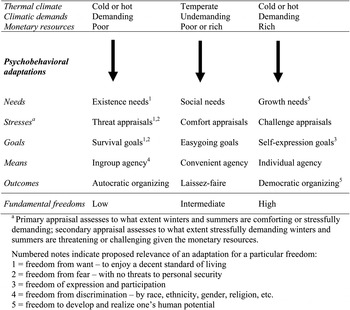
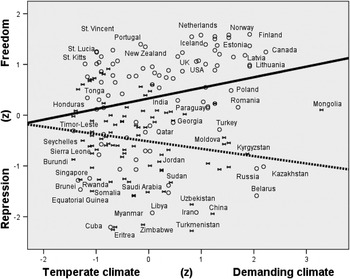
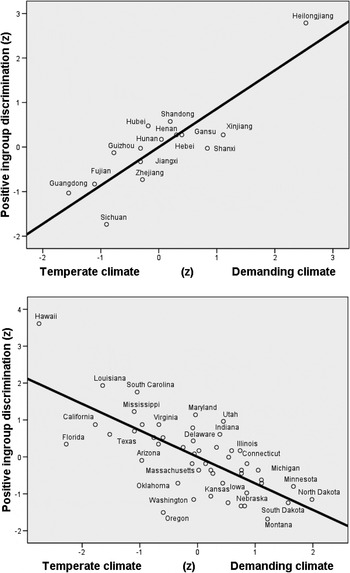
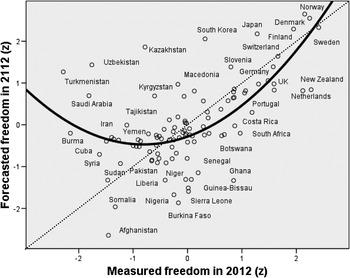




Target article
Climato-economic habitats support patterns of human needs, stresses, and freedoms
Related commentaries (24)
Cold climates demand more intertemporal self-control than warm climates1
Contextual freedom: Absoluteness versus relativity of freedom
Cultural adaptation to environmental change versus stability
Cultural adaptations to the differential threats posed by hot versus cold climates
Ecological priming: Convergent evidence for the link between ecology and psychological processes
Extending climato-economic theory: When, how, and why it explains differences in nations' creativity
Frontier migration fosters ethos of independence: Deconstructing the climato-economic theory of human culture
Fundamental freedoms and the psychology of threat, bargaining, and inequality
How is freedom distributed across the earth?
Improving climato-economic theorizing at the individual level
Individual identity and freedom of choice in the context of environmental and economic conditions
Interpersonal exchange and freedom for resource acquisition
Is there a role for “climatotherapy” in the sustainable development of mental health?
Methodological suggestions for climato-economic theory
Personality traits, national character stereotypes, and climate–economic conditions
Play, animals, resources: The need for a rich (and challenging) comparative environment
Press freedom, oil exports, and risk for natural disasters: A challenge for climato-economic theory?
Shared adaptiveness is not group adaptation
Subtle variation in ambient room temperature influences the expression of social cognition
The need for psychological needs: A role for social capital
Toward an integrated, causal, and psychological model of climato-economics
Unsurprising, in a good way
What about politics and culture?
What is freedom–and does wealth cause it?
Author response
White, gray, and black domains of cultural adaptations to climato-economic conditions