


Introduction
What is new about the fourth industrial revolution? Paradoxically, industrial revolutions tend to reopen old questions as much as create new ones. This is because they involve the unravelling or unbundling of existing arrangements, which require new answers to old questions. The human–machine relationship has been a longstanding issue in the future of work. The concept of a fourth industrial revolution is contested (Brown Reference Brown2024; Schwab Reference Schwab2016). However, the growth in application of new digital innovations such as generative artificial intelligence (AI), robotics, cloud computing, and blockchain, along with the potential of quantum technologies, is significant and already transforming work (Brynjolfsson and McAfee Reference Brynjolfsson and McAfee2014; Brynjolfsson et al Reference Brynjolfsson, Li and Raymond2025). In particular, AI and its algorithmic methods are widely viewed as having the potential to transform the way we work through improving the performance of cognitive tasks and holding the capacity to automate skilled workers (Wilson Reference Wilson2022). Yet it can also be used to augment human creativity. Some view generative AI as a technology of disinformation, raising widespread safety, ethical, and even existential concerns about its consequences for the future of human society. Others claim generative AI is becoming a general-purpose technology with the potential to supercharge the productivity of human labour and redefine corporate competitive advantage (Altman Reference Altman2024).
Since the publication of Adam Smith’s The Wealth of Nations, the drive for higher productivity has not been a straightforward issue of technical efficiency. Putting to one side the question of whether economic growth is sustainable or desirable, to what extent does economic growth depend on the widespread exploitation of human knowledge, skills, and efforts? To what extent does it provide workers with employment opportunities and skills and create the opportunity for social mobility? New technologies, over time, have delivered productivity growth; however, questions surrounding job quality and workers’ social progression have not disappeared. This article examines how new technologies, particularly generative AI, are believed to be pivotal to future productivity gains. We argue that the question is not whether new technologies fix the perceived productivity slump in Western economies but under what conditions the productivity increase leads to meaningful improvements. We argue that new technologies do not define the ‘one best way’ of increasing labour productivity, as there are choices about how employers can use technology to redesign jobs and redefine the human–machine relationship. Central to our argument is a distinction, developed more fully below, between two modes of productivity growth that differ in who captures the gains (Brown Reference Brown2024): zero-sum and positive-sum productivity. We argue that, while AI may well increase productivity in the zero-sum sense, the conditions necessary for positive-sum outcomes are currently weakening rather than strengthening.
This article is a conceptual contribution rather than a systematic review of the literature. It draws on two types of sources. Peer-reviewed research provides the empirical and theoretical foundations of the argument. Corporate and government reports are treated as discursive evidence, illustrating how AI-driven productivity is being constructed and legitimised in policy and corporate discourse, rather than as independent empirical projections. Methodologically, the paper follows what Alvesson and Sandberg (Reference Alvesson and Sandberg2011) term ‘problematisation’. Rather than filling a gap within the existing AI-productivity literature, it identifies and challenges the assumption underpinning that literature, namely that productivity gains translate into shared benefits. On this basis, it develops a conceptual framework that reframes the question. The paper first elaborates on the expectation that technologies, and in particular AI, will bring substantial productivity benefits. We then argue that the concept of productivity obscures fundamental issues about how technologies contribute to economic gains. We distinguish between positive-sum productivity and zero-sum productivity to find a human-centric approach to improving productivity (Brown Reference Brown2024). While the argument applies across advanced economies, we draw particularly on evidence from the UK and the United States, where the productivity puzzle is especially pronounced, and the decoupling of wages from productivity gains is well documented.
The productivity problem
For a long time, the political and economic imagery of the knowledge-based economy has perpetuated the notion that technological change is accompanied by more productive knowledge workers whose skills are complementary to modern technologies. Yet, the digital revolution over the last 20 years has not led to sustained growth in productivity, despite an unprecedented expansion of higher education. In recent years, many have observed that productivity after the financial crash has been stagnant despite rapid developments in the field of information and communication technology (IT) (Fernald et al Reference Fernald, Inklaar and Ruzic2025). This so-called productivity puzzle or paradox contrasts with the idea a growing demand for highly skilled labour complementary to new technology would drive a high-tech, high-skill economy.
Low productivity growth is observed in many advanced economies but is especially low and unprecedented in the UK context (Crafts and Mills Reference Crafts and Mills2020; van Ark and Venables Reference van Ark and Venables2020). UK productivity growth has decelerated sharply from the rapid pace of the post-war decades (Resolution Foundation 2022). In the so-called golden age period (1946–1974), UK productivity grew by an average of 3.7% a year. Productivity growth slowed after the oil shock of the 1970s and particularly after the 2008 economic crisis. The average growth rate of output per hour in the market sector has dropped from 2.4% in the 1997–2007 period to 0.4% in the 2009–2019 period (Chadha and Samiri Reference Chadha and Samiri2022).
It has puzzled many that the slowdown in productivity happened in a period where digital technologies are shaping work and the production process (Goldin et al Reference Goldin, Koutroumpis, Lafond and Winkler2024; Jackson Reference Jackson2018). How will digital technologies be any different from recent technologies that appear not to have brought about great increases in productivity? Will the productivity gains associated with new technology translate into improved wages for workers? Will it leave workers worse off, and will AI offer similar benefits to workers, including those with a university education? This uncertainty is supported by research evidence from Brown and Sadik (Reference Brown and Sadik2025), who describe how ‘cognitive capture’ is being used by companies to automate an increasing range of cognitive tasks associated with professional, managerial, and creative work.
AI and productivity
The debate over whether the spread of AI across the economy will drive substantial productivity growth has intensified, with optimistic perspectives dominating the discourse. Technological progress is typically seen as a key driver of productivity growth (Ferguson and Wascher Reference Ferguson and Wascher2004). AI is expected to fundamentally shape jobs throughout the economy. Dwivedi et al (Reference Dwivedi, Hughes, Ismagilova, Aarts, Coombs, Crick, Duan, Dwivedi, Edwards, Eirug, Galanos, Ilavarasan, Janssen, Jones, Kar, Kizgin, Kronemann, Lal, Lucini, Medaglia, Le Meunier-FitzHugh, Le Meunier-FitzHugh, Misra, Mogaji, Sharma, Singh, Raghavan, Raman, Rana, Samothrakis, Spencer, Tamilmani, Tubadji, Walton and Williams2021) argue that the potential impact of AI on work has the same transformative potential as the industrial revolution. Confidence persists that the substitution or displacement effect of labour-saving technologies will be outweighed by the income or compensation effect (Damioli et al Reference Damioli, Van Roy, Vertesy and Vivarelli2022). The high expectations that AI will improve economic performance are partly driven by the assumption that it has a distinct advantage in increasing productivity at both the firm and national aggregate levels. This is assumed to be especially the case if it becomes a general-purpose technology used throughout the economy.
Equally, many academic scholars, in particular economists, believe that technological innovation in the fourth industrial revolution will solve longstanding productivity issues by either improving existing machines or performing new tasks better (Acemoglu and Restrepo Reference Acemoglu and Restrepo2018). AI may be the key to reversing the trend of stagnant productivity growth in many economies (Mokyr Reference Mokyr2018). A key proponent of this idea is Erik Brynjolfsson, who has (with collaborators) argued that the real effect of AI on productivity and economic growth is yet to come and that AI and machine learning have not yet diffused widely enough (Brynjolfsson et al Reference Brynjolfsson, Rock and Syverson2017; Brynjolfsson et al Reference Brynjolfsson, Mitchell and Rock2018; Brynjolfsson and McAfee Reference Brynjolfsson and McAfee2014). They have emphasised that we cannot expect immediate advances in potential productivity. It takes time to build the stock of a new technology to a size sufficient to have an aggregate effect, and complementary investments are necessary to obtain the full benefit. Technological innovation is also believed to suffer from an ‘implementation lag’, so precise measurements of the impact of AI on productivity cannot be made yet (see also van Ark et al Reference van Ark, de Vries and Erumban2020).
Likewise, Crafts (Reference Crafts2021) argues that AI is potentially a general-purpose technology or a single generic technology (see also Petropoulos and Kapur Reference Petropoulos and Kapur2022 for a similar argument). Empirical research, to some extent, indicates that, at the firm level, the use of AI makes firms more productive (Babina et al Reference Babina, Fedyk, He and Hodson2024; Damioli et al Reference Damioli, Van Roy and Vertesy2021; Rammer et al Reference Rammer, Czarnitzki and Fernández2022). A growing body of firm-level and task-level evidence suggests productivity gains are already occurring (e.g., Gilardi et al Reference Gilardi, Alizadeh and Kubli2023; Hassani and Silva Reference Hassani and Silva2023; van Inwegen et al Reference van Inwegen, Munyikwa and Horton2023). These studies largely measure productivity at the task or firm level over short time periods and do not address the distributional question of whether efficiency gains translate into improved wages or employment conditions for workers.
The idea that AI will improve productivity has also been propagated by corporate actors such as management and financial consultants. Goldman Sachs (Reference Sachs2023, see also Reference Sachs2024) claims that widespread AI adoption could drive a 7% or almost $7 trillion increase in annual global GDP over a ten-year period. PwC projects that UK GDP will be up to 10.3% higher in 2030 as a result of AI, the equivalent of an additional £232 billion. This could be the ‘biggest commercial opportunities in today’s fast-changing economy’. In its industry forecasts McKinsey (2023, see also PwC 2024) projects that AI is expected to increase productivity for private-sector companies by between $2.6 and $4.4 trillion annually.
Finally, governments all over the world show great optimism and increasingly rely on digital technologies to improve the productivity of their economies. For the European Union, AI has become an area of strategic importance as a key driver of economic development, demonstrated in its European strategy on AI (EU 2021, see also Ulnicane et al Reference Ulnicane, Knight, Leach, Stahl and Wanjiku2021). For the US government, AI is both an economic opportunity and a security concern. In an economic sense, it presents a great opportunity to innovate and revitalise the economy. The Trump administration considers AI a crucial driver of economic growth and productivity. In January 2025, President Donald Trump signed an executive order titled ‘Removing Barriers to American Leadership in AI’. This order highlights the United States’ commitment to maintaining and strengthening its global dominance in AI to improve economic competitiveness, among other goals. In line with this strategy, the administration announced the formation of ‘Stargate’, a partnership involving OpenAI, Oracle, and SoftBank, with plans to invest up to $500 billion in AI infrastructure in the United States. The investments reflect the administration’s belief in AI’s potential to significantly enhance productivity and economic prosperity.
Likewise, the UK presents itself as a leader in AI and aims to build on this advantage for future economic growth (DBT 2019; DSIT 2021). Starmer’s Labour government has increasingly staked the future economy on AI, improving productivity, and future prosperity. In its AI action plan (UK Government 2025), it firmly places AI as a key driver of economic growth, supporting public services and national prosperity. It estimates that AI adoption could add an additional £400 billion to the UK economy by 2030, enhancing innovation and productivity in the workplace.
Against this chorus of consensus on AI and productivity, some voices have doubted whether AI technologies will actually lead to productivity growth. Gordon (Reference Gordon2016) argues that IT has less influence on economic growth than electricity, urban sanitation, chemicals and pharmaceuticals, and the internal combustion engine. Before assessing whether AI can deliver on these promises, it is necessary to examine what productivity actually measures and whose interests it serves.
What is productivity?
In economics, the concept of labour productivity measures how much total economy-wide income is generated in an average hour of work, using gross domestic product (GDP) as an aggregate measure of output. Productivity can be seen as an indicator of production efficiency (outputs per unit of input). In essence, productivity is determined by labour, capital, and the effectiveness with which these inputs are transformed into outputs, commonly measured as total factor productivity (TFP). Productivity has also been a key concept in economic policy, as it offers the potential to improve economic growth and living standards. It is no secret that labour productivity has considerable measurement issues. As Oulton (Reference Oulton2020) observes, ‘hours worked’ is not without ambiguity, as it is not the same as hours paid (which includes paid absences through sickness, holidays, maternity leave, and training). Then there is the problem of what productivity actually tells us about labour and workers, as GDP is affected by various factors, of which labour is just one.
Productivity, wage inequalities, and distributional outcomes
Apart from measurement issues, we need to challenge some of the underlying assumptions that are embedded in the concept of labour productivity. It reduces workers and their work to a black box, giving us no idea of how increased outputs per input unit are achieved. The worker’s skills and abilities may not drive an increase in productivity, which may instead result from the creation of more value without upgrading the work or the worker’s human capital. Porter et al (Reference Porter, Takeuchi and Sakakibara2000: 3) highlight that productivity, rightly understood, encompasses both the value (prices) that a nation’s product commands in the marketplace and the efficiency with which it is produced. Improving efficiency alone, or producing more units per unit of labour or capital, does not necessarily elevate wages and profits unless the prices of the products or services are stable or rising.
In digital capitalism, producing the same output may require less labour input, though it often involves greater capital investment in technologies such as digital platforms. While this can appear more ‘productive’ in terms of achieving more with fewer inputs, it may not necessarily enhance overall ‘productivity’ within a market economy. Here, the paradox of digital innovation is a ‘baby and bathwater’ issue. New technologies offer companies ways to strip out cost, but at the same time, they also strip out the source of profit. This was often the source of shared prosperity, much in the same way that the rise of mass production required mass employment. Firms can become more productive without benefiting the majority of the workforce. This typically involves sustaining value or increasing profits through cost-cutting and price increases, linked to skewed ‘productivity capture’ (Brown et al Reference Brown, Lauder and Cheung2020), where more of the value is captured by those at the apex of the organisation, along with shareholders. With the introduction and further penetration of digital technologies, productivity may increase, but the quality of work may decline, and remuneration may not keep pace.
Although technological investment can be separated from human capital in theory, in reality they are entangled. This means that for new technologies to increase productivity, changes within organisations are needed to support and help increase output. Leicht (Reference Leicht and Smith2013) writes:
efficient labor utilization is tied into myriad factors, only some of which have to do with how hard actual laborers work, including the social organization of production, types of technology used, and how efficiently technology is used. The tendency in many settings, with measures of labor productivity, is to attribute any and all changes in productivity to the quality and diligence of individual workers, devoid of the settings where production takes place. This is the basis of most social scientific critiques of labor productivity measures.
These organisational factors must be central to our understanding of what shapes productivity. The problem is that they are hard to measure. Economic models can encompass a wide range of factors in productivity measures. Those that cannot be measured are referred to as ‘intangibles’. These intangible factors represent the importance of organisational and social context, which cannot be easily measured; they include work relations and the implementation of technologies that structure the work process. Corrado et al (Reference Corrado, Haskel and Jona-Lasinio2021) argue that intangible capital, such as research and development, data, proprietary software, and human and organisational capital, has increased in importance and may help explain the low productivity in Western economies. Success in implementing AI is strongly associated with intangible capital (Petropoulos and Kapur Reference Petropoulos and Kapur2022) and is believed by some to be concentrated in a few firms that will reap the productivity rewards, whereas average productivity growth remains low (Kaus et al Reference Kaus, Slavtchev and Zimmermann2020). The growing complementarity of investments in intangibles, such as organisational change, process innovation, and business models, with investments in hardware and technology implies that both types of investment are required to drive productivity growth. Moreover, some of these intangible investments may be harder to realise and slower to generate a return (Pilat Reference Pilat2023).
In many economic narratives, the concept of a high-skilled economy is linked to sustained productivity growth through the adoption of new technologies. Those whose work is complementary to these new technologies will experience increased demand (Goldin and Katz Reference Goldin and Katz2008). Yet within a global competitive environment, productivity increases do not tell us much about where the increased returns to labour will go. Here, we draw on the distinction between zero-sum productivity and positive-sum productivity developed in Brown (Reference Brown2024). Zero-sum productivity is achieved through greater efficiency in the production process, particularly by using technology to produce more output at lower cost while seeking a competitive advantage over other firms. In these cases, workers may not see any benefits of greater productivity, such as improved wages or work conditions. Positive-sum productivity encapsulates a human-centric view in which increases in productivity are linked to workers’ performance and the social organisation of workers (Brown and Sadik Reference Brown and Sadik2025). The rewards are therefore shared among the workforce. Even if we assume that the spread of AI technology will increase productivity, we must consider what kind of productivity increases are achieved. These doubts are not coincidental but structural. The decoupling of wages from productivity since the 1970s demonstrates that the relationship between technological innovation and workers’ rewards is not automatic but mediated by power, institutions, and corporate strategy. Rather than treating productivity growth as an unqualified good, this framework directs attention to distributional questions that aggregate measures of productivity leave unaddressed. The framework builds on but departs from several existing theoretical traditions. Skill-biased technological change theory holds that new technologies raise demand for complementary high-level skills, rewarding workers whose capabilities are enhanced rather than displaced by innovation (Autor Reference Autor2015; Goldin and Katz Reference Goldin and Katz2008). The positive-sum/zero-sum distinction shares this concern with the relationship between technology and labour market outcomes. However, it rejects the assumption that skill complementarity automatically translates into shared rewards. Labour process theory, in the tradition of Braverman (Reference Braverman1974, see Thompson and Smith Reference Thompson and Smith2024 for an overview), offers a closer parallel. Its emphasis on management’s use of technology to deskill, control, and cheapen labour resonates strongly with the zero-sum scenario this article develops, and more recent contributions engage directly with how productivity gains are captured by capital through the logic of exploitation embedded in technological systems (Thompson and Laaser Reference Thompson and Laaser2021). Our framework shares this diagnosis but departs in orientation: where labour process theory locates the capture of productivity gains in the structural logic of capitalist production, the positive-sum/zero-sum distinction treats distributional outcomes as institutionally variable, asking under what conditions workers can share in productivity growth rather than treating capital capture as structurally determined.
Political economy perspectives demonstrate that the distribution of productivity gains is shaped by power and institutions rather than by technological change itself. Evenhuis et al (Reference Evenhuis, Lee, Martin and Tyler2021) frame the simultaneous productivity slowdown and rise in inequality in advanced economies as interrelated systemic problems. They question whether concentrations of corporate power and financial muscle act as impediments to economic dynamism by favouring rent-seeking over value-enhancing investment. Benkler (Reference Benkler, Allen, Benkler, Downey, Henderson and Simons2022) reinforces this point by showing that market societies operating at the same technological frontier produce radically different distributional outcomes. They argue that skill-biased technological change theory naturalises inequality by treating technology as an exogenous and politically neutral force, obscuring the role of institutions, ideology, and power in determining who captures productivity gains (see also Hacker and Pierson Reference Hacker and Pierson2010). Acemoglu and Johnson (Reference Acemoglu and Johnson2023) extend this argument into the present, contending that technology generates broad prosperity only when countervailing institutional and political forces direct its benefits towards labour rather than capital.
The zero-sum/positive-sum distinction synthesises insights from these traditions into a framework orientated explicitly towards distributional outcomes and the conditions under which workers share in productivity growth. It is not a neutral descriptive concept but a normative-analytical one that names what is at stake in debates about technological change and work. It also provides the lens through which the three mechanisms discussed below, namely corporate capture of productivity gains, the growing exposure of knowledge work to automation, and the institutional contingency of technological outcomes, can be understood not as separate observations but as expressions of a single underlying problem.
Why AI may not deliver positive-sum productivity
Acemoglu and Restrepo (Reference Acemoglu and Restrepo2019) show that where productivity growth is driven primarily by automation, labour’s share declines unless new tasks and labour-augmenting technologies actively compensate. This outcome depends on institutions, policies, and corporate strategies rather than on technological change itself. There are good reasons to doubt whether the new digital technologies, including AI, will lead to a greater share in profits and improved labour quality that positive-sum productivity encapsulates (Brown and Sadik Reference Brown and Sadik2025).
Reason 1: companies may not share
What is in doubt is who will benefit from the boost to productivity. What if all the gains are seized by a handful of tech giants? What if history fails to repeat itself, and AI destroys more jobs than it creates? What if AI does lead to a net increase in employment, but the new jobs are less well-paid than the old ones? Put simply, what if it is different this time? That may well be the case. (Elliott Reference Elliott2023)
For positive-sum productivity to expand, there needs to be a direct relationship between rewards and outputs. Yet in recent decades, the link between earnings and productivity has become weaker. Since the late 1970s, many countries have experienced growing wage inequality, with a concentration of wage income at the top and a growing share of income going to capital owners (the loss of labour’s share of income) (Piketty Reference Piketty2014). This has affected the link between productivity and workers’ earnings. The EPI (2026) found that in the US, the change in productivity between 1979 and 2025 was 92.4%, yet hourly pay grew 33.6%, meaning productivity has grown 2.7 times as much as pay. The persistent decoupling of wages from productivity is consistent with post-Keynesian accounts of income distribution, in which the wage share is determined not by marginal productivity but by the relative bargaining power of workers and the structural features of labour markets. This decoupling is not an incidental byproduct of technological change but reflects the political and institutional conditions under which productivity growth occurs. Warner and Xu (Reference Warner and Xu2021) demonstrate this directly: analysing US county-level data, they find that returns to labour are highest in states with stronger unionisation and lowest where corporate lobbying is most prevalent, confirming that the distribution of productivity gains is shaped by power relations rather than productivity itself.
According to Mishel et al (Reference Mishel, Gould and Bivens2015), a distinct problem with the conventional understanding of productivity is that wages have become largely decoupled from productivity, and the financial rewards of economic gains have been disproportionately distributed to the higher end of the wage distribution. Earnings for the majority of low- and middle-income workers have stagnated, even during periods of significant productivity growth (see Resolution Foundation 2022, for the UK). So even if new digital technologies improve productivity, it is unclear who will benefit. Grossman et al (Reference Grossman, Helpman, Oberfield and Sampson2018) observe that in many countries, a slowdown in aggregate productivity growth occurred alongside a decline in labour’s share of national income. The authors suggest that the productivity slowdown may have caused the decline in labour’s income share. We can also associate the growth in rent-seeking within many Western economies with the broken link between productivity and workers’ earnings. Rent-seeking in certain sectors (e.g., finance) means generating profits without raising productivity (Carey and Nasir Reference Carey and Nasir2019). Wealth creation through rent-seeking can result in a slowdown in aggregate productivity (Baqaee and Farhi Reference Baqaee and Farhi2017).
The impact of new technologies on work cannot be understood without understanding capitalism. As Brown (Reference Brown2024: 479) observes, ‘capitalism is the DNA of all industrial revolutions’. To understand the role of new technologies, we need to consider how corporations may use AI to increase profits and shareholder value rather than drive productivity that benefits the workforce (Dinerstein and Pitts Reference Dinerstein and Pitts2021). The historical evidence, therefore, establishes a strong prior: absent deliberate institutional intervention, productivity gains and workers’ rewards follow different trajectories regardless of the technological context.
These distributional dynamics have consequences that extend beyond fairness to the macroeconomic conditions on which sustained productivity growth depends. The first concerns demand. Workers are not only inputs into production but also a source of the demand on which production rests. Whether large-scale displacement weakens the labour-income-consumption circuit in aggregate is uncertain. It depends on whether displaced workers are redeployed and on how far spending by capital owners and public transfers substitute for lost wages. But the question is real, and a benign outcome depends on institutions rather than on the technology. A second consequence is harder to discount. Displacement concentrated among well-paid knowledge workers erodes the income-tax and social-contribution base while raising the cost of transfers, narrowing fiscal capacity at precisely the moment the state is being asked to underwrite AI infrastructure and adjustment (Acemoglu and Johnson Reference Acemoglu and Johnson2023). Public investment risks subsidising the very displacement that undercuts the public revenues on which adjustment depends. A third works on the supply side. Where displaced workers are not quickly reabsorbed into work that uses their skills, capabilities, and labour-force attachment decay, so that productive capacity is not merely idled but scarred, a dynamic that compounds the UK’s existing pattern of capital and skills underinvestment discussed below (Allas and Zenghelis Reference Allas and Zenghelis2025).
Reason 2: the impact on knowledge work
The difference between earlier waves of technology and new technologies lies in their potential to replace tasks previously considered unique to so-called knowledge workers (Brown et al Reference Brown, Lauder and Cheung2020). AI could affect work in virtually every occupational group. Already, better-paid, better-educated workers face the most exposure to AI (OECD 2021). Felten et al (Reference Felten, Raj and Seamans2023) found that highly educated, highly paid, white-collar occupations may be most exposed to generative AI in the future. Another OECD (2023) study found that AI has made the most progress in abilities required to perform non-routine, cognitive tasks associated with high-skilled occupations, such as those of business professionals, managers, chief executives, and science and engineering professionals. They write, ‘occupations in finance, medicine and legal activities, which often require many years of education and whose core functions rely on accumulated experience to reach decisions, may suddenly find themselves at risk of automation from AI’ (Milmo Reference Milmo2023).
If AI is used as a labour-cutting device to automate a growing number of cognitive tasks, the idea that it only impacts routine tasks and jobs is clearly outdated (Brown and Sadik Reference Brown and Sadik2025). OpenAI (2023) estimates that large language models, such as ChatGPT, could affect up to 80% of the US workforce, with 19% of jobs having at least 50% of tasks exposed. Compared with earlier technologies, it is highly skilled, highly paid occupations, including those in creative, complex, and analytical jobs, that are most exposed to generative AI. Hui et al (Reference Hui, Reshef and Zhou2024) examine the short-term impact of generative AI models on freelancers in online labour markets. Those impacted experienced reductions in both employment and earnings following the introduction of AI technologies. There is also evidence that AI deskills graduate-level work directly: Xue et al (Reference Xue, Cao, Feng, Gu and Zhang2022) found that AI adoption lowers job skill requirements by automating tasks that previously required a college education.
Davenport and Mittal (Reference Davenport and Mittal2022) stress that complex machine learning models are ready to overturn many skilled tasks in content creation, with substantial impacts on marketing, software, design, entertainment, and interpersonal communications. New digital technologies can perform jobs that rely on advanced cognitive skills (as well as menial tasks). Whereas previous IT technologies predominantly affected menial work, AI could reduce the position of many high-skilled workers, whose relatively high status, rewards, and job quality may worsen. The position of knowledge workers has already been subject to corporate efforts to use digital tools and transform knowledge work into working knowledge, which can be offshored to lower-cost locations (Brown et al Reference Brown, Lauder and Ashton2011). With the declining labour power of many so-called knowledge workers, positive-sum productivity may be unlikely to develop. The exposure of knowledge workers to AI thus removes the last relatively protected segment of the labour force from the logic of skill-biased technological change, undermining the human capital rationale that has underpinned education and labour market policy for three decades.
Some evidence cuts the other way. In a study of over 5,000 customer-support agents, Brynjolfsson et al (Reference Brynjolfsson, Li and Raymond2025) found that an AI assistant raised productivity most for novice and lower-skilled workers, compressing rather than widening the productivity distribution within the workforce. Yet this is less reassuring than it appears. The mechanism the authors identify is that the AI captures the tacit knowledge of the most able workers and disseminates it to the rest. Skilled workers were previously protected by the scarcity of that expertise; a technology that codifies and redistributes it erodes the premium on which their status and rewards depended, even as it lifts those below them. Such compression is therefore not a counterweight to the devaluation of knowledge work but another expression of it.
Reason 3: uncertain impacts
The empirical literature on the effect of automation on employment is far from easy to interpret (Zarifhonarvar Reference Zarifhonarvar2023), and the impact specifically of AI on employment is too early to judge. Caution is necessary when assessing the impact of AI on work transformation. There is a need to consider task-specific and contextual factors in AI implementation, as its impact is likely to be uneven and depends on how these technologies are used. There are also likely to be winners and losers depending on whether it is used for cognitive capture or cognitive extension (Brown and Sadik Reference Brown and Sadik2025; Teutloff et al Reference Teutloff, Einsiedler, Kässi, Braesemann, Mishkin and del Rio-Chanona2025). The implementation of new technologies is also shaped by the broader policy, regulatory, and economic environment (Zickuhr Reference Zickuhr2021).
The UK context illustrates these dynamics particularly clearly. The prospect of significant AI investment appears unlikely given the UK’s longstanding pattern of capital underinvestment. Allas and Zenghelis (Reference Allas and Zenghelis2025: 1) demonstrate that the UK consistently invests a smaller share of GDP in productive, long-term assets compared to other advanced economies. This underinvestment extends beyond technology to encompass ‘equipment and structures, workforce skills, ideas and processes’, creating a multi-trillion-pound capital shortfall that compounds over time. Skills investment follows a similar trajectory of decline. UK employers have reduced training expenditure per employee by 26% since 2005, while government investment in skills in England has fallen by £1 billion between 2010 and the present (Evans and Egglestone Reference Evans and Egglestone2024). Employer investment in training dropped 19% between 2011 and 2024, with spending per employee declining by 29% (DfE 2025). These declining investments in both capital and skills threaten UK firms’ absorptive capacity, their ability to effectively adopt and utilise new technologies to enhance productivity. This creates a self-reinforcing cycle: firms lacking skilled workforces struggle to leverage technological investments, which in turn disincentivise further capital expenditure. Moreover, these patterns play out unevenly across regions. Areas already characterised by lower skill levels, reduced productivity, and minimal training investment will fall further behind more economically robust regions, exacerbating existing geographical inequalities in economic development (Massini et al Reference Massini, Sanchez-Barrioluengo, Yu, Kim, Chen and Velu2025; Royal Society Reference Society2022).
Grimshaw and Miozzo (Reference Grimshaw and Miozzo2021: 4) stress that organisational factors make the skill-technology-productivity equation highly contingent and refer to the extensive literature on organisational and sectoral characteristics that shape the contingent relationship between human capital and productivity. These include the type of work organisation, use of outsourcing, nature of employee engagement, quality of management practices, and kind of employment – whether temporary or permanent, part-time or full-time. Souto-Otero et al (Reference Souto-Otero, Freebody and Brown2021) argue that certain firm characteristics can have a ‘sheltering effect’ on jobs when technology is introduced in the workplace, including firms’ stock of skills, organisational structure, competitive strategies, and management’s perception of their workforce. Their findings suggested that neither skill levels in the firm nor high-performance organisational practices have a sheltering effect, while firms’ competitive strategies and managers’ perceptions of the competence and commitment of their workforce do. There is also uncertainty about whether AI will benefit all sectors, organisations, and, crucially, workers equally. AI technologies are not as skill-based as many earlier IT technologies are believed to be.
In sum, whether digital technologies will strengthen the power of all workers remains highly uncertain, as corporations find ways to use new technologies to their advantage. Acemoglu (Reference Acemoglu2021) reminds us that automation, including AI-based automation, is fundamentally an effort to cut labour costs. Rodrik and colleagues have shown policy choices, financing structures, tax systems, and workplace power dynamics currently incentivise labour-replacing automation over labour-augmenting technologies (Rodrik Reference Rodrik2022; Rodrik and Sabel Reference Rodrik, Sabel, Allen, Benkler, Downey, Henderson and Simons2022; Rodrik and Stantcheva Reference Rodrik and Stantcheva2021). The introduction of AI by management can be driven by wishful thinking. A recent study surveyed 2500 executives, full-time employees, and freelancers from global companies (Monahan and Burlacu Reference Monahan and Burlacu2024). It found a significant disconnect between managers’ high expectations and employees’ actual experiences with AI. While 96% of executives believe that AI will enhance productivity, the study reveals that 77% of employees utilising AI feel it has increased their workload and made it harder to achieve the anticipated productivity gains. Uncertainty here is therefore not merely empirical but systemic: without the institutional conditions that once made broad distribution of productivity gains the norm, there is no default mechanism through which positive-sum outcomes will emerge.
Three reasons, one underlying problem
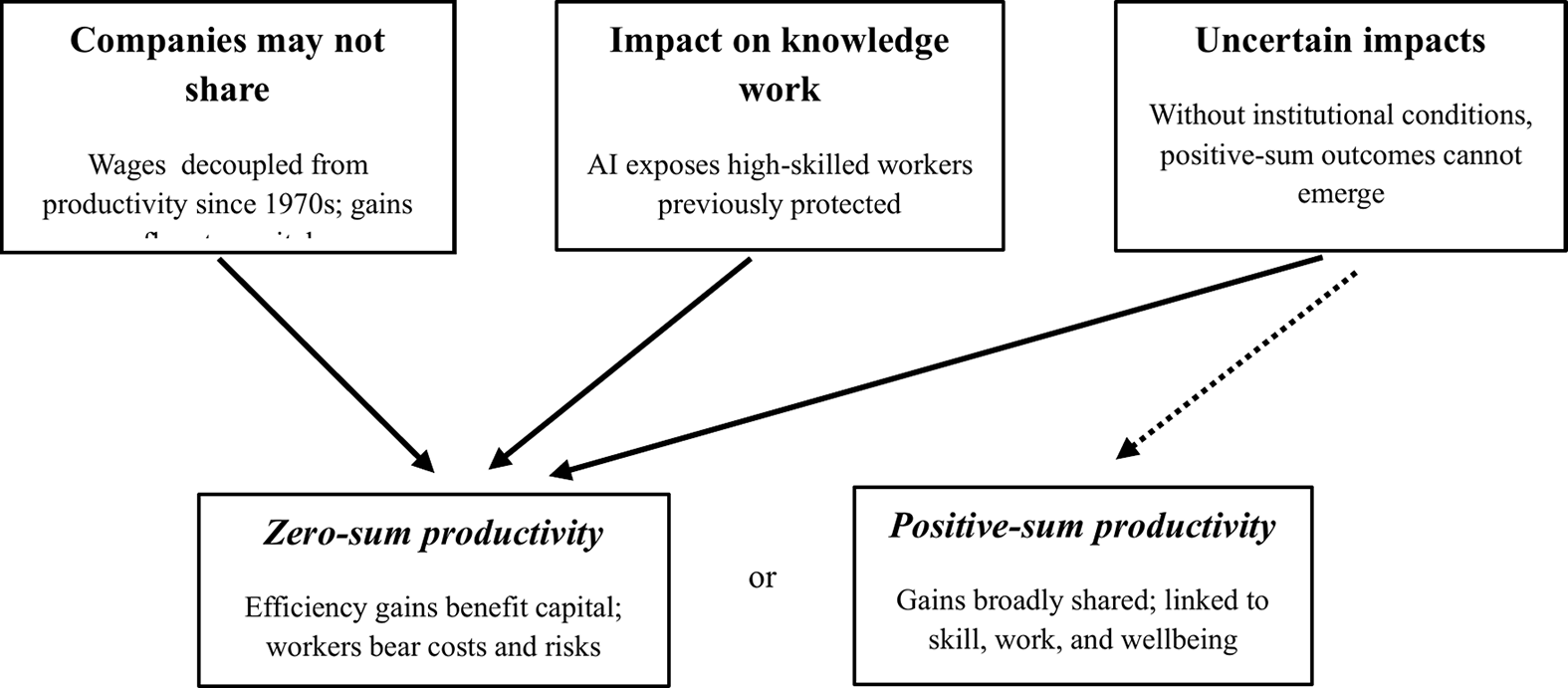
The three reasons outlined above are not independent observations but mutually reinforcing expressions of a single underlying problem: the structural disconnect between productivity growth and its distribution. The first reason establishes that this disconnect is active and deliberate. Corporations systematically capture productivity gains through market power and corporate strategy rather than sharing them with workers. The second shows that knowledge workers, who have historically been able to protect themselves from this logic through credentials and expertise, are now exposed to the same dynamic as AI erodes the shelter that specialised skills once provided. The third shows that the outcome is institutionally contingent rather than technologically determined and that the conditions necessary to secure shared gains are not in place. Figure 1 summarises the reasons why the further integration of AI is likely to lead to zero-sum productivity.
Three mutually reinforcing reasons why AI is unlikely to deliver positive-sum productivity.

Our argument should not be read as a claim that technological change must always produce zero-sum outcomes. On the distributional question, history offers a clear counter-example: the post-war ‘golden age’ discussed above combined rapid productivity growth with rising real wages and expanding employment, distributing its gains comparatively broadly. The shared gains of the post-war period were not an automatic product of technology but an institutional achievement, resting on strong unions, collective bargaining, and full-employment policy. Those gains eroded as those institutions weakened rather than as the technology changed (Acemoglu and Johnson Reference Acemoglu and Johnson2023). The historical record therefore supports rather than undercuts our claim about institutional contingency: where workers shared in productivity growth, they did so because countervailing institutions made them, not because the technology of the day distributed its gains on its own.
Conclusion
Technological innovation in the fourth industrial revolution has been assumed to have created a scarcity for those whose skills are complementary to these technologies, and workers will be rewarded according to their investment in technology skills. We argue that new technologies can deskill, standardise, and automate work, including various aspects of ‘knowledge’ work. And thus, as digital technologies offer opportunities to produce more output with less human input, the benefits of improved productivity may not be fully realised by workers. Rather than fixating on the question of whether digital technologies, such as AI, can improve productivity at the level of the firm or the economy, we argue that what is also important is how the benefits are shared. In other words, even if productivity increases, where will the rewards of this extra productivity be captured? Despite the great optimism supporting the predictions of those who view AI as part of the solution to the lag in productivity growth, there are key reasons to doubt that positive-sum productivity will occur.
The diffusion of AI is likely to produce uneven outcomes across the workforce. While some workers may see their skills augmented, others face deskilling, reduced autonomy, and growing inequality (Brito and Curl Reference Brito and Curl2020; Holm and Lorenz Reference Holm and Lorenz2022; Korinek and Stiglitz Reference Korinek, Stiglitz, Agrawal, Gans and Goldfarb2019). Fundamental changes in work that accompany the introduction of new technologies are not about replacing labour but about changing the labour process. This reorganisation of work may not always favour workers. Employer decisions around the implementation of technology, and therefore, how they impact workers, are intertwined with the conditions in which these jobs exist (Zickuhr Reference Zickuhr2021). Lloyd and Payne (Reference Lloyd and Payne2019) caution against treating technology as a determining force, arguing that the impact of AI on the quantity, quality, and distribution of work ultimately depends on the priorities of those who hold economic and social power, the objectives of employers, and the capacity of workers to contest or negotiate the terms of technological change. The openness of how increased productivity is achieved offers reasons for optimism despite the reasons why AI may not deliver positive-sum productivity outlined in this article (Brown and Sadik Reference Brown and Sadik2025).
We argue for a human-centric approach that understands productivity as a positive-sum game for labour (Cotta and Breque Reference Cotta and Breque2021). Rather than simply training workers to adapt to new technologies, governments could actively steer innovation towards employment-friendly directions (Rodrik and Stantcheva Reference Rodrik and Stantcheva2021). There is nothing inherent to AI that cannot be used to produce higher output whilst offering workers a share of the rewards linked to them. Similarly, firms can use AI to improve job quality and design meaningful jobs. We need to accept that the basic problem in market economies is not the lack of skills complementary to new technologies within the labour force but a scarcity of decent job opportunities for workers under a changing technological landscape (Brown et al Reference Brown, Lauder and Cheung2020). New technologies do not necessarily increase the demand for higher-level skills. They can undermine the economic capacity to produce suitable job opportunities, especially for a more educated workforce. Although the effects of AI and other digital technologies are uncertain at this point, it is essential to look for signs not so much for technological unemployment (although not unimportant) but for technological underemployment, where jobs do not use the skills of the workforce.
Making this distinction operational requires concrete policy instruments rather than broad calls for state intervention. Promoting positive-sum productivity growth means actively thinking about skill utilisation and the creation of meaningful jobs. This is hard to imagine without an active state willing to intervene through wide-ranging industrial policies that encourage and incentivise companies to incorporate job creation, job design, and skill use into their corporate strategies. Four instruments follow directly from the framework. First, conditional public AI investment means directing AI infrastructure funding and tax incentives towards firms that can demonstrate positive-sum outcomes, measured against wage growth, labour share, and job quality indicators rather than output figures alone. Second, mandatory AI productivity reporting would require firms above a certain size to report not just productivity gains from AI adoption but their distribution across wages, skill utilisation, and employment conditions, making the zero-sum/positive-sum distinction institutionally visible (Rodrik and Stantcheva Reference Rodrik and Stantcheva2021). Third, reformed corporate governance would make board-level worker representation and stakeholder accountability a condition of access to public AI investment, ensuring that decisions about AI deployment reflect worker interests alongside shareholder value. Fourth, AI work design obligations would tie AI adoption incentives to employer commitments on retraining and meaningful job redesign, actively steering innovation towards cognitive extension rather than cognitive capture (Brown and Sadik Reference Brown and Sadik2025; Rodrik Reference Rodrik, Sabel, Allen, Benkler, Downey, Henderson and Simons2022). The state also has the power to shape the institutional features that structure the relationship between education, jobs, and wages, such as the educational system and labour protection (Diessner et al Reference Diessner, Durazzi and Hope2021). Together these instruments would begin to create the institutional conditions under which positive-sum AI productivity becomes not the exception but the norm. The question is not whether AI will increase productivity but whether the institutional and policy conditions exist to ensure those gains are broadly shared, conditions that current trends suggest are weakening rather than strengthening.
Acknowledgments
We would like to thank Professor Phillip Brown for his extensive comments and feedback during the development of the manuscript.
Funding statement
An earlier version of this article was funded as part of the Digital Futures of Work Research Programme (https://digitalfuturesofwork.com/).
Competing interests
The author(s) declare no conflicts of interest.

 Open access

