In social sciences, climate reflects a metaphor that explains differences in human functioning (Litwin & Stringer Reference Litwin and Stringer1968). Van de Vliert treats climate literally and exhibits how climatic demands themselves, and their interactions with nations' wealth, influence societies' needs and values. His theory offers some insights into explanations of higher-order aspects of human functioning. Deducing from the mechanisms proposed by Van de Vliert, we expected the climato-economic theory to predict differences in nations' creativity.
Creativity has several different forms: it can be frustration-based, which stems from threat (Heinzen Reference Heinzen, Shaw and Runco1994), or challenge-based, which breaks the status quo (Perkins Reference Perkins and Sternberg1988). Hence, both mechanisms caused by demanding climate could stimulate creativity. Theoretical models of organizational climate for creativity (Ekvall Reference Ekvall1996; Karwowski Reference Karwowski2011) and meta-analyses (e.g., Hunter et al. Reference Hunter, Bedell and Mumford2007) highlight the positive role of challenge and risk to creativity (effect size: 0.87 and 0.78, respectively; Hunter et al. Reference Hunter, Bedell and Mumford2007). Conversely, analyses at nations' level demonstrated that threats associated with destabilisation decrease creativity (Simonton Reference Simonton1990). Research on organizational climate suggests that the relationship between challenge and creativity is curvilinear rather than linear: increasing challenge translates into higher creativity, yet too challenging conditions are detrimental to creative production (Baer & Oldham Reference Baer and Oldham2006).
To date, economic variables were rarely involved in explaining creativity (Florida Reference Florida2002b; Rubenson & Runco Reference Rubenson and Runco1992), whereas climatic characteristics were completely ignored. Using Van de Vliert's data on climatic demands and monetary resources, we examined whether these factors and their interaction could explain differences in nations' creative output. We operationalised creativity with the use of the measures of a nation's innovation potential (developed by INSEAD (Dutta Reference Dutta2012) and the Boston Consulting Group [BCG]) and indexes of creative achievements covering the arts (Nobel Prizes in Literature, Oscar Academy Award nominations and awards for international movies, and awards in World Design Rankings), sciences (Nobel Prizes in Science, a log of published scientific papers, and a H-index log), and the social world (Nobel Prizes in Peace).
Regression models explained between 0.5% (when H-index served as a dependent variable) and 79% (when INSEAD innovation score was explained) of the variance in creativity. Climatic demands reliably and positively predicted the INSEAD innovation index and Nobel Prizes in Science. Monetary resources formed a positive predictor in eight cases (all except the BCG innovation index, numbers of published scientific papers, and the H-index), whereas the interaction of climatic demands and monetary resources positively predicted the number of Nobel Prizes in Science and Peace, the number of published papers, and the H-index.
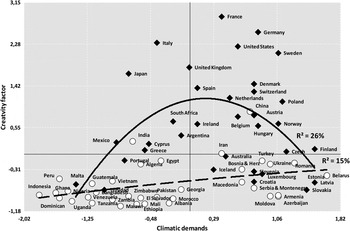
Factor analysis reduced the number of creativity variables to two groups. The first described “overall creativity score” and was composed of Nobel Prizes, Oscar and design awards, and INSEAD index, whereas the second was made up of scientific production: the number of published papers, citations rates, H-index, and BCG innovation score. The “creativity factor” was highly reliable (α = .88) and interestingly related to climato-economic factors (Fig. 1).
Figure 1.
Effects of climatic demands on nations' creativity moderated by monetary resources (curvilinear relationship shows the effect of challenge among richer countries; linear relationship is that of the threat among poorer countries). As a result of missing values, the sample was limited to 71 countries out of 85 analysed by Van de Vliert (83.5%).
When nations' population was controlled, the strongest effect was that of monetary resources (β = .79; p < .0001), whereas the effect of climatic demands was not reliable (β = .08). However, when we examined a possible curvilinear relationship, the squared term of climatic demands was indeed reliable (β = −.15, p = .017), showing decrease of creativity after some point. Climatic demands, their squared term, and monetary resources, together with nations' population, explained 76% of creativity variance. Interaction of squared climatic demands with monetary resources added significantly to the model (ΔR
2 = .02) with a negative effect (β = −.24, p = .03).
In case of poorer countries, we noted a clear–albeit moderate–linear relationship between climatic demands and creativity. The more demanding the climate, the higher the country's creativity. The mechanism of threat seems to have a positive impact by motivating people to look for new solutions to their problems. In rich countries, the observed relationship reflects the pattern hypothesised in the theories of organizational climate for creativity (Karwowski Reference Karwowski2011): the level of nations' creativity increases with the challenge generated by climatic demands, but decreases after achieving its optimum. Nations with the highest level of creative achievements are those of moderate (or slightly higher than moderate) climatic demands. This finding fits well with predictions deduced from the theories of organisational climate for creativity and challenges the assumptions of Van de Vliert's theory. The interaction between climatic demands and monetary resources that explains creativity does exist, yet its pattern is more complex than observed in the case of other variables described in Van de Vliert's article. On the one hand, the relationship observed in poorer countries is coherent with folk wisdom: under harsh conditions, creativity pays off. On the other hand, however, the level of creativity is generally low there; probably more important needs need to be fulfilled than engagement in creative activity. In richer countries, the observed relationship is even more interesting: moderate demands translate into the highest achievement, whereas too comfortable or too demanding conditions are similarly detrimental.
Further works should look for explanations for these findings. We can speculate that in richer countries not just challenge is important, but also values accepted in the society (Inglehart Reference Inglehart2000), attitudes toward creativity (Florida Reference Florida2002b), or uncertainty avoidance (Hofstede Reference Hofstede2001). When we repeated our analyses on thirty-five of the richest countries, introducing secular-rational values derived from the World Value Survey as a predictor, we found a marginally reliable association with the creativity level (β = .36, p = .057). The low power caused by a small number of countries (which were actually very similar: all except the United States and Australia were European countries, and all, without exception, belonged to the group of Western countries) calls for a more elaborated analysis in the future.





In social sciences, climate reflects a metaphor that explains differences in human functioning (Litwin & Stringer Reference Litwin and Stringer1968). Van de Vliert treats climate literally and exhibits how climatic demands themselves, and their interactions with nations' wealth, influence societies' needs and values. His theory offers some insights into explanations of higher-order aspects of human functioning. Deducing from the mechanisms proposed by Van de Vliert, we expected the climato-economic theory to predict differences in nations' creativity.
Creativity has several different forms: it can be frustration-based, which stems from threat (Heinzen Reference Heinzen, Shaw and Runco1994), or challenge-based, which breaks the status quo (Perkins Reference Perkins and Sternberg1988). Hence, both mechanisms caused by demanding climate could stimulate creativity. Theoretical models of organizational climate for creativity (Ekvall Reference Ekvall1996; Karwowski Reference Karwowski2011) and meta-analyses (e.g., Hunter et al. Reference Hunter, Bedell and Mumford2007) highlight the positive role of challenge and risk to creativity (effect size: 0.87 and 0.78, respectively; Hunter et al. Reference Hunter, Bedell and Mumford2007). Conversely, analyses at nations' level demonstrated that threats associated with destabilisation decrease creativity (Simonton Reference Simonton1990). Research on organizational climate suggests that the relationship between challenge and creativity is curvilinear rather than linear: increasing challenge translates into higher creativity, yet too challenging conditions are detrimental to creative production (Baer & Oldham Reference Baer and Oldham2006).
To date, economic variables were rarely involved in explaining creativity (Florida Reference Florida2002b; Rubenson & Runco Reference Rubenson and Runco1992), whereas climatic characteristics were completely ignored. Using Van de Vliert's data on climatic demands and monetary resources, we examined whether these factors and their interaction could explain differences in nations' creative output. We operationalised creativity with the use of the measures of a nation's innovation potential (developed by INSEAD (Dutta Reference Dutta2012) and the Boston Consulting Group [BCG]) and indexes of creative achievements covering the arts (Nobel Prizes in Literature, Oscar Academy Award nominations and awards for international movies, and awards in World Design Rankings), sciences (Nobel Prizes in Science, a log of published scientific papers, and a H-index log), and the social world (Nobel Prizes in Peace).
Regression models explained between 0.5% (when H-index served as a dependent variable) and 79% (when INSEAD innovation score was explained) of the variance in creativity. Climatic demands reliably and positively predicted the INSEAD innovation index and Nobel Prizes in Science. Monetary resources formed a positive predictor in eight cases (all except the BCG innovation index, numbers of published scientific papers, and the H-index), whereas the interaction of climatic demands and monetary resources positively predicted the number of Nobel Prizes in Science and Peace, the number of published papers, and the H-index.
Factor analysis reduced the number of creativity variables to two groups. The first described “overall creativity score” and was composed of Nobel Prizes, Oscar and design awards, and INSEAD index, whereas the second was made up of scientific production: the number of published papers, citations rates, H-index, and BCG innovation score. The “creativity factor” was highly reliable (α = .88) and interestingly related to climato-economic factors (Fig. 1).
Effects of climatic demands on nations' creativity moderated by monetary resources (curvilinear relationship shows the effect of challenge among richer countries; linear relationship is that of the threat among poorer countries). As a result of missing values, the sample was limited to 71 countries out of 85 analysed by Van de Vliert (83.5%).
When nations' population was controlled, the strongest effect was that of monetary resources (β = .79; p < .0001), whereas the effect of climatic demands was not reliable (β = .08). However, when we examined a possible curvilinear relationship, the squared term of climatic demands was indeed reliable (β = −.15, p = .017), showing decrease of creativity after some point. Climatic demands, their squared term, and monetary resources, together with nations' population, explained 76% of creativity variance. Interaction of squared climatic demands with monetary resources added significantly to the model (ΔR 2 = .02) with a negative effect (β = −.24, p = .03).
In case of poorer countries, we noted a clear–albeit moderate–linear relationship between climatic demands and creativity. The more demanding the climate, the higher the country's creativity. The mechanism of threat seems to have a positive impact by motivating people to look for new solutions to their problems. In rich countries, the observed relationship reflects the pattern hypothesised in the theories of organizational climate for creativity (Karwowski Reference Karwowski2011): the level of nations' creativity increases with the challenge generated by climatic demands, but decreases after achieving its optimum. Nations with the highest level of creative achievements are those of moderate (or slightly higher than moderate) climatic demands. This finding fits well with predictions deduced from the theories of organisational climate for creativity and challenges the assumptions of Van de Vliert's theory. The interaction between climatic demands and monetary resources that explains creativity does exist, yet its pattern is more complex than observed in the case of other variables described in Van de Vliert's article. On the one hand, the relationship observed in poorer countries is coherent with folk wisdom: under harsh conditions, creativity pays off. On the other hand, however, the level of creativity is generally low there; probably more important needs need to be fulfilled than engagement in creative activity. In richer countries, the observed relationship is even more interesting: moderate demands translate into the highest achievement, whereas too comfortable or too demanding conditions are similarly detrimental.
Further works should look for explanations for these findings. We can speculate that in richer countries not just challenge is important, but also values accepted in the society (Inglehart Reference Inglehart2000), attitudes toward creativity (Florida Reference Florida2002b), or uncertainty avoidance (Hofstede Reference Hofstede2001). When we repeated our analyses on thirty-five of the richest countries, introducing secular-rational values derived from the World Value Survey as a predictor, we found a marginally reliable association with the creativity level (β = .36, p = .057). The low power caused by a small number of countries (which were actually very similar: all except the United States and Australia were European countries, and all, without exception, belonged to the group of Western countries) calls for a more elaborated analysis in the future.