



The cognitive science of language is concerned with both linguistic representations and how those representations are used in processing. All researchers, whether nominally psychologists or linguists, should seek to address both questions. In practice, however, linguists have focused largely on representation and used a single method (acceptability judgments) to investigate it, whereas psychologists have not investigated representation but instead imported linguistic theories into their accounts. In this paper, we argue instead that researchers need not, and should not, be restricted to acceptability judgments when investigating linguistic representation.
This proposal is not new but was previously just a theoretical possibility. It now appears, however, that structural priming – the tendency to repeat linguistic structure across utterances – allows researchers to investigate linguistic representations in a way that has many advantages over acceptability judgments. Most important, it has now reached maturity, in that hundreds of studies have used this method; and many of them are informative, not merely about language processing, but also about linguistic representations themselves. In fact, we argue that evidence from structural priming supports quite specific proposals about linguistic structure relating to syntax and semantics, so that it can be used to develop linguistic theory and discriminate among competing accounts. Thus, the dominance of acceptability judgments can be ended, and the understanding of linguistic representation can develop to a greater extent than before.
This paper describes our theoretical claims, linguistic account, and applications. In section 1, we motivate the use of structural priming to investigate mental representation and present the advantages of structural priming over acceptability judgments. In section 2, we consider what the extensive evidence using this method tells us about linguistic representation. Section 3 discusses the implications of our account.
1. Why a psychological account of linguistic structure is now possible
A complete theory of human language requires characterization of both people's linguistic representations and the processes that operate over those representations. Therefore, issues of representation and processing are in principle of interest to both linguists and psychologists, albeit from different perspectives. In practice, however, linguistic representation (in particular, with respect to syntactic and semantic structure) has for the last four decades been largely the domain of linguists and has been studied primarily using a single approach in which linguists or their informants make explicit metalinguistic judgments about the grammatical (or semantic) acceptability of individual sentences – henceforth, acceptability judgments. Such judgments constitute the dataset upon which theories of linguistic representation are based.
In this paper, we propose that the representations underlying language use need not and, in fact, should not be investigated only via such judgments. Rather, we suggest that they can be examined directly through a behavioral measure that has been used widely in psychological research to investigate the representation of a range of information types. This method is priming: If processing one stimulus affects the subsequent processing of another stimulus, then these stimuli share some aspect of their representation. Hence, structural priming effects, where processing one utterance affects the processing of another utterance that shares an aspect of linguistic structure but is otherwise unrelated, provide evidence about linguistic representation. In the classic demonstration, Bock (Reference Bock1986) had participants repeat active or passive sentences and then describe pictures depicting transitive events. She found that they were more likely to use a passive target sentence (e.g., The church is being struck by lightning) after repeating a passive prime sentence (The referee was punched by one of the fans) than after repeating an active (One of the fans punched the referee). As subsequent studies have demonstrated, these effects appear to arise from repetition of aspects of abstract linguistic structure and occur largely outside of awareness (Pickering & Ferreira Reference Pickering and Ferreira2008).
They cannot be explained in terms of repetition of particular words. Bock (Reference Bock1989) showed that participants tended to use prepositional object (PO) dative sentences (The girl is handing a paintbrush to the man) rather than double object (DO) sentences (The girl is handing the man a paintbrush) after a dative sentence that did not include to (The secretary baked the cake for her boss). Therefore, priming could not be due to word repetition, because the PO and DO target sentences share all words except to.
We also can rule out explanations couched entirely in terms of meaning. First, the alternative responses (e.g., PO and DO, or active and passive) denote the same events, in that they both can be used to describe the same picture. Second, Messenger et al. (Reference Messenger, Branigan, McLean and Sorace2012b) found priming between sentences describing different event types (e.g., Experiencer-Theme: The king is being ignored by the bear, and Agent-Patient: The doctor gets licked by the cow). Additionally, Hartsuiker and Westenberg (Reference Hartsuiker and Westenberg2000) found that Dutch participants repeated the order of auxiliary and main verb (was geblokkeerd [“was blocked”] vs. geblokkeerd was [“blocked was”]), even though they do not differ in meaning. Moreover, the effects cannot be explained by repetition of metrical structure, because The girl is handing a paintbrush to the man was not primed by Susan brought a book to study, though it was primed by the metrically equivalent Susan brought a book to Stella (Bock & Loebell Reference Bock and Loebell1990). Overall, these results are consistent with priming of representations that are specified for syntactic information but not semantic, lexical, or phonological information. This conclusion is supported by studies showing priming of many other syntactic constructions, such as noun-phrase structure (Cleland & Pickering Reference Cleland and Pickering2003) and verb-particle placement (Konopka & Bock Reference Konopka and Bock2009).
Priming, however, is also informative about other aspects of linguistic structure, including many components of semantics including thematic roles, quantification, and information structure. It occurs in diverse languages (e.g., English, Mandarin, Basque) and between languages, and in children, non-native speakers, amnesiacs, and aphasics. It has been found using many experimental methods, as well as in natural conversation (Pickering & Ferreira Reference Pickering and Ferreira2008).
It also occurs in comprehension, as indicated by choice of structure (e.g., Branigan et al. Reference Branigan, Pickering and McLean2005), reading time (e.g., Traxler et al. Reference Traxler, Tooley and Pickering2014), predictive eye movements (Arai et al. Reference Arai, van Gompel and Scheepers2007; Thothathiri & Snedeker Reference Thothathiri and Snedeker2008a), event-related potentials (ERPs) (Ledoux et al. Reference Ledoux, Traxler and Swaab2007), and brain activity revealed by functional magnetic resonance imaging or fMRI (Segaert et al. Reference Segaert, Menenti, Weber, Petersson and Hagoort2012). Priming of comprehension usually involves participants selecting between analyses that have different meanings (e.g., high- or low-attached prepositional phrases [PPs]; Branigan et al. Reference Branigan, Pickering and McLean2005), though experiments investigating predictions in “visual-world” paradigms and those using fMRI are exceptions. When both meaning and syntax differ across conditions, it becomes much harder to relate any priming effects to linguistic representation.
Importantly, structural priming occurs from comprehension to production (Branigan et al. Reference Branigan, Pickering and Cleland2000; Potter & Lombardi Reference Potter and Lombardi1998) to a similar extent as within production (Bock et al. Reference Bock, Dell, Chang and Onishi2007; Tooley & Bock Reference Tooley and Bock2014), and from production to comprehension to a similar extent as within comprehension (Branigan et al. Reference Branigan, Pickering and McLean2005). Moreover, studies of priming effects within comprehension, within production, and between production and comprehension implicate common neural architectures (Menenti et al. Reference Menenti, Gierhan, Segaert and Hagoort2011; Segaert et al. Reference Segaert, Menenti, Weber, Petersson and Hagoort2012; Segaert et al. Reference Segaert, Kempen, Petersson and Hagoort2013). These findings are particularly important for justifying the relevance of priming to representation. We therefore believe we can use structural priming effects to develop a psychologically motivated theory of syntactic representation and the way in which it relates to semantic representation. But before sketching this account in section 2, we need to justify why such an account is possible in principle.
1.1. The reality of linguistic representation
The nature of linguistic representation is of fundamental interest for experimental psychologists who are concerned with language, because people must represent linguistic structure to use language. Psychological theories of language, therefore, must specify the representations that speakers and hearers use, as well as the processes that operate over those representations, in the same way that theories of visual cognition specify the representations that perceivers construct as they interpret scenes (Biederman Reference Biederman1987).
Understanding the nature of linguistic representation has also been the central goal of most theoretical linguistics, at least since the publication of Syntactic Structures (Chomsky Reference Chomsky1957). Linguists have attempted to provide grammars for natural languages (i.e., precise descriptions of the relationships that may hold between linguistic expressions). Some linguists view such grammars as characterizations of essentially “platonic” objects that have nothing to do with the human mind (e.g., Katz Reference Katz1981; see also Langendoen & Postal Reference Langendoen and Postal1984). Any such platonic linguistics is not our concern. For most linguists, however, grammars are envisaged as the knowledge that underlies speakers' and hearers' use of language: “Linguistics is that branch of psychology that focuses its attention on one specific cognitive domain and one faculty of mind, the language faculty” (Chomsky Reference Chomsky1980, p. 4). Its primary aim is to construct a grammar that is psychologically real, in the sense that “the grammar corresponds to the speaker's internal representation of that domain” (Bresnan & Kaplan Reference Bresnan, Kaplan and Bresnan1982, p. xxiii). Our concern is the nature of this internal representation.
Among linguists, however, there are different views on the relationship between this representation and language processing (see Lewis & Phillips Reference Lewis and Phillips2015). One possibility is that the grammar is drawn upon directly during processing. This is clearly the simplest approach, requiring the fewest additional assumptions. Under this approach, evidence about the representations involved in language processing is clearly relevant to linguistic theory; “linguistic” and “psycholinguistic” representations would be the same. (Any discrepancies between evidence from processing and acceptability judgments would be due to factors such as processing limitations that are explicable in terms of generally accepted cognitive assumptions [Lewis & Phillips Reference Lewis and Phillips2015].)
Other linguists assume that the grammar is not used directly in processing – in other words, that the grammar and the language processing system form two distinct systems. For these researchers, processing is assumed to involve linguistic representations, but the nature of those representations need not constrain their theories. The kinds of theory involving two such systems might include those that specify a form of “universal grammar” that is available early in development and inputs into the grammars of specific languages but does not continue to be represented later in development (e.g., Clahsen & Muysken Reference Clahsen and Muysken1986), or theories in which underlying representations are compiled into different representations that are used during processing online (e.g., Berwick & Weinberg Reference Berwick and Weinberg1984; Fodor Reference Fodor1983). Moreover, linguistically motivated theories tend to seek to describe the language using as parsimonious a representational system as possible (e.g., Chomsky Reference Chomsky1995), an approach that will not necessarily be compatible with the representations used in language processing (e.g., Croft Reference Croft2001; Jackendoff Reference Jackendoff2002).
In all such cases, however, the representations used by the processor remain an object of enquiry that critically pertains to the speaker's internal representation of the linguistic domain (and any theory that assumes two systems of representation must explain how the two systems are related). Our goal is to consider alternative (experimental) methods to acceptability judgments that potentially address the linguistic representations implicated in language processing. Evidence from such methods cannot disprove the existence of other representations. But a theory that does not assume inaccessible representations, however, is more parsimonious than one that does. If the two representational systems are assumed only because of apparent incompatibility between acceptability judgment and processing data, then it is preferable to assume a single representation, and that different methods tap into the same representation in slightly different ways (see Lewis & Phillips Reference Lewis and Phillips2015).
We therefore assume – in the absence of compelling evidence to the contrary – that there is a single representational system for language structure, which is implicated during language processing, and that people do not have other (inaccessible) mental representations of language structure. If any such representations were to exist, they would clearly be of interest. But they do not form part of our account, and it is for theories that propose such representations to motivate them and to specify the mapping between them and those used in processing.
To characterize the knowledge that speakers and hearers draw on, researchers from both experimental psychological and theoretical linguistic backgrounds might, in principle, use evidence from many different sources, including judgments of grammaticality and meaning, and evidence from language acquisition and perceptual experiments (Chomsky Reference Chomsky1965, p. 37). However, Chomsky is unconvinced by the use of processing evidence to investigate linguistic representation. In an important footnote, he says:
One common fallacy is to assume that if some experimental result provides counter-evidence to a theory of processing that includes a grammatical theory T and parsing procedure P…, then it is T that is challenged and must be changed. The conclusion is particularly unreasonable in the light of the fact that in general there is independent (so-called linguistic) evidence in support of T while there is no reason at all to believe that P is true. (Chomsky Reference Chomsky1981, p. 283, footnote 39)
This provides a justification for ignoring experimental data. In practice, most linguists have adopted this approach. Therefore, they have tended to base their theories (particularly of syntax) primarily on evidence from acceptability judgments; in particular, they have tended to ignore psychological data suggesting that people process sentences using representations that differ from those proposed by linguists (see Fodor et al. Reference Fodor, Bever and Garrett1974; Wasow & Arnold Reference Wasow and Arnold2005).
1.2. Why acceptability judgments are not enough
Acceptability judgments involve native speakers of a language deciding whether sentences are acceptable or unacceptable. Traditionally, linguists who investigate whether sentences are grammatical usually refer to them as grammaticality judgments: Sentences judged grammatical should be licensed by the grammar; sentences that are judged ungrammatical should not be licensed by the grammar. Acceptability judgments are a convenient source of data, because all that is required is a native speaker. They can provide evidence about the set of possible sentences that comprise a language, and are assumed to give evidence concerning the structure of speakers' internalized knowledge of language (e.g., Chomsky Reference Chomsky1986). Acceptability judgments historically have provided a fertile source of evidence for hypotheses about the nature of linguistic representation, but they pose many concerns.
Some are surmountable and relate to how they typically have been used (e.g., Gibson & Fedorenko Reference Gibson and Fedorenko2013). For example, linguists standardly ask a single informant about the acceptability of a few sentences. It is possible, however, to conduct acceptability judgments as a well-controlled psycholinguistic experiment using many (varied) sentences, using naïve participants, controlling for plausibility, and randomizing presentation order. It is also possible to control for effects of previous exposure or judgments (sentences appearing more or less acceptable when the construction is repeated; e.g., Levelt Reference Levelt1972; Luka & Barsalou Reference Luka and Barsalou2005; Snyder Reference Snyder2000), a phenomenon presumably related to structural priming.
Next, acceptability judgments face the problems associated with any explicit task. The informant's judgments may reflect decision-making biases. This concern is exacerbated when the informant is the researcher or has knowledge of the theoretical questions under investigation. Moreover, the informant may not interpret terms such as grammatical or acceptable as the linguist intends. To all of these concerns, linguists may respond that traditional methods are adequate, because they have not led to many errors (e.g., Sprouse et al. Reference Sprouse, Schütze and Almeida2013) and because native-speaker linguists can immediately detect erroneous judgments used in theory building (e.g., Phillips Reference Phillips, Iwasaki, Hoji, Clancy and Sohn2009), but controversy remains.
However, acceptability judgments face more fundamental problems. Most obviously, they can be used to study linguistic representations only in certain populations, because they can be elicited only from speakers who are capable of making metalinguistic judgments. For example, they cannot be used with children younger than 3 (nor indeed with many 3-year-olds; Ambridge & Rowland Reference Ambridge and Rowland2013; McDaniel & Smith Cairns Reference McDaniel, Cairns, McDaniel, McKee and Cairns1998). Hence, acceptability judgments cannot be used to address some fundamental representational questions.
Another far-reaching problem is source ambiguity (Hofmeister et al. Reference Hofmeister, Jaeger, Arnon, Sag and Snider2013). There is no reason to believe that acceptability judgments offer privileged access to linguistic representation in a way that other methods do not. Acceptability judgments are the results of linguistic and cognitive processes, by which people attempt to process sentences and then make metalinguistic judgments on the results of those acts of processing (e.g., someone cannot understand a sentence or finds it jarring and, therefore, assumes it is unacceptable). Thus, they implicate the same linguistic representations involved in all acts of processing. Therefore, it is not possible to tell whether any judgment of unacceptability reflects ungrammaticality, low probability, or unprocessability. For example, Bresnan (Reference Bresnan, Featherston and Sternefeld2007) found that acceptability judgments for sentences were affected by those sentences' probability of occurrence. Equally, people often judge center-embedded sentences (e.g., The rat that the cat that the dog bit chased fled) as unacceptable, yet most theorists follow Chomsky (Reference Chomsky1965) in assuming they are grammatical and that people's judgments reflect processing difficulty. Similarly, garden-path sentences (e.g., The horse raced past the barn fell) often are judged unacceptable, yet most theorists assume this is because people initially misanalyze them and fail to recover (Bever Reference Bever and Hayes1970). In these cases, linguists might argue that there are clear explanations for why they are judged unacceptable (complexity, confusability, ambiguity).
In other cases, however, the explanation for why a sentence is unacceptable is more contentious – for example, whether the unacceptability of What did who visit? reflects a syntactic violation (Chomsky Reference Chomsky1995) or processing difficulty (Hofmeister et al. Reference Hofmeister, Jaeger, Arnon, Sag and Snider2013). Conversely, linguists sometimes argue that acceptable sentences are not grammatical (e.g., It was I; Sobin Reference Sobin1997). In this respect, acceptability judgments are susceptible to the same challenges as processing data: The data are compatible with particular grammar-processor pairings, not just with particular grammars. An explanation of which sentences are acceptable and which are not therefore seems to require a theory of processing alongside a theory of grammaticality.
A more fundamental problem is that, even if it could somehow be determined that a particular set of acceptability judgments indexed grammaticality, such judgments directly determine only set membership. That is, they determine weak generative capacity: which sentences are members of the set of sentences licensed by a grammar, and which sentences are not.Footnote 1 However, they cannot by themselves determine linguistic structure. To draw inferences about linguistic structure, they need to be combined with tests about constituency.
As widely acknowledged, however, constituency structure tests are inconsistent and problematic in many ways. Textbooks introducing such tests standardly warn that they produce contradictory results. To give some examples: Coordination tests support the existence of constituents (e.g., an NP-NP constituent in The woman gave the child a cake and the dog a bone) that other tests such as topicalization and it-cleft do not (and in this case, most linguistic theories ignore the coordination test). Ellipsis and question-short answer tests may support constituents (e.g., baked a cake in I said he baked a cake and in fact he did so/What did he do? Baked a cake) when topicalization and it-cleft tests do not (*I said he baked a cake and baked a cake he/*It is baked a cake that he, where* indicates ungrammaticality). Ellipsis tests yield obviously problematic results (e.g., China is a country Tom wants to visit, and he will if he gets the money suggests that China … visit is a constituent; Kempson et al. Reference Kempson, Meyer-Viol, Gabbay, Lappin and Benmamoun1999). These are not unusual or isolated examples, and even the most basic assumptions about constituency (e.g., the structure of simple transitive sentences) show different results for different tests. Moreover, the basic rationale for why these specific tests should tap constituent structure remains unclear (Berg Reference Berg2009). In fact, it has been proposed that they are more appropriately considered as structural heuristics rather than structural diagnostics (Payne Reference Payne2006).
Most important, the use of acceptability judgments, with or without the application of constituency tests, has yielded no consensus at all about linguistic representation. For example, theories associated with the transformational tradition (i.e., following accounts such as Chomsky Reference Chomsky1981; Chomsky Reference Chomsky1995) assume syntactic representations of considerable complexity, including many more branching nodes than words, a large number of empty categories, and extensive movement of constituents. Such representations can be interpreted as involving many syntactic levels (if movement is interpreted as taking place in stages) and associations between the syntactic representations and other representations such as Logical Form or LF) and Phonetic Form or PF, which themselves input into meaning and sound. These theories also make broad assumptions such as binary branching. In contrast, theories such as Head-Driven Phrase Structure Grammar (HPSG; Pollard & Sag Reference Pollard and Sag1994) make very different assumptions, with simpler, flatter trees, and few if any empty categories. Some theories assume grammatical functions play a central role (e.g., Lexical-Functional Grammar [LFG]; Kaplan & Bresnan Reference Kaplan, Bresnan and Bresnan1982), whereas others do not. Other theories assign a key role to “constructions” (e.g., Goldberg Reference Goldberg1995) or allow overlapping constituents (e.g., Steedman Reference Steedman2000). Additionally, there is little agreement about whether there is a clear distinction between syntactic and lexical information, or whether most syntactic information is stored alongside lexical items. Acceptability judgments have not been able to adjudicate between these alternatives, except insofar as one set of rules or constraints that can generate the same set of sentences is “better” by some metric such as parsimony or learnability (and even on these grounds, there is disagreement).
In sum, acceptability judgments have been more successful in inspiring accounts of linguistic representation than in discriminating among those accounts. They have inherent and fundamental limitations: Judgments can be influenced easily by nonlinguistic factors; they cannot be used at all with some populations; and, most importantly, they do not provide direct evidence about structure. Given these concerns, researchers concerned with linguistic representations should not rely solely on such judgments; they should call on additional methodologies that are directly sensitive to structure and that avoid the limitations discussed above.
1.3. Psycholinguistic approaches to linguistic representation
Is there a different approach to linguistic representation that is based more directly on psycholinguistic methods? Researchers have intermittently proposed that some form of experimental method may be informative about linguistic representation (and not merely processing). In the 1960s, psychologists attempted to relate processing difficulty to linguistic complexity (e.g., number of transformations; Chomsky Reference Chomsky1965) using reaction time measures (McMahon Reference McMahon1963; Miller Reference Miller1962; Miller & McKean Reference Miller and McKean1964). However, it proved very difficult to control for other potentially relevant factors. For example, a passive might take longer to process than an active because a passive involves an additional transformation (hence, greater representational complexity), or alternatively because of length, word frequency, local or global ambiguity, and so on.
Other experimental studies tested for the existence of empty categories, as assumed by some linguistic theories (e.g., Chomsky Reference Chomsky1981) but not others. McElree and Bever (Reference McElree and Bever1989) found that people were faster to decide whether a critical phrase had occurred in a sentence if an empty category (or “gap”) corresponding to the phrase occurred at the end of the sentence than if the sentence had no empty category. They argued that comprehenders reactivated the empty category at its location, and hence, that empty elements are mentally represented (see also Nicol & Swinney Reference Nicol and Swinney1989). But these results do not require empty categories, and may instead be due to semantic processes. Pickering & Barry (Reference Pickering and Barry1991) accordingly argued against the representation of empty categories in sentences such as In which pot did you put the cup? because people appear to relate in which pot to the verb put as soon as they reach the verb (Sag & Fodor Reference Sag, Fodor, Aranovich, Byrne, Preuss and Senturia1994; Traxler & Pickering Reference Traxler and Pickering1996). Gibson and Hickok (Reference Gibson and Hickok1993), however, proposed an account of these data in which people project (i.e., predict) an empty category when they reach the verb. In accord with Chomsky (Reference Chomsky1981), Pickering and Barry's data can be explained by either a bottom-up parser (parsing procedure P1) using a grammar without empty categories (grammatical theory T1), or a top-down parser (P2) using a grammar with empty categories (T2). More recent attempts to use processing evidence to adjudicate among competing linguistic theories of ellipsis, quantification, and scalar implicature have faced analogous problems (Lewis & Phillips Reference Lewis and Phillips2015).
Other types of experimental work are relevant, in principle, to linguistic representation but do not provide the basis for a general methodology for understanding linguistic representation. Sprouse et al. (Reference Sprouse, Wagers and Phillips2012) found that the acceptability of sentences violating island constraints (e.g., What do you wonder whether John bought? ) is unrelated to measures of working-memory capacity and therefore argued that such island constraints are likely to constitute part of grammar. Such research may constrain linguistic theories but relates to quite specific phenomena. Some researchers have used patterns of agreement errors (the road to the islands; e.g., Bock & Miller Reference Bock and Miller1991) to draw conclusions supporting linguistic frameworks incorporating movement and empty categories (Franck et al. Reference Franck, Soare, Frauenfelder and Rizzi2010), but others assume that they are informative about processing mechanisms (e.g., the scope of utterance planning; Gillespie & Pearlmutter Reference Gillespie and Pearlmutter2013). Research that uses young children's errors to infer their underlying representations runs into the same problem of distinguishing representational from processing explanations (Ambridge & Rowland Reference Ambridge and Rowland2013). Studies using ERPs show different signatures for implausible versus ungrammatical sentences (e.g., Kutas & Hillyard Reference Kutas and Hillyard1980; Osterhout & Holcomb Reference Osterhout and Holcomb1992), but it is unclear whether there is a specifically semantic or syntactic component in the ERP waveform (e.g., Kim & Osterhout Reference Kim and Osterhout2005; Nieuwland et al. Reference Nieuwland, Martin and Carreiras2013). Likewise, fMRI studies do not unambiguously identify brain regions that are associated with particular levels of linguistic representation (Price Reference Price2010).
In fact, most psychologists of language largely have shied away from making claims about linguistic representation and instead adopt the representations proposed by linguists. A classic example is Frazier's (Reference Frazier and Coltheart1987) garden-path theory, which assumes that comprehenders initially select the syntactically simpler analysis of an ambiguous utterance. The theory makes specific syntactic assumptions (e.g., ternary branching structure is possible), which affect its predictions. However, experiments concerned with the theory (e.g., Frazier & Rayner Reference Frazier and Rayner1982) have not attempted to test whether these assumptions are correct. Many alternative accounts of parsing are, if anything, even less tempted to encroach on the territory of linguistic representation (e.g., MacDonald et al. Reference MacDonald, Pearlmutter and Seidenberg1994).
In sum, linguists and psychologists agree that linguistic structure is mentally represented. But acceptability judgments are an imperfect and limited way of investigating such representations, and psychological approaches have not provided a general method for investigating linguistic representation. However, we now propose that structural priming is a very promising method that can be used systematically to address many linguistic questions.
1.4. Can structural priming be used to investigate linguistic representation?
Priming effects occur when processing a stimulus with particular characteristics affects subsequent processing of another stimulus with the same or related characteristics (Schacter Reference Schacter1987). Such effects are found pervasively throughout cognition. In visual perception, for example, object recognition can be facilitated by previous exposure to a stimulus with shared visual features (Biederman & Cooper Reference Biederman and Cooper1991). Psychologists use such effects to investigate the nature of underlying representations. The logic underlying priming methodologies is that exposure to a prime stimulus facilitates (or inhibits) particular representations, making them more (or less) amenable to subsequent reuse if they can be applied to a subsequent target stimulus.Footnote 2 If processing of a stimulus A is affected by prior processing of B to a greater extent than by prior processing of C, then the representation underlying A is more similar to the representation underlying B than it is to the representation underlying C. By careful investigation, we can determine how A and B are related, and use this relationship to inform a general theory of representation. For example, Biederman and Cooper manipulated the extent to which prime and target stimuli shared visual attributes such as vertices and convex/concave components, and used their results to propose a theory of visual object representation.
Such effects provide an implicit measure of representation that is independent of any explicit response (e.g., regarding well-formedness, presence of particular characteristics, similarity). They occur without awareness or explicit recall of the prime stimulus and are generally believed to be automatic and resource free (e.g., Dehaene et al. Reference Dehaene, Naccache, Le Clec'H, Koechlin, Mueller, Dehaene-Lambertz, van de Moortele and Le Bihan1998; Forster & Davis Reference Forster and Davis1984). In other words, priming effects arguably implicate a direct relationship between representation and behavior.
Priming paradigms have been applied to language extensively. For example, participants are faster at judging that a target stimulus is a word (e.g., nurse) if they have just responded to a semantically (or associatively) related prime word (doctor) than an unrelated word (table; Meyer & Schvaneveldt Reference Meyer and Schvaneveldt1971). By manipulating the relationship between prime and target, researchers have constructed detailed models of the psychological representation of lexical entries (McNamara Reference McNamara2005). For example, Marslen-Wilson et al. (Reference Marslen-Wilson, Tyler, Waksler and Older1994) found priming between words that shared a semantically transparent stem (e.g., observation-observant) but not between words that had a common historical derivation but did not share a semantically transparent stem (e.g., apart-apartment) and used these findings to argue that the former had a decomposable (bimorphemic) representation whereas the latter did not. They noted that this psychological evidence contrasted with theoretical and historical linguistic analyses.
We argue that priming can be used similarly to investigate the representation of any aspect of linguistic structure. Thus, we could demonstrate changes in some aspect of behavior (e.g., likelihood of a particular response, response time, patterns of brain activity) following a sentence with particular characteristics and draw inferences about the representations that underlie the prime and target, without requiring participants to make any explicit judgment.
Experiments using structural priming paradigms avoid many problems typically associated with acceptability judgments. They standardly use many sentences and many naïve participants, control for plausibility differences and effects of previous exposure, and randomize presentation order (though we have noted that these controls can be applied to acceptability judgments). Because they use implicit behavioral measures, they can avoid decision-making biases and problems about informants' interpretation of acceptable and unacceptable (or grammatical and ungrammatical). For the same reason, they can be used to investigate representations in participants who cannot make appropriate metalinguistic judgments or who are indeed unable to make any explicit response – for example, young children or language-impaired patients. Furthermore, because priming is based on the processor recognizing that two utterances are related, such experiments provide evidence that goes beyond set membership. Finally, investigations of priming between comprehension and production are directly informative about representation (rather than aspects of processing that are specific to production or comprehension).Footnote 3
A possible concern is that priming between two sentences may tap into a level of representation that is distinct from another linguistic representation that is inaccessible to priming (e.g., a “deep structure” as in Chomsky Reference Chomsky1965). As stated above, however, our goal is to characterize the linguistic representations implicated in language use (and we have argued against inaccessible representations; Section 1.1). Of course, any such objection equally applies to the use of acceptability judgments, which also involve processing and might fail to access such representations.
Another concern is identifying which aspect of structure that priming taps into. For example, speakers might tend to repeat POs or DOs (Bock Reference Bock1986) because they are primed to repeat syntactic structure, or because they are primed to repeat aspects of meaning, thematic role order (e.g., Theme-Recipient vs. Recipient-Theme), or order of animate/inanimate entities, among other possibilities. In some cases, it is possible to exclude alternative explanations within an experiment. In other cases, we should seek converging evidence across experiments, whereby alternative explanations are ruled out systematically (as has been done for POs/DOs; see sect. 1, para. 3–4, and sect. 2).
A different concern is that structural priming itself may be susceptible to processing influences. Obviously, it may not be sensitive to linguistic relationships under all conditions – for example, if the target occurs too long after the prime. Participants also may sometimes fail to demonstrate priming because of processing limitations (e.g., children may sometimes be unable to produce complex structures, despite having the relevant linguistic representations). For these participants, it may be important to use priming paradigms that minimize processing requirements or do not require an overt response (e.g., using ERPs and fMRI; Ledoux et al. Reference Ledoux, Traxler and Swaab2007; Segaert et al. Reference Segaert, Menenti, Weber, Petersson and Hagoort2012).
A more serious problem would occur if an effect that mimicked structural priming arose for reasons that are not informative about linguistic representation. In the case of acceptability judgments and when using comprehension data (e.g., reading times), we have noted that conclusions about linguistic representation (i.e., T) might depend on assumptions about processing (i.e., P). But it is hard to see how the explanation of priming could depend on processing assumptions.
Priming also could occur for reasons other than similarity of linguistic representation. For example, comprehending a garden-path sentence might be easier following another, unrelated garden-path sentence, because comprehenders are primed to adopt more complex or less frequent analyses. Equally, speakers might be more likely to produce a rare (or less felicitous) structure after encountering another rare (or less felicitous) structure. But such effects should be more general than effects due to structural priming and could be distinguished with careful experimentation.
A final concern is that most demonstrations of priming in production relate to choices between sentence forms, and so rely on the existence of structural alternatives. It is hard to use priming in production to investigate the representation of sentences in which no relevant alternative exists, or in which one alternative is highly infrequent or infelicitous. This simply means that priming in production cannot be used to investigate all structures. On some occasions, priming in comprehension may present an alternative.
1.5. Summary
There has been a historical division between a theoretical linguistic focus on representation and a psychological focus on processing. Research on representation has relied almost exclusively on acceptability judgments, which have provided a fertile source of data for developing hypotheses but have many limitations and do not provide unambiguous diagnostics that can discriminate among alternative hypotheses. Most methods grounded in psychology (or neuroscience) have not themselves provided such diagnostics. However, we have argued that structural priming is different: It provides evidence that is directly informative about mental representation.
We propose that acceptability judgments can be used with appropriate controls alongside structural priming (and perhaps other experimental methods; see sect. 1.3) as a means of developing representational hypotheses.Footnote 4 But they should not be the final arbiters for discriminating among hypotheses. Instead, researchers should where possible use structural priming to test hypotheses. In many cases, evidence from structural priming will converge with evidence from acceptability judgments, and hence provide strong support for specific representational claims. In other cases, priming evidence will adjudicate between competing linguistic accounts (whether different analyses of the same construction within the same broad linguistic framework, or analyses based on very different linguistic assumptions). Where acceptability judgment and priming evidence do not converge, evidence from priming should be favored, especially when acceptability judgments do not produce clear evidence.
We have made this argument in principle. But we suggest that there is now sufficient evidence from structural priming experiments to outline a psychologically motivated account of syntactic aspects of linguistic representation and their relationship to semantics and the lexicon. We base this account on specific structural priming findings but argue that it is also compatible with traditional linguistic evidence and that it discriminates among theories based on such evidence.
2. An outline theory of syntax and its interfaces based on structural priming
To explain our account, we consider the representation of A book was begun by every linguist, under an interpretation in which each linguist began writing a (possibly) different book. We focus on information that appears relevant to syntactic representation, either as part of the syntactic representation itself or by interfacing with the syntactic representation.
First, people must represent semantic information (roughly corresponding to the speaker's intended “message”; Levelt Reference Levelt1989). Importantly, this includes propositions represented in terms of predicates and their arguments. In our example, one proposition encodes a complex event structure involving the initiation of an event of writing. This writing event is associated with two thematic roles: an Agent that undertakes the act of writing and a Theme that is written. The Agent of the writing act is also the Agent who initiates this act. There is also quantificational information that every linguist has wider scope than a book, and information structure specifying that a book is emphasized.
We also assume that people represent syntactic and lexical information about the words that are used and how they are arranged. Thus, people represent that the sentence includes the words a and book, in that order, as well as information about larger units of structure (e.g., that a and book form a constituent). Importantly, elements expressed in the message may not always correspond straightforwardly to elements expressed in the syntax and to lexical content (e.g., there is no word expressing the writing event; cf. Jackendoff Reference Jackendoff2002). Finally, people represent the relationship between these different types of information and sound (phonology, intonation, etc.).
Our account has the following basic properties (see Fig. 1). It distinguishes representations specifying semantics from those specifying syntax. There is a single semantic level of representation that encodes information about quantificational scope relations, information structure, and thematic structure, including missing elements (i.e., elements that do not correspond to an element that is uttered). There is a single syntactic level of representation that draws on well-formedness constraints (or rules) specifying local relations with respect to linear order as well as hierarchical relations. The syntactic level of representation includes syntactic category information but not semantic information (e.g., thematic roles) or lexical content. There is no syntactic movement, but some elements that are not uttered are represented in the syntax. The syntactic level is separate from a single sound-based level of representation that encodes phonology, syllabic structure, and metrical information (to which we refer using the blanket term “phonological information”). We assume one sound-based level, because there is insufficient evidence to discriminate different levels (see Sevald et al. Reference Sevald, Dell and Cole1995; Tooley et al. Reference Tooley, Konopka and Watson2014a).
Outline model of the representation of A book was begun by every linguist, incorporating a single level of semantic representation, a single level of syntactic representation, and a single level of phonological representation. Dashed lines indicate bindings between components of semantic, syntactic, and phonological structural representations, and the semantic, syntactic, and phonological components, respectively, of lexical entries. Subscripts indicate coindexation between levels.

2.1. Syntactic representation
We begin by motivating the syntactic level of representation, because this is the level for which there is most evidence from priming. Our account assumes a single level of syntax that includes constituent structure. There are no separate levels containing, for example, reordered constituents (e.g., Deep Structure) or unordered constituents (e.g., incorporating hierarchical structure but not linear order). In addition, this level does not incorporate quantificational information (which instead forms part of the semantic representation).
First, syntactic representations do not contain semantic information. This claim is supported by evidence of priming between sentences involving different types of events, predicates, and entities. Bock and Loebell (Reference Bock and Loebell1990) found that intransitive active sentences with a by-phrase expressing a location (The foreigner was loitering by the broken traffic light) primed transitive passive sentences where the by-phrase expressed an Agent (The boy was woken by an alarm clock). Messenger et al. (Reference Messenger, Branigan, McLean and Sorace2012b) showed priming between passive sentences that involved different thematic roles (e.g., The girl is being scared by the pig and The king is being ignored by the bear both primed The doctor gets licked by the cow); as we discuss below, these results cannot be explained by closed-class word repetition (see also Bock Reference Bock1989). Both studies found the same magnitude of priming when primes and targets did not involve the same thematic roles as when they did.
Additionally, priming occurs when the alternatives involve no discernible semantic difference. Hartsuiker and Westenberg (Reference Hartsuiker and Westenberg2000) found structural priming for the order of the auxiliary and main verb in Dutch, even though they involve the same words and do not express different meanings. Konopka and Bock (Reference Konopka and Bock2009) similarly showed priming for the position of the particle in meaning-identical sentences involving phrasal verbs (e.g., pulled the sweater off vs. pulled off the sweater). Ferreira (Reference Ferreira2003) found priming for the presence versus absence of the complementizer that (e.g., The mechanic mentioned the car could use a tune-up vs. The mechanic mentioned that the car could use a tune-up).
These studies also demonstrate that the relevant representations are not bound intrinsically to open-class lexical content: Priming occurs between sentences that share no such content. Nor are they bound to closed-class content (e.g., The secretary baked a cake for her boss and The secretary brought a cake to her boss primed The girl is giving a paintbrush to the man to the same extent [Bock Reference Bock1989; see also Pickering & Branigan Reference Pickering and Branigan1998]). Other experiments show structural priming between sentences containing a mismatch between syntactic structure and the verb's subcategorization requirements (e.g., The waitress exists the book to the monk primes PO responses [Ivanova et al. Reference Ivanova, Pickering, Branigan, Costa and McLean2012a; see also Ivanova et al. Reference Ivanova, Pickering, McLean, Costa and Branigan2012b]) If syntactic representations were bound to lexical content, priming should have occurred only when the syntactic properties of the words were compatible with the sentence structure.
The finding that priming occurs between sentences with different phonological content (e.g., for-to in Bock Reference Bock1989; was showing-showed in Pickering & Branigan Reference Pickering and Branigan1998) to the same extent as priming between sentences with the same phonological content (to-to; showed-showed) also implies that syntactic representations do not contain word-level phonological information. Additionally, Bock and Loebell (Reference Bock and Loebell1990) showed that priming did not occur based on metrical structure (e.g., Susan bought a book for Susan primed POs, but Susan brought a book to study did not).
Hence, priming evidence supports the existence of abstract syntactic representations. It also suggests that these are shallow and monostratal in a way that corresponds at least roughly to the assumptions of Culicover and Jackendoff (Reference Culicover and Jackendoff2005) and many other nontransformational theories (e.g., Gazdar et al. Reference Gazdar, Klein, Pullum and Sag1985; Goldberg Reference Goldberg1995; Pollard & Sag Reference Pollard and Sag1994; Steedman Reference Steedman2000). It does not support a second, underlying level of syntactic structure or the syntactic representation of empty categories associated with the movement of constituents in some transformational analyses. Thus, Bock and Loebell's (Reference Bock and Loebell1990) finding of priming from intransitive (active) locatives to passives implies that these structures share syntactic representations, which we take to be noun-phrase (NP; the foreigner, the boy), verb (including auxiliary; was loitering, was woken), and PP (by the broken traffic light, by an alarm clock). Our account contrasts with many syntactocentric linguistic theories, which assume distinct syntactic representations for passives and intransitive locatives. Specifically, transformational accounts assume that the passive involves an empty category associated with the subject (the boy) immediately after the verb (woken), whereas intransitive locatives do not involve an empty category. Converging evidence supporting our account comes from Flett's (Reference Flett2006) finding that Spanish speakers tended to repeat the order of the subject and verb in unaccusative sentences to the same extent following unergative and unaccusative primes, which transformational accounts assume involve distinct syntactic representations (with unaccusatives but not unergatives involving subject movement and an associated empty category).
Similarly, priming from transitive locatives to POs implies that these constructions share syntactic representations (Bock & Loebell Reference Bock and Loebell1990), whereas many transformational accounts assume that they have different structures such that the PP appears as a sister to the verb node in POs (because it is a complement) but as a sister to a higher V' node in locatives (because it is an adjunct). The only accounts in which POs and transitive locatives have the same representation are where the structure is shallow and simple, in the sense that there are nodes for the verb, NP, and PP, but nothing else. Likewise, Wittenberg (Reference Wittenberg2014) found (bidirectional) priming between POs/DOs and “light-verb” sentences (e.g., The kidnapper gives the government an ultimatum/an ultimatum to the government), whereas transformational accounts assume distinct representations, with POs/DOs – unlike light-verb sentences – involving a V-trace (Hale & Keyser Reference Hale, Keyser, Hale and Keyser1993; Reference Hale and Keyser2002; Wittenberg et al. Reference Wittenberg, Jackendoff, Kuperberg, Paczynski, Snedeker, Wiese, Bachrach, Roy and Stockall2014).
Syntactic representations also are monostratal in the sense that they represent hierarchical and linear relations simultaneously. Pickering et al. (Reference Pickering, Branigan and McLean2002) showed that sentences involving the same hierarchical relations but different linear relations did not prime each other. Participants were no more likely to produce a PO (involving V NP PP order) following a “shifted” PO (the same constituents in V PP NP order; e.g., The racing driver showed to the helpful mechanic the damaged wheel) than following an intransitive sentence. Pappert and Pechmann (Reference Pappert and Pechmann2014) found similar results in German, in which the shifted order is much less unusual.
The syntactic representations capture local relationships between a “mother” and its constituent “daughter(s)” (e.g., a VP comprising a verb and two NPs), independent of the larger context in which the phrase appears (e.g., that the VP occurs within a subordinate clause), or the internal structure of the subphrases that constitute it (e.g., that the first NP comprises a determiner, adjective, and noun).Footnote 5 This assumption is consistent with any approach to grammar that distinguishes within- and between-phrasal relations, such as context-free grammars with maximal projections. It is motivated by evidence that priming occurs between sentences that share local structure but differ at other levels. Branigan et al. (Reference Branigan, Pickering, McLean and Stewart2006) found priming when the prime involved a DO or PO structure in a main clause (e.g., The racing driver showed the helpful mechanic the flat tyre), and the target involved a subordinate clause (e.g., The rumours alleged that the patient showed the doctor his scar) and vice versa. In fact, priming occurred to the same extent whether the prime and target involved the same or different clause types, implying that the same representations were involved whenever a DO or PO structure was used, irrespective of the larger context (see also Melinger & Cleland Reference Melinger and Cleland2011).
Likewise, priming occurs between sentences that differ in detailed structure (i.e., constituents' internal structure). Pickering and Branigan (Reference Pickering and Branigan1998) found PO/DO priming when the internal structure of complement NPs differed between prime and target (e.g., omission or inclusion of adjectives: The racing driver showed the torn overall to the manager primed The patient showed his spots to the doctor). Moreover, Fox Tree and Meijer (Reference Fox Tree and Meijer1999) found equivalent priming for POs and DOs whether the VPs in prime and target had the same internal structure (i.e., both included or did not include a subordinate relative clause) or different internal structure (i.e., one involved a subordinate relative clause and the other did not). This finding also demonstrates that priming is not based on a sequence of phrasal categories (i.e., without hierarchical structure).
Finally, traditional theories of language production refer to grammatical functions such as subject (e.g., Garrett Reference Garrett and Bower1975), for example assuming that they have their own “deep” level of representation (corresponding roughly to F-structure in LFG; Kaplan & Bresnan Reference Kaplan, Bresnan and Bresnan1982) that is independent of constituent structure. Many linguistic theories also assume some form of representation of grammatical functions, even those that attempt to develop monostratal syntax (see Culicover & Jackendoff Reference Culicover and Jackendoff2005 pp. 152, 538). For John loves Mary, speakers might compute <JohnSUBJECT, MaryDIRECT-OBJECT, loves> as an unordered representation separate from [NP John] [VP [V loves] [NP Mary]]. Such a representation would be incompatible with our assumption of a single syntactic level.
Some priming studies have been interpreted in terms of grammatical functions (see sect. 2.4). Bock et al. (Reference Bock, Loebell and Morey1992) argued that speakers repeat mappings of animacy features (encoded in semantic representations) to grammatical functions (e.g., inanimate to subject). But participants also might have repeated mappings of animacy features to word-order positions (e.g., inanimate to first NP). Chang et al. (Reference Chang, Bock and Goldberg2003) reported priming effects that could have reflected a tendency to repeatedly assign thematic roles (e.g., Location) to grammatical functions (e.g., direct object) or to word-order positions (e.g., immediately following the verb). Cai et al. (Reference Cai, Pickering and Branigan2012) found some evidence (in Mandarin) for separate priming from thematic roles to grammatical functions and from thematic roles to word-order positions, and argued that grammatical functions should be incorporated into the constituent structure representation (e.g., [ NP John SUBJECT] [VP [V loves] [NP Mary DIRECT-OBJECT]]). However, priming has not yet resolved the status of grammatical functions, so we do not incorporate them into Figure 1.
2.1.1. Missing elements
We have argued that priming evidence does not support the existence of empty categories associated with the movement of NPs or verbs in syntactic structure and have proposed a monostratal account involving a single level of syntax linked to a single level of semantics and a single level of phonology. But within this account, some elements that are not phonologically represented may be syntactically represented. In fact, priming may allow us to determine cases in which missing elements are represented syntactically and cases in which they are not. More generally, priming potentially allows us to address the syntactic representation of sentences in which the semantics and phonology are misaligned: Does the syntax align with the former or the latter?
We first consider ellipsis. Syntactic accounts of ellipsis assume that elided elements are represented syntactically (as well as semantically; e.g., Hankamer Reference Hankamer1979; Merchant Reference Merchant2001); semantic accounts assume that they are represented semantically but not syntactically (e.g., Fiengo & May Reference Fiengo and May1994). Consider The charity needed support so the man gave some money, in which the semantic representation specifies the Agent (the man), Theme (some money), and Recipient (the charity), whereas the phonological representation specifies the Agent and Theme but not the Recipient. According to syntactic accounts, the syntactic representation includes a PP (e.g., V NP PP), so that it is aligned with the semantic (but not the phonological) representation, as in Figure 2a; according to semantic accounts, it does not include a PP (e.g., V NP), so that it is aligned with the phonological (but not the semantic) representation, as in Figure 2b.
Accounts of the representation of the missing-argument sentence The man gave some money. The italicized sentences represent the phonological representation. In (a), the meaning and thematic role of the missing argument are specified in the semantic representation (top), and the missing argument is specified in the syntactic representation (center); in (b), the meaning and thematic role of the missing argument are specified in the semantic representation, but the missing argument is not specified in the syntactic representation. Subscripts indicate coindexation between levels.

Cai et al. (Reference Cai, Pickering, Wang and Branigan2015) found that missing (elided) NP arguments in Mandarin are represented syntactically. They showed that full DO targets were primed by DOs in which the Theme was missing (e.g., Niuzai mai-le yiben shu hou song-gei-le shuishou; “The cowboy bought a book and later gave the sailor [the book]”) to the same extent as by DOs in which the Theme was not missing (Niuzai mai-le yiben shu hou song-gei-le shuishou naben shu; “The cowboy bought a book and later gave the sailor the book”). Similarly, PO targets were equally primed by POs with or without the Theme. These results suggest that the missing element was represented in the syntactic structure in the same way as an overtly expressed element, as in Figure 2a, and are therefore consistent with syntactic accounts.
In contrast, Cai et al. (Reference Cai, Pickering and Sturt2013) found that elided VPs in Mandarin are not represented syntactically. They showed that full DO targets were not primed by DOs in which the VP was elided (e.g., Fuwuyuan xiang jie-gei shuishou naba qiang. Yinwei haipa reshi, chushi que bu xiang, “The waitress would like to lend the sailor the gun. Being afraid of getting into trouble, the chef would not like to [lend the sailor the gun]”), compared to when the VP was overtly expressed (Chushi que bu xiang jie-gei shuishou naba qiang, “The chef would not like to lend the sailor the gun”). These results suggest that the internal structure of the elided VP (V NP NP) was not represented syntactically and are therefore consistent with semantic accounts.
Other priming evidence similarly indicates that some semantically specified elements are not specified syntactically. Raffray et al. (Reference Raffray, Pickering, Cai and Branigan2014) examined sentences such as The celebrity began drinking the champagne (full VP sentence) and The celebrity began the champagne (coerced sentence). The semantic representation for both sentences specifies the nature of the predicate (i.e., drinking) involved in the event. However, Raffray et al. found that The celebrity began the champagne did not prime production of The clerk began reading the report, suggesting that the coerced sentence has no syntactic element corresponding to the missing predicate drinking. Instead, it behaved like a noncoerced sentence such as the celebrity began the speech (in which there is no missing predicate, given that the speech refers to an event).
In addition, Pappert and Pechmann (Reference Pappert and Pechmann2013) showed that PO/DO sentences (e.g., Die Sekretärin backte ihrem Chef einen Kuchen, “The secretary baked her boss a cake”) primed benefactive sentences (e.g., Der Soldat hob seinem Freund eine Zigarette auf, “The soldier saved his pal a cigarette”), despite their semantic differences: PO/DO sentences involve a simple transfer event, whereas benefactives involve a complex event comprising a creation or preparation event and a potential transfer or change of possession event (Shibatani Reference Shibatani, Shibatani and Thompson1996). These results suggest that they are nevertheless syntactically represented in the same way.Footnote 6
Overall, these results provide evidence for the syntactic representation of some but not all missing elements (i.e., elements that are semantically but not phonologically represented). Moreover, they imply that patterns of structural priming can determine which missing elements are syntactically represented and which are not. More generally, they suggest that priming can help determine the extent to which syntactic representations are aligned with semantic or phonological representations.
2.2. Semantic representation
Our model proposes that the semantic level of representation contains at least specifications of quantificational information, information structure, and thematic roles. We assume a single level of semantic representation, because most studies have focused on distinguishing different aspects of semantics from syntax and have not sought to distinguish among aspects of semantics. We first consider the representation of quantificational information and its relation to thematic roles. Raffray and Pickering (Reference Raffray and Pickering2010) reported that priming is sensitive to a level of semantic representation specifying quantifier scope (see also Chemla & Bott Reference Chemla and Bott2015; Feiman & Snedeker Reference Feiman and Snedeker2016; Viau et al. Reference Viau, Lidz and Musolino2010). They presented participants with doubly quantified prime sentences such as Every kid climbed a tree, which are ambiguous between a universal-wide interpretation (every kid climbed a potentially different tree) and an existential-wide interpretation (every kid climbed the same tree), together with a disambiguating picture that forced one or other interpretation. When they then read a different doubly quantified target sentence that also involved a universally quantified Agent and existentially quantified Patient (Every hiker climbed a hill), participants tended to interpret it in the same way.
Participants did not tend to repeat the interpretation of Every hiker climbed a hill after active primes such as A kid climbed every tree; hence, they did not simply repeat whether a referred to one or potentially more than one entity. In contrast, they tended to repeat the interpretation of Every hiker climbed a hill after passive primes such as A tree was climbed by every kid. So, they repeated the use of an agentive noun with a to refer to a single entity, even when this noun had a different grammatical function (i.e., subject versus oblique object) and was in a different linear position (i.e., first versus second NP). Participants therefore repeated mappings of scope to quantified thematic roles. Overall, these results support a semantic representation that encodes both quantificational and thematic information (but in which thematic roles are unordered). Critically, they do not support an account in which logical form (encoding quantification) constitutes a distinct level of representation between syntactic representation and final interpretation (e.g., May Reference May1985).
We also assume that the semantic representation contains a specification of information structure. By information structure, we mean the way in which information is packaged with respect to the current context – for example, to reflect which information is known to the listener or is emphasized (e.g. Chafe Reference Chafe and Li1976; Halliday Reference Halliday1967; Lambrecht Reference Lambrecht1994; Vallduvi Reference Vallduvi1992). In our account, information structure is specified with respect to thematic roles – for example, that the Patient is emphasized (roughly corresponding to topic, theme, or given information, depending on theoretical framework).
In support of this claim, Vernice et al. (Reference Vernice, Pickering and Hartsuiker2012) showed that Dutch speakers repeated emphasis of particular thematic roles across sentences in the absence of syntactic or lexical repetition. They were more likely to produce passives with Patient-Agent order, which emphasized the Patient (e.g., Het meisje wordt overspoeld door de golf, “The girl is being soaked by the wave”), after Patient-emphasis WH-cleft sentences with Agent-Patient order (Degene die hij slaat is de cowboy, “The one who he is hitting is the cowboy”) than after Agent-emphasis WH-cleft sentences with Patient-Agent order (Degene die hem slaat is de cowboy, “The one who is hitting him is the cowboy”). These results further support a representation containing unordered thematic roles and imply that these roles are specified with respect to information structure (see also Bernolet et al. Reference Bernolet, Hartsuiker and Pickering2009).
In all of these studies, priming occurred between sentences that involved different entities and/or different predicates, implying that the relevant representations were abstracted over these elements. Other priming evidence similarly supports a semantic representation framed in terms of abstract predicates, event components, and entities (Bunger et al. Reference Bunger, Papafragou and Trueswell2013; Raffray et al. Reference Raffray, Pickering, Cai and Branigan2014; see sect. 2.4).
2.3. Structural representations and the lexicon
So far, we have been concerned with characterizing the nature of syntactic and semantic representations, based on evidence of priming between sentences that share different aspects of structure in the absence of lexical repetition. These results provide evidence for at least some abstract representation of both syntactic and semantic structure. Additionally, however, a particularly robust finding is that various types of structural priming are enhanced considerably by repetition of the head of the local tree (the so-called lexical boost; e.g., Branigan et al. Reference Branigan, Pickering and Cleland2000; Cleland & Pickering Reference Cleland and Pickering2003; Hartsuiker et al. Reference Hartsuiker, Bernolet, Schoonbaert, Speybroeck and Vanderelst2008; Pickering & Branigan Reference Pickering and Branigan1998).Footnote 7 Both the existence of abstract priming and the lexical boost are informative about the lexical basis for linguistic representation.
Abstract syntactic priming provides evidence for a representation of syntax that is independent of lexical representation. The existence of priming between, say, Give the woman a book and Send the girl a letter indicates that the representation of grammatical information (here, about the DO structure) cannot be localized entirely to specific lexical entries. This is incompatible with one interpretation of lexicalist theories such as categorial grammars (Steedman Reference Steedman2000) and HPSG (Pollard & Sag Reference Pollard and Sag1994). Such theories assume a few very general rules (e.g., function application, function composition, function substitution; Steedman Reference Steedman1987), but such rules cannot be the locus of abstract priming, because the same rules are applied across alternations such as DO and PO. To explain abstract priming, lexicalist theories must assume that the syntactic representations (e.g., VP/NP/NP in categorial grammar) are shared across lexical entries. Similarly, the occurrence of abstract semantic priming (e.g., emphasizing the Patient or producing coerced structures; Raffray et al. Reference Raffray, Pickering, Cai and Branigan2014; Vernice et al. Reference Vernice, Pickering and Hartsuiker2012) implies that such information is not purely localized to lexical entries.
The existence of the lexical boost, however, also argues against an extreme structuralist account in which lexical information is not part of the central syntactic component – for example, an account in which lexical entries are merely “slotted in” to a representation derived entirely from abstract (lexically unspecified) syntactic well-formedness constraints. Thus, there must be a representation that encodes a binding between constituent structure and the lemma (syntactic component) of the lexical entry for the head. For the sentence The man gives the book to the woman, this representation is [V[give] NP PP]VP, where give is a lemma and not a complete lexical entry that additionally encodes semantic and phonological information. Importantly, the binding between V and the lemma give is the same type of binding that connects representations at different levels of structure (e.g., the syntactic and semantic representations associated with The man gives the book to the woman), rather than the links that connect components of the syntactic representation itself (e.g., linking VP and V). Repetition of the lemma and the syntactic well-formedness constraint that licenses the constituent structure (e.g., give and VP → V NP PP) then leads to an enhanced priming effect.Footnote 8
This account accords with the finding that the lexical boost appears to be due to repetition of a particular lemma (e.g., give) rather than a lemma that is instantiated for particular feature values (e.g., give [+SING, +PRES, +PROG]). Pickering and Branigan (Reference Pickering and Branigan1998) found a lexical boost whenever the verb lemma was repeated, irrespective of whether the prime and target verbs shared tense, number, and aspect features (e.g., The racing driver was showing the torn overall to the mechanic yielded the same lexical boost as The racing driver showed the torn overall to the mechanic for the target The patient showed his wound to the doctor). Such results occur because the binding is between the constituent structure rule and a lexical entry without reference to features such as tense, but presumably with reference to syntactic category (to ensure that only well-formed bindings occur).
Little is known about priming of unbounded dependencies, and an interesting question is whether a constituent such as The book that the doctor gave to the patient would prime a PO, which would indicate whether a missing and an expressed NP differ in terms of a feature or a syntactic category. This distinction can be seen in two versions of Generalized Phrase Structure Grammar (GPSG). In both versions, The doctor gave to the patient is captured by VP/NP → V NP/NP PP and NP/NP → Ø. According to Gazdar et al. (Reference Gazdar, Klein, Pullum and Sag1985; see also HPSG; Pollard & Sag Reference Pollard and Sag1994), the slash-category /NP is simply a feature “missing NP.” It is therefore similar to other features such as number (although it differs in having internal structure), and we have already noted that priming appears unaffected by feature differences. Thus, this account predicts that priming should occur in this case just as it does from a PO prime. But according to Gazdar (Reference Gazdar1981), slash categories differ at the categorical level from other categories. Hence, priming should be eliminated (or at least reduced) in this case. We know of no evidence that distinguishes these accounts.
Similar to syntactic priming, abstract semantic priming provides evidence for a representation of semantics that is independent of lexical representation. But there is also evidence for a lexical boost to semantic priming, even when the relevant elements are not present in the phonological representation. Raffray et al. (Reference Raffray, Pickering, Cai and Branigan2014) found priming of coerced sentences when the events that the prime and target sentences described involved different entities and different coerced predicates (e.g., The celebrity began the champagne primed The clerk began the report; see sect. 2.4), implying the existence of semantic representations that were abstracted over these elements. However, they found a boost to priming when the coerced predicate was repeated between prime and target, even though the associated verb was not expressed: The celebrity began the champagne (coerced predicate: drink) was a stronger prime than The caretaker began the stairs (coerced predicate: sweep) for The banker began the tea (coerced predicate: drink). These results suggest the existence of bindings between lexical items (whether expressed or not) and semantic representations.
2.4. Structural representations and their interfaces
An account of structural representations also must specify mappings between levels of representation. Evidence from priming supports a range of mappings between information encoded in the semantic representation and information encoded in the syntactic representation: between thematic roles and grammatical functions, between thematic roles and word order, between animacy and syntactic structure, and between event structures and syntactic structures.
Cai et al. (Reference Cai, Pickering and Branigan2012) showed priming of mappings between thematic roles and grammatical functions. After hearing a Mandarin topicalized PO such as Naben shu niuzai song le gei shuishou, “The book, the cowboy gave [it] to the sailor,” participants tended to produce POs (e.g., Jingcha song-le yiding maozi gei shibing; “The policeman gave a hat to the soldier”), in which the same thematic roles were mapped to the same grammatical functions (Theme to direct object and Recipient to oblique object) but different word order positions.
They also showed priming between thematic roles and word order: Participants also tended to produce POs (with Theme-Recipient order) after hearing a topicalized DO (which also has Theme-Recipient order; e.g., Naben shu niuzai song-gei le shuishou, “The book, the cowboy gave the sailor [it]”). Köhne et al. (Reference Köhne, Pickering and Branigan2014) similarly showed that German participants tended to produce sentences with Theme-Recipient order following a prime with Theme-Recipient order (e.g., Der Mann verspricht die Putzhilfe der Ehefrau, “The man promises the cleaning woman the wife”). Additionally, Chang et al. (Reference Chang, Bock and Goldberg2003) found priming that was compatible with thematic-function mappings or thematic-order mappings.Footnote 9 Bock et al. (Reference Bock, Loebell and Morey1992) found that participants were more likely to produce descriptions in which an animate entity was a sentence-initial subject (e.g., The boy is woken by the alarm clock) after reading and repeating sentences with an animate sentence-initial subject (Five people carried the boat, or Five people were carried by the boat) than an inanimate sentence-initial subject (The boat carried five people, or The boat was carried by five people). These results are compatible with priming of animacy-function or animacy-order mappings. However, other research has not found priming of animacy to syntactic structure mappings (Bernolet et al. Reference Bernolet, Hartsuiker and Pickering2009; Carminati et al. Reference Carminati, van Gompel, Scheepers and Arai2008; Huang et al. Reference Huang, Pickering, Yang, Wang and Branigan2016).
Bunger et al. (Reference Bunger, Papafragou and Trueswell2013) and Raffray et al. (Reference Raffray, Pickering, Cai and Branigan2014) showed priming of mappings between components of event structures and syntactic structures. The former researchers demonstrated that speakers repeated mappings of components of motion events to syntactic structure. Participants who had read sentences in which information about the manner of a motion event was mapped onto the sentence-initial subject of the sentence (e.g., The zebra on the motorcycle entered the garage) were more likely to produce descriptions in which information about the manner of an unrelated event was similarly encoded in the sentence-initial subject (e.g., The driver is going into the cave) than participants in a control condition (who were not exposed to primes).
Raffray et al. (Reference Raffray, Pickering, Cai and Branigan2014) investigated utterances expressing complex events in which speakers had a choice of how to map a complex event (e.g., the clerk beginning to read the report) onto syntactic structure. Specifically, the complex event involved three semantic elements: an event lacking a (subordinate) event (the clerk beginning); an event lacking an entity (the clerk reading); and an entity (the report). Speakers could map these semantic elements to two or three syntactic elements in the VP (i.e., V NP: began the report; or V V-ing NP: began reading the report). They were more likely to produce sentences such as The clerk began the report after sentences that similarly involved mappings to two syntactic elements (e.g., The celebrity began the champagne) than after sentences that expressed the same meaning (e.g., The celebrity began drinking the champagne) or used the same syntactic structure (e.g., The celebrity began the speech) but did not involve the same mappings. In conclusion, priming can uncover the relationship between misaligned syntactic and semantic representations, just as it can uncover the nature of syntactic and semantic representations themselves.
3. Implications and predictions
Section 2 discussed the implications of research on structural priming for many aspects of linguistic representation in adult native speakers. We now consider how our proposals relate to current theoretical linguistic frameworks. We then consider priming in bilingualism as a means of understanding structural representations across languages, and priming in children as a means of understanding structural representations during language development. We conclude by addressing broader implications and predictions of our proposals.
3.1. Implications for linguistic theory
We have argued that structural priming supports separate representations encoding semantic, syntactic, and phonological information. The single semantic level includes quantificational, information-structural, and thematic information, including information pertaining to elements that are not overtly expressed. The single syntactic level is specified in terms of grammatical categories (and does not include semantic, lexical, or phonological information). It captures local relations specifying linear order and hierarchical relations. It represents some missing elements, but there is no syntactic movement.
Our account is therefore incompatible with “mainstream generative grammar” (see Culicover & Jackendoff Reference Culicover and Jackendoff2005) – the framework derived from early transformational grammar (Chomsky Reference Chomsky1965) via Government and Binding Theory (Chomsky Reference Chomsky1981) and the Minimalist Program (Chomsky Reference Chomsky1995). This framework assumes that the generative capacity of language is associated strictly with the grammar. An initially abstract syntactic structure is altered sequentially through movement of elements (transformations). The resulting surface syntactic structure forms the input into both Logical Form (a “covert” level of syntactic representation that interfaces with semantic representations encoding sentence meaning) and Phonetic Form (which is concerned with sound-based aspects of the sentence).
The assumption of autonomous syntax, into which phonological content is subsequently inserted, fits with evidence of priming between sentences without shared lexical content (e.g., Bock Reference Bock1989). The assumption that speakers may represent syntactically some elements that they do not utter fits with evidence that sentences with missing arguments prime sentences without missing arguments (Cai et al. Reference Cai, Pickering, Wang and Branigan2015). But in other respects, mainstream generative grammar is incompatible with priming evidence about linguistic representation. Most fundamentally, priming studies provide no evidence for movement or a wide range of associated empty elements (e.g., traces, copies, or multiply dominated elements).
The clearest example involves passive sentences. Under a mainstream generative account, passives involve movement of the underlying object to subject position in the surface structure (leaving an NP trace or equivalent), whereas intransitive (active) locatives do not. Hence, the two sentence types involve very different representations. The mainstream account is therefore incompatible with evidence that intransitive locatives prime passives (Bock & Loebell Reference Bock and Loebell1990) and that unergatives prime unaccusatives (Flett Reference Flett2006). For similar reasons, it is inconsistent with evidence that transitive locatives prime POs (Bock & Loebell Reference Bock and Loebell1990), and that POs and DOs prime light-verb sentences and vice versa (Wittenberg Reference Wittenberg2014). The assumption of a syntactic level of Logical Form (i.e., without specifications of meaning) is also incompatible with priming evidence for abstract semantic representations that specify quantifier scope (Chemla & Bott Reference Chemla and Bott2015; Raffray & Pickering Reference Raffray and Pickering2010). Overall, the findings from structural priming do not support mainstream generative grammar.
Our account is more compatible with a broad range of alternative frameworks that eschew syntactocentrism and instead assume nondirectional and constraint-based generative capacities (i.e., specifying well-formed structures) that do not involve movement and in which syntactic structure is shallow and not limited to binary branching. Such frameworks include the Parallel Architecture (Culicover & Jackendoff Reference Culicover and Jackendoff2005; Jackendoff Reference Jackendoff2002), HPSG (Pollard & Sag Reference Pollard and Sag1994), and Construction Grammar (Goldberg Reference Goldberg1995).Footnote 10
We focus here on the Parallel Architecture (Culicover & Jackendoff Reference Culicover and Jackendoff2005; Jackendoff Reference Jackendoff2002); see Jackendoff (Reference Jackendoff2007) for an accessible and psycholinguistically oriented discussion. This framework assumes separate generative capacities for semantics, syntax, and phonology, and proposes that they are linked via interfaces, or mappings, that involve input from the lexicon. So the girl was chased by the dog might have the syntactic representation S[NP[Det N]VP[Aux V PP], the semantic representation CHASED[DOG, GIRL]-[TOPIC] Footnote 11 and the phonological representation /ðəɡɜ:lwəztʃeɪsdbɑɪðədɒɡ/. The syntactic representation occurs through combination of “constraints” (stored fragments of structure) such as S[NP VP] and NP[Det N]. Culicover and Jackendoff (Reference Culicover and Jackendoff2005) also proposed a further tier of syntactic structure that captures grammatical function information associated with the ordering of NP arguments. Lexical entries comprise constraints (again, stored fragments of structure) such as DEF - Det - /ðə / and GIRL - N - /ɡɜ:l/ that play a role in the composition of sentence structure. They act as interface rules constraining relations between semantic, syntactic, and phonological representations. Such constraints yield coindexation of elements at different linguistic levels in parallel – for example DEF1 GIRL2, NP[Det1 N2], and /ðə/1/ɡɜ:l/2 (with the indices indicating the links between representational levels). All linguistic representations (whether semantic/syntactic/phonological or lexical) are stored in long-term memory.
In many respects, this account is compatible with priming evidence. The assumption that speakers and listeners access the same local syntactic constraints that are independent of semantics or phonology (e.g., VP[V NP PP] for a PO) is consistent with abstract syntactic priming over local structures. Shallow syntactic structure and the associated assumption that many detailed distinctions are made in the semantics rather than syntax (and that there is no movement) are compatible with priming between intransitive locatives and passives. Association of a lexical entry with a syntactic constraint (e.g., linking the entry for give with the PO constraint) accounts for the lexical boost. The assumption of a grammatical function tier as part of syntactic structure is consistent with priming of thematic-function mappings. The assumptions of abstract semantic representations based on events, predicates, and entities, which may include elements not represented in the syntax, together with interface constraints between semantics and syntax, are compatible with priming of semantic-syntactic mappings in sentences involving complement coercion and motion events (Raffray et al. Reference Raffray, Pickering, Cai and Branigan2014; Bunger et al. Reference Bunger, Papafragou and Trueswell2013).
This account is less compatible with evidence about the relationship between hierarchical relations and word order. Priming evidence suggests that hierarchical relations and word order are encoded in a single representation, because sentences with the same hierarchical relations but different word orders do not prime each other (Pappert & Pechmann Reference Pappert and Pechmann2014; Pickering et al. Reference Pickering, Branigan and McLean2002). In contrast, Culicover and Jackendoff (Reference Culicover and Jackendoff2005) proposed that there are independent constraints on hierarchical relations (constituency) and word order, as in GPSG (Gazdar et al. Reference Gazdar, Klein, Pullum and Sag1985) and HPSG (Pollard & Sag Reference Pollard and Sag1994). They argued that separating these constraints allows important generalizations – for example, about regularities of phrasal ordering that are independent of hierarchical structure (e.g., about head position). Though these generalizations may be important, priming suggests that they do not reflect the representations used in language processing (see discussion in sect. 1.1).
Additionally, the Parallel Architecture account assumes that thematic structure, quantification, and information structure involve different tiers within semantics. Current priming evidence supports semantic representations that are specified for thematic roles in conjunction with quantification (Raffray & Pickering Reference Raffray and Pickering2010; priming of patients taking wide scope) and information structure (Vernice et al. Reference Vernice, Pickering and Hartsuiker2012; priming of patients receiving emphasis). However, it does not discriminate whether these constitute one integrated semantic representation (as we have assumed) or multiple semantic representations for thematic roles, quantification, and information structure that are linked to each other (as in the Parallel Architecture account). Further research might distinguish these accounts by investigating whether priming involving two semantic components (e.g., quantification and information structure) is independent of another component (e.g., thematic roles).
More generally, structural priming has implications for linguistic theory in offering a means of adjudicating between alternative analyses that cannot be determined using other methods. For example, it may be able to resolve long-standing debates about the appropriate representation of English small-clause structures (e.g., He called the boy a liar, for which acceptability judgments support both a structure in which the boy and a liar do not form a constituent, and a structure in which they do; see Matthews Reference Matthews2007): Under the former account, a sentence such as He called the boy a liar should prime a sentence such as The doctor gave the pharmacist the pills, whereas under the latter account it should not. Similarly, it could resolve the ongoing controversy about Chinese bei-passives (e.g., Nashan de men bei niuzai chuai-huai-le, “That door by the cowboy was kicked in,” for which acceptability judgments and constituency tests support both an analysis in which bei heads a prepositional phrase, and an analysis in which it heads a verb phrase; see Huang et al. Reference Huang, Li and Li2009).
3.2. Structural priming and representation across languages
Our account is based on evidence from a range of languages with different characteristics (e.g., English, German, Mandarin, Basque). Importantly, structural priming occurs in all languages that have been investigated, including American Sign Language (Hall et al. Reference Hall, Ferreira and Mayberry2014), and appears to exert similar effects. Moreover, priming evidence supports very similar representations for structures across languages. For example, Mandarin (a language unrelated to English) has an alternation that appears similar to the English PO/DO alternation, and Cai et al. (Reference Cai, Pickering, Yan and Branigan2011) found very similar priming as in English, with a comparable magnitude of priming and lexical boost. Likewise, evidence from Basque (a language with ergative properties) supports syntactic representations that, like those found in English, are independent of lexical, thematic, and morphological content (Santesteban et al. Reference Santesteban, Pickering, Laka and Branigan2015). Evidence from typologically distinct languages therefore suggests that our account is not restricted to a small range of Western Indo-European languages with quite specific characteristics.
Many studies have shown strong priming in non-native speakers, even for structures that do not exist in their native language, and that priming has similar characteristics in natives and non-natives (e.g., occurring for the same constructions, and demonstrating the lexical boost; Cai et al. Reference Cai, Pickering, Yan and Branigan2011; Flett et al. Reference Flett, Branigan and Pickering2013; Kantola & van Gompel Reference Kantola and van Gompel2011; Salamoura & Williams Reference Salamoura and Williams2006; Schoonbaert et al. Reference Schoonbaert, Hartsuiker and Pickering2007). Current evidence therefore suggests that linguistic representation is similar for natives and non-natives. Of course, it remains possible that native and non-native linguistic representations differ in subtle ways (e.g., in relation to unbounded dependencies; Clahsen & Felser Reference Clahsen and Felser2006).
Strikingly, structural priming occurs between languages, with effects often similar to those within languages. It occurs between many pairs of languages with differing degrees of similarity (e.g., German and English: Loebell & Bock Reference Loebell and Bock2003; Dutch and English: Bernolet et al. Reference Bernolet, Hartsuiker and Pickering2009; Spanish and English: Hartsuiker et al. Reference Hartsuiker, Pickering and Veltkamp2004; Korean and English: Shin & Christianson Reference Shin and Christianson2009; Mandarin and Cantonese: Cai et al. Reference Cai, Pickering, Yan and Branigan2011; Greek and English: Salamoura & Williams Reference Salamoura and Williams2007). These studies, of course, demonstrate abstract structural priming: The words are different across languages. But more interestingly, they imply that bilinguals not only use a common representational vocabulary across languages, but also the same structural representations where possible (and these representations are the same as those of monolinguals). One relevant restriction on structure sharing is word order: Between-language priming is reduced or eliminated when the structures have different word orders across languages (e.g., English: the shark that is red vs. Dutch: de haai die rood is, “the shark that red is”; Bernolet et al. Reference Bernolet, Hartsuiker and Pickering2007). This restriction follows from our assumption that syntactic representations are specified for both hierarchical and linear relations. Other studies of between-language priming support our claims that semantic representations encode thematic information and information structure (e.g., Bernolet et al. Reference Bernolet, Hartsuiker and Pickering2009; Fleischer et al. Reference Fleischer, Pickering and McLean2012).
More speculatively, structural priming might allow researchers to detect linguistic universals that are accessible in adult speakers (i.e., not just as an initial state that disappears during development). For example, priming has not been demonstrated with agglutinative languages. Our account assumes abstract syntactic structure, independent of lexical or morphological content, and hence that priming will occur between examples of the same structure in which the verb involves considerable morphological differences. For instance, a sentence with an NP PP V syntactic representation would prime another sentence with the same representation even if the verb contained many different morphemes, as is possible in an agglutinative language (e.g., Turkish). But if such priming does not occur (or is affected by morphological overlap), it would suggest that syntactic representations are morphosyntactically specified in such languages, so that there is no single well-formedness constraint VP à NP PP V, but rather different ones depending on the form of the verb.
Another possibility is that constituent structure is not universal (e.g., Evans & Levinson Reference Evans and Levinson2009). For example, some researchers have argued that some languages (e.g., Walpiri) are nonconfigurational and do not have hierarchical constituent structure (Hale Reference Hale1983; Austin & Bresnan Reference Austin and Bresnan1996). If so, they should not give rise to constituent structure priming within or between languages (though careful comparisons are clearly needed to control for other sources of priming such as thematic order priming).
We propose that a thorough analysis of priming across a full range of languages (e.g., agglutinative and isolating languages, languages with ergative characteristics, nonconfigurational languages, sign languages) is necessary to determine the extent to which our account holds universally, or whether different types of languages involve different representational structures. If our account does not hold universally, then it may still be possible to establish that some properties are universal and some vary across languages. For example, all languages might involve a distinction between semantic and syntactic representations, but in some languages syntactic representations might include “missing” elements and in some languages they might not. Priming, therefore, might allow us to develop a cognitive representational approach to language typology.
3.3. Structural priming and language development
Research on language development has recognized the importance of priming as a means of investigating structural representation, perhaps more strongly than research on adult language (Bencini & Valian Reference Bencini and Valian2008; Messenger et al. (Reference Messenger, Branigan, McLean and Sorace2012b); Rowland et al. Reference Rowland, Chang, Ambridge, Pine and Lieven2012; Savage et al. Reference Savage, Lieven, Theakston and Tomasello2003). Structural priming occurs in children across age groups (e.g., 3-year-olds: Bencini & Valian Reference Bencini and Valian2008; 6- and 9-year-olds: Messenger et al. (Reference Messenger, Branigan and McLean2012a); 3- to 4-year-olds and 5- to 6-year-olds: Rowland et al. Reference Rowland, Chang, Ambridge, Pine and Lieven2012; 3-, 4-, and 6-year-olds: Savage et al. Reference Savage, Lieven, Theakston and Tomasello2003; 7- to 8- and 11- to 12-year-olds: van Beijsterveldt & van Hell Reference van Beijsterveldt and van Hell2009), in comprehension as well as production (4-year-olds: Thothathiri & Snedeker Reference Thothathiri and Snedeker2008b). It occurs in children in different languages (e.g., English-speaking 4- to 5-year-olds: Huttenlocher et al. Reference Huttenlocher, Vasilyeva and Shimpi2004; Spanish-speaking 4- and 5-year-olds: Gámez et al. Reference Gámez, Shimpi, Waterfall and Huttenlocher2009; Russian-speaking 5- to 6-year-olds: Vasilyeva & Waterfall Reference Vasilyeva and Waterfall2012), and populations, including bilinguals (between languages; 5- to 6-year-olds: Vasilyeva et al. Reference Vasilyeva, Waterfall, Gámez, Gómez, Bowers and Shimpi2010), deaf children (11- to 12-year-olds: van Beijsterveldt & van Hell Reference van Beijsterveldt and van Hell2009), children with Specific Language Impairment (4- to 6-year-olds: Garraffa et al. Reference Garraffa, Coco and Branigan2015; Leonard Reference Leonard, Miller, Grela, Holland, Gerber and Petucci2000; Miller & Deevy Reference Miller and Deevy2006; 6- to 7-year-olds: Riches Reference Riches2012), and children with an Autistic Spectrum Disorder (8- to 13-year-olds: Allen et al. Reference Allen, Haywood, Rajendran and Branigan2011; Hopkins et al. Reference Hopkins, Yuill and Keller2016). Of course, some of these children cannot make grammaticality or acceptability judgments, so it simply would not be possible to investigate their structural representations if researchers relied on these methods.
Evidence from these studies suggests that, from a relatively young age, children's structural representations are similar to adults'. Like adults, 3- and 4-year-olds appear to have abstract syntactic representations that are not specified for lexical or thematic content (e.g., Bencini & Valian Reference Bencini and Valian2008; Huttenlocher et al. Reference Huttenlocher, Vasilyeva and Shimpi2004; Messenger et al. (Reference Messenger, Branigan, McLean and Sorace2012b); Rowland et al. Reference Rowland, Chang, Ambridge, Pine and Lieven2012). Rowland et al. showed that they tended to produce DOs after hearing and repeating DOs involving different nouns and verbs (e.g., Prime: The king brought the queen a puppy – Target: Dora gave Boots a rabbit). Messenger et al. (Reference Messenger, Branigan, McLean and Sorace2012b) showed they were primed to produce passives involving Patient/Agent thematic roles (e.g., The witch was hugged by the cat) to the same extent when the prime involved Experiencer/Theme roles (e.g., The girl was shocked by the tiger) and Theme/Experiencer roles (e.g., The girl was ignored by the tiger). There is some evidence of a lexical boost in children (3- to 4-year-olds: Branigan & McLean Reference Branigan and McLean2016; 7- to 8-year-olds: van Beijsterveldt & van Hell Reference van Beijsterveldt and van Hell2009). Interestingly, there is no evidence of a stronger lexical boost in young children compared to older children and adults (3- to 4-year-olds: Peter et al. Reference Peter, Chang, Pine, Blything and Rowland2015; Rowland et al. Reference Rowland, Chang, Ambridge, Pine and Lieven2012), as might be expected on an account in which early grammars involve “islands” of information associated with individual verbs, that is, partly lexicalized syntactic structures (Tomasello Reference Tomasello1992). These priming studies therefore contribute important evidence to the debate about the extent to which children's early structural representations are abstract versus lexically specified (e.g., Fisher Reference Fisher, Landau, Sabini, Jonides and Newport2001; Goldberg Reference Goldberg2006; Pinker Reference Pinker1989; Tomasello (Reference Tomasello2003a)).
Importantly, structural priming experiments also have provided evidence to discriminate specific theoretical linguistic accounts (motivated by error and frequency data) of young children's syntactic representations. Messenger et al. (Reference Messenger, Branigan and McLean2012a) demonstration of priming between Experiencer-Theme and Agent-Patient passive sentences provided evidence that 3- to 4-year-olds have an abstract representation of passive structure that is not semantically restricted (contra Maratsos et al. Reference Maratsos, Fox, Becker and Chalkley1985). Likewise, Messenger et al.'s (Reference Messenger, Branigan and McLean2011) demonstration of priming between short passives and full passives suggests that 3-to 4-year-olds do not represent short passives in a distinct way from full passives (for example, as an adjectival phrase; Borer & Wexler Reference Borer, Wexler, Roeper and Williams1987; Horgan Reference Horgan1976).
Children's semantic representations also appear similar to those of adults. For example, Gámez et al. (Reference Gámez, Shimpi, Waterfall and Huttenlocher2009) and Vasilyeva and Waterfall (Reference Vasilyeva and Waterfall2012) showed priming of thematic emphasis in Spanish-speaking 4- to 5-year-olds and Russian-speaking 5- to 6-year-olds (with passive structures priming patient-emphasized structures), suggesting that children have a thematically specified representation of information structure. Viau et al. (Reference Viau, Lidz and Musolino2010) found priming of abstract quantified representations, with respect to the scope of negation, in 4-year-olds' comprehension. Children were more likely to adopt a negation-wide interpretation of Every horse didn't jump a fence after hearing a sentence with a negation-wide interpretation than after a sentence with negation-narrow interpretation, even when the prime differed in syntax and quantifier order (e.g., Not every horse jumped over a pig). These findings all suggest that, at least from age 3, children and adults have similar representational structures at each level, and similar interfaces between levels. However, it is clearly necessary to test further structures, as well as younger children if possible.
3.4. Further implications
We have argued that the method of structural priming is informative about linguistic representation with reference to evidence from not only monolingual adults, but also bilingual adults and children. Other relevant evidence relates to atypical populations, including demonstrations of structural priming in aphasia (Hartsuiker & Kolk Reference Hartsuiker and Kolk1998; Saffran & Martin Reference Saffran and Martin1997), Specific Language Impairment (Garraffa et al. Reference Garraffa, Coco and Branigan2015; Leonard et al. Reference Leonard, Miller, Grela, Holland, Gerber and Petucci2000), and amnesia (Ferreira et al. Reference Ferreira, Bock, Wilson and Cohen2008). For example, aphasic speakers may produce passives (although often containing morphological errors) after repeating unrelated passives, despite not producing such structures spontaneously. Such findings suggest that structural representations may be intact even if not evinced in patients' spontaneous language behavior; these findings also may be relevant to therapy. More theoretically, priming evidence can be used to determine the structure of linguistic representations in language pathologies. Additionally, the neural underpinnings of priming are not well understood (although see Menenti et al. Reference Menenti, Gierhan, Segaert and Hagoort2011; Noppeney & Price Reference Noppeney and Price2004; Segaert et al. Reference Segaert, Menenti, Weber, Petersson and Hagoort2012; Segaert et al. Reference Segaert, Kempen, Petersson and Hagoort2013), but priming is likely to be informative about neurolinguistic representation.
We further propose that structural priming similarly can be used to investigate other aspects of cognition involving structured representations. These may include representations of the results of complex human activities involving domains such as music, mathematics, and artificial languages. In such cases, the representations may of course be derivative of linguistic representations (though it is also possible that they developed independently). For example, Scheepers et al. (Reference Scheepers, Sturt, Martin, Myachykov, Teevan and Viskupova2011) showed that people tended to repeat their interpretation of complex arithmetical expressions that lacked brackets (in other words, copying the bracketing from prime to target) and, moreover, that language and arithmetic could prime each other. Similar priming occurred between language and music (van der Cavey & Hartsuiker Reference Van der Cavey and Hartsuiker2016) . Another relevant domain is gesture, in which evidence suggests that people repeat gesture patterns (Mol et al. Reference Mol, Krahmer, Maes and Swerts2012). However, there is no clear priming evidence about the structure of complex gestures expressing events (see Goldin-Meadow et al. Reference Goldin-Meadow, So, Ozyürek and Mylander2008). Additionally, it may be possible to investigate priming of structured animal calls (Schlenker et al. Reference Schlenker, Chemla, Arnold, Lemasson, Ouattara, Keenan, Stephan, Ryder and Zuberbühler2014). In these cases, there is either little evidence about structure, or it is simply assumed that some standard representation (e.g., musical or mathematical notation) is adequate for explaining cognitive representations. Priming may be informative about these representations and, indeed, the relationships between such representations across domains.
Finally, we return to priming of comprehension: the tendency for comprehension to be affected by comprehension (or production) of previous utterances that share aspects of structure. We have not focused on it because the data are much more limited and less clearly established than priming of production (e.g., there are contradictions concerning when priming occurs without verb repetition; Arai et al. Reference Arai, van Gompel and Scheepers2007; Thothathiri & Snedeker Reference Thothathiri and Snedeker2008a), and because experimental conditions often differ extensively in both form and meaning (e.g., main clause vs. reduced relatives; see Traxler et al. Reference Traxler, Tooley and Pickering2014).Footnote 12 But priming of comprehension occurs when prime and target differ primarily in form (e.g., active/passive, PO/DO), and the effects reveal shared processes with priming of production (Segaert et al. Reference Segaert, Kempen, Petersson and Hagoort2013). Priming in comprehension can be informative about the representation of structures in the absence of alternatives (i.e., when participants do not choose between alternative structures), in a way that appears hard to demonstrate in production. It also may be valuable for investigating populations whose ability to produce language is restricted (e.g., very young children, some aphasics). Importantly, we propose that priming in comprehension is likely to become a technique of similar importance to priming in production for determining linguistic representation.Footnote 13
4. Conclusion
Many linguists assume that acceptability judgments are pretty much the only valid means of obtaining data that are informative about linguistic representation. Instead, we have argued that structural priming can provide a valid method with many advantages and have shown how experimental psychology (and not just traditional linguistics) can be informative about the nature of language. We have now reached the stage at which structural priming is a mature method that provides extensive evidence about representation. Thus, we have used that evidence to develop a general approach to linguistic representation. This account is largely but not entirely compatible with a parallel linguistic architecture (e.g., Culicover & Jackendoff Reference Culicover and Jackendoff2005), though the data support the existence of some empty elements in the syntactic representation. Structural priming provides evidence about linguistic representation that informs linguistic theory, processing accounts that are based on such theories, and claims about development and language universals. It is a method that truly has come of age and should help integrate linguistics and the psychology of language as part of the cognitive sciences of language.
ACKNOWLEDGMENTS
Holly Branigan was supported by a British Academy/Leverhulme Trust Senior Research Fellowship. This research was supported by the European Union's Seventh Framework Programme for research, technological development and demonstration under grant agreement no. 613465; the Economic and Social Research Council (grant number ESN0131151); and a Royal Society of Edinburgh/National Science Foundation of China research grant. We thank Caroline Heycock and Mante Nieuwland for helpful comments; all views expressed are our own.

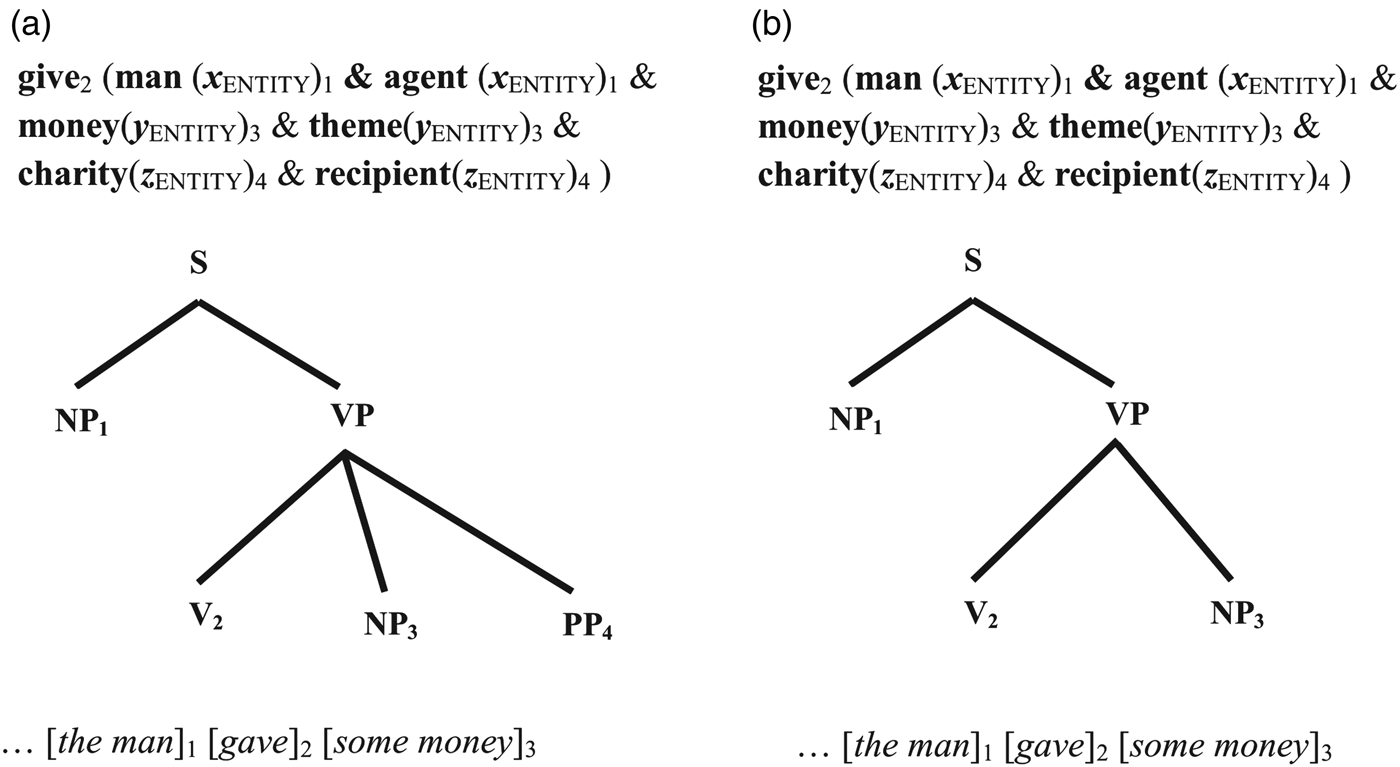



Target article
An experimental approach to linguistic representation
Related commentaries (30)
A usage-based cognitive linguistic (re-)interpretation of priming evidence
Acceptability judgments still matter: Deafness and documentation
Action sequences instead of representational levels
Can structural priming answer the important questions about language?
Considering experimental and observational evidence of priming together, syntax doesn't look so autonomous
Converging on a theory of language through multiple methods
Developmental psycholinguistics teaches us that we need multi-method, not single-method, approaches to the study of linguistic representation
Don't forget the neurobiology: An experimental approach to linguistic representation
Don't shoot the giant whose shoulders we are standing on
Horses for courses: When acceptability judgments are more suitable than structural priming (and vice versa)
If priming is graded rather than all-or-none, can reactivating abstract structures be the underlying mechanism?
Microscopic and macroscopic approaches to the mental representations of second languages
Moving beyond the priming of single-language sentences: A proposal for a comprehensive model to account for linguistic representation in bilinguals
On the nature of structure in structural priming
Priming is swell, but it's far from simple
Priming methods in semantics and pragmatics
Setting the empirical record straight: Acceptability judgments appear to be reliable, robust, and replicable
Structural priming can inform syntactic analyses of partially grammaticalized constructions
Structural priming is a useful but imperfect technique for studying all linguistic representations, including those of pragmatics
Structural priming is most useful when the conclusions are statistically robust
Structural priming is not a Royal Road to representations
Structural priming supports grammatical networks
Structural priming, action planning, and grammar
Syntactic levels, lexicalism, and ellipsis: The jury is still out
The limitations of structural priming are not the limits of linguistic theory
The logic of syntactic priming and acceptability judgments
The malleability of linguistic representations poses a challenge to the priming-based experimental approach
The relationship between priming and linguistic representations is mediated by processing constraints
The syntax of priming
What structural priming can and cannot reveal
Author response
Structural priming and the representation of language