




No CrossRef data available.
Article contents
Microscopic and macroscopic approaches to the mental representations of second languages
Published online by Cambridge University Press: 10 November 2017
Abstract
With a particular reference to second language (L2), we discuss (1) how structural priming can be used to tap into L2 representations and their relationships with first and target language representations; and (2) how complex networks additionally can be used to reveal the global and local patterning of L2 linguistic features and L2 developmental trajectories.
Information
- Type
- Open Peer Commentary
- Information
- Copyright
- Copyright © Cambridge University Press 2017
References
Borodkin, K., Kenett, Y. N., Faust, M. & Mashal, N. (2016) When pumpkin is closer to onion than to squash: The structure of the second language lexicon. Cognition
156:60–70.CrossRefGoogle ScholarPubMed
Cai, Z. G., Pickering, M. J. & Branigan, H. P. (2012) Mapping concepts to syntax: Evidence from structural priming in Mandarin Chinese. Journal of Memory and Language
66(4):833–49. doi:10.1016/j.jml.2012.03.009.CrossRefGoogle Scholar
Čech, R. & Mačutek, J. (2009) Word form and lemma syntactic dependency networks in Czech: A comparative study. Glottometrics
19:85–98.Google Scholar
Chan, A. Y. (2004) Syntactic transfer: Evidence from the interlanguage of Hong Kong Chinese ESL learners. Modern Language Journal
88:56–74.CrossRefGoogle Scholar
Chen, B., Jia, Y., Wang, Z. & Dunlap, S. (2013) Is word-order similarity necessary for cross-linguistic structural priming?
Second Language Research
29:375–89.CrossRefGoogle Scholar
Clahsen, H. & Felser, C. (2006) Grammatical processing in language learners. Applied Psycholinguistics
27(1):3–42. doi:10.1017/S0142716406060024.CrossRefGoogle Scholar
Cong, J. & Liu, H. (2014) Approaching human language with complex networks. Physics of Life Reviews
11(4):598–618.CrossRefGoogle ScholarPubMed
Corominas-Murtra, B., Valverde, S. & Solé, R. V. (2009) The ontogeny of scale-free syntax networks: Phase transitions in early language acquisition. Advances in Complex Systems
12:371–92.CrossRefGoogle Scholar
Eubank, L. (1996) Negation in early German-English interlanguage: More valueless features in the L2 initial state. Second Language Research
12(1):73–106.CrossRefGoogle Scholar
Ferrer i Cancho, R., Solé, R. V. & Köhler, R. (2004) Patterns in syntactic dependency networks. Physical Review E, 69:051915.CrossRefGoogle ScholarPubMed
Hartsuiker, R. J., Beerts, S., Loncke, M., Desmet, T. & Bernolet, S. (2016) Cross-linguistic structural priming in multilinguals: Further evidence for shared syntax. Journal of Memory and Language
90:14–30.CrossRefGoogle Scholar
Hartsuiker, R. J., Pickering, M. J. & Veltkamp, E. (2004) Is syntax separate or shared between languages? Cross-linguistic syntactic priming in Spanish-English bilinguals. Psychological Science
15(6):409–14. doi:10.1111/j.0956-7976.2004.00693.x.CrossRefGoogle ScholarPubMed
Ke, J. & Yao, Y. (2008) Analysing language development from a network approach. Journal of Quantitative Linguistics
15(1):70–99.CrossRefGoogle Scholar
Liu, H. (2009) Statistical properties of Chinese semantic networks. Chinese Science Bulletin
54:2781–85.CrossRefGoogle Scholar
Liu, H. & Li, W. W. (2010) Language clusters based on linguistic complex networks. Chinese Science Bulletin
55(30):3458–65.CrossRefGoogle Scholar
McDonough, K. & Mackey, A. (2006) Responses to recasts: Repetitions, primed production, and linguistic development. Language Learning
56(4):693–720. doi:10.1111/j.1467-9922.2006.00393.x.CrossRefGoogle Scholar
Mehler, A., Lücking, A., Banisch, S., Blanchard, P. & Job, B. (2015) Towards a theoretical framework for analyzing complex linguistic networks. Springer.Google Scholar
Rowland, C. F., Chang, F., Ambridge, B., Pine, J. M. & Lieven, E. V. M. (2012) The development of abstract syntax: Evidence from structural priming and the lexical boost. Cognition
125(1):49–63. doi:10.1016/j.cognition.2012.06.008.CrossRefGoogle ScholarPubMed
Siew, C. S. & Vitevitch, M. S. (2016) Spoken word recognition and serial recall of words from components in the phonological network. Journal of Experimental Psychology: Learning, Memory, and Cognition
42(3):394.Google ScholarPubMed
Steyvers, M. & Tenenbaum, J. B. (2005) The largescale structure of semantic networks: Statistical analyses and a model of semantic growth. Cognitive Science
29(1):41–78.CrossRefGoogle Scholar
Tomasello, M. (2000) Do young children have adult syntactic competence?
Cognition
74(3):209–53. Available at: https://doi.org/10.1016/S0010-0277(99)00069-4.CrossRefGoogle Scholar
Van Patten, B. (2014) The psycholinguistics of SLA. In: Research methods in second language psycholinguistics, ed. Jegerski, J. & VanPatten, B., pp. 1–19. Routledge.Google Scholar
Wilks, C. & Meara, P. (2002) Untangling word webs: Graph theory and the notion of density in second language word association networks. Second Language Research
18(4):303–24.CrossRefGoogle Scholar
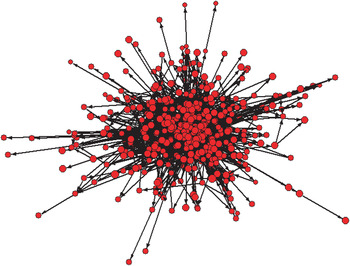
Figure 1. A syntactic network based on a 5000-word L2 text. Networks like this can be compared in terms of their parameters at different learning stages to reveal developmental trajectories, or the dynamic relations between L2 and L1 and between L2 and TL.
 You have
Access
One can draw methodological parallels between linguistics and astronomy in their development as scientific disciplines. Millennia of naked-eye astronomical observations (e.g., movement of stars) had advanced our understanding of the universe, but modern astronomy did not take off until the invention of the telescopes that allowed close (microscopic) examination of celestial bodies and mathematical formulations (e.g., gravitational attraction) that provided tools for large-scale (macroscopic) characterisation of stellar and galactic systems. Linguistics follows a similar track. Whereas decades, if not centuries, of intuitional data have offered deep insights into language, the availability of experimental and mathematical techniques has now afforded the opportunity to uncover the mental representations underlying language and to verify and advance existing intuition-based theories. In this sense, we applaud Branigan & Pickering (B&P) for their proposal to use structural priming to map out linguistic representations. In addition, we propose that mathematical tools such as complex networks allow us to unveil the laws governing the macroscopic patterning of language. In this commentary, we discuss how structural priming and complex networks can be used complementarily to approach our linguistic knowledge, with a particular reference to second language (L2) in adult learners.
The dominant view among L2 researchers is that learners' linguistic knowledge can be inferred from their grammaticality intuitions (using acceptability judgments), whereas psycholinguistic methods (e.g., eyetracking) merely capture language comprehension and production processes (e.g., VanPatten Reference Van Patten, Jegerski and VanPatten2014). However, as argued convincingly by B&P, acceptability judgement is a crude method susceptible to plausibility and processibility confounds and decisional biases (all the more so when judgements come for learners, as in L2 research). Further insight into L2 representations therefore requires more refined experimental methods. As B&P proposed, structural priming fits the niche as an implicit method that reflects representational similarity between the prime and the target. Indeed, much research in the past decade has employed structural priming to show that learners have integrated representations for similar constructions between their first language (L1) and L2 (Chen et al. Reference Chen, Jia, Wang and Dunlap2013; Hartsuiker et al. Reference Hartsuiker, Pickering and Veltkamp2004, Reference Hartsuiker, Beerts, Loncke, Desmet and Bernolet2016). Such integrated representations may reflect a strategy for efficient learning: When possible, an L2 construction co-opts an existing L1 representation. This, in turn, may account for the pervasiveness of L1 transfer in L2 (Chan Reference Chan2004; Eubank Reference Eubank1996).
Apart from revealing L1-L2 relationship, structural priming can be used to reveal the extent to which an L2 representation can be identified with its corresponding representation in the target language (TL). L2 learners, it was claimed, do not have as fully fledged syntactic representations as native speakers do (Clahsen & Felser Reference Clahsen and Felser2006). Such a claim can be tested using structural priming within L2. For example, Cai et al. (Reference Cai, Pickering and Branigan2012) showed that a dative sentence with a missing argument behaves similarly to its corresponding full-form sentence in priming dative sentences, suggesting that native speakers of Mandarin syntactically represent the missing argument even though it is not phonologically realised. If L2 speakers do not develop the same level of representational sophistication for missing-argument sentences, one would then expect reduced priming from a missing-argument dative compared to its full-form counterpart in L2. In addition, structural priming can be used to map out the developmental trajectory for syntactic constructions (McDonough & Mackey Reference McDonough and Mackey2006). It has been proposed that L2 learners initially develop item-specific structural representations and gradually transit to more abstract representations, as children do (Tomasello Reference Tomasello2000). If so, a syntactic structure should exhibit only lexically driven structural priming when initially learned and lexical-independent priming at a later stage (Rowland et al. Reference Rowland, Chang, Ambridge, Pine and Lieven2012).
Structural priming, however, is less useful when it comes to evaluating the L2 system at a macroscopic level (e.g., to what extent L2 syntax or lexicon resembles its TL or L1 counterpart), an issue that research using complex networks attempts to address. Network science treats language as a complex system at each level (e.g., lexicon, syntax, phonology), consisting of interconnected elements (e.g., concepts, words, phonemes) (see Fig. 1 for an example). Complex networks allow for the characterisations of these interconnections that are indicative of global and local patterning of linguistic elements (Cong & Liu Reference Cong and Liu2014; Mehler et al. Reference Mehler, Lücking, Banisch, Blanchard and Job2015). For example, one can examine the average distance among syntactic relations to determine the complexity of syntax, or examine the interconnectivity among lexical concepts to determine the structure of the lexico-semantic representations. Indeed, complex networks have been applied to phonology (Siew & Vitevitch Reference Siew and Vitevitch2016), morphology (Čech & Mačutek Reference Čech and Mačutek2009), lexico-semantics (Steyvers & Tenenbaum Reference Steyvers and Tenenbaum2005), syntax (Ferrer i Cancho et al. Reference Ferrer i Cancho, Solé and Köhler2004), semantics (Liu Reference Liu2009), language typology (Liu & Li Reference Liu and Li2010) and L1 acquisition (Ke & Yao Reference Ke and Yao2008; Corominas-Murtra et al. Reference Corominas-Murtra, Valverde and Solé2009). In theory, we can apply similar networks to L2 to explore how L2 is organized at these different levels. Borodkin et al. (Reference Borodkin, Kenett, Faust and Mashal2016) and Wilks & Meara (Reference Wilks and Meara2002), for example, used complex networks to show that lexico-semantic organization is less optimal (e.g., lexical concepts are clustered to a lesser extent into subcategories such as vegetables and fruits) in L2 than in L1. Apart from examining static patterns in L2, future work can also explore L2 as a dynamic system by constructing networks (e.g., of syntactic relations) at different time points of L2 learning; by examining the changes in the network parameters, one can explore the development of a particular L2 feature (e.g., syntax or morphology). By constructing similar cross-sectional networks, one also can map out the dynamic trajectory of L2 approximation to TL and L2 detachment from L1.
A syntactic network based on a 5000-word L2 text. Networks like this can be compared in terms of their parameters at different learning stages to reveal developmental trajectories, or the dynamic relations between L2 and L1 and between L2 and TL.
All in all, we believe the time has come to use structural priming to examine L2 mental representations, and complex networks to extract the underlying patterning of L2 linguistic features. Such a convergent approach, making use of both microscopic and macroscopic analysis of linguistic features, is important for constructing a theory of L2 representations and L2 acquisition, and indeed, a theory of linguistic knowledge in general.
ACKNOWLEDGMENT
Preparation of this manuscript was supported by an ESRC grant to Zhenguang G. Cai. (S/L010224/1).