






No CrossRef data available.
Article contents
Polygenic risk scores cannot make their mark on psychiatry without considering epigenetics
Published online by Cambridge University Press: 11 September 2023
Abstract
We generally agree with Burt's thesis. However, we note that the author did not discuss epigenetics, the study of how the environment can alter gene structure and function. Given epigenetic mechanisms, the utility of polygenic risk scores (PRS) is limited in studies of development and mental illness. Finally, in this commentary we expand upon the risks of reliance upon PRSs.
Information
- Type
- Open Peer Commentary
- Information
- Copyright
- Copyright © The Author(s), 2023. Published by Cambridge University Press
References
Auger, A. P., & Auger, C. J. (2011). Epigenetic turn ons and turn offs: Chromatin reorganization and brain differentiation. Endocrinology 152, 349–353. https://doi.org/10.1210/en.2010-0793CrossRefGoogle ScholarPubMed
Auger, A. P., & Auger, C. J. (2017). Epigenetic mechanisms shaping the brain: Implications for psychological science. In Call, J. (Ed.), APA handbook of comparative psychology, Vol. 1. Basic concepts: Methods, neural substrates, and behavior (pp. 449–471). American Psychological Association. https://doi.org/10.1037/0000011-022CrossRefGoogle Scholar
Auger, C. J., & Auger, A. P. (2013). Permanent and plastic epigenesis in neuroendocrine systems. Frontiers in Neuroendocrinology, 34, 190–197. https://doi.org/10.1016/j.yfrne.2013.05.003CrossRefGoogle ScholarPubMed
Bedrosian, T. A., Quayle, C., Novaresi, N., & Gage, F. H. (2018). Early life experience drives structural variation of neural genomes in mice. Science (New York, N.Y.), 359, 1395–1399.CrossRefGoogle ScholarPubMed
Cuarenta, A., Kigar, S. L., Henlon, I. C., Chang, L., Bakshi, V. P., & Auger, A. P. (2021). Early life stress during the neonatal period alters social play and LINE 1 during the juvenile stage of development. Scientific Reports, 11, 3549. https://doi.org/10.1038/s41598-021-82953-3CrossRefGoogle ScholarPubMed
Doyle, G. A., Crist, R. C., Karatas, E. T., Hammond, M. J., Ewing, A. D., Ferraro, T. N., … Berrettini, W. H. (2017). Analysis of LINE-1 elements in DNA from postmortem brains of individuals with schizophrenia. Neuropsychopharmacology, 42, 2602–2611. https://doi:10.1038/npp.2017.115CrossRefGoogle ScholarPubMed
Dworkin, R. H., Lewis, J. A., Cornblatt, B. A., & Erlenmeyer-Kimling, L. (1994). Social competence deficits in adolescents at risk for schizophrenia. The Journal of Nervous and Mental Disease, 182(2), 103–108.CrossRefGoogle ScholarPubMed
Glatt, S. J., Stone, W. S., Faraone, S. V., Seidan, L. J., & Tsuang, M. T. (2006). Psychopathology, personality traits and social development of young first-degree relatives of patients with schizophrenia: A meta-analysis. Neuroscience and Biobehavioral Reviews, 35, 573–588.Google Scholar
Gooding, D. C. (2022). Brave new world: Harnessing the promise of biomarkers to help solve the epigenetic puzzle. Schizophrenia Research, 242, 35–41. https://doi.org/10.1016/j.schres.2022.01.020CrossRefGoogle ScholarPubMed
Gooding, D. C., & Iacono, W. G. (1995). Schizophrenia through the lens of a developmental psychopathology perspective. In Cicchetti, D. & Cohen, D. J. (Eds.), Manual of developmental psychopathology, Vol. II. Risk, disorder, and adaptation (pp. 535–580). Wiley.Google Scholar
Gooding, D. C., Zahn-Waxler, C., Light, S. N., Kestenbaum, C. J., & Erlenmeyer-Kimling, L. (2018). Childhood affective indicators of risk for adulthood psychopathology: The New York high-risk project findings. Journal of Psychiatry and Brain Science, 3(3), 4. https://doi.org/10.20900/jpbs.20180004Google ScholarPubMed
Gottesman, I. I., Shields, J., & Hanson, D. R. (1982). Schizophrenia: The epigenetic puzzle. Cambridge University Press.Google Scholar
Jahangir, M., Li, L., Zhou, J.-S., Lang, B., & Wang, X.-P. (2022). L1 retrotransposons: A potential endogeneous regulator for schizophrenia. Frontiers in Genetics, 13, 878508. https://doi:10.3389/fgene.2022.878508CrossRefGoogle ScholarPubMed
Li, S., Yang, Q., Hou, Y., Jiang, T., Zong, L., Wang, Z., … Zhao, C. (2018). Hypomethylation of LINE-1 elements in schizophrenia and bipolar disorder. Journal of Psychiatric Research, 107, 68–72. https://doi.org/10.1016/j.jpsychires.2018.10.009CrossRefGoogle ScholarPubMed
Martin, A. R., Kanai, M., Kamatani, Y., Okada, Y., Neale, B. M., & Daly, M. J. (2019). Clinical use of current polygenic risk scores may exacerbate health disparities. Nature Genetics, 51, 584–591. https://doi.org/10.1038/s41588-019-0379-xCrossRefGoogle ScholarPubMed
Palk, A. C., Dalvie, S., de Vries, J., Martin, A. R., & Stein, D. J. (2019). Potential use of clinical polygenic risk scores in psychiatry – Ethical implications and communicating high polygenic risk. Philosophy, Ethics, and Humanities in Medicine, 14, 4. doi: doi.org/10.1186/s13010-019-0073-8CrossRefGoogle ScholarPubMed
Sandstrom, A., Sahiti, O., Pavlova, B., & Uher, R. (2019). Offspring of parents with schizophrenia, bipolar disorder, and depression: A review of familial high-risk and molecular genetics studies. Psychiatric Genetics, 29, 160–169. https://doi.or/10.1097/YPG.000000000000240CrossRefGoogle ScholarPubMed
Schiffman, S., Walker, E., Ekstrom, M., Schulsinger, F., Sorensen, H., & Mednick, S. (2004). Childhood videotaped social and neuromotor precursors of schizophrenia: A prospective investigation. American Journal of Psychiatry, 161, 2021–2027.CrossRefGoogle ScholarPubMed
Tandon, R., Nasrallah, H. A., & Keshavan, M. S. (2009). Schizophrenia, “just the facts” 4. Clinical features and conceptualization. Schizophrenia Research, 110, 1–23. https://doi.10.1016/j.schres.2009.03.005CrossRefGoogle Scholar
Torkamani, A., Wineinger, N. E., & Topol, E. J. (2018). The personal and clinical utility of polygenic risk scores. Nature Reviews, 19, 581–590. https://doi.org/10.1038/s41576-018-0018-xCrossRefGoogle ScholarPubMed
Yehuda, R., & Lehrner, A. (2018). Intergenerational transmission of trauma effects: Putative role of epigenetic mechanisms. World Psychiatry, 17, 243–257.CrossRefGoogle ScholarPubMed
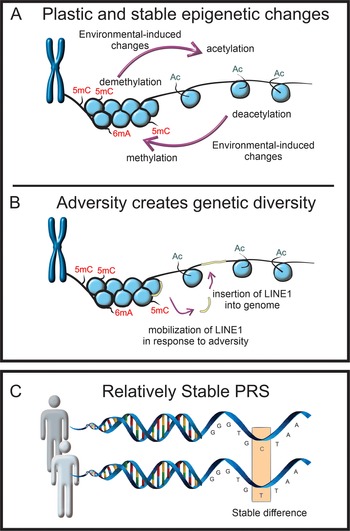
Figure 1. Schematic representation of how epigenetic modifications regulate gene expression. (A) Plastic and stable epigenetic changes. Environmental signals can alter DNA methylation patterns (e.g., methylation of cytosine or adenine; 5 mC and 6 mA, respectively), as well as modifications to histone (e.g., acetylation of histone tails; Ac) to impact gene expression. Generally, methylation of DNA decreases gene expression by tightening up chromatin making it inaccessible to transcription factors; whereas acetylation of histones changes the charge of histone–DNA interactions, loosening chromatin to allow DNA more assessable to transcription factors. These epigenetic modifications impacting gene expression can last hours, months, years, or be somewhat permanent. (B) Adversity creates genetic diversity. Cartoon depicting how adverse events can epigenetically modify chromatin, resulting in the activation and mobilization of the retrotransposable element, LINE 1. Once LINE 1 becomes active, it results in transcription of LINE 1 RNA, which produces critical proteins that aid its insertion back into the genome someplace else. These insertions result in increased genetic copy number of LINE 1 throughout the genome disrupting and altering gene expression in somewhat permanent ways impacting mental health and behavior. (C) Relatively stable polygenic risk scores (PRSs). This figure depicts how the individual variations in gene sequences are relatively stable, that is, not generally altered by changes in social or other environmental events even though health and behavioral consequences can be observed at individual or population levels because of modifications to the epigenome.
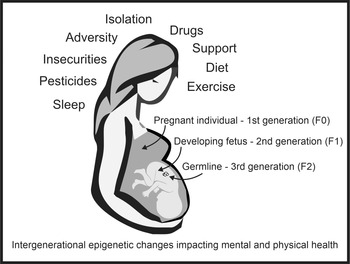
Figure 2. Intergenerational epigenetic changes impacting mental and physical health. A cartoon depicting how different experiences can impact the epigenome of an individual but also how these experiences can impact the epigenome of future generations. If the exposed individual (F0) is pregnant, the developing fetus (F1) is also exposed to the same events. Less considered is that in the developing F1 fetus, the germline (F2) for the subsequence generation is most likely formed and thereby is also exposed to the same perturbations. Thereby large-scale societal or individual events that impact our behavior are likely to persist in the epigenome for generations.
Target article
Related commentaries (24)
Beware of the phony horserace between genes and environments
Burt uses a fallacious motte-and-bailey argument to dispute the value of genetics for social science
Don't miss the chance to reap the fruits of recent advances in behavioral genetics
Increasing the use of functional and multimodal genetic data in social science research
Burt's target article had many strengths, including acknowledgment of the challenges associated with reliance upon polygenic risk scores (PRSs). We concur that sociogenomics cannot and should not occur without consideration of the environment. Although Burt raises the importance of the environment, she did not mention epigenetics. Indeed, epigenetics, the study of how the environment can alter gene structure and function, is important to acknowledge. Epigenetic processes involve any change to chromatin without necessarily changing the underlying DNA code (Auger & Auger, Reference Auger and Auger2011, Reference Auger and Auger2013; Cuarenta et al., Reference Cuarenta, Kigar, Henlon, Chang, Bakshi and Auger2021). Epigenetic modifications typically occur through DNA methylation, histone modification, or through regulation by noncoding RNA.
One can think of DNA methylation as making a mark, whereas DNA demethylation is removing a mark (see Fig. 1A; Auger & Auger, Reference Auger and Auger2013). These processes can be modified by environmental cues across development. Importantly, early life stress/adversity can have lasting consequences on DNA methylation, histone modifications, and noncoding RNA that can have a subtle or dramatic impact on an organism's health or behavior (Fig. 1B). Such a modification might occur early in life but not affect gene expression until later in life (Auger & Auger, Reference Auger, Auger and Call2017).
Schematic representation of how epigenetic modifications regulate gene expression. (A) Plastic and stable epigenetic changes. Environmental signals can alter DNA methylation patterns (e.g., methylation of cytosine or adenine; 5 mC and 6 mA, respectively), as well as modifications to histone (e.g., acetylation of histone tails; Ac) to impact gene expression. Generally, methylation of DNA decreases gene expression by tightening up chromatin making it inaccessible to transcription factors; whereas acetylation of histones changes the charge of histone–DNA interactions, loosening chromatin to allow DNA more assessable to transcription factors. These epigenetic modifications impacting gene expression can last hours, months, years, or be somewhat permanent. (B) Adversity creates genetic diversity. Cartoon depicting how adverse events can epigenetically modify chromatin, resulting in the activation and mobilization of the retrotransposable element, LINE 1. Once LINE 1 becomes active, it results in transcription of LINE 1 RNA, which produces critical proteins that aid its insertion back into the genome someplace else. These insertions result in increased genetic copy number of LINE 1 throughout the genome disrupting and altering gene expression in somewhat permanent ways impacting mental health and behavior. (C) Relatively stable polygenic risk scores (PRSs). This figure depicts how the individual variations in gene sequences are relatively stable, that is, not generally altered by changes in social or other environmental events even though health and behavioral consequences can be observed at individual or population levels because of modifications to the epigenome.
Another, more recent, mechanism for epigenetic modifications is via altered retrotransposon activity. Retrotransposons are autonomous elements capable of self-replication; long interspersed element 1 (LINE 1) is a retrotransposon present and presumably nonactive in humans, nonhuman primates, and rodents (Cuarenta et al., Reference Cuarenta, Kigar, Henlon, Chang, Bakshi and Auger2021). Using rats, Cuarenta et al. (Reference Cuarenta, Kigar, Henlon, Chang, Bakshi and Auger2021) demonstrated that exposure to early life stress (i.e., predator odor exposure) altered LINE 1 levels and copy number within a brain region critical for juvenile social play. This suggests that early life stress can actually result in changes to DNA sequences within the brain. Converging evidence from rodent and human postmortem studies indicates that an organism's experience can not only reshape the structure and function of DNA via epigenetic modifications, but can also result in changes to DNA sequences. The regulation of DNA sequences, structure, and function by our personal or social experiences across our lifespan is generally ignored in PRSs (Fig. 1C).
PRSs are calculated by adding up the cumulative effects of each risk allele (multiplied by the effect size of each variant) to provide an index of genetic risk for a given disease (Burt, target article; Palk, Dalvie, de Vries, Martin, & Stein, Reference Palk, Dalvie, de Vries, Martin and Stein2019; Torkamani, Wineinger, & Topol, Reference Torkamani, Wineinger and Topol2018). PRSs may have limited utility if they are unable to allow for epigenetic changes, in addition to the types of gene–environment interplay exemplified by gene–environment interactions (G × E).
That is, epigenetic mechanisms could influence the human neuroepigenome across time and/or at different stages across an individual's lifespan. Because of epigenetics, there is greater plasticity within our genome via alterations to the underlying DNA sequence itself in response to environmental challenges during development. There are stable epigenetic events (e.g., X inactivation and imprinting) as well as plastic epigenetic events (e.g., gene regulation). PRSs do not consider either type of event. PRSs are limited in accounting for the ways by which experience may induce variations in the genome sequence, such as gene × environment × time interactions, which are especially important in brain development (Auger & Auger, Reference Auger and Auger2013).
It is also important to consider the use of PRSs in psychiatry. When considering risks for psychiatric disorders, it is imperative that we also consider the developmental stage of the organism (Gooding & Iacono, Reference Gooding, Iacono, Cicchetti and Cohen1995). Moreover, sex differences in epigenetic mechanisms may underlie observed gender differences in prevalence, age of onset, and course of disorders such as schizophrenia and depression. PRS prediction may remain useful at the population level yet be unhelpful for assisting individuals in making predictions and prognoses. Below we use the example of schizophrenia, an exemplar of an epigenetic disorder (Gottesman, Reference Gottesman1991; Gottesman, Shields, & Hanson, Reference Gottesman, Shields and Hanson1982).
Schizophrenia is a genetically mediated neurodevelopmental disorder characterized by etiological and phenomenological heterogeneity (Gooding, Reference Gooding2022; Tandon, Nasrallah, & Keshavan, Reference Tandon, Nasrallah and Keshavan2009). Changes in LINE 1 DNA copy number have been implicated in schizophrenia (Bedrosian, Quayle, Novaresi, & Gage, Reference Bedrosian, Quayle, Novaresi and Gage2018; Doyle et al., Reference Doyle, Crist, Karatas, Hammond, Ewing, Ferraro and Berrettini2017; Jahangir, Li, Zhou, Lang, & Wang, Reference Jahangir, Li, Zhou, Lang and Wang2022; Li et al., Reference Li, Yang, Hou, Jiang, Zong, Wang and Zhao2018). Studies of offspring of schizophrenia patients (e.g., Dworkin, Lewis, Cornblatt, & Erlenmeyer-Kimling, Reference Dworkin, Lewis, Cornblatt and Erlenmeyer-Kimling1994; Glatt, Stone, Faraone, Seidan, & Tsuang, Reference Glatt, Stone, Faraone, Seidan and Tsuang2006; Gooding, Zahn-Waxler, Light, Kestenbaum, & Erlenmeyer-Kimling, Reference Gooding, Zahn-Waxler, Light, Kestenbaum and Erlenmeyer-Kimling2018; Schiffman et al., Reference Schiffman, Walker, Ekstrom, Schulsinger, Sorensen and Mednick2004) suggest that impaired social functioning and emotional withdrawal in mid-childhood are predictors of schizophrenia. Recall that LINE 1 perturbations are associated with reduced social play in juvenile rodents. At present, family history (i.e., having a first-degree relative with schizophrenia) remains a more powerful predictor than a PRS (Sandstrom, Sahiti, Pavlova, & Uher, Reference Sandstrom, Sahiti, Pavlova and Uher2019).
We also recognize the potential scientific costs of reliance upon PRSs given the limited ancestral data upon which genome-wide association studies (GWASs) are based. To date, the majority of GWASs are based upon populations of European ancestry. Environmental stressors may affect different ancestral groups differentially. The disproportionate representation of European ancestry groups limits the extent to which findings can be extrapolated, as genetic prediction accuracy is substantially lower for groups of non-European ancestry. Reliance on prediction scores that are less informative in already underrepresented groups such as those of African-descent only serves to further health and healthcare disparities (Martin et al., Reference Martin, Kanai, Kamatani, Okada, Neale and Daly2019; Palk et al., Reference Palk, Dalvie, de Vries, Martin and Stein2019; Torkamani et al., Reference Torkamani, Wineinger and Topol2018). Furthermore, evidence suggests that effects of environmental stressors may cause epigenetic changes that are inherited ancestrally, that is, adverse stimuli may directly affect the organism, their offspring prenatally, and future generations through epigenetic modification of the germ line (Auger & Auger, Reference Auger, Auger and Call2017; Yehuda & Lehrner, Reference Yehuda and Lehrner2018; see Fig. 2). If epigenetic mechanisms are involved in DNA perturbations that occur across generations, PRSs would be rendered less accurate.
Intergenerational epigenetic changes impacting mental and physical health. A cartoon depicting how different experiences can impact the epigenome of an individual but also how these experiences can impact the epigenome of future generations. If the exposed individual (F0) is pregnant, the developing fetus (F1) is also exposed to the same events. Less considered is that in the developing F1 fetus, the germline (F2) for the subsequence generation is most likely formed and thereby is also exposed to the same perturbations. Thereby large-scale societal or individual events that impact our behavior are likely to persist in the epigenome for generations.
In summary, we agree with Burt's conclusion that PRSs do not add much to our understanding of behavior in a social context. Although PRSs have some utility on a population level for predicting some health risks, we assert that reliance upon biomarkers, which can be accurately measured and reassessed following intervention, would be a more prudent guide for clinical, personal, or family decision making.
Financial support
The authors received no funding in connection with this commentary.
Competing interest
None.