







1 Introduction
The equal sum product problem concerns, among other questions, estimating the number of solutions
 $N_1(n)$
to the Diophantine equation
 $$ \begin{align} x_1+x_2+\cdots+x_n=x_1x_2\cdot\ldots\cdot x_n,\text{ where }\,x_1\ge x_2\ge\cdots\ge x_n\ge 1. \end{align} $$
The initial results can be found in [Reference Bukor, Filakovszky and Tóth2–Reference Guy4, Reference Kurlandchik and Nowicki6, Reference Zakarczemny17]. Schinzel asked in [Reference Schinzel12, Reference Schinzel13] whether
 $N_1(n)$
tends to infinity with n. For equation (1.1) and its solution
 $(x_1, x_2, \ldots , x_n)$
, several useful facts are known:
-
1)
 $x_1 \cdot \ldots \cdot x_n \le 2n,\,\,x_n \le n$
(see [Reference Kurlandchik and Nowicki6]).
-
2)
$x_{n-1} \le 1+\lfloor \sqrt {n - 1}\rfloor $
(see [Reference Sándor and Zakarczemny11]). -
3) If
$N_1(n)=1$
, then
$n-1$
is a Sophie Germain prime (see [Reference Nyblom8]). -
4)
$N_1(n) \le \binom {n+1}{2}$
(see [Reference Bukor, Filakovszky and Tóth2]). -
5) Let
$\varepsilon> 0$
, with the exception of the set of natural density zero, we have
$ (\log n)^{\log 2-\varepsilon }<N_1(n)<e^{2\sqrt {\log n}}\,\,\, $
(see [Reference Sándor and Zakarczemny11]). -
6) Let
$\varepsilon>0$
, there exists a constant
$C(\varepsilon )$
such that
$N_1(n)<n^{1+\varepsilon }$
for
$n\ge C(\varepsilon )$
(see [Reference Sándor and Zakarczemny11]). -
7) Let
$\varepsilon>0$
, there exist infinitely many n such that
$N_1(n)>n^{1-\varepsilon }$
(see [Reference Sándor and Zakarczemny11]).


Average asymptotic behavior was obtained by Weingartner (see [Reference Weingartner16]):
 $$ \begin{align*}\sum_{2\le n\le x}N_1(n)\sim\frac{xe^{2\sqrt{\log x}}}{2\sqrt{\pi} (\log x)^{3/4}}.\end{align*} $$
Hurwitz (see [Reference Hurwitz5]) studied the family of equations
 $x_1^2+x_2^2+\cdots +x_n^2=ax_1x_2\cdot \ldots \cdot x_n,$
where
 $a,n\in \mathbb {Z}^+$
and
 $n\ge 3$
. This case is different because of the quadratic form and the use of the Vieta jumping method.
An interesting generalization that preserves linearity but loses the symmetry of the sum is the equation of the form:
 $$ \begin{align*}c_1x_1+c_2x_2+\cdots+c_nx_n=ax_1x_2\cdot\ldots\cdot x_n,\end{align*} $$
with fixed a and
 $c_i$
, where
 $a,c_i,n\in \mathbb {Z}^+,n\ge 2.$
Let us now assume that
 $n~\in \mathbb {Z},\,n\ge 2,\,a>1.$
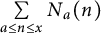
In this article, we provide the average asymptotic behavior
 $N_a(n),$
the number of integer solutions
 $(x_1,\,x_2,\ldots ,x_n)$
to the equation
 $$ \begin{align} x_1+x_2+\cdots+x_n=ax_1x_2\cdot\ldots\cdot x_n \end{align} $$
such that
 $x_1\ge x_2\ge \cdots \ge x_n\ge 1$
. A related equation was also investigated in [Reference Shiu14, Reference Takeda15]. It is worth noting that if equation (1.2) has solutions, then
 $n \ge a$
. In particular, we have
 $N_a(n)=0$
for
 $n<a$
. The article is organized as follows. First, in Section 2, we introduce several lemmas and remarks. Next, in Section 3, we establish the average asymptotic behavior of
 $N_a(n)$
, the number of integer solutions
 $(x_1,\ldots ,x_n)$
to equation (1.2), together with the resulting upper bound for
 $N_a(n)$
. Finally, we derive asymptotics for the sums
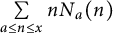
 $\sum \limits _{a\le n\le x} n\,N_a(n)$
and
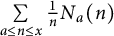
 $\sum \limits _{a\le n\le x} \frac {1}{n}\,N_a(n)$
, and for the Dirichlet convolution sums
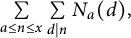
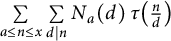
 $\sum \limits _{a\le n\le x}\sum \limits _{d\mid n} N_a(d)$
and
 $\sum \limits _{a\le n\le x}\sum \limits _{d\mid n} N_a(d)\,\tau \!\left (\frac {n}{d}\right )$
.
2 Preliminaries
In this section, we discuss the necessary basic results. First, we note an observation that if
 $n<a,$
then
 $N_a(n)=0$
. Thus, we may assume that
 $n\ge a$
.
Lemma 2.1 Let
 $(x_1,\ldots ,x_n)$
with
 $x_i\in \mathbb {Z}^+$
be a solution of (1.2), where
 $1<a\le n$
. Then:
-
(1)
$$ \begin{align*}\prod_{i=1}^{n} x_i \le \frac{n-1}{a-1}.\end{align*} $$
-
(2) If
$k=\lvert \{i: x_i>1\}\rvert \ge 2$
, then
$$ \begin{align*}\prod_{i=1}^{n} x_i \le \frac{n-2}{a-1}.\end{align*} $$


Proof For
 $i\le k,$
we have
 $x_i=y_i+1$
with
 $y_i\ge 1$
, and for
 $i>k,$
we have
 $x_i=1$
. Denote
 $$ \begin{align*}S=\sum_{i=1}^{k} y_i,\,\,P=\prod_{i=1}^{k}(y_i+1)=\prod_{i=1}^{n} x_i. \end{align*} $$
From equation (1.2), we have
 $aP=S+n$
. Expanding the product gives
 $P\ge 1+S.$
Thus,
 $P\ge 1+aP-n$
, hence, for
 $a>1,$
we obtain
 $P\le \frac {n-1}{a-1}$
.
Assume now that
 $k=|\{i: x_i>1\}|\ge 2$
.
Expanding the product gives
 $P\ge 1+S+S_2,$
where
 $S_2=\sum \limits _{1\le i<j\le k}y_iy_j\ge y_1y_2\ge 1.$
Hence,
 $n-(a-1)P=P-S\ge 1+S_2\ge 2.$
Therefore,
 $P\le \frac {n-2}{a-1}.$
Remark 2.2 If
 $k\ge 2$
, then equality
 $P= \frac {n-2}{a-1}$
holds exactly for
 $k=2$
,
 $y_1=y_2=1$
, that is, for the solution
 $(x_1, \ldots , x_n)=(2,2,1,\ldots ,1)$
. Then
 $P=4$
,
 $S=2$
, and from
 $aP=S+n,$
we get
 $n=4a-2$
, which gives
 $P=(n-2)/(a-1)$
.
Remark 2.3 It is also useful to know a bound for the product
 $\prod _{i=2}^{n}x_i$
, that is, the product excluding the largest term
 $x_1$
.
Assume
 $a>1$
and let
 $(x_1,\dots ,x_n)$
be a solution of
 $x_1+\cdots +x_n=a\,x_1\ldots x_n$
with
 $x_1\ge \cdots \ge x_n\ge 1$
. Set
 $Q=\prod _{i=2}^{n}x_i.$
If
 $k=\lvert \{i: x_i>1\}\rvert =1$
, then
 $Q=1$
. If
 $k\ge 2$
, then
 $P\le \frac {n-2}{a-1}$
and
 $x_1\ge 2$
, hence
 $ Q=\frac {P}{x_1}\le \frac {P}{2}\le \frac {n-2}{2(a-1)}.$
The bound is sharp: for
 $n=4a-2,$
the solution
 $(2,2,1,\dots ,1)$
gives
 $Q=2=\frac {n-2}{2(a-1)}$
.
3 Main results
We denote by
 $a_n$
the number of distinct unordered factorizations of the positive integer n into the factors larger than
 $1$
. Factorizations that differ only in the order of factors are considered the same. Let
 $f(x)=\sum _{2\le n\le x}a_n.$
It means that
 $$ \begin{align*}f(x)=\Big|\{(z_1,z_2,\ldots,z_k):z_1\ge z_2\ge\cdots\ge z_k\ge 2,\,z_i\in\mathbb{Z},\,k\in \mathbb{Z}^+,z_1z_2\cdot\ldots\cdot z_k\le x\}\Big|.\end{align*} $$
Oppenheim proved in [Reference Oppenheim9] that
 $$ \begin{align} f(x)\sim\frac{xe^{2\sqrt{\log x}}}{2\sqrt{\pi} (\log x)^{3/4}}. \end{align} $$
We begin with a lemma whose analog for the case
 $a=1$
was proved in [Reference Sándor and Zakarczemny10].
Lemma 3.1 Let
 $ x> a > 1 $
. We have
 $$ \begin{align*}1+f\left( \frac{x}{a} \right)< \sum_{a \le n \leq x} N_a(n) \le 1+f\left( \frac{x + \frac{x-1}{a-1}\,e^{-\sqrt{\log x}}}{a} \right) + \frac{x - 1}{a - 1} f\left( \left( \log_2 \frac{x - 1}{a - 1} \right) e^{\sqrt{\log x}} \right). \end{align*} $$
Proof If
 $x_1 + \cdots + x_n = ax_1 \cdot \ldots \cdot x_n, n \ge a>1,$
where
 $x_1 \ge x_2 \ge \cdots \ge x_k \ge 2,$
 $x_{k+1} = \cdots = x_n = 1,$
then
 $ax_1 \cdot \ldots \cdot x_k = x_1 + \cdots + x_k + n - k,$
that is,
 $n = ax_1 \cdot \ldots \cdot x_k - (x_1 + \cdots + x_k) + k.$
Note that
 $k=0$
is possible only when
 $n=a$
, and
 $N_a(a)=1$
. Therefore,
 $-1+\sum _{a\le n\le x}N_a(n)=\sum _{a<n\le x}N_a(n).$
Thus, we assume
 $k\ge 1$
and determine bounds for the sum
 $-1+\sum \limits _{a \le n \le x} N_a(n)$
. We have, for
 $n>a$
,
 $$ \begin{align*} N_a(n) = \Big| \{ (x_1, \ldots, x_k) : & \, x_1 \ge \cdots \ge x_k \ge 2, k \ge 1,\\ & ax_1 \cdot \ldots \cdot x_k - (x_1 + \cdots + x_k) + k = n \}\Big|. \end{align*} $$
Note that if
 $ax_1 \cdot \ldots \cdot x_k \leq x$
and
 $x_1 \ge x_2 \ge \cdots \ge x_k \ge 2,\,\,k\ge 1,\,\,a>1$
, then
 $$ \begin{align*}a \le ax_1 \cdot \ldots \cdot x_k - (x_1 + \cdots + x_k) + k \le x.\end{align*} $$
Hence,
 $$ \begin{align*} -1+\sum_{a \leq n \leq x} N_a(n)&=\Big|\{(x_1,\ldots,x_k): x_1\ge\cdots\ge x_k\ge 2,k\ge 1,\\& \hspace{2.8cm} a\le ax_1\cdot\ldots\cdot x_k-(x_1+\cdots+x_k)+k\le x\}\Big| \\&\ge \Big|\{(x_1,\ldots,x_k): x_1\ge x_2\ge\cdots\ge x_k\ge 2, k\ge 1,\,ax_1\cdot\ldots\cdot x_k\le x\}\Big|\\&=\left|\left\{(x_1,\ldots,x_k): x_1\ge x_2\ge\cdots\ge x_k\ge 2,\,k\ge 1,\,x_1\cdot\ldots\cdot x_k\le \frac{x}{a}\right\}\right|\\&\ge f(\frac{x}{a}). \end{align*} $$
We now prove the second inequality of the lemma.
If
 $x_1+\cdots + x_k<\frac {x-1}{a-1}\,e^{-\sqrt {\log x}}$
, then
 $ax_1\cdot \ldots \cdot x_k\le x+(x_1+\cdots +x_k)-k<x+\frac {x-1}{a-1}\,e^{-\sqrt {\log x}}$
.
Thus,
 $$ \begin{align*} \Big|\{(x_1,\dots,x_k):\, & x_1\ge\cdots\ge x_k\ge 2, k\ge 1,\\ & a\le a\,x_1\dots x_k-(x_1+\cdots+x_k)+k\le x,\\ & x_1+\cdots+x_k< \tfrac{x-1}{a-1}\,e^{-\sqrt{\log x}}\} \Big| \\[4pt] \le \Big|\{(x_1,\dots,x_k):\, & x_1\ge\cdots\ge x_k\ge 2, k\ge 1,\\ & x_1\dots x_k\le \tfrac{x+\frac{x-1}{a-1}\,e^{-\sqrt{\log x}}}{a}\}\Big| \le f\left(\tfrac{x+\frac{x-1}{a-1}\,e^{-\sqrt{\log x}}}{a}\right). \end{align*} $$
If
 $x_1+\cdots +x_n=ax_1\cdot \ldots \cdot x_n,\,x_1\ge \cdots \ge x_n\ge 1,\, x_i\in \mathbb {Z},$
then by Lemma 2.1,
 $x_1\cdot \ldots \cdot x_n\le \frac {n-1}{a-1}$
. It follows that
 $x_1\le x_1\cdot \ldots \cdot x_k=x_1\cdot \ldots \cdot x_n\le \frac {n-1}{a-1}\le \frac {x-1}{a-1}$
. Therefore, we have at most
 $\frac {x-1}{a-1}$
possibilities for
 $x_1$
. Note also that
 $2^k\le x_1\cdot \ldots \cdot x_k\le \frac {x-1}{a-1}$
implies
 $k\le \log _2{\frac {x-1}{a-1}}.$
If
 $x_1+\cdots +x_k\ge \frac {x-1}{a-1}\,e^{-\sqrt {\log x}},$
then
 $x_1\ge \tfrac {\frac {x-1}{a-1}\,e^{-\sqrt {\log x}}}{k}\ge \tfrac {\frac {x-1}{a-1}\,e^{-\sqrt {\log x}}}{\log _2{\frac {x-1}{a-1}}}$
. Thus,
 $$ \begin{align} x_2\cdot\ldots\cdot x_k\le \tfrac{\frac{x-1}{a-1}}{x_1}\le (\log_2{\tfrac{x-1}{a-1}})e^{\sqrt{\log x}}. \end{align} $$
Therefore, we have at most
 $f\left ( (\log _2{\tfrac {x-1}{a-1}})e^{\sqrt {\log x}}\right )$
possibilities for
 $(x_2,\ldots ,x_k)$
. Hence,
 $$ \begin{align*} &\hspace{0.5cm}\Big|\{(x_1,\ldots,x_k):\,x_1\ge \cdots x_k\ge 2,\,x_i\in\mathbb{Z},\,k\ge 1,\\&\hspace{2.9cm}a\le ax_1\cdot\ldots\cdot x_k-(x_1+\cdots+x_k)+k\le x,\\&\hspace{2.9cm}x_1+\cdots+x_k\ge \tfrac{x-1}{a-1}\,e^{-\sqrt{\log x}}\}\Big|\\ &\le \tfrac{x-1}{a-1}f\left( (\log_2{\tfrac{x-1}{a-1}})e^{\sqrt{\log x}}\right). \end{align*} $$
Thus,
 $-1+\sum _{a \le n \leq x} N_a(n) \le f\left ( \frac {x + \frac {x-1}{a-1}\,e^{-\sqrt {\log x}}}{a} \right ) + \frac {x - 1}{a - 1} f\left ( \left ( \log _2 \frac {x - 1}{a - 1} \right ) e^{\sqrt {\log x}} \right ).$
Theorem 3.2 Let
 $a>1$
be fixed. As
 $x\to \infty ,$
 $$ \begin{align*}S_a(x)=\sum_{a\le n\le x} N_a(n)\sim f \left(\tfrac{x}{a} \right) \sim\tfrac{1}{a}\tfrac{xe^{2\sqrt{\log x}}}{2\sqrt{\pi} (\log x)^{3/4}}.\end{align*} $$
Proof From Lemma 3.1, we have
 $$ \begin{align*}f\left(\tfrac{x}{a}\right)<S_a(x)-1\le f\left(\frac{x+\frac{x-1}{a-1}\,e^{-\sqrt{\log x}}}{a}\right)+\tfrac{x-1}{a-1} f\left( (\log_2{\tfrac{x-1}{a-1}})e^{\sqrt{\log x}}\right). \end{align*} $$
We have
 $x+\frac {x-1}{a-1}\,e^{-\sqrt {\log x}} \sim x.$
Using Oppenheim’s asymptotic formula,
 $f(u)\sim \frac {u\,e^{2\sqrt {\log u}}}{2\sqrt {\pi }\,(\log u)^{3/4}}.$
We obtain, as
 $x\to \infty ,$
 $$ \begin{align*}f\left(\frac{x+\frac{x-1}{a-1}\,e^{-\sqrt{\log x}}}{a}\right)\sim f\left(\frac{x}{a}\right). \end{align*} $$
The second term on the right-hand side is negligible. Indeed, we denote
 $$ \begin{align*}w(x)=(\log_2\tfrac{x-1}{a-1})e^{\sqrt{\log x}}. \end{align*} $$
Then
 $\log w(x)\sim \sqrt {\log x}+\log \log x$
and
 $\sqrt {\log w(x)}\sim (\log x)^{1/4}$
. A direct application of the asymptotic for f gives
 $ \lim \limits _{x\to \infty } \frac {\frac {x-1}{a-1}\,f\bigl (w(x)\bigr )}{f\left (\frac {x}{a}\right )}=0. $
From these estimates and the two-sided inequality, we get
 $ S_a(x)\sim f \left (\frac {x}{a}\right ). $
Finally, by Oppenheim’s asymptotic formula,
 $f\left (\frac {x}{a}\right ) \sim \frac {1}{a}f(x),$
since
 $ \lim \limits _{x\to \infty } \frac {e^{2\sqrt {\log (x/a)}}(\log x)^{3/4}} {e^{2\sqrt {\log x}}(\log (x/a))^{3/4}} =1.$
Remark 3.3 Together with the result of Weingartner (see [Reference Weingartner16]), this implies that for
 $a \ge 1,$
we have
 $$ \begin{align*}S_a(x)=\sum_{a\le n\le x} N_a(n)\sim\tfrac{1}{a}\tfrac{xe^{2\sqrt{\log x}}}{2\sqrt{\pi} (\log x)^{3/4}}.\end{align*} $$
Note that one can try to estimate the approximation error by using the error estimate for
 $f(x)$
(see [Reference Oppenheim9]).
Corollary 3.4 Fix
 $a>1$
. For every
 $\varepsilon>0,$
there exists an integer
 $C(\varepsilon ,a)$
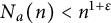
such that
 $$ \begin{align*}N_a(n)<n^{1+\varepsilon}\,\,\,\text{for all }n\ge C(\varepsilon,a). \end{align*} $$
Proof By Theorem 3.2, as
 $x\to \infty $
, we have
 $ S_a(x)\sim \frac {x}{a}\,\frac {e^{2\sqrt {\log x}}}{2\sqrt {\pi }\,(\log x)^{3/4}}. $
Hence, there exist
 $x_0(a)$
and
 $C_a>0,$
depending only on a, such that for all
 $x\ge x_0(a)$
,
 $$ \begin{align} S_a(x)\le C_a\frac{xe^{2\sqrt{\log x}}}{(\log x)^{3/4}}. \end{align} $$
Fix
 $\varepsilon>0$
. Choose
 $C(\varepsilon ,a)\ge x_0(a)$
so large that for all
 $x\ge C(\varepsilon ,a)$
, we have
 $$ \begin{align*}C_a\,x\,\frac{e^{2\sqrt{\log x}}}{(\log x)^{3/4}}\le x^{1+\varepsilon}.\end{align*} $$
Since, for any integer
 $x,$
we have
 $N_a(x)\le S_a(x)$
, it follows that
 $N_a(x)<x^{1+\varepsilon }$
for all
 $x\ge C(\varepsilon ,a)$
.
To prove the next lemma, we use a standard method. From an upper bound for the average size of an arithmetic function, we show that very large values occur only on a set of natural density zero.
Lemma 3.5 Let
 $a>1$
be fixed and let
 $h:[2,\infty )\to (0,\infty )$
be nondecreasing. Assume
 $$ \begin{align} \lim_{x\to\infty}h\left(\tfrac{x}{\log x}\right)^{-1}\frac{e^{2\sqrt{\log x}}}{(\log x)^{3/4} }=0. \end{align} $$
Define
 $E_h(x)=\{n\in \mathbb {Z}_{\ge a}:n\le x, N_a(n)\ge h(n)\}$
. Then for all sufficiently large x,
 $$ \begin{align} \frac{|E_h(x)|}{x} \le \frac{1}{\log x} + C_a\,h(\tfrac{x}{\log x})^{-1}\frac{e^{2\sqrt{\log x}}}{(\log x)^{3/4} }, \end{align} $$
for some constant
 $C_a>0$
.
The set
 $\{n:\,\, N_a(n)\ge h(n)\}$
has natural density
 $0$
.
Proof Let, as before,
 $S_a(x)=\sum _{a\le n\le x}N_a(n)$
. Since h is nondecreasing,
 $$ \begin{align*}S_a(x)\ge\sum_{n\in E_h(x)\cap[\frac{x}{\log x}, x]}N_a(n) \ge \sum_{n\in E_h(x)\cap[\frac{x}{\log x}, x]}h(n) \ge \left(|E_h(x)|-\tfrac{x}{\log x}\right)\,h(\tfrac{x}{\log x}). \end{align*} $$
From (3.3), it follows that, for sufficiently large x,
 $$ \begin{align*}\left(|E_h(x)|-\tfrac{x}{\log x}\right)\,h(\tfrac{x}{\log x})\le C_a\,\frac{x\,e^{2\sqrt{\log x}}}{(\log x)^{3/4}}. \end{align*} $$
Dividing by x gives (3.5). The limit (3.4) implies that
 $\lim \limits _{x\to \infty }\frac {|E_h(x)|}{x}=0$
.
Remark 3.6 The assumption (3.4) holds, for example, in each of the following cases:
-
(1)
$h(x)=\tfrac {e^{2\sqrt {\log x}}}{(\log x)^{3/4}}\,L(x)$
with
$\lim \limits _{x\to \infty }L(x)=\infty $
and
$\lim \limits _{x\to \infty }\frac {L(\frac {x}{\log x})}{L(x)}=1$
; -
(2)
$h(x)=\frac {e^{2\sqrt {\log x}}}{(\log x)^{\gamma }}$
with any
$\gamma <3/4$
; -
(3)
$h(x)=e^{(2+\eta )\sqrt {\log x}}$
with any
$\eta>0$
.


In particular, the set
 $\left\{n:\,\, N_a(n)\ge \frac {e^{2\sqrt {\log n}}}{(\log n)^{\gamma }}\right\}$
with any fixed
 $\gamma <3/4$
has natural density
 $0$
.
Corollary 3.7 Except for a set of natural density
 $0$
, for any
 $\gamma <3/4,$
the inequality holds:
 $$ \begin{align*}N_a(n)\le \frac{e^{2\sqrt{\log n}}}{(\log n)^{\gamma}}.\end{align*} $$
Theorem 3.8 Let
 $a\in \mathbb {Z}^{+}$
and
 $ L_a(x)=\sum _{a\le n\le x} n\,N_a(n). $
Then for every
 $x\ge a$
,
 $$ \begin{align} L_a(x)=xS_a(x)-\sum_{a\le n\le x-1} S_a(n). \end{align} $$
Moreover, as
 $x\to \infty $
,
 $$ \begin{align*}L_a(x)\sim \frac{1}{4\sqrt{\pi}\,a}\cdot \frac{x^{2}\,e^{2\sqrt{\log x}}}{(\log x)^{3/4}}. \end{align*} $$
Proof The identity (3.6) follows directly from [Reference Nathanson7, Theorem 6.8] on partial summation:
 $$ \begin{align*}\sum_{n=a}^{x} f(n)g(n) = F(x)g(x)-F(a-1)g(a) - \sum_{n=a}^{x-1} F(n)\bigl(g(n+1)-g(n)\bigr), \end{align*} $$
where  , and
 $F(u)=S_a(u).$
Denote
 $k(x)=\frac {e^{2\sqrt {\log x}}}{(\log x)^{3/4}}$
. Then
 $(x+1)^2k(x+1)-x^2k(x)=2xk(x)(1+\varepsilon (x))$
, where
 $\varepsilon (x)=o(1)$
. By the Stolz–Cesàro theorem and from Theorem 3.2, we have
 $$ \begin{align*}\lim_{x\to\infty}\frac{\sum\limits_{a\le n\le x-1} S_a(n)}{x^2k(x)} =\lim_{x\to\infty}\frac{\sum\limits_{a\le n\le x} S_a(n)-\sum\limits_{a\le n\le x-1} S_a(n)}{(x+1)^2k(x+1)-x^2k(x)}\end{align*} $$
 $$ \begin{align*}=\lim_{x\to\infty}\frac{S_a(x)}{2xk(x)}\cdot\frac{1}{1+\varepsilon(x)}=\frac{1}{4\sqrt{\pi}a}. \end{align*} $$
Therefore,
 $$ \begin{align*}\sum_{a\le n\le x-1} S_a(n)\sim \frac{1}{4\sqrt{\pi}\,a}\cdot \frac{x^{2}e^{2\sqrt{\log x}}}{(\log x)^{3/4}}. \end{align*} $$
Since
 $xS_a(x)\sim \frac {1}{2\sqrt {\pi }\,a}\cdot \frac {x^{2}e^{2\sqrt {\log x}}}{(\log x)^{3/4}}$
, then from (3.6), we get
 $ L_a(x) \sim \frac {1}{4\sqrt {\pi }\,a}\cdot \frac {x^{2}e^{2\sqrt {\log x}}}{(\log x)^{3/4}}. $
Theorem 3.9 Let
 $a \in \mathbb {Z}^{+}$
and
 $ H_a(x)=\sum _{a\le n\le x}\frac {1}{n}\,N_a(n). $
Then for every
 $x\ge a$
,
 $$ \begin{align} H_a(x)=\frac{S_a(x)}{x}+\sum_{a\le n\le x-1}\frac{S_a(n)}{n(n+1)}. \end{align} $$
Moreover, as
 $x\to \infty $
,
 $$ \begin{align} H_a(x)\sim \frac{1}{a}\cdot \frac{e^{2\sqrt{\log x}}}{2\sqrt{\pi}\,(\log x)^{1/4}}. \end{align} $$
Proof The identity (3.7) follows directly from [Reference Nathanson7, Theorem 6.8] on partial summation:
 $$ \begin{align*}\sum_{n=a}^{x} f(n)g(n) = F(x)g(x)-F(a-1)g(a) - \sum_{n=a}^{x-1} F(n)\bigl(g(n+1)-g(n)\bigr), \end{align*} $$
where  , and
 $F(u)=S_a(u).$
We obtain
 $$ \begin{align*}H_a(x)-\frac{S_a(x)}{x}=\sum_{a\le n\le x-1}\frac{S_a(n)}{n(n+1)}.\end{align*} $$
By Theorem 3.2, we have
 $S_a(n)=O\left (\frac {ne^{2\sqrt {\log n}}}{(\log n)^{3/4}}\right )$
. Thus,
 $$ \begin{align*}H_a(x)&=\frac{S_a(x)}{x}+ \sum_{\log{x}\le n\le x-1}\frac{S_a(n)}{n(n+1)}+O\left(\sum_{a\le n\le \log{x}}\frac{e^{2\sqrt{\log n}}}{n(\log n)^{3/4}}\right)\\&=\frac{S_a(x)}{x}+\sum_{\log{x}\le n\le x-1}\frac{S_a(n)}{n(n+1)}+O\left(\sum_{a\le n\le \log{x}}\frac{1}{\sqrt{n}}\right)\\&=\frac{S_a(x)}{x}+\sum_{\log{x}\le n\le x-1}\frac{S_a(n)}{n(n+1)}+O\left(\sqrt{\log{x}}\right)\\&=\sum_{\log{x}\le n\le x-1}\frac{S_a(n)}{n(n+1)}+O\left(\frac{e^{2\sqrt{\log x}}}{(\log x)^{3/4}}\right). \end{align*} $$
When x tends to infinity, the lower summation index
 $\log x$
also tends to infinity. Therefore, we may apply the asymptotics of
 $S_a(x)\sim \frac {1}{a}\cdot \frac {x\,e^{2\sqrt {\log x}}}{2\sqrt {\pi }(\log x)^{3/4}}$
to the sum
 $$ \begin{align*}\sum_{\log{x}\le n\le x-1}\frac{S_a(n)}{n(n+1)} \sim \frac{1}{2\sqrt{\pi}a}\sum_{\log{x}\le n\le x-1}\frac{e^{2\sqrt{\log n}}}{(n+1)(\log n)^{3/4}}.\end{align*} $$
From [Reference Nathanson7, Theorem 6.3] for decreasing function, taking care of the proper estimation of the boundary terms of the sum, we obtain
 $$ \begin{align*}\sum_{\log{x}\le n\le x-1}\frac{e^{2\sqrt{\log n}}}{(n+1)(\log n)^{3/4}}\sim \int_{\log{x}}^{x-1}\frac{e^{2\sqrt{\log t}}}{(t+1)(\log t)^{3/4}}dt\sim \frac{e^{2\sqrt{\log x}}}{(\log x)^{1/4}}.\end{align*} $$
Thus,
 $H_a(x)\sim \frac {e^{2\sqrt {\log x}}}{2\sqrt {\pi }a(\log x)^{1/4}}.$
Remark 3.10 Let us note that
 $H_a(e^x)=\sum _{a\le n\le e^x} \tfrac {1}{n}N_a(n)\sim \tfrac {1}{2\sqrt {\pi }a}x^{-1/4}e^{2\sqrt {x}}.$
A curious observation is that the above asymptotic form implies that the function
 $H_a(e^x)$
satisfies Benford’s law. For this purpose, it suffices to verify the sufficient condition with
 $h=1$
(see [Reference Anderson, Rolen and Stoehr1, Definition]). The fact that
 $H_a(e^x)$
satisfies Benford’s law means that the distribution of its leading significant digit is given by
 $\log _{10}\left (1+\frac {1}{d}\right ), d \in \{1,\ldots ,9\}.$
In particular, the digit
 $1$
appears as the leading significant digit about
 $30.1\%$
of the time, while the digit
 $9$
occurs with probability less than
 $5\%$
.
Finally, we study the Dirichlet convolution of
 $N_a$
, namely,
 $N_a * \mathbf {1}$
, where
 $\mathbf {1}(n)\equiv 1$
, and also the convolution
 $N_a * \tau $
, where
 $\tau (n)=\sum _{d\mid n}1$
is the divisor function.
Theorem 3.11 Let
 $a,n\in \mathbb {Z}^{+},\,n\ge 2,$
and
 $D_a(n)=\sum _{d\mid n} N_a(d). $
Then, as
 $x\to \infty ,$
we have
 $$ \begin{align*}\sum_{a\le n\le x} D_a(n) \sim\frac{1}{a}\,\frac{x\,e^{2\sqrt{\log x}}}{2\sqrt{\pi}\,(\log x)^{1/4}}. \end{align*} $$
Proof Since
 $N_a(n)=0$
for
 $n<a$
, we get
 $D_a(n)=0$
for
 $n<a$
. We have
 $$ \begin{align*} \sum_{a\le n\le x} D_a(n) &=\sum_{n\le x} D_a(n)=\sum_{n\le x}\sum_{d\mid n} N_a(d) =\sum_{d\le x} N_a(d)\sum_{\substack{n\le x\\ d\mid n}}1 =\sum_{d\le x} N_a(d)\Big\lfloor\frac{x}{d}\Big\rfloor\\ &=\sum_{a\le d\le x} N_a(d)\Big\lfloor\frac{x}{d}\Big\rfloor = x\sum_{a\le d\le x}\frac{N_a(d)}{d} -\sum_{a\le d\le x} N_a(d)\Big\{\frac{x}{d}\Big\}. \end{align*} $$
By Theorem 3.9, we have
 $$ \begin{align*}x\sum_{a\le d\le x}\frac{N_a(d)}{d}=xH_a(x)\sim\frac{1}{a}\,\frac{x\,e^{2\sqrt{\log x}}}{2\sqrt{\pi}\,(\log x)^{1/4}}. \end{align*} $$
For the remainder, since
 $0\le \{x/d\}\le 1$
, and by Remark 3.3,
 $$ \begin{align*}0\le \sum_{a\le d\le x} N_a(d)\Big\{\frac{x}{d}\Big\}\le \sum_{a\le d\le x} N_a(d)=S_a(x)=O\left(\frac{1}{a}\,\frac{x\,e^{2\sqrt{\log x}}}{2\sqrt{\pi}\,(\log x)^{3/4}}\right).\\[-34pt] \end{align*} $$
Theorem 3.12 Let
 $a,n\in \mathbb {Z}^{+},\,n\ge 2,$
and
 $T_a(n)=(N_a*\tau )(n)=\sum _{d\mid n} N_a(d)\,\tau \!\left (\frac {n}{d}\right ).$
Then, as
 $x\to \infty ,$
we have
 $ \sum \limits _{a\le n\le x} T_a(n)=O\left (x\,e^{2\sqrt {\log x}}(\log x)^{3/4}\right ). $
Proof As
 $N_a(n)=0$
for
 $n<a$
, it follows that
 $T_a(n)=0$
for
 $n<a$
. Thus,
 $$ \begin{align*}\sum_{a\le n\le x}T_a(n)=\sum_{n\le x}T_a(n) =\sum_{n\le x}\sum_{d\mid n}N_a(d)\,\tau\!\left(\frac{n}{d}\right) =\sum_{d\le x}N_a(d)\sum_{m\le x/d}\tau(m). \end{align*} $$
We have
 $\sum _{m\le y}\tau (m)=O(y\log y),$
hence,
 $$ \begin{align*} \sum_{a\le n\le x}T_a(n) &=O\left(\sum_{d\le x}N_a(d)\left(\tfrac{x}{d}\log\tfrac{x}{d}\right)\right) =O\left(x \log x\sum_{d\le x}\tfrac{N_a(d)}{d}\right)\\&=O\left(x\log x H_a(x)\right)=O\left(x\,e^{2\sqrt{\log x}}(\log x)^{3/4}\right).\\[-34pt] \end{align*} $$



