






No CrossRef data available.
Article contents
Do nonlinguistic creatures deploy mental symbols for logical connectives in reasoning?
Published online by Cambridge University Press: 28 September 2023
Abstract
Some nonlinguistic systems of representation display some of the six features of a language-of-thought (LoT) delineated by Quilty-Dunn et al. But they conjecture something stronger: That all six features cooccur homeostatically in nonlinguistic thought. Here I argue that there is no good evidence for nonlinguistic deductive reasoning involving the disjunctive syllogism. Animals and prelinguistic children probably do not make logical inferences.
Information
- Type
- Open Peer Commentary
- Information
- Copyright
- Copyright © The Author(s), 2023. Published by Cambridge University Press
References
Cesana-Arlotti, N., Martin, A., Teglas, A., Vorobyova, L., Cetnarski, R., & Bonatti, L. L. (2018). Precursors of logical reasoning in preverbal human infants. Science (New York, N.Y.), 359, 1263–1266.10.1126/science.aao3539CrossRefGoogle ScholarPubMed
de Carvalho, A., Crimon, C., Barrault, A., Trueswell, J., & Cristophe, A. (2021). “Look. It is not a bamoule”: 18- and 24-month-olds can use negative sentences to constrain their interpretation of novel word meanings. Developmental Science, 24(4), e13085.10.1111/desc.13085CrossRefGoogle ScholarPubMed
Engelmann, J., Haux, L., Völter, C. J., Call, J., Rakoczy, H., Herrmann, E., & Schleihauf, H. (2022). Do chimpanzees reason logically? Child Development , 94, 1–15. https://doi.org/10.1111/cdev.13861Google ScholarPubMed
Engelmann, J., Volter, C. J., O'Madagain, C., Prot, M., Haun, D. B., Rakoczy, H., & Herrmann, E. (2021). Chimpanzees consider alternative possibilities. Current Biology, 32, R1–R3.Google Scholar
Feiman, R., Carey, S., & Cushman, F. (2015). Infants representations of others’ goals: Representing approach over avoidance. Cognition, 136, 204–214.10.1016/j.cognition.2014.10.007CrossRefGoogle ScholarPubMed
Feiman, R., Mody, S., & Carey, S. (2022). The development of reasoning by exclusion in infancy. Cognitive Psychology, 135, 101473, 1–20.10.1016/j.cogpsych.2022.101473CrossRefGoogle ScholarPubMed
Ferrigno, S., Huang, Y., & Cantlon, J. F. (2021). Reasoning through the disjunctive syllogism in mondeys. Psychological Science, 32, 292–300.10.1177/0956797620971653CrossRefGoogle Scholar
Fisher, C., Jin, K., & Scott, R. M. (2019). The developmental origins of syntactic bootstrapping. Topics in Cognitive Science, 12, 48–77.10.1111/tops.12447CrossRefGoogle ScholarPubMed
Leahy, B., Huemer, M., Steele, M., Alderette, S., & Carey, S. (2022). Minimal representations of possibility at age 3. Proceedings of the National Academy of Sciences of the United States of America, 119, e2207499119.Google ScholarPubMed
Mody, S., & Carey, S. (2016). The emergence of reasoning by the disjunctive syllogism in early childhood. Cognition, 154, 40–48.10.1016/j.cognition.2016.05.012CrossRefGoogle ScholarPubMed
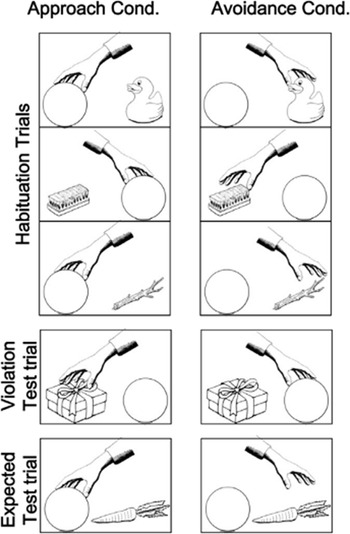
Figure 1. During habituation in the approach condition, an agent repeatedly reaches for A (a ball in this example) over B, C, D,…. In the avoidance condition the agent repeatedly reaches for whatever is not A (here, a duck, a brush, a stick, a present, a carrot, etc.). The test trials establish that the child extends this pattern to a new pair A X, for example, a ball and a car, generalizing habituation when the agent's action matches the pattern seen up to then (i.e., reaching to the ball in the approach condition and reaching to the car in the avoidance condition) and recovering interest if the agent's action violates the pattern (from Feiman, Carey, & Cushman, 2015).
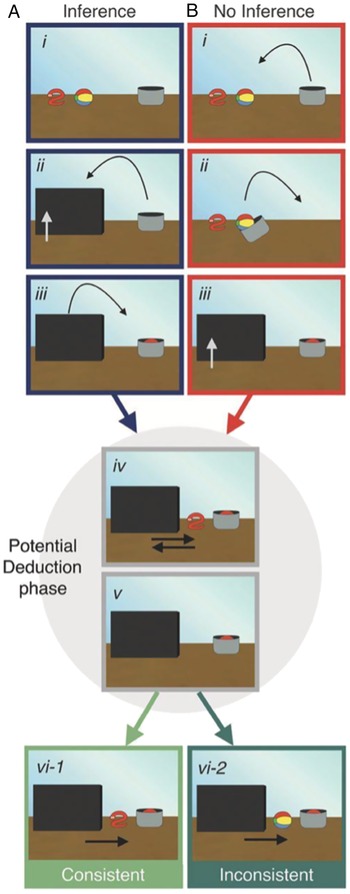
Figure 2. Cesana-Arlotti et al.'s (2018) object disambiguation paradigm. Focus on inference condition (A): During the setup, the child sees a ball and a snake on the stage, these are occluded, and a cup swoops in and picks up one of them (unknown which one). In the potential deduction phase, one of the objects comes out from behind the screen and returns (here the snake). During the test phase, the child recovers interest either if the ball emerges from behind the occluder (shown here, inconsistent event) or if the snake is revealed in the cup (not shown here, but the inconsistent event for another group of infants). (B): in the No Inference condition, not discussed here, the child knows where the snake and the ball are from the beginning of the experiment.
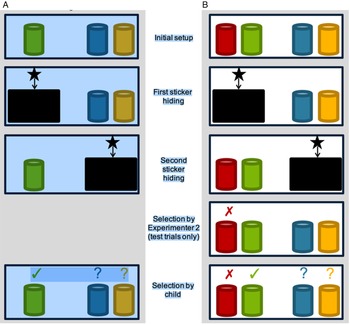
Figure 3. (A) Three-cup procedure; child has one choice to obtain a sticker. The green cup is certain to have a prize; a prize can be in either the blue or yellow cup. (B) Four-cup procedure; the child again has one choice to obtain a sticker, and again a prize can be in either the blue or yellow cup, whereas the green cup is certain to contain a prize if the child can eliminate the possibility of red's containing a sticker upon seeing the red cup is empty. The pattern of response that maximizes reward is to always choose the green cup in both three- and four-cup trials.
Target article
Related commentaries (30)
Language-of-thought hypothesis: Wrong, but sometimes useful?
Neither neural networks nor the language-of-thought alone make a complete game
In the landmark target article, Quilty-Dunn et al. establish that object perception and visual working memory both display some of their six features of a language-of-thought (LoT). Nonetheless, I believe evidence to date fails to make a convincing case for predicate–argument structure and logical connectives in nonlinguistic thought. Here, I examine Quilty-Dunn et al.'s evidence for nonverbal disjunctive syllogism inferences.
Who counts as prelinguistic? Children master the basic argument structure of English sentences between 12 and 15 months of age (Fisher, Jin, & Scott, Reference Fisher, Jin and Scott2019). For French and Hungarian, children have mastered the logical meanings of words for “not” and “no” at least by 17 or 18 months of age (e.g., de Carvalho, Crimon, Barrault, Trueswell, & Cristophe, Reference de Carvalho, Crimon, Barrault, Trueswell and Cristophe2021). So only children under 17 months of age can be safely considered prelinguistic with respect to propositional representations and negation.
What counts as a mental symbol for disjunction or negation? The numerical content in visual working memory models of small sets of explicitly represented individuals, which support 1–1 correspondence operations is implicit. Concepts can also be “proto” or “precursor” versions of later emerging ones, expressing part of some target logical function, but not the whole function (as analog number representations are proto-integer concepts).
All animal thought is nonlinguistic. Regarding the disjunctive syllogism, Quilty-Dunn et al. appeal first to Call's two-cup task, which is solved by some individuals of many species. However, except for adult great apes, often half or more of individuals tested fail even after hundreds of trials of training (e.g., Ferrigno, Huang, & Cantlon, Reference Ferrigno, Huang and Cantlon2021). Prelinguistic infants (i.e., 15-month olds) all dramatically fail the two-cup task. When asked to “find the toy,” they choose the empty container 50% of the time, failing to eliminate an option upon learning it is empty (a contrary of containing the reward) or upon learning that it does not contain the hidden reward. Importantly, control experiments showed that the 15-month olds were not confused by the actions that revealed one container empty, had not forgotten the reward, and wanted it. Further, the literature on 10- to 12-month olds’ working memory argues against other plausible hypotheses about task demands that might be masking competence. In contrast, 17-month olds succeeded, needing no training, at which age they show a domain-general capacity to eliminate options in indirect screening off trials in causal reasoning as well (Feiman, Mody, & Carey, Reference Feiman, Mody and Carey2022). But 17-month olds are not prelinguistic creatures.
There is convergent evidence for the absence of negation in prelinguistic human thought (Fig. 1). Fourteen-month-old infants learn that the agent likes or wants A in the approach condition, but fail to learn the agent does not like A, or wants anything that is not A in the avoidance condition.
During habituation in the approach condition, an agent repeatedly reaches for A (a ball in this example) over B, C, D,…. In the avoidance condition the agent repeatedly reaches for whatever is not A (here, a duck, a brush, a stick, a present, a carrot, etc.). The test trials establish that the child extends this pattern to a new pair A X, for example, a ball and a car, generalizing habituation when the agent's action matches the pattern seen up to then (i.e., reaching to the ball in the approach condition and reaching to the car in the avoidance condition) and recovering interest if the agent's action violates the pattern (from Feiman, Carey, & Cushman, Reference Feiman, Carey and Cushman2015).
Quilty-Dunn et al. draw on Cesana-Arlotti et al. (Reference Cesana-Arlotti, Martin, Teglas, Vorobyova, Cetnarski and Bonatti2018; Fig. 2) as evidence for reasoning involving the disjunctive syllogism by prelinguistic (12-month olds) infants. The flip side of worrying about task demands explaining failures is worrying about spurious successes. In this case, the well-characterized object file visual working memory system fully explains all the data. When small numbers of attended objects are occluded, working memory models with one object file for each attended object, with property and kind information bound to each, are formed and maintained as the event unfolds. Those representations support reidentifying an object when it comes back into view.
Cesana-Arlotti et al.'s (Reference Cesana-Arlotti, Martin, Teglas, Vorobyova, Cetnarski and Bonatti2018) object disambiguation paradigm. Focus on inference condition (A): During the setup, the child sees a ball and a snake on the stage, these are occluded, and a cup swoops in and picks up one of them (unknown which one). In the potential deduction phase, one of the objects comes out from behind the screen and returns (here the snake). During the test phase, the child recovers interest either if the ball emerges from behind the occluder (shown here, inconsistent event) or if the snake is revealed in the cup (not shown here, but the inconsistent event for another group of infants). (B): in the No Inference condition, not discussed here, the child knows where the snake and the ball are from the beginning of the experiment.
Infants make mental models of objects that are occluded (a snake and a ball; Fig. 2). This model is held in working memory as the child watches the unfolding scene. The child only updates that working model with respect to further information when that information becomes available, and only reacts with surprise if they see something inconsistent with that model. When the cup swoops up one of the objects, this is still consistent with the snake and the ball being occluded in the scene. When the child sees the snake comes out from behind the occluder, the location of the snake is added to the model; a 1–1 mapping computation between the objects in the scene and those in working memory completes the model. Importantly in this process the child need not wonder whether the object in the object in the cup is the ball or the snake, nor ever draws a conclusion from the fact that the snake is not the ball. There need be no implicit or proto concepts of negation or disjunction in this process. This 1–1 mapping computation predicts the same pupil dilation and looking patterns during the potential deduction phase as does the disjunctive syllogism hypothesis and could underlie all of the successes attested in children under 17 months of age to date.
With respect to nonhuman animals, Quilty-Dunn et al. mainly draw on above chance performance in the three- and four-cup tasks (Fig. 3), first introduced by Mody and Carey (Reference Mody and Carey2016). The developmental facts are now clear from many replications (Leahy, Huemer, Steele, Alderette, & Carey, Reference Leahy, Huemer, Steele, Alderette and Carey2022). At 2.5 years of age children choose the certain cup exactly half of the time, on both the three- and four-cup tasks, and by age 3, 80% still choose it half of the time, whereas the remaining children always choose the certain cup. Even 50% is better than chance (33% on both tasks, because even 17-month olds can eliminate an option). Leahy et al. (Reference Leahy, Huemer, Steele, Alderette and Carey2022) establishes that this 50% performance is because of a proto-concept of possibility – children simulate one possible location on the doubleton side and take that simulation as equivalent to the simulated location on the singleton side. They do not draw on a representation OR, or on a representation POSSIBLE, and thus are not reasoning through the disjunctive syllogism. Engelmann et al. (Reference Engelmann, Haux, Völter, Call, Rakoczy, Herrmann and Schleihauf2022), in a later paper than that discussed by Quilty-Dunn et al. (Engelmann et al., Reference Engelmann, Volter, O'Madagain, Prot, Haun, Rakoczy and Herrmann2021), find that chimpanzees pattern exactly with 2.5-year olds, choosing the singleton cup exactly half of the time in both the three- and four-cup tasks, and conclude they are probably not reasoning deductively.
(A) Three-cup procedure; child has one choice to obtain a sticker. The green cup is certain to have a prize; a prize can be in either the blue or yellow cup. (B) Four-cup procedure; the child again has one choice to obtain a sticker, and again a prize can be in either the blue or yellow cup, whereas the green cup is certain to contain a prize if the child can eliminate the possibility of red's containing a sticker upon seeing the red cup is empty. The pattern of response that maximizes reward is to always choose the green cup in both three- and four-cup trials.
Although I agree with Quilty-Dunn et al. that possibility of logical connectives in nonlinguistic reasoning is still open, the evidence for the disjunctive syllogism that they cite does not show logical connectives in nonlinguistic thought.
Financial support
Funding for research reported here from my lab was provided by Harvard University – support for graduate students and their research, internal grants for faculty research – and by a Network Grant from the McDonnell Foundation (“The Ontogenetic Origins of Abstract Combinatorial Thought”). I am extremely grateful to both institutions for their support of this work.
Competing interest
None.