






No CrossRef data available.
Article contents
The reemergence of the language-of-thought hypothesis: Consequences for the development of the logic of thought
Published online by Cambridge University Press: 28 September 2023
Abstract
Quilty-Dunn et al. defended the reemergence of language-of-thought hypothesis (LoTH). My commentary builds up implications for the study of the development of our logical capacities. Empirical support for logically augmented LoT systems calls for the investigation of their logical primitives and developmental origin. Furthermore, Quilty-Dunn et al.'s characterization of LoT helps the quest for the foundation of logic by dissociating logical cognition from natural language.
Information
- Type
- Open Peer Commentary
- Information
- Copyright
- Copyright © The Author(s), 2023. Published by Cambridge University Press
References
Bermúdez, J. L. (2007). Thinking without words (1st issued as an Oxford University Press paperback). Oxford University Press.Google Scholar
Braine, M. D. S., & O'Brien, D. P. (1998). Mental logic. Erlbaum.10.4324/9781410603005CrossRefGoogle Scholar
Burge, T. (2010). Steps toward origins of propositional thought. Disputatio, 4(29), 39–67. https://doi.org/10.2478/disp-2010-0010CrossRefGoogle Scholar
Cesana-Arlotti, N., Kovács, Á. M., & Téglás, E. (2020). Infants recruit logic to learn about the social world. Nature Communications, 11(1), 5999. https://doi.org/10.1038/s41467-020-19734-5CrossRefGoogle ScholarPubMed
Cesana-Arlotti, N., Martín, A., Téglás, E., Vorobyova, L., Cetnarski, R., & Bonatti, L. L. (2018). Precursors of logical reasoning in preverbal human infants. Science (New York, N.Y.), 359(6381), 1263–1266. https://doi.org/10.1126/science.aao3539CrossRefGoogle ScholarPubMed
Cesana-Arlotti, N., Varga, B., & Téglás, E. (2022). The pupillometry of the possible: An investigation of infants’ representation of alternative possibilities. Philosophical Transactions of the Royal Society B: Biological Sciences, 377(1866), 20210343. https://doi.org/10.1098/rstb.2021.0343CrossRefGoogle ScholarPubMed
Chierchia, G. (2013). Logic in grammar: Polarity, free choice, and intervention (1st ed.). Oxford University Press.CrossRefGoogle Scholar
Fodor, J. A. (1979). The language of thought (1st paperback printing). Harvard University Press.Google Scholar
Gauffroy, C., & Barrouillet, P. (2011). The primacy of thinking about possibilities in the development of reasoning. Developmental Psychology, 47(4), 1000–1011. https://doi.org/10.1037/a0023269CrossRefGoogle ScholarPubMed
Goodman, N. D., Tenenbaum, J. B., Feldman, J., & Griffiths, T. L. (2008). A rational analysis of rule-based concept learning. Cognitive Science, 32(1), 108–154. https://doi.org/10.1080/03640210701802071CrossRefGoogle ScholarPubMed
Goodman, N. D., Tenenbaum, J. B., & Gerstenberg, T. (2015). Concepts in a probabilistic language of thought. In Margolis, E. & Laurence, S. (Eds.), The conceptual mind: New directions in the study of concepts (pp. 623–654). MIT Press.10.7551/mitpress/9383.003.0035CrossRefGoogle Scholar
Johnson-Laird, P. N., Khemlani, S. S., & Goodwin, G. P. (2015). Logic, probability, and human reasoning. Trends in Cognitive Sciences, 19(4), 201–214. https://doi.org/10.1016/j.tics.2015.02.006CrossRefGoogle ScholarPubMed
Leahy, B. P., & Carey, S. E. (2020). The acquisition of modal concepts. Trends in Cognitive Sciences, 24(1), 65–78. https://doi.org/10.1016/j.tics.2019.11.004CrossRefGoogle ScholarPubMed
Luo, Y., Hennefield, L., Mou, Y., vanMarle, K., & Markson, L. (2017). Infants’ understanding of preferences when agents make inconsistent choices. Infancy, 22(6), 843–856. https://doi.org/10.1111/infa.12194CrossRefGoogle ScholarPubMed
Piantadosi, S. T. (2021). The computational origin of representation. Minds and Machines, 31(1), 1–58. https://doi.org/10.1007/s11023-020-09540-9CrossRefGoogle ScholarPubMed
Piantadosi, S. T., Tenenbaum, J. B., & Goodman, N. D. (2016). The logical primitives of thought: Empirical foundations for compositional cognitive models. Psychological Review, 123(4), 392–424. https://doi.org/10.1037/a0039980CrossRefGoogle ScholarPubMed
Pietroski, P. M. (2018). Conjoining meanings: Semantics without truth values (1st ed.). Oxford University Press.CrossRefGoogle Scholar
Quilty-Dunn, J., & Mandelbaum, E. (2018). Against dispositionalism: Belief in cognitive science. Philosophical Studies, 175(9), 2353–2372. https://doi.org/10.1007/s11098-017-0962-xCrossRefGoogle Scholar
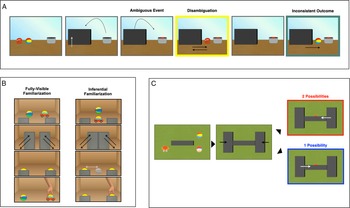
Figure 1. Tests of infants' disjunctive representation. (A) Infants are presented with movies where a half-hidden object is compatible with just two possible identities (ambiguous event; the half-hidden object is the snake OR the ball). Next, infants see which object is outside the cup, evidence that rules out one of the alternatives (disambiguation; the snake is outside the cup; so, the hidden object is the ball). We found that infants reacted to the disambiguating evidence with a reorientation of attention toward the half-hidden object, and then were surprised (i.e., look longer) by a later violation of the logical expectation that the other object is inside the cup (inconsistent outcome; the ball is outside the cup). Importantly, higher attentional reorientation at the time of the exclusion was predictive of later surprise. At the same time, this relationship was absent in a noninferential control condition (adapted from Cesana-Arlotti et al., 2018). (B) Infants were familiarized with a choice of an object which was either directly visible (fully visible familiarization) or had to be inferred via disjunctive inference (inferential familiarization). Infants familiarized via inference performed just as well as those who could directly see the choice (adapted from Cesana-Arlotti et al., 2020). (C) Infants watched visually identical events where a half-hidden object was compatible with a varying number of identities (one or two). Infants' pupil dilation (an index of processing load) was higher when there were two alternatives compatible with the object, suggesting that infants were not simulating just a single identity regardless of the alternative possibilities (adapted from Cesana-Arlotti et al., 2022).
Target article
Related commentaries (30)
Language-of-thought hypothesis: Wrong, but sometimes useful?
Neither neural networks nor the language-of-thought alone make a complete game
The connections between language-of-thought (LoT), learning, and the development of logic were central in Fodor's proposal (Fodor, Reference Fodor1979). He pointed out that efficient learning by hypothesis-confirmation requires combinatorial, structured representations. Quilty-Dunn et al.'s article vindicates Fodor's conjecture: Contemporary cognitive science confirms that human-like flexibility and systematicity in learning (Goodman, Tenenbaum, Feldman, & Griffiths, Reference Goodman, Tenenbaum, Feldman and Griffiths2008; Goodman, Tenenbaum, & Gerstenberg Reference Goodman, Tenenbaum, Gerstenberg, Margolis and Laurence2015; Piantadosi, Tenenbaum, & Goodman, Reference Piantadosi, Tenenbaum and Goodman2016), and the ability to master a natural language (Chierchia, Reference Chierchia2013; Pietroski, Reference Pietroski2018), are best explained by LoT-like cognitive systems augmented with a repertoire of logical operators.
Fodor also argued that the compositional logical primitives of LoT (the logical building blocks that are not decomposed in more basic operators) must be developmental primitives – representations that are not learned – because concept learning requires decomposition. To be sure, we can “decompose” logical notions. But to do so, we need an equivalent or more powerful (expressive) logic. For instance, the operators of propositional logic can be interdefined (e.g., “p OR q” = “IF NOT p THEN q”) or can be defined by more expressive logical systems (e.g., lambda calculus or combinatory logic; Piantadosi, Reference Piantadosi2021). So, although children and adults could learn specific logical notions, this would require a LoT with equivalent, or more powerful, logical primitives.
As a result, the reemergence of LoTH carries important consequences for the study of the development of logic in the mind. If human cognition traffics in logically rich LoT systems, then cognitive development must start with a firm foundation of primitive logical capacities. But if not learning, what is the origin of our logical primitives? And what natural logical resources are in place when learning begins?
My next point expands on the hypothesis that natural language may not be the unique source of our logical capacities. I fully agree with Quilty-Dunn et al. that serious consideration should be given to the alternative picture: Logical primitives might be in place in LoTs distinct from the natural language. First, preverbal logical representations can explain our capacity to acquire many logical concepts through language and acculturation. Second, preverbal logic might play a role in accounting for infants' surprising learning potentials (Cesana-Arlotti, Kovács, & Téglás, Reference Cesana-Arlotti, Kovács and Téglás2020). After all, logically augmented LoTs are powerful hypothesis-testing devices.
With my collaborators, we have begun to investigate preverbal infants' logical abilities, targeting disjunction, the logical relation between two or more representations entailing that at least one of them is true (expressed by “OR” in formal logic). We tested whether 12-month-olds represented the identity of a half-hidden object compatible with two possibilities and inferred one identity based on evidence incompatible with the other (Figure 1A). Infants' looking times and oculomotor responses provided evidence of disjunctive representation at the preverbal stage (Cesana-Arlotti et al., Reference Cesana-Arlotti, Martín, Téglás, Vorobyova, Cetnarski and Bonatti2018).
Tests of infants' disjunctive representation. (A) Infants are presented with movies where a half-hidden object is compatible with just two possible identities (ambiguous event; the half-hidden object is the snake OR the ball). Next, infants see which object is outside the cup, evidence that rules out one of the alternatives (disambiguation; the snake is outside the cup; so, the hidden object is the ball). We found that infants reacted to the disambiguating evidence with a reorientation of attention toward the half-hidden object, and then were surprised (i.e., look longer) by a later violation of the logical expectation that the other object is inside the cup (inconsistent outcome; the ball is outside the cup). Importantly, higher attentional reorientation at the time of the exclusion was predictive of later surprise. At the same time, this relationship was absent in a noninferential control condition (adapted from Cesana-Arlotti et al., Reference Cesana-Arlotti, Martín, Téglás, Vorobyova, Cetnarski and Bonatti2018). (B) Infants were familiarized with a choice of an object which was either directly visible (fully visible familiarization) or had to be inferred via disjunctive inference (inferential familiarization). Infants familiarized via inference performed just as well as those who could directly see the choice (adapted from Cesana-Arlotti et al., Reference Cesana-Arlotti, Kovács and Téglás2020). (C) Infants watched visually identical events where a half-hidden object was compatible with a varying number of identities (one or two). Infants' pupil dilation (an index of processing load) was higher when there were two alternatives compatible with the object, suggesting that infants were not simulating just a single identity regardless of the alternative possibilities (adapted from Cesana-Arlotti et al., Reference Cesana-Arlotti, Varga and Téglás2022).
Evidence of preverbal logical abilities calls for a challenge: Extending the notion of logical representation beyond language and its formalizations (Bermúdez, Reference Bermúdez2007; Burge, Reference Burge2010). To formulate and test hypotheses about the presence and nature of preverbal logical representations, we need a framework that could dissociate logic from language. Quilty-Dunn et al.'s homeostatic characterization of LoT offers a tool to this end: Unlike natural language, preverbal infants' logical primitives might not have all the properties of the LoT format. To conclude my commentary, I ask whether we have reasons to think infants' disjunctive inferences have key properties of an LoT.
First, infants' disjunctive inference displays evidence of inferential promiscuity. We found that infants quickly learn the preference of an agent reaching for a hidden goal, which has to be identified by exclusion (Cesana-Arlotti et al., Reference Cesana-Arlotti, Kovács and Téglás2020). The infants who had to learn the preference based on the inference (experiment 4) performed at the same level as those who could directly see the agent's goal (experiment 3, Figure 1B). This is striking given the few demonstrations needed by infants and the previous finding that observing few inconsistent reaches is sufficient to disrupt their learning (Luo, Hennefield, Mou, vanMarle, & Markson, Reference Luo, Hennefield, Mou, vanMarle and Markson2017). New experiments should systematically investigate whether the disjunctive representations deployed by infants and adults in processing visual scenes trigger automatic inferences (Braine & O'Brien, Reference Braine and O'Brien1998; Quilty-Dunn & Mandelbaum, Reference Quilty-Dunn and Mandelbaum2018).
Second, it is currently unclear whether infants' disjunctive representations have discrete constituency. Operators of formal logic are discrete symbols (e.g., “p OR q,” “NOT p”) that encode binary or monadic logical relations (e.g., truth-functions). Discrete constituency is crucial for formal logic because it supports compositionality: New logical relations can be expressed by embedding logical operators (e.g., “NOT (p OR q)”). Unlike formal logic, preverbal disjunctive inferences might use a format with no discrete logical operators, like the mental model theory (Johnson-Laird, Khemlani, & Goodwin, Reference Johnson-Laird, Khemlani and Goodwin2015). In the mental model framework, the disjunction of p and q is represented with multiple models, or simulations, of alternative possibilities: “p,” “q” (assuming p and q are mutually exclusive). The disjunctive inference is carried out with an algorithm that erases the alternatives incompatible with new data. Although such an algorithm carries out deductively-valid inferences, it involves no discrete logical operators (e.g., a collection of models is not a representation that can be recursively combined with “NOT p”).
Crucially, without logical operators, disjunction requires to store and update multiple mental models in parallel. This is costly for adults and plausibly very challenging for infants with immature cognitive resources (Gauffroy & Barrouillet, Reference Gauffroy and Barrouillet2011). Thus, we may expect that if infants have no logical operators, they will simulate and store just one disjunct at the time (for a related prediction, see Leahy & Carey, Reference Leahy and Carey2020). A new study provides evidence that infants do NOT respond to objects with multiple possible identities by simulating just a single identity at the time (Cesana-Arlotti, Varga, & Téglás, Reference Cesana-Arlotti, Varga and Téglás2022), as their pupil diameter – indexing processing load – increases with the number of possible identities. Although infants might have simulated multiple models, the proposal of a single complex logical representation (e.g., “the elephant OR the ball”) may best account for this result, considering their limited cognitive resources. Future research will further test the constituency structure of preverbal disjunctive representations.
In conclusion, the reemergence of LoTH is a boon for developmental psychologists, logicians, and philosophers alike: It points to the need to chart the foundation of our logical capacities and opens exciting questions about the logical primitives of the mind.
Acknowledgments
I am grateful to E. Téglás, F. Keil, and L. Barlassina for their very valuable comments on the manuscript.
Financial support
This research was supported by funds for a postdoctoral fellowship from the James S. McDonnell Foundation.
Competing interest
None.