Emotions influence both individual and collective behavior. Yet, in their account of collective behavior, Bentley et al. do not mention emotions even once, and it is not clear how they could be integrated into their proposal such that it would truly account for the discrete decisions that individuals face. The two axes they propose for organizing the analysis of big data are meant to measure the degree of social influence and transparency of payoffs in discrete choices, yet the way individual choices are influenced by emotions cannot simply be assimilated by any of the given variables. It has become increasingly clear that economic decisions cannot be explained without taking the emotions into account (Berezin Reference Berezin, Swedberg and Smelser2005; Reference Berezin2009). While Bentley et al. recognize that “the map requires a few simplifying assumptions to prevent it from morphing into something so large that it loses its usefulness” (target article, sect. 2, para. 7), we argue that neglecting emotions can only result in a distorted and impoverished account of behavioral types, which reduces, if not spoils, the usefulness of the map altogether. We need “more sensitive methodologies with which to capture these complex multidimensional decision-making processes” (Williams Reference Williams, Archer and Tritter2000, p. 58).
Perhaps Bentley et al. have ignored emotions on the basis of the assumption that they fall into the category of “opaque and socially influenced behavior.” But this assumption would be wrong, for emotions do not only influence cognition and decision making; they are also present, in varying degrees, in seemingly independent behavior. By not explicitly including the role of emotions in decision making, Bentley et al. are likely to have arrived at conclusions based on spurious variables.
The way emotions influence cognition cannot be adequately represented in terms of transparency versus opacity of the pay-offs and risks along the north–south axis. While there are cases of “collective effervescence” (Durkheim Reference Durkheim2001, p. 171) in which emotions influence cognition to the point that they obscure any thought of the consequences of a given action, at other times emotion does not obscure the recognition of consequences and yet agents still decide to act regardless of the consequences. Think, for example, of someone who sacrifices something for a friend: While it might be said that in this case the agent weighs two options and finds one of them more rewarding than the other, there is room to argue that emotions cannot be accounted for in terms of a cost-benefit analysis (Archer & Tritter Reference Archer, Tritter, Archer and Tritter2000). To give a more plausible account of behavioral types that indirectly reflects personal and cultural values (Hechtman et al. Reference Hechtman, Pornpattananangkul and Y Chao2012), emotions should be considered as an independent variable. Thus, although a particular agent might have clear knowledge of the objective costs and benefits involved in a particular choice, her decision may not be determined by those considerations. Indeed, it is completely plausible that the emotional variable sometimes trumps other variables in the decision-making process.
Yet, in addition to their role as independent variables, emotions can influence the cognitive process itself, that is, cognitive evaluation is not independent of emotional dimensions. The information we consider relevant in a given context depends on emotional states. As Bandelj (Reference Bandelj2009) notes:
[E]motions serve as one of the chief mechanisms to constrain and direct our attention, and hence frame our decisions. Emotions define what shall be considered as relevant for any particular action problem. In addition, during the process of selecting optimal means for desired goals, emotions help us narrow down the range of plausible alternatives and help us rank these alternatives. (p. 352)
The level of emotional involvement regulates cognitive processes as well as what counts as a cost or a benefit in a particular situation. Accordingly, transparency and opacity do not depend only on the objective information provided, but also on the degree of emotional involvement. Cognitive transparency is not equivalent to “emotional detachment”; certainly, very often it is only through emotions and the evaluations they entail, that is, through some degree of emotional involvement, that we come to realize the seriousness of certain injustices.
Presence of emotions along the west–east axis cannot be reduced to the “opaque and socially influenced behavior.” It is certainly true that emotions are present in socially influenced behavior – if only to avoid cases of “cognitive dissonance” (Festinger Reference Festinger1964, p. 5). From this perspective, we could even inquire into the extent to which the Internet influences emotional reactions to events and, hence, the very nature of big data collected through it. However, reducing the presence of emotions to the quadrant of “opaque and socially influenced behavior” would be misleading. This is so for two reasons: first, because emotions can also be the motive for isolationist behavior, which at first sight could resemble independent behavior, and second, because highly independent and calculated decisions are sometimes made precisely to create some sort of emotional bond, and it is precisely the Internet, with its extensive social media, which often serves this purpose (Illouz Reference Illouz2007).
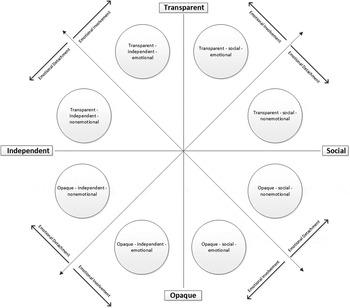
In light of these considerations, we think that Bentley et al.’s empirical framework for big-data research would benefit from introducing a Z-axis that registers the intensity of emotions influencing individual choices at any given moment. While this inclusion entails complicating the behavioral types (see graph in our Fig. 1), the result not only provides a more plausible account of human behavior, but arguably better serves the practical ends that the authors advance at the end of the article. After all, as marketing researchers know well (Bagozzi et al. Reference Bagozzi, Gopinath and Nyer1999), when decisions are mostly based on emotions, providing too much information may be counterproductive; the important thing, then, is not to provide too much information, but rather to provide the information relevant to the agent (see Fig. 1).
Figure 1.
Graph 1: A tentative reformulation of behavioral types that includes emotions.





 You have
Access
Emotions influence both individual and collective behavior. Yet, in their account of collective behavior, Bentley et al. do not mention emotions even once, and it is not clear how they could be integrated into their proposal such that it would truly account for the discrete decisions that individuals face. The two axes they propose for organizing the analysis of big data are meant to measure the degree of social influence and transparency of payoffs in discrete choices, yet the way individual choices are influenced by emotions cannot simply be assimilated by any of the given variables. It has become increasingly clear that economic decisions cannot be explained without taking the emotions into account (Berezin Reference Berezin, Swedberg and Smelser2005; Reference Berezin2009). While Bentley et al. recognize that “the map requires a few simplifying assumptions to prevent it from morphing into something so large that it loses its usefulness” (target article, sect. 2, para. 7), we argue that neglecting emotions can only result in a distorted and impoverished account of behavioral types, which reduces, if not spoils, the usefulness of the map altogether. We need “more sensitive methodologies with which to capture these complex multidimensional decision-making processes” (Williams Reference Williams, Archer and Tritter2000, p. 58).
Perhaps Bentley et al. have ignored emotions on the basis of the assumption that they fall into the category of “opaque and socially influenced behavior.” But this assumption would be wrong, for emotions do not only influence cognition and decision making; they are also present, in varying degrees, in seemingly independent behavior. By not explicitly including the role of emotions in decision making, Bentley et al. are likely to have arrived at conclusions based on spurious variables.
The way emotions influence cognition cannot be adequately represented in terms of transparency versus opacity of the pay-offs and risks along the north–south axis. While there are cases of “collective effervescence” (Durkheim Reference Durkheim2001, p. 171) in which emotions influence cognition to the point that they obscure any thought of the consequences of a given action, at other times emotion does not obscure the recognition of consequences and yet agents still decide to act regardless of the consequences. Think, for example, of someone who sacrifices something for a friend: While it might be said that in this case the agent weighs two options and finds one of them more rewarding than the other, there is room to argue that emotions cannot be accounted for in terms of a cost-benefit analysis (Archer & Tritter Reference Archer, Tritter, Archer and Tritter2000). To give a more plausible account of behavioral types that indirectly reflects personal and cultural values (Hechtman et al. Reference Hechtman, Pornpattananangkul and Y Chao2012), emotions should be considered as an independent variable. Thus, although a particular agent might have clear knowledge of the objective costs and benefits involved in a particular choice, her decision may not be determined by those considerations. Indeed, it is completely plausible that the emotional variable sometimes trumps other variables in the decision-making process.
Yet, in addition to their role as independent variables, emotions can influence the cognitive process itself, that is, cognitive evaluation is not independent of emotional dimensions. The information we consider relevant in a given context depends on emotional states. As Bandelj (Reference Bandelj2009) notes:
[E]motions serve as one of the chief mechanisms to constrain and direct our attention, and hence frame our decisions. Emotions define what shall be considered as relevant for any particular action problem. In addition, during the process of selecting optimal means for desired goals, emotions help us narrow down the range of plausible alternatives and help us rank these alternatives. (p. 352)
The level of emotional involvement regulates cognitive processes as well as what counts as a cost or a benefit in a particular situation. Accordingly, transparency and opacity do not depend only on the objective information provided, but also on the degree of emotional involvement. Cognitive transparency is not equivalent to “emotional detachment”; certainly, very often it is only through emotions and the evaluations they entail, that is, through some degree of emotional involvement, that we come to realize the seriousness of certain injustices.
Presence of emotions along the west–east axis cannot be reduced to the “opaque and socially influenced behavior.” It is certainly true that emotions are present in socially influenced behavior – if only to avoid cases of “cognitive dissonance” (Festinger Reference Festinger1964, p. 5). From this perspective, we could even inquire into the extent to which the Internet influences emotional reactions to events and, hence, the very nature of big data collected through it. However, reducing the presence of emotions to the quadrant of “opaque and socially influenced behavior” would be misleading. This is so for two reasons: first, because emotions can also be the motive for isolationist behavior, which at first sight could resemble independent behavior, and second, because highly independent and calculated decisions are sometimes made precisely to create some sort of emotional bond, and it is precisely the Internet, with its extensive social media, which often serves this purpose (Illouz Reference Illouz2007).
In light of these considerations, we think that Bentley et al.’s empirical framework for big-data research would benefit from introducing a Z-axis that registers the intensity of emotions influencing individual choices at any given moment. While this inclusion entails complicating the behavioral types (see graph in our Fig. 1), the result not only provides a more plausible account of human behavior, but arguably better serves the practical ends that the authors advance at the end of the article. After all, as marketing researchers know well (Bagozzi et al. Reference Bagozzi, Gopinath and Nyer1999), when decisions are mostly based on emotions, providing too much information may be counterproductive; the important thing, then, is not to provide too much information, but rather to provide the information relevant to the agent (see Fig. 1).
Graph 1: A tentative reformulation of behavioral types that includes emotions.