




No CrossRef data available.
Article contents
The analytic utility of distinguishing fighting from dying
Published online by Cambridge University Press: 27 December 2018
Abstract
Fighting and dying, or what Whitehouse calls “out-group hostility” and “extreme self-sacrifice,” are not conceptually overlapping, but in fact are highly distinguishable, both theoretically and empirically. I present empirical evidence from a reanalysis of Ginges et al. (2009, Study 4), demonstrating the potentially inverse relationship between “parochial hostility” – fighting and “sacrificial altruism” – “and” dying.
Information
- Type
- Open Peer Commentary
- Information
- Copyright
- Copyright © Cambridge University Press 2018
References
Atran, S. & Norenzayan, A. (2004) Religion's evolutionary landscape: Counterintuition, commitment, compassion, communion. Behavioral and Brain Sciences 27:713–70.Google Scholar
Da Silva, C. (2018, April 3) Israel green-lighted ‘unlawful’ killing of unarmed Gaza protesters, says Human Rights Watch. Newsweek. Available at: http://www.newsweek.com/israel-green-lighted-unlawful-killing-unarmed-gaza-protesters-says-human-869588.Google Scholar
Doughty, K. & Ntambara, D. M. (2005) Resistance and protection: Muslim community actions during the Rwandan genocide. CDA Collaborative Learning Projects Available at: www.cdainc.com/cdawww/pdf/casestudy/steps_rwanda_case_study_Pdf.pdf.Google Scholar
Easwaran, E. (1999) Nonviolent soldier of Islam: Badshah Khan, a man to match his mountains. Blue Mountain Center of Meditation.Google Scholar
Enemark, C. (2017, October 5) Drones, risk, and moral injury. Critical Military Studies. doi: 10.1080/23337486.2017.1384979.Google Scholar
Farrell, B. (2011, January 19) Tunisia emerges unarmed and victorious. Waging nonviolence. Available at: https://wagingnonviolence.org/feature/tunisia-emerges-victorious-and-unarmed/.Google Scholar
Ginges, J., Hansen, I. G. & Norenzayan, A. (2009) Religion and support for suicide attacks. Psychological Science 20(2):224–30.Google Scholar
Hansen, I. G., Jackson, V. W. Y. & Ryder, A. (2018) Religion and oppression: Cross-national and experimental investigations. Religion, Brain and Behavior 18(4):369–93. doi: https://doi.org/10.1080/2153599X.2017.1358208.Google Scholar
Hansen, I. G. & Ryder, A. (2016) In search of “religion proper”: Intrinsic religiosity and coalitional rigidity make opposing predictions of intergroup hostility across religious groups. Journal of Cross-Cultural Psychology 47:835–57. doi: https://doi.org/10.1177/0022022116644983.Google Scholar
Liphshiz, C. (2018, January 19) What made Muslim Albanians risk their lives to save Jews from the Holocaust? The Times of Israel. Available at: https://www.timesofisrael.com/what-made-muslim-albanians-risk-their-lives-to-save-jews-from-the-holocaust/.Google Scholar
Lusher, A. (2017, December 23) At least 10,000 people died in Tiananmen Square Massacre, secret British cable from the time alleged. The Independent. Available at: https://www.independent.co.uk/news/world/asia/tiananmen-square-massacre-death-toll-secret-cable-british-ambassador-1989-alan-donald-a8126461.html.Google Scholar
Ouellet, J. X. (2013) Women and religion in Liberia's peace and reconciliation. Critical Intersections in Education 1:12–20. Available at: http://jps.library.utoronto.ca/index.php/cie/article/download/17063/16059.Google Scholar
Samaha, N. (2015, April 24) How Arabs reached out to Armenians amid 1915 massacre. Al Jazeera. Available at: https://www.aljazeera.com/news/2015/04/arabs-reached-armenians-1915-massacre-150424102949363.html.Google Scholar
Schwartz, F. & Jones, R. (2018, May 14) Scores killed as Palestinians protest U.S. embassy opening in Jerusalem. Wall Street Journal. Available at: https://www.wsj.com/articles/at-least-16-palestinian-protesters-killed-as-u-s-opens-embassy-in-jerusalem-1526298531.Google Scholar
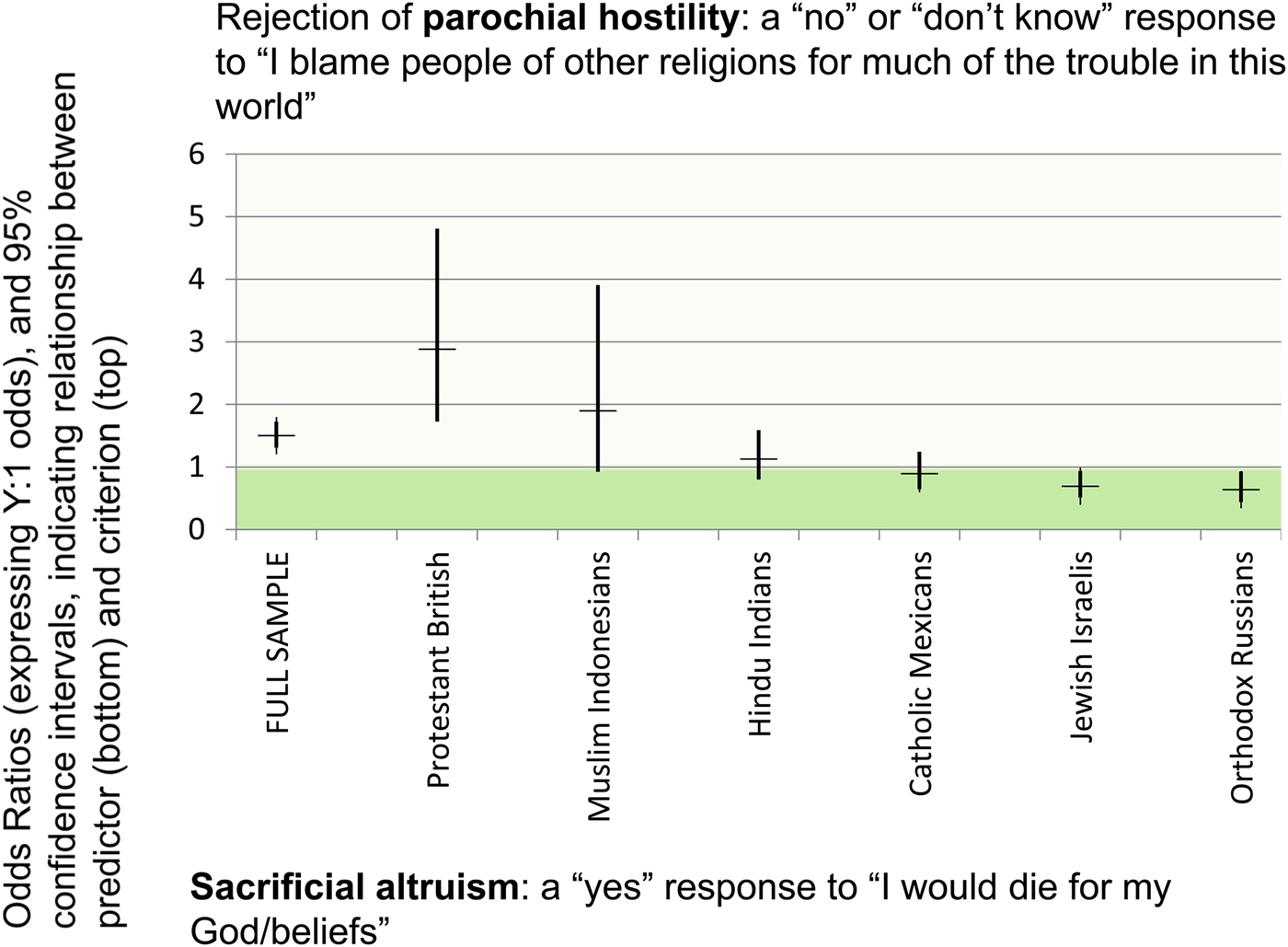
Figure 1. Odds of rejecting parochial hostility as predicted by sacrificial altruism, in the six subsamples analyzed by Ginges et al. (2009, Study 4).
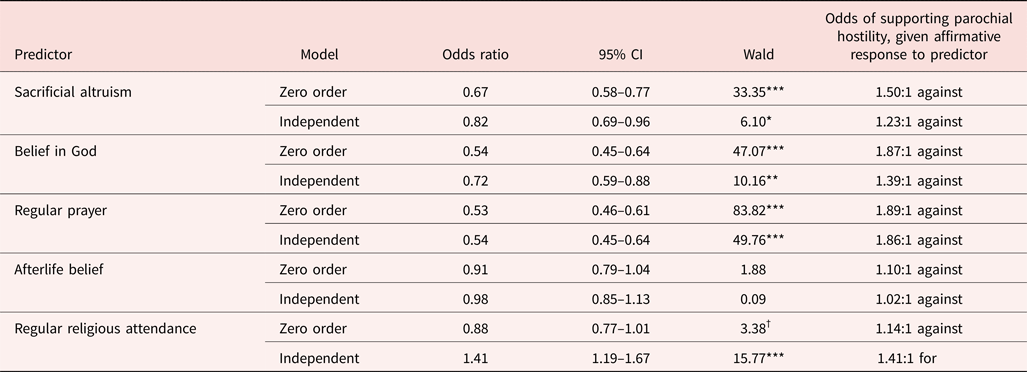
Table 1. Odds of blaming people of other religions for the world's problems (parochial hostility) as predicted by sacrificial altruism and other religiosity measures
A correction has been issued for this article:
Target article
Related commentaries (29)
Altruism, collective rationality, and extreme self-sacrifice
As promising as Whitehouse's fusion theory is, he often references “extreme self-sacrifice” and “out-group hostility” (even “murderous” inclinations, sect. 1, para. 1) as if conceptually overlapping. This muddies the theory's utility for understanding the subjects of his inquiry. For example, Whitehouse uses the phrase “fight and die” 12 times. Fighting, of the “murderous” killing kind at least, is not the same as dying. Admittedly, this linkage is not unprecedented. Killing and dying are typically conjoined in highly vulnerable military operations, as Whitehouse notes regarding the risks undergone by those awarded Britain's Victoria Cross medal (sect. 2, para. 9). They are also conjoined in violent martyrdom operations (Ginges et al. Reference Ginges, Hansen and Norenzayan2009).
It is possible to separate killing from dying, however. For example, one can risk, or even practically guarantee, dying for a morally aspirational cause, and do so without killing. Such moral heroism often occurs in grassroots civilian rescue operations against genocide (Doughty & Ntambara Reference Doughty and Ntambara2005; Liphshiz Reference Liphshiz2018; Samaha Reference Samaha2015) and various other forms of nonviolent resistance, to civil wars (Ouellet Reference Ouellet2013), to colonial oppression (Easwaran Reference Easwaran1999), to kleptocratic national corruption under dictators (Farrell Reference Farrell2011), and to diplomatic outrages (Schwartz & Jones Reference Schwartz and Jones2018). Complementarily, it is possible to kill without risking death, as with targeted assassinations using weaponized drones (Enemark Reference Enemark2017) and soldiers firing live ammunition into crowds of predominantly nonviolent protestors (Da Silva Reference Da Silva2018; Lusher Reference Lusher2017). Therefore, a separation between willing martyrdom and willing murderousness is theoretically conceivable and existentially demonstrable. Is it also empirically likely?
Whitehouse (sect. 2, para. 5) references Ginges and colleagues (Reference Ginges, Hansen and Norenzayan2009), specifically their finding that Palestinian Muslims attending mosques are more likely to support suicide attacks. However, that article's focus is not primarily Muslims or mosques, but rather how, across a variety of religious contexts, the less religious aspects of religiosity (attending religious services) predict support for suicide attacks, and the more religious aspects (regular prayer) do not. Most relevant to the question at hand, Ginges and colleagues’ Study 4 examines how prayer and religious attendance predicted “parochial altruism,” a compound construct measuring the simultaneous endorsement of two separate measures: “I would die for my God/beliefs” (sacrificial altruism), and “I blame people of other religions for much of the trouble in this world” (parochial hostility). As Ginges and colleagues note, “The suicide attack can be thought of as belonging to an extreme subset of parochial altruism” (p. 224).
The data from Ginges and colleagues’ Study 4 (the “Ginges sample”) offer an opportunity for investigating the relationship between sacrificial altruism (SA) and parochial hostility (PH) as separable inclinations. Figure 1 illustrates the results of a new analysis of the relation between SA and rejection of PH in the Ginges sample.
Odds of rejecting parochial hostility as predicted by sacrificial altruism, in the six subsamples analyzed by Ginges et al. (Reference Ginges, Hansen and Norenzayan2009, Study 4).
Figure 1 suggests that, although the relationship varied somewhat from subgroup to subgroup, SA manifested distinctly antihostile tendencies in the full Ginges sample. This finding may reflect sacrificial altruism being a core feature of religiosity, specifically embodying the “commitment” aspect identified by Atran and Norenzayan (Reference Atran and Norenzayan2004).
Indeed, Hansen et al. (Reference Hansen, Jackson and Ryder2018), referencing Atran and Norenzayan's (Reference Atran and Norenzayan2004) taxonomy of religious features, includes sacrificial altruism in their index of religiosity (α = .72). This index also includes belief in God, attendance at religious services, belief in the afterlife, and regular prayer (Hansen et al. Reference Hansen, Jackson and Ryder2018, pp. 380–81). Among countries of comparable human development, this index was (a) positively related to Freedom House ratings of national protection of political rights and civil liberties and (b) negatively related to the number of refugees fleeing the country – the latter being an indicator not only of lack of liberty but also of violent conflict (Hansen et al. Reference Hansen, Jackson and Ryder2018). This finding provides indirect evidence that religiosity – possibly including SA – is a potentially anti-hostile inclination and corroborates the finding in Figure 1.
To address this question more directly, Table 1 outlines how the remaining variance in SA, independent of the four other religious index items, independently predicted PH in the Ginges sample. Supporting the hypothesis of SA as inherently antihostile, Table 1 shows SA was negatively related to PH even when controlling the other four indices of religiosity, which themselves were all nominally or significantly negatively related to PH zero order. The independent relations of prayer and belief in God to PH remained negative in binary logistic regression, though religious attendance became positively related, and belief in the afterlife remained unrelated. Controlling for the demographic variables previously controlled by Ginges and colleagues did not change these relationships.
Odds of blaming people of other religions for the world's problems (parochial hostility) as predicted by sacrificial altruism and other religiosity measures
*p < .05. **p < .01. ***p < .001. †p < .01.
This negative relationship between SA and PH is also evident in reanalyses of data from Hansen et al. (Reference Hansen, Jackson and Ryder2018), as well as two additional data sets measuring SA's relationship to other forms of PH. These analyses (Hansen, Reference Hansenin preparation, Study 3) confirm that SA, like basic religiosity in general, negatively predicts Freedom House-rated oppression in a country and the number of refugees fleeing that country. The analyses also confirm that SA is negatively related to support for killing religious others and “the wicked,” at least when “coalitional rigidity” variables (Hansen & Ryder Reference Hansen and Ryder2016) are controlled.
To understand phenomena conjoining killing and dying (like violent martyrdom operations), step one should be to address the inherent tension between them, specifically the potentially inverse relationship between SA and PH. Whitehouse's fusion theory might yet prove relevant to identifying processes that can modulate this tension, but first the tension itself needs acknowledgment. I am concerned that Whitehouse's fusion theory, which neglects this tension, applies more readily to identifying antecedents of SA than of PH, particularly given his claim that Gandhi's hunger strikes followed the “logic” of Jewish zealots and Ismaili assassins (sect. 5, next-to-last paragraph). What makes this concerning is the potential for increased governmental interest in discerning emergent signs of fusion in certain social and political groups. If fusion theory proves influential to, say, strategists at SRI International, the Human Resources Research Organization, and the Office of Naval Research, will the possibly vast amounts of money and manpower directed to profiling and targeting “fusers” be most effective at preventing (a) mass murder or (b) the courageous risk of life and limb to rescue others from it?