Bentley et al. adapt a well-known probabilistic model of discrete choice to generate distributions characteristic of situations of high and low social influence on decisions and of high and low salience (“transparency”) of rewards, to support inference from “big data” in which the details of individual decisions may not be recorded but the distributions are. Another element of decisions that may influence the placement of a decision process in their map is the way in which individual decisions interact to determine the payoffs. This is the subject matter of non-cooperative game theory (Aumann Reference Aumann2003; Schelling Reference Schelling1960). We consider three classes of non-cooperative games that, in a context of boundedly rational learning but with given parameters of social influence and reward salience, yield very different positions in the Bentley et al. map. The three classes of games are coordination games, anti-coordination games, and congestion games. We focus here mainly on anti-coordination games, but will refer to our own study of the determinants of congestion of hospital emergency rooms (McCain et al. Reference McCain, Hamilton, Linnehan, Osinga, Hofstede and Verwaart2011) to illustrate the point, with evidence from a questionnaire study that the expectations of the patients are consistent with a Nash equilibrium, based on learning from individual experience with some errors (thus in the far northeast of Bentley et al.'s map.) This poses the deeper question, at which Bentley et al. hint: How do individuals learn how best to learn from their own experience and the experience of others?
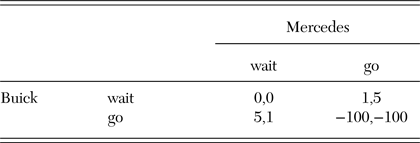
Anti-coordination games can be illustrated by an example from street traffic. Two cars meet, crossing, at a street intersection. Each has two strategies: to wait or to go. The payoffs are shown in Table 1. As we see, if both stop, they simply reproduce the problem, for payoffs of zero; but if both go, they will crash, for payoffs of –100. If one goes and the other waits, the one who goes “wins,” getting through the intersection first, for 5, while the other goes through the intersection second (but safely) for a payoff of 1.
Table 1.
The Drive On Game
For this game, there are two Nash equilibria, each of the strategy pairs at which one car waits and the other goes. In this game, it is necessary for the players to choose different strategies in a coordinated way, in order to realize a Nash equilibrium, and while they are not equally well off at the equilibrium, both are better off than they will be at a non-equilibrium strategy pair. In some recent writing on game theory, games such as this are called anti-coordination games. The decision-makers will need a bit of information from outside the game in order to appropriately coordinate their strategies; but for an anti-coordination game, it is necessary that each gets a different bit of information, that can signal one to go and the other to stop. One possible source of this information could be a stoplight at the intersection. In general, however, imitative learning will not provide the kind of differentiated signal provided by a stoplight, and consequently anti-coordination games present a deeper problem for mapping in Bentley et al.'s map than do coordination games. This can be verified by agent-based computer simulation.
Congestion games share some of the characteristics of anti-coordination games. Our study of emergency room congestion modeled the decision to seek emergency room service as a congestion game. To further extend the model and allow for (1) much larger numbers of potential patients; (2) heterogeneity of health states, experience, and expectation; (3) boundedly rational learning; and (4) initialization effects, dynamic adjustment, and transients, we undertook agent-based computer simulation. (Holland & Miller Reference Holland and Miller1991). We then validated the predictions of the computer simulation by a questionnaire study of patients in the emergency department of Hahnemann Hospital, associated with the Drexel University College of Medicine.
The key point for the Bentley et al. map is that learning in the simulations reported, although based on a probabilistic choice model such as Bentley et al. postulate, relied only on individual experience to learn and estimate the benefits from the different strategies available to the agents. Different individual signals from the individual's own past experience provide the different signals necessary to support a Nash equilibrium in an anti-coordination game. Thus, these simulations belong in the extreme northeast of the Bentley et al. map. Indeed we do see, as predicted, an r-shaped adoption curve. However, in preliminary simulations that did assume social learning, no tendency to converge to a Nash equilibrium was observed. The shared average experience of each type of agent provides no different signal that could support the choice of different strategies in the congestion game, as a Nash equilibrium requires in such a game. These simulations also, consequently, disagree with the evidence from the questionnaire study, which were consistent with the hypothesis of Nash equilibrium.
Here is the conclusion. On the one hand, the game-theoretic discussion and the agent-based computer simulations indicate that social learning is inappropriate to congestion games, in that it cannot provide signals that lead different agents to choose different strategies, whereas a reliance on individual experience may do so. On the other hand, the evidence suggests that the Nash equilibrium hypothesis is descriptive of the actual experience of patients in emergency departments. Somehow, people seem to have focused their attention and learning on the sort of information that could give rise to individually satisfactory outcomes, so far as the “game” permits. Perhaps the Bentley et al. map, which seems to take the social or individual bias of decision-making as given, needs some refinement on the basis of non-cooperative game theory.





Bentley et al. adapt a well-known probabilistic model of discrete choice to generate distributions characteristic of situations of high and low social influence on decisions and of high and low salience (“transparency”) of rewards, to support inference from “big data” in which the details of individual decisions may not be recorded but the distributions are. Another element of decisions that may influence the placement of a decision process in their map is the way in which individual decisions interact to determine the payoffs. This is the subject matter of non-cooperative game theory (Aumann Reference Aumann2003; Schelling Reference Schelling1960). We consider three classes of non-cooperative games that, in a context of boundedly rational learning but with given parameters of social influence and reward salience, yield very different positions in the Bentley et al. map. The three classes of games are coordination games, anti-coordination games, and congestion games. We focus here mainly on anti-coordination games, but will refer to our own study of the determinants of congestion of hospital emergency rooms (McCain et al. Reference McCain, Hamilton, Linnehan, Osinga, Hofstede and Verwaart2011) to illustrate the point, with evidence from a questionnaire study that the expectations of the patients are consistent with a Nash equilibrium, based on learning from individual experience with some errors (thus in the far northeast of Bentley et al.'s map.) This poses the deeper question, at which Bentley et al. hint: How do individuals learn how best to learn from their own experience and the experience of others?
Anti-coordination games can be illustrated by an example from street traffic. Two cars meet, crossing, at a street intersection. Each has two strategies: to wait or to go. The payoffs are shown in Table 1. As we see, if both stop, they simply reproduce the problem, for payoffs of zero; but if both go, they will crash, for payoffs of –100. If one goes and the other waits, the one who goes “wins,” getting through the intersection first, for 5, while the other goes through the intersection second (but safely) for a payoff of 1.
The Drive On Game
For this game, there are two Nash equilibria, each of the strategy pairs at which one car waits and the other goes. In this game, it is necessary for the players to choose different strategies in a coordinated way, in order to realize a Nash equilibrium, and while they are not equally well off at the equilibrium, both are better off than they will be at a non-equilibrium strategy pair. In some recent writing on game theory, games such as this are called anti-coordination games. The decision-makers will need a bit of information from outside the game in order to appropriately coordinate their strategies; but for an anti-coordination game, it is necessary that each gets a different bit of information, that can signal one to go and the other to stop. One possible source of this information could be a stoplight at the intersection. In general, however, imitative learning will not provide the kind of differentiated signal provided by a stoplight, and consequently anti-coordination games present a deeper problem for mapping in Bentley et al.'s map than do coordination games. This can be verified by agent-based computer simulation.
Congestion games share some of the characteristics of anti-coordination games. Our study of emergency room congestion modeled the decision to seek emergency room service as a congestion game. To further extend the model and allow for (1) much larger numbers of potential patients; (2) heterogeneity of health states, experience, and expectation; (3) boundedly rational learning; and (4) initialization effects, dynamic adjustment, and transients, we undertook agent-based computer simulation. (Holland & Miller Reference Holland and Miller1991). We then validated the predictions of the computer simulation by a questionnaire study of patients in the emergency department of Hahnemann Hospital, associated with the Drexel University College of Medicine.
The key point for the Bentley et al. map is that learning in the simulations reported, although based on a probabilistic choice model such as Bentley et al. postulate, relied only on individual experience to learn and estimate the benefits from the different strategies available to the agents. Different individual signals from the individual's own past experience provide the different signals necessary to support a Nash equilibrium in an anti-coordination game. Thus, these simulations belong in the extreme northeast of the Bentley et al. map. Indeed we do see, as predicted, an r-shaped adoption curve. However, in preliminary simulations that did assume social learning, no tendency to converge to a Nash equilibrium was observed. The shared average experience of each type of agent provides no different signal that could support the choice of different strategies in the congestion game, as a Nash equilibrium requires in such a game. These simulations also, consequently, disagree with the evidence from the questionnaire study, which were consistent with the hypothesis of Nash equilibrium.
Here is the conclusion. On the one hand, the game-theoretic discussion and the agent-based computer simulations indicate that social learning is inappropriate to congestion games, in that it cannot provide signals that lead different agents to choose different strategies, whereas a reliance on individual experience may do so. On the other hand, the evidence suggests that the Nash equilibrium hypothesis is descriptive of the actual experience of patients in emergency departments. Somehow, people seem to have focused their attention and learning on the sort of information that could give rise to individually satisfactory outcomes, so far as the “game” permits. Perhaps the Bentley et al. map, which seems to take the social or individual bias of decision-making as given, needs some refinement on the basis of non-cooperative game theory.