





1 Introduction
The study of the spectrum of the Laplacian on fractals dates back to the work of Rammal and Toulouse [Reference Rammal11, Reference Rammal and Toulouse12], who discovered that the Weyl scaling exponent, or the spectral dimension
$d_S$
 , for the spectrum of the Sierpinski gasket (
$SG$
 ) does not correspond to the Hausdorff dimension. Their work also showed that, unlike the situation described by the classical Weyl law, this spectrum has large gaps and high multiplicities, so that the renormalized eigenvalue counting function converges to a log-periodic function (see, e.g., [Reference Fukushima and Shima6, Reference Strichartz16]). Later work has extended these ideas to a much wider class of fractals (see, e.g., [Reference Malozemov and Teplyaev9, Reference Kigami and Lapidus8, Reference Shima13]).
Following Strichartz [Reference Strichartz14], we say that the spectrum of the Laplacian on a compact fractal, which consists of an increasing discrete set of eigenvalues
$\lambda _n$
 , has large gaps if

Strichartz found that the existence of these large gaps has interesting consequences for Fourier analysis on these sets; for example, he showed that large gaps and heat kernel estimates together imply that there are subsequences of eigenvalues along which the Dirichlet kernel forms an approximation of the identity, and hence that the fractal analog of Fourier series of a continuous function converges uniformly along the subsequence, which is unusual in classical analysis. Other papers, including [Reference Drenning5, Reference Hare, Steinhurst, Teplyaev and Zhou7], have discussed large gaps in the spectrum of the Laplacian.
A natural and important quantity to consider in this context is the infimum spacing between the ordered sequence of distinct eigenvalues given by

The infimum spacing is useful for estimating the error that results from approximating the Laplace operator on a given space, as seen, for example, in [Reference Armstrong and Venkatraman2, Reference Wahl17]. In the present work, we give sufficient conditions on classes of fractals for this measurement of the spacing of eigenvalues to be strictly positive and a sufficient condition for it to be zero.
It may be technically difficult to determine the exact value of this infimum. For example, the case of the
$SG$
 was treated in the recent work of Alonso Ruiz [Reference Alonso Ruiz1], where using the technique of spectral decimation found in [Reference Fukushima and Shima6], it was shown that this minimum is attained and coincides with the spectral gap – the spacing between the first two eigenvalues.
The structure of this article is as follows. In Section 2, we consider some preliminaries, including graph approximations, and briefly discuss spectral decimation.
Section 3 is the main part of this text. It is divided into two sections. In Section 3.1, we prove Theorem 3.1, which shows that if the multiplier of a nonzero fixed point of the spectral decimation function dominates that of the zero fixed point, then the infimum spacing must be zero. This is a partial converse to Theorem 3.5 in Section 3.2, where we give a condition under which the infimum spacing is positive. The main idea is to apply Lemma 3.4 to the discrete case and then pass to the continuous case using spectral decimation. In each section, we provide simple examples that illustrate the conclusions of the main theorems. Examples 3.2 and 3.7 are particularly interesting in that they also show that certain features that may hold on
$SG$
 may not necessarily apply to
$SG_3$
 .
2 Preliminaries
2.1 Graph approximations
We begin with a discussion of graph approximations following Strichartz [Reference Strichartz15].
A self-similar set K is defined to be the unique nonempty compact set satisfying:

for some distinct injective contraction mappings
$\varphi _j$
 on a complete metric space. Equation (2.1) is known as a self-similar identity. Here, K is self-similar in the sense that it is a union of copies of itself.
To illustrate, we take the unit interval I as an example. The mappings

on I, with fixed points
$0$
 and
$1,$
 respectively, give the self-similar identity

More generally, by composing the maps
$F_i$
 , we obtain

where
$F_w=F_{w_1}\circ \dots \circ F_{w_m}$
 . We call w a word of length
$m=|w|$
 ,
$F_wI$
 an m-level cell, and write
$x\underset {m}\sim y$
 if there is an m-level cell with x and y as its boundary points. Let
$V_0=\{q_0,q_1\}, q_0=0,q_1=1$
 , and define inductively

We regard the sets
$V_m$
 as the vertices of the graph
$\Gamma _m$
 , with edge relation
$x\underset {m}\sim y$
 , built inductively from
$\Gamma _{m-1}$
 by taking the two images
$F_0\Gamma _{m-1}$
 and
$F_1\Gamma _{m-1}$
 . Observe that
$V_m$
 increases to
$V_*$
 , the set of dyadic rationals in I, which is dense in I. Hence, if we are interested only in continuous functions on I, then it suffices to know their values on
$V_*$
 .
The case of
$SG$
 may be viewed as a generalization of the case of the unit interval (I) with

where the points
$q_i$
 are the vertices of a nondegenerate triangle in the plane.
$SG$
 satisfies the self-similar identity:

In the case of
$SG$
 , we take
$V_0 = \{q_0,q_1,q_2\}$
 , the vertices of the triangle, and construct a graph
$\Gamma _m$
 with vertices
$V_m$
 by defining the edge relation
$x\underset {m}\sim y$
 if there is a cell of level m containing both x and y.
$\Gamma _m$
 is obtained by taking three copies
$F_i\Gamma _{m-1}$
 of
$\Gamma _{m-1}$
 and identifying the points
$\{F_iq_j = F_jq_i\}_{i\neq j}, i,j=0,1,2$
 .
2.2 Spectral decimation
The precise definition of spectral decimation can be found in [Reference Derfel, Grabner and Vogl4]. For the purpose of this article, it suffices to describe it as follows.
Let
$V_m$
 denote the vertices of the m-level approximation of K. We define the discrete Laplacian
$\Delta _m$
 on
$V_m$
 by

It is known, for example, from [Reference Hare, Steinhurst, Teplyaev and Zhou7] that for a fully symmetric self-similar structure on a finitely ramified fractal K, there is a function R, called the spectral decimation function relating the eigenvalues of
$\Delta _m$
 and those of
$\Delta _{m-1}$
 . In [Reference Shima13, Proposition 2.18], Shima shows that
$R(0)=0$
 and
$c_\Delta := R'(0)>1$
 . Thus,
$0$
 is a repulsive fixed point of the spectral decimation function.
Definition 2.1 Define the standard Laplacian on K as

if the limit exists.
Let
$\phi _0,\dots , \phi _L$
 be the partial inverses of R with
$\phi _0$
 satisfying
$\phi _0(0)=0$
 .
If all the eigenvalues of
$\Delta $
 have the form

where
$\lambda _k^{(n)}$
 is the k-th eigenvalue of
$\Delta _n$
 , then
$\Delta $
 is said to admit spectral decimation [Reference Hare, Steinhurst, Teplyaev and Zhou7].
The class of fully symmetric self-similar finitely ramified fractals admits spectral decimation.
Note that Definition 2.1 describes a phenomenon where a suitable sequence of eigenvalues in the finite-level approximation of a self-similar set is produced by an orbit of a particular dynamical system. This phenomenon is what is termed spectral decimation [Reference Fukushima and Shima6].
3 Minimal spacing of eigenvalues
The main results of this article are derived in this section. We consider a condition for zero infimum spacing and then a condition for positive infimum spacing. Following this, we prove Lemma 3.4, which plays a key role in proving Theorem 3.5 by passing from the discrete case to the continuous case using spectral decimation.
3.1 Zero infimum spacing
The next theorem gives a condition under which the infimum spacing is zero. Here, our main result is Theorem 3.1, where we show that the existence of a nonzero repulsive fixed point of the spectral decimation function with a multiplier larger than the zero fixed point leads to a zero infimum spacing in the spectrum.
Theorem 3.1 Assume
$\Delta $
 admits spectral decimation with spectral decimation function R and suppose
$0,\zeta>0$
 are fixed points of R with
$|R'(\zeta )|>\vert {R'(0)}\vert >1$
 . Then,
$\inf \{|\lambda -\lambda '|:\lambda \neq \lambda ',\lambda ,\lambda '\in \sigma (\Delta )\}=0$
 .
Proof Let
$\phi _\zeta $
 be the inverse branch of R with
$\zeta $
 in its range. Note that given
${\delta>0}$
 , there is a neighborhood
$U_\delta $
 of
$\zeta $
 , such that
$\phi _\zeta ^m$
 is a contraction on
$U_\delta $
 with the contraction rate bounded by
$(\vert {R'(\zeta )}\vert -\delta )^{-m}$
 . Moreover, since
$\zeta $
 is in the Julia set of R and is an attracting fixed point of
$\phi _\zeta $
 , we may choose n such that
$x_1, x_2 \in \sigma (\Delta _n)\cap U_\delta $
 . Now, by [Reference Shima13, Proposition 3.1],

converge to eigenvalues of
$\Delta $
 say
$\lambda ^{(m)},(\lambda ^{(m)})'$
 , respectively, as
$j\to \infty $
 . And by the Kœnigs linearization theorem (see, e.g., [Reference Milnor10, Theorem 6.1]), there is a local holomorphic change of coordinates
$\mathscr {R}$
 , called the Kœnigs function, such that

Hence, for some
$\gamma _m$
 lying between
$\phi _\zeta ^m(x_1)$
 and
$\phi _\zeta ^m(x_2),$
 the spacing between these two eigenvalues is bounded by

which gets arbitrarily small as
$m\to \infty $
 for small
$\delta $
 .
Example 3.2 (Level-
$3$
 Sierpinski gasket,
$SG_3$
 )
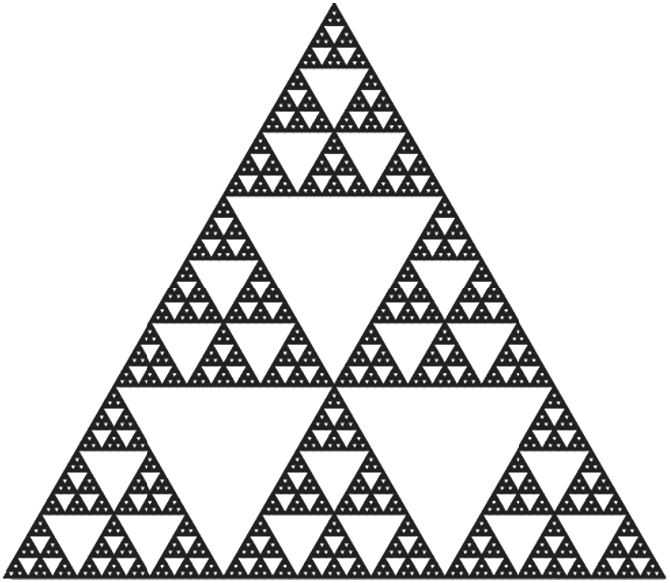
$SG_3$
 .

Figure 1 Long description
The diagram depicts a Sierpinski triangle, a fractal based on an equilateral triangle.
* The overall structure is a large equilateral triangle with its apex pointing upward.
* At the first level of recursion, the central area is a large white inverted equilateral triangle, which divides the original black triangle into three smaller black equilateral triangles located at the top, bottom-left, and bottom-right corners.
* At the second level, each of those three black triangles contains its own smaller white inverted triangle at its center, further subdividing them into nine even smaller black triangles.
* This recursive process continues through multiple iterations. Each black triangular area is composed of three smaller triangles around a central white void.
* At the smallest visible scale, the black areas appear as tiny dots or triangles, creating a complex, self-similar lattice pattern where the large-scale geometry is mirrored exactly in the microscopic details.
In [Reference Bajorin, Chen, Dagan, Emmons, Hussein, Khalil, Mody, Steinhurst and Teplyaev3], Bajorin et al. have described the spectrum of the discrete Laplacian on
$SG_3$
 (Figure 1), which is given by

and whose spectral decimation function is

with derivative,

Note that
$0,1,\frac {3}{4},\frac {5}{4} \in R^{-n}(0) \subseteq \sigma (\Delta _n)$
 . R also has a fixed point between
$1.30$
 and
$1.31$
 . A direct computation shows
$R'(0)=\frac {90}{7} < 23.542849 \approx \inf _{y \in [1.2,1.5]}R'(y)$
 . Hence, by Theorem 3.1, we must have that the infimum spacing in
$\sigma (\Delta )$
 is zero.
Theorem 3.3 Let
$\{\lambda _{n,k}\}_k\subseteq \sigma (\Delta _n)$
 be the complete list of distinct finite-level eigenvalues of
$\Delta _n$
 in increasing order. Then,

if and only if

Proof Using the notation in the previous theorem, note that for each n and k, we have that
$c_\Delta ^n\mathscr {R}(\lambda _{n,k})$
 and
$c_\Delta ^n\mathscr {R}(\lambda _{n,k+1})$
 are eigenvalues of
$\Delta $
 . Moreover,

Since
$\mathscr {R}'$
 is bounded and the factor
$c_\Delta ^n\vert {\lambda _{n,0}-\lambda _{n,1}}\vert $
 converges to
$\mathscr {R}(x)-\mathscr {R}(y)$
 for some
$x,y$
 , the reverse implication follows by taking the limit as
$n\to \infty $
 .
On the other hand, if
$\inf _{\lambda \neq \lambda ', \lambda ,\lambda '\in \sigma (\Delta )}\vert {\lambda -\lambda '}\vert =0$
 , then for each
$m\in \mathbb {N}$
 , there exist
$\lambda ,\lambda '\in \sigma (\Delta )$
 such that
$\vert {\lambda -\lambda '}\vert \leq \frac {1}{m}$
 . Now note that for any two distinct eigenvalues,
$\lambda ,\lambda '\in \sigma (\Delta )$
 , we may choose
$n\geq m$
 sufficiently large such that
$\lambda =c_\Delta ^n\mathscr {R}(\lambda _{n,j}), \lambda '=c_\Delta ^n\mathscr {R}(\lambda _{n,j'})$
 , and we have

The conclusion follows by letting n go to infinity.
3.2 Positive infimum spacing
The proof of the next result relies on the mean value theorem and induction. It is crucial for proving the main Theorem 3.5, which guarantees that the infimum spacing in the spectrum is positive under certain conditions. While it has many technical assumptions, to the author’s knowledge, all of them – except that
$R'(0)$
 is maximal – are satisfied in all examples of spectral decimation considered in [Reference Bajorin, Chen, Dagan, Emmons, Hussein, Khalil, Mody, Steinhurst and Teplyaev3, Reference Shima13].
Lemma 3.4 Assume
$\Delta $
 admits spectral decimation with spectral decimation function R, and suppose
$0$
 is a fixed point of R with
$\vert {R'(0)}\vert>1$
 .
Let
$D_0=\{0,x_1,\dots ,x_r\}$
 be a finite set with
$0<x_1<\cdots <x_r$
 . Suppose the interval
$[0,x_r]$
 is a backward invariant under R and the inverse branches
$\phi _j$
 of R are defined on all of this interval.
Assume further that
-
• $R^{-1}(0,x_r)\cap D_0 =\emptyset , \ \ R^{-1}\{0,x_r\}\subseteq D_0$
 and
-
• $R'(0) = \max _{x\in R^{-1}[0,x_r]}|R'(x)|$
,


and set
$D_n:= \cup _{m= 0}^n R^{-m}(D_0)$
 . Then, there is a constant
$C_0$
 , depending on
$D_0$
 , such that

Proof Let
$C_0 = min_k |x_k -x_{k-1}|, x_j \in D_0$
 . We know
$D_1= D_0 \cup R^{-1}(D_0)$
 . If
$x,y \in D_0, x\neq y$
 , then we obtain

If
$x \in D_0$
 and
$y\in R^{-1}(D_0)$
 , then
$y\in R^{-1}[0,x_r]$
 . Thus,
$y\in \phi _k[0,x_r]$
 , for some k. But
$R^{-1}(0,x_r)\cap D_0 = \emptyset , R^{-1}\{0,x_r\} \subseteq D_0$
 implies
$\vert {x-y}\vert \geq \min _{z\in \{0,x_r\}}\vert {y-\phi _k(z)}\vert $
 . For
$z\in \{0,x_r\}$
 , we have
$\left |\frac {R(y)-R(\phi _k(z))}{y-\phi _k(z)}\right |=\vert {R'(c)}\vert \leq R'(0)$
 , for some
$c\in \phi _k[0,x_r]$
 . Thus,
$\vert {y-\phi _k(z)}\vert \geq \frac {\vert {R(y)-R(\phi _k(z))}\vert }{R'(0)}\geq \frac {C_0}{R'(0)}.$

For
$x,y \in R^{-1}(D_0), x\neq y$
 : It suffices to assume
$x,y\in \phi _k[0,x_r]$
 , for some k, since
$\phi _j\{0,x_r\}\subseteq D_0$
 for all j. R is a bijection on this interval, which implies
$R(x) \neq R(y)$
 . We obtain

Thus,

The general case follows by induction and this completes the proof.
Theorem 3.5 Suppose there is
$D_0$
 , so that
$\sigma (\Delta _n) \subseteq D_n$
 for all n and
$R,D_n$
 satisfy the conditions of Lemma 3.4. Then,

Proof It follows from Lemma 3.4 that the spacings in
$\sigma (c_\Delta ^n\Delta _n)$
 are bounded below uniformly in n, where
$c_\Delta = R'(0)$
 . The conclusion follows.
Remark 3.6 Theorem 3.5 again holds for the Neumann eigenvalues of
$\Delta $
 .
Although the following examples are elementary, they are useful for understanding the results obtained in this section and how they apply to other complex scenarios.
Example 3.7 (
$SG$
 )
Alonso Ruiz shows in [Reference Alonso Ruiz1, Theorem 3] that

and

Thus, the infimum spacing between eigenvalues coincides with the spectral gap, which is positive.
Example 3.8 (I)
Since the spectrum of the Laplacian on I is explicit, a direct computation shows that the infimum spacing is again the spectral gap.
Note that the Dirichlet spectrum is given by
$\{\pi ^2k^2\}_{k=1}^\infty $
 . Hence, the spacing between successive eigenvalues is given by

which is increasing in k; hence, the infimum spacing is again the spectral gap, which occurs when
$k=1$
 . Thus,

Recall that the Neumann spectrum is given by
$\{\pi ^2k^2\}_{k=0}^\infty $
 . Thus, the spacing between successive eigenvalues is again given by
$\pi ^2(2k+1)$
 , which coincides with the Dirichlet case, with minimum occurring when
$k=0$
 . Thus,

Remark 3.9 Typically, to choose
$D_0$
 , one fixes a large n and sets
$D_0=R^{n}\sigma (\Delta _n)$
 .
Acknowledgments
I am deeply grateful to Alexander Teplyaev for his invaluable guidance while working on this project. I also acknowledge interesting conversations about some aspects of this work with Christopher Hayes, Luke Rogers, and Kasso Okoudjou.



 Open access

