For a self-sufficient, generalist ideography to arise, language must keep its hands to itself. The evolution of writing admits little chance of this. When writing systems diverge from the languages they are used to represent, as an ideography must, they frequently converge on properties of other natural languages. This suggests that language is not only the source of writing systems' self-sufficiency and generality, as Morin contends, but also that linguistic forces guide the development of such systems. Real though Morin's problem of standardisation is, the key challenge facing language-independent ideography – manifest in the evolution of writing and its comparative study – is the pervasiveness of language itself.
A defining property of syntax is recursion, that outputs can also be inputs (Berwick & Chomsky, Reference Berwick and Chomsky2017). Recursion is similarly key to ideograms, and other sign types. Signs that depict or suggest what they denote are a common trope in early-stage writing. These signs typically build on one another. Sumerian uses water in an enclosure to suggest “marsh”; Chinese uses the sun behind a tree to suggest “east” (Fig. 1). An ideography in which every sign differs substantively from every other is conceivable but not how ideograms in early scripts work.
Figure 1.Examples of ideography (Sumerian, Chinese).
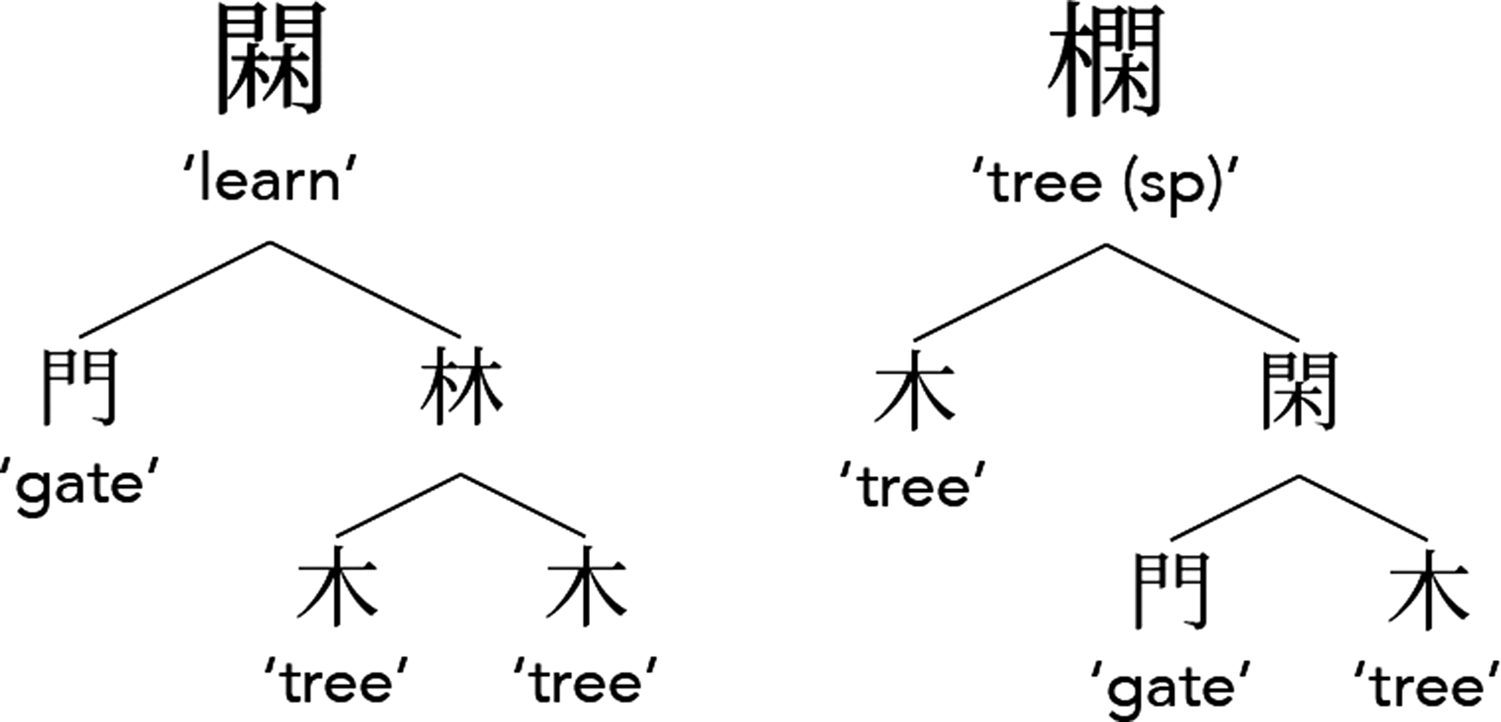
Recursion in ideography (and other logograms) is reminiscent of natural language both in degree and kind. Deep recursion is an overriding characteristic of Chinese signs, revealing hallmarks of natural language. Hierarchy matters in recursion. “Unlockable” is ambiguous between un-[lockable] “not capable of being locked” and [unlock]-able “capable of not being locked.” The same morphemes differently combined have different meanings. Equally, different combinations of a sign set are interpretatively distinct. “Tree,” “tree,” and “gate” combine into hierarchically distinct gate-[tree-tree] “learn” and tree-[gate-tree], a tree species (Fig. 2). These two signs are homophones, hence only semi-ideographic, but more purely ideographic examples exist.
Figure 2.Different hierarchical arrangements of the same inputs (Chinese).
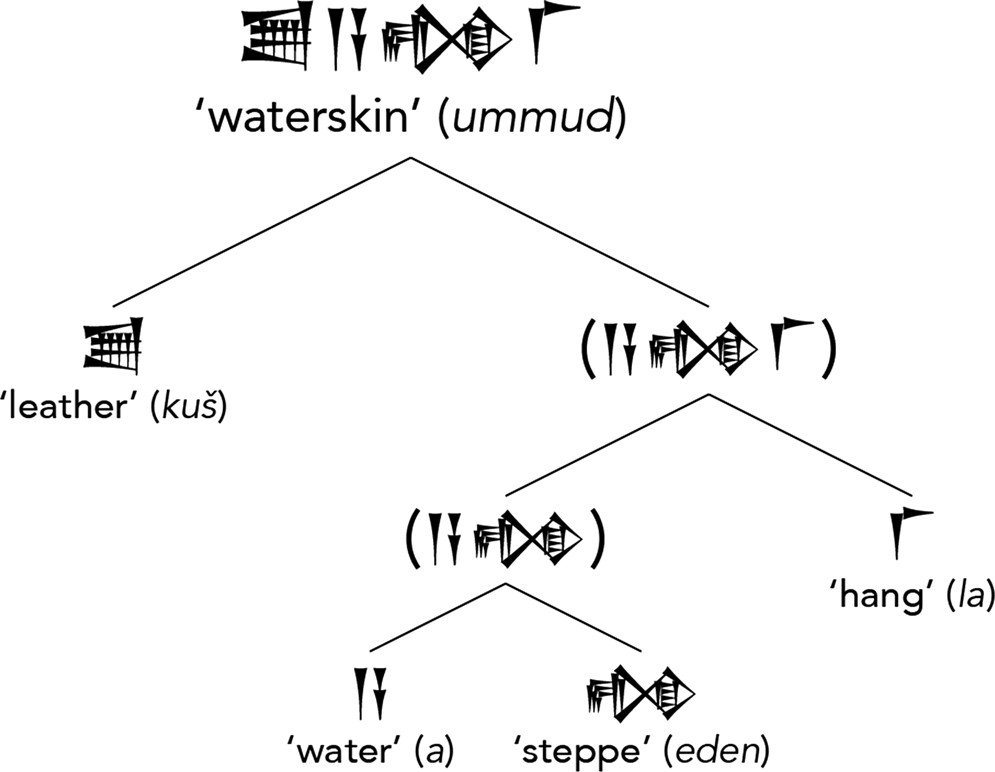
The Sumerian sign for “waterskin” comprises “leather,” “water,” “steppe,” and “hang” (Fig. 3). There is no phonetic relationship between ummud (“waterskin”) and its constituents, kuš, a, eden, la. This is ideography: Waterskins as leather hangers for water on steppes (Selz, Reference Selz, Feliu, Karahashi and Rubio2017). Rich in compounds, Sumerian had the left-headed noun–noun and right-headed agentive noun–verb compounds required for leather-[[water-steppe]-hanger]. Yet it used internally inflected phrases, not compounds, for items of this complexity (Jagersma, Reference Jagersma2010). Written, “waterskin” thus diverges from spoken Sumerian both in being a compound and in its degree of recursion. Deeply recursive compounding is found in natural languages, though (famously, Sanskrit; Lowe, Reference Lowe2015). Ideograms like “waterskin” thus extrapolate native constructions to converge on a foreign language's grammatical norms.
Figure 3.Compounding in ideography (Sumerian).
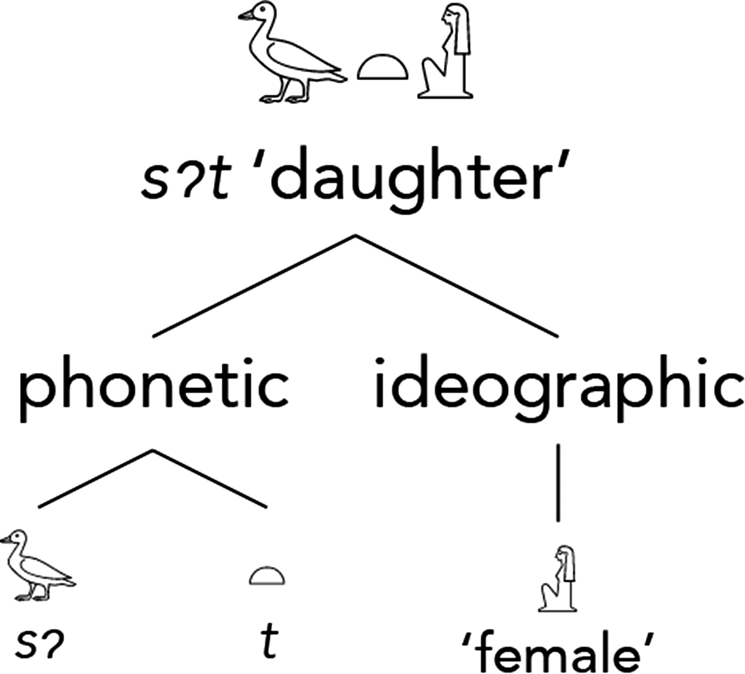
Ancient Egyptian ideography strikingly illustrates how grammar fills the gap that arises when writing diverges from the speech it was devised to record. In hieroglyphs, Egyptian nouns were typically followed by “determinatives.” These unpronounced glyphs categorised the preceding noun semantically. In sʔt “daughter” (Fig. 4), the phonetic glyphs sʔ and t are followed by “woman,” classifying the referent as female. Goldwasser and Grinevald (Reference Goldwasser, Grinevald, Grossman, Polis and Winand2012) observe that noun phrases in the Mayan language Jacaltec have this same structure: ix q'opoj “a/the girl” consist of q'opoj “girl” and ix “woman,” which also accompanies other human females. Written Egyptian has thus evolved to resemble a spoken language with noun classifiers though Egyptian was itself not a classifier language. (Jacaltec classifiers are prenominal and Egyptian determinatives postnominal, a point on which classifier languages vary; Aikhenvald, Reference Aikhenvald2000.)
Figure 4.Classification by ideography (Ancient Egyptian).
A syntax-centric view of sign formation has consequences. The dominant model of grammatical interaction in theoretical linguistics places syntax before morphology–phonology. The syntactic module builds structures absent of sound, and sound is supplied later in the morphological–phonological module. Despite their different modalities, spoken and signed languages have been shown to have analogous morphological and phonological properties (Brentari, Fenlon, & Cormier, Reference Brentari, Fenlon and Cormier2018). If sign inventories are constructed by syntactic recursion and then externalised via a hand-held implement, then the externalisation process is potentially subject to similar morphology- and phonology-like forces.
The most thoroughgoing explorations of parallels between natural language grammar and writing system structure are Myers (Reference Myers2019) and Meletis (Reference Meletis2020); the latter, a typological survey, the former, a study of Chinese characters. Both map extensive correlations between grammatical and graphic systems. For reasons of space, though, the next paragraphs offer briefer illustrations of, respectively, phonological and morphological parallels with writing systems.
Many languages have phonological minimal word constraints. These often apply to lexical but not functional vocabulary. From the irregular morass of English orthography, a minimality constraint has emerged at the graphic level (McCawley, Reference McCawley and Watt1994). In two- and three-letter homophone pairs, the shorter form is reserved for function words (by, or, we), the longer for lexical ones (bye, ore, wee). A different example of convergence on phonological norms is found in segmental order written in syllabic clusters, like Hangul (Korea) and Thaana (used to write Dhivehi; Maldives). These orthographic syllables obey rules familiar from syllabic structures in spoken languages but not always those of the spoken Korean and Dhivehi that they are used to write (Gnanadesikan, Reference Gnanadesikanin press).
Afroasiatic writing systems are renowned for frequent vowel omission. Given that many Afroasiatic grammatical properties are encoded vocalically, this omission simulates morphological impoverishment. The contrasts thus neutralised are ones that other languages simply lack, so writing divergent from speech again converges with other languages (Harbour, Reference Harbour and Haralambous2021). More broadly, the complexities of segment order in Brahmic scripts display many contrasts familiar from morphological theory, such as affixality, allomorphy, headedness, and affixal levels, whereas orientation in Canadian Aboriginal Syllabics appears analogous to “ion-morphs” in American Sign Language (Gnanadesikan, Reference Gnanadesikan2022).
Such morphological and phonological parallels with natural languages are expected if sign inventories are constructed by the syntactic module and externalised via pathways of spoken and signed languages. Hockett (Reference Hockett1960) famously observed that the coupling of meaning with the inherently meaningless (external gestures) is key to language. If sign systems exploit the generative infrastructure of language, for how long could a self-sufficient, generalist ideography keep both inherently meaningless, hence nonideographic, elements and the languages of its would-be users at bay?








 You have
Access
For a self-sufficient, generalist ideography to arise, language must keep its hands to itself. The evolution of writing admits little chance of this. When writing systems diverge from the languages they are used to represent, as an ideography must, they frequently converge on properties of other natural languages. This suggests that language is not only the source of writing systems' self-sufficiency and generality, as Morin contends, but also that linguistic forces guide the development of such systems. Real though Morin's problem of standardisation is, the key challenge facing language-independent ideography – manifest in the evolution of writing and its comparative study – is the pervasiveness of language itself.
A defining property of syntax is recursion, that outputs can also be inputs (Berwick & Chomsky, Reference Berwick and Chomsky2017). Recursion is similarly key to ideograms, and other sign types. Signs that depict or suggest what they denote are a common trope in early-stage writing. These signs typically build on one another. Sumerian uses water in an enclosure to suggest “marsh”; Chinese uses the sun behind a tree to suggest “east” (Fig. 1). An ideography in which every sign differs substantively from every other is conceivable but not how ideograms in early scripts work.
Examples of ideography (Sumerian, Chinese).
Recursion in ideography (and other logograms) is reminiscent of natural language both in degree and kind. Deep recursion is an overriding characteristic of Chinese signs, revealing hallmarks of natural language. Hierarchy matters in recursion. “Unlockable” is ambiguous between un-[lockable] “not capable of being locked” and [unlock]-able “capable of not being locked.” The same morphemes differently combined have different meanings. Equally, different combinations of a sign set are interpretatively distinct. “Tree,” “tree,” and “gate” combine into hierarchically distinct gate-[tree-tree] “learn” and tree-[gate-tree], a tree species (Fig. 2). These two signs are homophones, hence only semi-ideographic, but more purely ideographic examples exist.
Different hierarchical arrangements of the same inputs (Chinese).
The Sumerian sign for “waterskin” comprises “leather,” “water,” “steppe,” and “hang” (Fig. 3). There is no phonetic relationship between ummud (“waterskin”) and its constituents, kuš, a, eden, la. This is ideography: Waterskins as leather hangers for water on steppes (Selz, Reference Selz, Feliu, Karahashi and Rubio2017). Rich in compounds, Sumerian had the left-headed noun–noun and right-headed agentive noun–verb compounds required for leather-[[water-steppe]-hanger]. Yet it used internally inflected phrases, not compounds, for items of this complexity (Jagersma, Reference Jagersma2010). Written, “waterskin” thus diverges from spoken Sumerian both in being a compound and in its degree of recursion. Deeply recursive compounding is found in natural languages, though (famously, Sanskrit; Lowe, Reference Lowe2015). Ideograms like “waterskin” thus extrapolate native constructions to converge on a foreign language's grammatical norms.
Compounding in ideography (Sumerian).
Ancient Egyptian ideography strikingly illustrates how grammar fills the gap that arises when writing diverges from the speech it was devised to record. In hieroglyphs, Egyptian nouns were typically followed by “determinatives.” These unpronounced glyphs categorised the preceding noun semantically. In sʔt “daughter” (Fig. 4), the phonetic glyphs sʔ and t are followed by “woman,” classifying the referent as female. Goldwasser and Grinevald (Reference Goldwasser, Grinevald, Grossman, Polis and Winand2012) observe that noun phrases in the Mayan language Jacaltec have this same structure: ix q'opoj “a/the girl” consist of q'opoj “girl” and ix “woman,” which also accompanies other human females. Written Egyptian has thus evolved to resemble a spoken language with noun classifiers though Egyptian was itself not a classifier language. (Jacaltec classifiers are prenominal and Egyptian determinatives postnominal, a point on which classifier languages vary; Aikhenvald, Reference Aikhenvald2000.)
Classification by ideography (Ancient Egyptian).
A syntax-centric view of sign formation has consequences. The dominant model of grammatical interaction in theoretical linguistics places syntax before morphology–phonology. The syntactic module builds structures absent of sound, and sound is supplied later in the morphological–phonological module. Despite their different modalities, spoken and signed languages have been shown to have analogous morphological and phonological properties (Brentari, Fenlon, & Cormier, Reference Brentari, Fenlon and Cormier2018). If sign inventories are constructed by syntactic recursion and then externalised via a hand-held implement, then the externalisation process is potentially subject to similar morphology- and phonology-like forces.
The most thoroughgoing explorations of parallels between natural language grammar and writing system structure are Myers (Reference Myers2019) and Meletis (Reference Meletis2020); the latter, a typological survey, the former, a study of Chinese characters. Both map extensive correlations between grammatical and graphic systems. For reasons of space, though, the next paragraphs offer briefer illustrations of, respectively, phonological and morphological parallels with writing systems.
Many languages have phonological minimal word constraints. These often apply to lexical but not functional vocabulary. From the irregular morass of English orthography, a minimality constraint has emerged at the graphic level (McCawley, Reference McCawley and Watt1994). In two- and three-letter homophone pairs, the shorter form is reserved for function words (by, or, we), the longer for lexical ones (bye, ore, wee). A different example of convergence on phonological norms is found in segmental order written in syllabic clusters, like Hangul (Korea) and Thaana (used to write Dhivehi; Maldives). These orthographic syllables obey rules familiar from syllabic structures in spoken languages but not always those of the spoken Korean and Dhivehi that they are used to write (Gnanadesikan, Reference Gnanadesikanin press).
Afroasiatic writing systems are renowned for frequent vowel omission. Given that many Afroasiatic grammatical properties are encoded vocalically, this omission simulates morphological impoverishment. The contrasts thus neutralised are ones that other languages simply lack, so writing divergent from speech again converges with other languages (Harbour, Reference Harbour and Haralambous2021). More broadly, the complexities of segment order in Brahmic scripts display many contrasts familiar from morphological theory, such as affixality, allomorphy, headedness, and affixal levels, whereas orientation in Canadian Aboriginal Syllabics appears analogous to “ion-morphs” in American Sign Language (Gnanadesikan, Reference Gnanadesikan2022).
Such morphological and phonological parallels with natural languages are expected if sign inventories are constructed by the syntactic module and externalised via pathways of spoken and signed languages. Hockett (Reference Hockett1960) famously observed that the coupling of meaning with the inherently meaningless (external gestures) is key to language. If sign systems exploit the generative infrastructure of language, for how long could a self-sufficient, generalist ideography keep both inherently meaningless, hence nonideographic, elements and the languages of its would-be users at bay?
Acknowledgments
The author thanks David Adger, Amalia Gnanadesikan, Yukiko Miller, and James Myers.
Competing interest
None.