Dialogues are joint activities (Clark, Reference Clark1996; Pickering & Garrod, Reference Pickering and Garrod2021), where interlocutors act in coordination, constantly switching their conversational roles from speaker to addressee and providing each other with feedback, which ultimately supports mutual comprehension. In SMS dialogues, such feedback can involve ideographs – smiling faces, thumbs-up, question marks, cartoon airplanes, or actual photographs or gifs. Here we expand on the standardization account predictions for the use of ideography in the age of digital communication (target article, sect. 6.4), by focusing on the role interlocutors take when using it in dialogues.
In face-to-face dialogues, interlocutors produce cospeech gestures, including head movements and hand and facial gestures (see Bavelas, Reference Bavelas2022). In Clark's terms (Reference Clark1996, p. 155; following Peirce, Reference Peirce1932), interlocutors produce linguistic or nonlinguistic signals (e.g., waving at someone or saying “Hello”) or a combination of both (e.g., waving at someone, while saying “Hello”). Signals can include signs that relate to objects by convention (symbols, e.g., nodding to accept a request or using the word “dog” to refer to a specific animal), by resembling the objects they refer to (icons, e.g., drawing a notebook in the air while saying “Can you hand me the notebook?”), or by having a causal relationship with them (indexes, e.g., demonstrating writing while saying “Can you hand me the notebook?”).
In SMS dialogues, similarly to iconic gestures, ideographs can be embedded in main contributors' utterances (e.g., “John was caught cheating and looked  ” – i.e., meaning John was embarrassed), or they can add information to a complete utterance (e.g., “John was caught cheating and looked embarrassed ” – i.e., meaning the writer is annoyed with John's action and attitude). In both examples, the emoji do not make sense without the linguistic context – the emoji are dependent on the words in the SMS. In the first example, the text is incomplete without the emoji, whereas in the second example the text is complete, and the emoji adds an additional message (see Grosz, Kaiser, & Pierini, Reference Grosz, Kaiser and Pierini2021, for analysis).
Alternatively, ideographs can function in the same way as symbolic gestures, acting as substitutes for atomic words (i.e., words that need not be embedded in syntactic structures to form full utterances, such as “Yes” or “Hello”; Clark, Reference Clark1996, p. 163). So, the word “Yes” can be replaced by an actual thumbs-up in face-to-face communication or by a thumbs-up emoji in SMS. And like such gestures, addressees can use ideographs to provide complete feedback, indicating understanding or failure to understand, and regulating turn taking (Sacks, Schegloff, & Jefferson, Reference Sacks, Schegloff and Jefferson1974).
In face-to-face dialogues, addressees often indicate understanding (or alignment) by producing brief linguistic feedback (e.g., “Yeah”) or nonlinguistic feedback (e.g., nodding) and misunderstanding by producing equally brief contributions (e.g., “Eh?”), specific or generic questions (e.g., “Which one?” or “Who?”), or movements (e.g., frowning). Moreover, addressees are often good at indicating where the problem is (Dingemanse et al., Reference Dingemanse, Roberts, Baranova, Blythe, Drew, Floyd and Enfield2015): If a person with two sisters, one with blond and one with dark hair, says “I visited my sister in Vienna,” their addressee might ask “The blond one?” rather than “Who?,” to indicate that the locus of difficulty is the identity of the referent. Critically, addressees need not interrupt main contributors to provide feedback: They can use backchannels (Yngve, Reference Yngve1970), which have been shown to influence the quality, shape, and timing of speakers' utterances (Bavelas, Coates, & Johnson, Reference Bavelas, Coates and Johnson2000; Tolins & Fox Tree, Reference Tolins and Fox Tree2014). Speakers use the feedback provided by their addressees to adjust their plans, to retain or vacate the floor to their interlocutor, and to repair their contributions on the fly, as the dialogue unfolds (Pickering & Garrod, Reference Pickering and Garrod2021, Ch. 5).
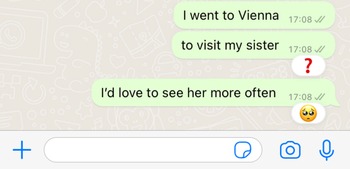
Historically, the type of feedback that printed communication (e.g., letters, emails, post-its) allowed was produced slowly or limited to typewritten characters. However, current platforms for instant messaging (WhatsApp, Telegram, Slack, Teams, etc.) support flexible and highly informative forms of feedback that approximate to what happens in face-to-face interactions. Not only can addressees reply to main contributors' turns almost instantly in a subsequent turn (often called replies), but they can also comment on distinct turns by using just ideographs (often called reactions). As backchannels, reactions allow addressees to indicate the source of the problem, without interrupting the main contributor (see Fig. 1 for an example: While the first emoji indicates misunderstanding, the second might express empathy and neither of those interrupts the main contributor).
Figure 1.Example of reactions in SMS dialogue.
Ideographs can thus play the same role as face-to-face feedback: First, they can provide generic or specific evidence of understanding. Writers can use conventional positive or negative ideographs (e.g., , or , ) to provide generic feedback or combine ideographs (e.g., using and instead of typing “The blond one?”) to provide specific feedback, which indicates exactly what needs to be repaired (see some examples of conventionalized pairs of emoji in Gawne & McCulloch, Reference Gawne and McCulloch2019). Second, emoji can regulate turn taking by allowing addressees to provide feedback without interrupting the main contributors. Interestingly, in group chats, attendees either can show agreement by texting individual contributions or can just wait for one of the addressees to add a reaction (e.g., ), and just click on it, which results in a sum of all the clicks (e.g., for five clicks).
In summary, ideographs are used flexibly in SMS: When used by the main contributors, they can be incorporated into the utterance or can serve as an additional but dependent contribution, but they cannot replace the main linguistic contribution. When used by the addressees, they can serve as a complete contribution in their own right, and function as feedback to the main contribution. Analysing SMS interactions from the perspective of dialogue, we support the standardization account in predicting an evolution of ideographic language, but only when such language comprises feedback, and not main contributions. This might explain why the ideographs that are usually associated with – more generic – feedback seem to be the ones with established conventional meaning (e.g., or ).






 You have
Access
Dialogues are joint activities (Clark, Reference Clark1996; Pickering & Garrod, Reference Pickering and Garrod2021), where interlocutors act in coordination, constantly switching their conversational roles from speaker to addressee and providing each other with feedback, which ultimately supports mutual comprehension. In SMS dialogues, such feedback can involve ideographs – smiling faces, thumbs-up, question marks, cartoon airplanes, or actual photographs or gifs. Here we expand on the standardization account predictions for the use of ideography in the age of digital communication (target article, sect. 6.4), by focusing on the role interlocutors take when using it in dialogues.
In face-to-face dialogues, interlocutors produce cospeech gestures, including head movements and hand and facial gestures (see Bavelas, Reference Bavelas2022). In Clark's terms (Reference Clark1996, p. 155; following Peirce, Reference Peirce1932), interlocutors produce linguistic or nonlinguistic signals (e.g., waving at someone or saying “Hello”) or a combination of both (e.g., waving at someone, while saying “Hello”). Signals can include signs that relate to objects by convention (symbols, e.g., nodding to accept a request or using the word “dog” to refer to a specific animal), by resembling the objects they refer to (icons, e.g., drawing a notebook in the air while saying “Can you hand me the notebook?”), or by having a causal relationship with them (indexes, e.g., demonstrating writing while saying “Can you hand me the notebook?”).
In SMS dialogues, similarly to iconic gestures, ideographs can be embedded in main contributors' utterances (e.g., “John was caught cheating and looked ” – i.e., meaning John was embarrassed), or they can add information to a complete utterance (e.g., “John was caught cheating and looked embarrassed
 ” – i.e., meaning the writer is annoyed with John's action and attitude). In both examples, the emoji do not make sense without the linguistic context – the emoji are dependent on the words in the SMS. In the first example, the text is incomplete without the emoji, whereas in the second example the text is complete, and the emoji adds an additional message (see Grosz, Kaiser, & Pierini, Reference Grosz, Kaiser and Pierini2021, for analysis).
Alternatively, ideographs can function in the same way as symbolic gestures, acting as substitutes for atomic words (i.e., words that need not be embedded in syntactic structures to form full utterances, such as “Yes” or “Hello”; Clark, Reference Clark1996, p. 163). So, the word “Yes” can be replaced by an actual thumbs-up in face-to-face communication or by a thumbs-up emoji in SMS. And like such gestures, addressees can use ideographs to provide complete feedback, indicating understanding or failure to understand, and regulating turn taking (Sacks, Schegloff, & Jefferson, Reference Sacks, Schegloff and Jefferson1974).
In face-to-face dialogues, addressees often indicate understanding (or alignment) by producing brief linguistic feedback (e.g., “Yeah”) or nonlinguistic feedback (e.g., nodding) and misunderstanding by producing equally brief contributions (e.g., “Eh?”), specific or generic questions (e.g., “Which one?” or “Who?”), or movements (e.g., frowning). Moreover, addressees are often good at indicating where the problem is (Dingemanse et al., Reference Dingemanse, Roberts, Baranova, Blythe, Drew, Floyd and Enfield2015): If a person with two sisters, one with blond and one with dark hair, says “I visited my sister in Vienna,” their addressee might ask “The blond one?” rather than “Who?,” to indicate that the locus of difficulty is the identity of the referent. Critically, addressees need not interrupt main contributors to provide feedback: They can use backchannels (Yngve, Reference Yngve1970), which have been shown to influence the quality, shape, and timing of speakers' utterances (Bavelas, Coates, & Johnson, Reference Bavelas, Coates and Johnson2000; Tolins & Fox Tree, Reference Tolins and Fox Tree2014). Speakers use the feedback provided by their addressees to adjust their plans, to retain or vacate the floor to their interlocutor, and to repair their contributions on the fly, as the dialogue unfolds (Pickering & Garrod, Reference Pickering and Garrod2021, Ch. 5).
Historically, the type of feedback that printed communication (e.g., letters, emails, post-its) allowed was produced slowly or limited to typewritten characters. However, current platforms for instant messaging (WhatsApp, Telegram, Slack, Teams, etc.) support flexible and highly informative forms of feedback that approximate to what happens in face-to-face interactions. Not only can addressees reply to main contributors' turns almost instantly in a subsequent turn (often called replies), but they can also comment on distinct turns by using just ideographs (often called reactions). As backchannels, reactions allow addressees to indicate the source of the problem, without interrupting the main contributor (see Fig. 1 for an example: While the first emoji indicates misunderstanding, the second might express empathy and neither of those interrupts the main contributor).
Example of reactions in SMS dialogue.
Ideographs can thus play the same role as face-to-face feedback: First, they can provide generic or specific evidence of understanding. Writers can use conventional positive or negative ideographs (e.g., ,
 or
 ,
 ) to provide generic feedback or combine ideographs (e.g., using
 and
 instead of typing “The blond one?”) to provide specific feedback, which indicates exactly what needs to be repaired (see some examples of conventionalized pairs of emoji in Gawne & McCulloch, Reference Gawne and McCulloch2019). Second, emoji can regulate turn taking by allowing addressees to provide feedback without interrupting the main contributors. Interestingly, in group chats, attendees either can show agreement by texting individual contributions or can just wait for one of the addressees to add a reaction (e.g.,
 ), and just click on it, which results in a sum of all the clicks (e.g.,
 for five clicks).
In summary, ideographs are used flexibly in SMS: When used by the main contributors, they can be incorporated into the utterance or can serve as an additional but dependent contribution, but they cannot replace the main linguistic contribution. When used by the addressees, they can serve as a complete contribution in their own right, and function as feedback to the main contribution. Analysing SMS interactions from the perspective of dialogue, we support the standardization account in predicting an evolution of ideographic language, but only when such language comprises feedback, and not main contributions. This might explain why the ideographs that are usually associated with – more generic – feedback seem to be the ones with established conventional meaning (e.g., or
 ).
Financial support
This project has received funding from the European Union's Horizon 2020 research and innovation programme under the Marie Skłodowska-Curie grant agreement (grant no. 859588).
Competing interest
None.