1 Introduction
Let S be either a regular local ring, or the polynomial ring
$S=K[x_1,\dots ,x_n]$
 over a field K, and let
$I\subset S$
 be an ideal. We say that I is Cohen–Macaulay if
$S/I$
 is a Cohen–Macaulay ring. Assume, moreover, that I is radical. Then, a classical result in commutative algebra guarantees that I is a complete intersection if and only if
$I^k$
 is Cohen–Macaulay for infinitely many k. This result was proved in the late seventies, more or less independently, by Achilles and Vogel in [Reference Achilles and Vogel1], by Cowsik and Nori in [Reference Cowsik and Nori7], and by Waldi in [Reference Waldi43].
In particular, let
$I=I(G)$
 be the edge ideal of a finite simple graph G on the vertex set
$\{x_1,\dots ,x_n\}$
 , that is, the ideal in the polynomial ring
$S=K[x_1,\dots ,x_n]$
 generated by those monomials
$x_ix_j$
 for which
$\{x_i,x_j\}$
 is an edge. Hereafter, we will say that G is a Cohen–Macaulay graph, if
$I(G)$
 is Cohen–Macaulay. We have that
$I(G)$
 is a radical ideal, and the aforementioned result implies that all powers
$I(G)^k$
 are Cohen–Macaulay if and only if
$E(G)$
 consists of disjoint edges.
The situation becomes more interesting if one turns its attention to other kind of powers. The first paper in this direction [Reference Minh and Trung34], written by Minh and Trung, characterizes those unmixed two-dimensional monomial ideals
$I\subset S$
 whose (almost) all symbolic powers
$I^{(k)}$
 are Cohen–Macaulay. After the appearance of this article, many researchers tried to characterize all those unmixed monomial ideals
$I\subset S$
 whose (almost) all symbolic powers are Cohen–Macaulay, culminating with the beautiful solution due, independently, to Minh and Trung [Reference Minh and Trung35], and Varbaro [Reference Varbaro42]. Writing any squarefree monomial ideal I as the Stanley–Reisner ideal
$I_\Delta $
 of a simplicial complex
$\Delta $
 , the aforementioned authors proved, independently, that
$I_\Delta ^{(k)}$
 is Cohen–Macaulay for all
$k\gg 0$
 if and only if
$\Delta $
 is a matroid.
Very recently, in [Reference Bigdeli, Herzog and Zaare-Nahandi3, Reference Erey, Herzog, Hibi and Saeedi Madani17], the concept of squarefree power was introduced. Subsequently, this concept was extended to all monomial ideals with the introduction of matching powers [Reference Erey and Ficarra16] (see also [Reference Crupi, Ficarra and Lax11, Reference Das, Roy and Saha13, Reference Erey and Ficarra15, Reference Erey, Herzog, Hibi and Saeedi Madani18, Reference Erey and Hibi19, Reference Ficarra21, Reference Ficarra, Herzog and Hibi22, Reference Kamberi, Navarra and Qureshi30, Reference Seyed Fakhari37–Reference Seyed Fakhari40]). Hereafter, we always refer to this generalized concept. Let
$I\subset S$
 be a monomial ideal, and let
$\mathcal {G}(I)$
 be its minimal monomial generating set. The kth matching power of I is the monomial ideal generated by the products
$u_1\ldots u_k$
 , where the
$u_i\in \mathcal {G}(I)$
 form a regular sequence. In other words,
$\text {supp}(u_i)\cap \text {supp}(u_j)=\emptyset $
 for all
$1\le i<j\le k$
 , where the support of a monomial
$w\in S$
 is defined as the set
$\text {supp}(w)=\{x_i:x_i\ \text {divides}\ w\}$
 . Moreover, the monomial grade of I is defined as
$\nu (I)=\max \{k:I^{[k]}\ne 0\}$
 . A matching of G is a family of pairwise disjoint edges of G. Let
$\nu (G)$
 be the maximum size of a matching of G. Then, it is easy to see that
$\nu (I(G))=\nu (G)$
 . Furthermore, the generators of
$I(G)^{[k]}$
 correspond to the vertex sets of the k-matchings of G, which motivates the choice to name the ideals
$I^{[k]}$
 the matching powers of I. Our goal is to identify and classify those monomial ideals
$I\subset S$
 whose matching powers
$I^{[k]}$
 are Cohen–Macaulay, for all
$1\le k\le \nu (I)$
 .
Recently, in [Reference Das, Roy and Saha13], Das et al. proved that
$I(G)^{[k]}$
 is Cohen–Macaulay for all
$1\le k\le \nu (G)$
 , if G is a Cohen–Macaulay forest. Moreover, it is proven in [Reference Erey and Ficarra16] and [Reference Erey and Ficarra15] that
$I(G)^{[\nu (G)]}$
 is a polymatroidal ideal for any graph G. By a result due to Herzog and Hibi [Reference Herzog and Hibi26], the Cohen–Macaulay polymatroidal ideals are of very special nature. These two facts suggest that there should be a pleasant theory regarding the Cohen–Macaulayness of the matching powers of an edge ideal. This is what we consider in this article. More precisely, we study when all matching powers of
$I(G)$
 are Cohen–Macaulay. We characterize such graphs G when G has a perfect matching and the
$(\nu (G)-1)$
 th matching power of
$I(G)$
 has height
$2$
 . These conditions are fulfilled when G is a Cohen–Macaulay very well-covered graph. Chordal graphs and Cameron–Walker graphs are other families for which we give such characterization. We will also discuss the situation for the graphs having up to seven vertices.
The article is structured as follows. In Section 2, we investigate the hereditary nature of the Cohen–Macaulay property of
$I(G)^{[k]}$
 . It is shown that if
$I(G)^{[k]}$
 possesses the Cohen–Macaulay property, then so does
$I(G')^{[k]}$
 , where
$G'$
 is either the subgraph
$G\setminus N_G[x]$
 for any vertex x of G or a connected component of G (see Theorem 2.5 and Corollary 2.6). Another main result in this section is Theorem 2.8, which gives a purely combinatorial characterization for the edge ideals whose last non-vanishing matching power is Cohen–Macaulay. More precisely, it is shown that
$I(G)^{[\nu (G)]}$
 is Cohen–Macaulay if and only if either G has a perfect matching, or
$G\setminus \{i\}$
 has a perfect matching of size
$|V(G)|-1$
 for all
$i\in V(G)$
 . This result can be seen as an algebraic analog of the famous Tutte theorem in classical graph theory [Reference Tutte41]. Recall that Tutte’s theorem gives necessary and sufficient graph-theoretic conditions for a graph to admit a perfect matching. Similarly, Theorem 2.8 characterizes the existence of a perfect (or near-perfect) matching through an algebraic property of the squarefree power
$I(G)^{[\nu (G)]}$
 . The characterization given in Theorem 2.8 plays an important role in the study of edge ideals of graphs whose all matching powers are Cohen–Macaulay.
In Section 3, we concentrate our attention on the family of graphs which admit a perfect matching. In Theorem 3.2, we characterize the graphs G from this family for which all matching powers
$I(G)^{[k]}$
 are Cohen–Macaulay, provided that
$\dim S/I(G)^{[\nu (G)-1]}=|V(G)|-2$
 . This dimension can take only the two values
$|V(G)|-2$
 and
$|V(G)|-3$
 , as is shown in Lemma 3.4. To prove Theorem 3.2, we use the Hilbert–Burch theorem and a well-known result from graph theory on the characterization of trees. An interesting family of graphs which meets the conditions of Theorem 3.2 is the family of the Cohen–Macaulay very well-covered graphs. Using a characterization of this family due to Crupi et al. [Reference Crupi, Rinaldo and Terai12], in Proposition 3.7, we give a formula for the dimension of
$S/I(G)^{[k]}$
 for all k. In particular, when
$k=\nu (G)-1$
 , this dimension is
$|V(G)|-2$
 . So, applying our main theorem to this family we get Corollary 3.8, which shows that the only very well-covered graphs for which all matching powers of their edge ideals are Cohen–Macaulay are only the Cohen–Macaulay forests. Bipartite graphs and whisker graphs are subfamilies of very well-covered graphs. Applying our result to these families, we obtain the analogous characterizations (see Corollaries 3.9 and 3.10). We close this section by obtaining the normalized depth function of edge ideals of very well-covered graphs G such that
$I(G)^{[k]}$
 is Cohen–Macaulay, for all
$1\le k\le \nu (G)$
 (see Corollary 3.11).
In Section 4, we answer our question on Cohen–Macaulay matching powers for the family of chordal graphs and Cameron–Walker graphs. For chordal graphs, we use a result by Herzog et al. [Reference Herzog, Hibi and Zheng28] which characterizes Cohen–Macaulay chordal graphs. In Theorem 4.1, we prove that all matching powers of the edge ideal of a chordal graph are Cohen–Macaulay if and only if G is either a complete graph or a Cohen–Macaulay forest. Using the characterizations given for chordal graphs and bipartite graphs, in Theorem 4.5, we answer our question for the family of Cameron–Walker graphs.
In the final Section 5, using the Macaulay2 [Reference Grayson and Stillman25] packages, NautyGraphs [Reference McKay and Piperno33], and MatchingPowers [Reference Ficarra21], we determined, up to isomorphism, all graphs G with a small number of vertices for which
$I(G)^{[k]}$
 is Cohen–Macaulay for all
$1\le k\le \nu (G)$
 . Our experiments would indicate that among the graphs on
$n\ge 5$
 non-isolated vertices, besides the complete graphs and the Cohen–Macaulay forests, there are only two extra graphs, up to isomorphism, for which the matching powers of their edge ideal is Cohen–Macaulay for all k. Furthermore, we expect that such a classification does not depend on the underlying field K of the polynomial ring
$S=K[x_i:i\in V(G)]$
 .
2 Cohen–Macaulayness of matching powers of edge ideals
Throughout this article, G is a finite simple graph, K is a fixed field, and
$S=K[x_i: x_i\in V(G)]$
 is a polynomial ring over K. Since the edge ideal of G does not change by removing isolated vertices, we may extra assume that G has no isolated vertices. We denote the vertex set of G by
$V(G)$
 and the edge set by
$E(G)$
 . In this section, we show that the Cohen–Macaulayness of a matching power of
$I(G)$
 is inherited by its connected components and by its subgraphs
$G\setminus N_G[x]$
 for any vertex x of G. Moreover, we characterize those edge ideals whose last non-vanishing matching power is Cohen–Macaulay.
Recall that for a vertex
$x_i\in V(G)$
 , the sets

are called the open neighborhood and the closed neighborhood of
$x_i$
 in G.
The following lemma is needed for the proof of Theorem 2.5.
Lemma 2.1 Let
$I\subset S$
 be a monomial ideal and
$u\in S$
 be a monomial with
$u\notin I$
 . If
$S/I$
 is Cohen–Macaulay, then
$S/(I:u)$
 is Cohen–Macaulay and moreover
$\text {depth}\ S/I=\text {depth}\ S/(I:u)$
 .
Proof By [Reference Caviglia, Hà, Herzog, Kummini, Terai and Trung6, Lemma 4.1],
$\text {depth}\ S/I\leq \text {depth}\ S/(I:u)$
 . Combining this with the inequalities
$\text {depth}\ S/(I:u)\leq \dim S/(I:u)\leq \dim S/I$
 implies the assertion.
For what follows, we need to recall some concepts and results from [Reference Eliahou and Kervaire14, Reference Francisco, Ha and Van Tuyl23]. Let
$I\subset S$
 be a monomial ideal. By
$\mathcal {G}(I)$
 , we denote the unique minimal set of monomial generators of I. Let
$J,L\subset S$
 be monomial ideals such that
$\mathcal {G}(I)$
 is the disjoint union of
$\mathcal {G}(J)$
 and
$\mathcal {G}(L)$
 . Following [Reference Francisco, Ha and Van Tuyl23], we say that
$I=J+L$
 is a Betti splitting if

Consider the natural short exact sequence

By [Reference Francisco, Ha and Van Tuyl23, Proposition 2.1], Equation (2.1) holds if and only if the induced maps

in the
$\text {Tor}$
 exact sequence arising from the above sequence are zero for all
$i\ge 0$
 . In this case, we say that the inclusion map
$J\cap L\rightarrow J\oplus L$
 is
$\text {Tor}$
 -vanishing. The next result appeared implicitly firstly in [Reference Eliahou and Kervaire14, Proposition 3.1] (see also [Reference Nguyen and Vu36, Lemma 4.2]).
Proposition 2.2 Let
$J,L\subset S$
 be nonzero monomial ideals with
$J\subset L$
 . Suppose there exists a map
$\varphi :\mathcal {G}(J)\rightarrow \mathcal {G}(L)$
 such that for any
$\emptyset \ne \Omega \subseteq \mathcal {G}(J)$
 we have

where
$\mathfrak {m}=(x_1,x_2,\dots ,x_n)$
 . Then, the inclusion map
$J\rightarrow L$
 is
$\text {Tor}$
 -vanishing.
For a monomial ideal
$I\subset S$
 , we denote by
$\partial ^* I$
 the ideal generated by the elements of the form
$u/x_i$
 , where
$u\in \mathcal {G}(I)$
 , and
$x_i$
 is a variable dividing u. The following result was proved in [Reference Nguyen and Vu36, Proposition 4.4].
Lemma 2.3 Let
$J,L\subset S$
 be nonzero monomial ideals. Suppose that
$\partial ^* J\subseteq L$
 . Then,
$J\subseteq \mathfrak {m}L$
 and there exists a map
$\varphi :\mathcal {G}(J)\rightarrow \mathcal {G}(L)$
 satisfying the assumption of Proposition 2.2. In particular, the inclusion map
$J\rightarrow L$
 is
$\text {Tor}$
 -vanishing.
Lemma 2.4 Let G be a graph,
$1\le k\le \nu (G)$
 be an integer, and
$x\in V(G)$
 be a vertex. Then,

If
$I(G\setminus N_G[x])^{[k]}\neq 0$
 , then this decomposition is a Betti splitting, and in particular,

Proof Equation (2.3) was proved in [Reference Das, Roy and Saha13, Lemma 2.9(ii)]. To simplify our discussion, we set
$I=(I(G)^{[k]}:x)$
 ,
$J=\sum _{y\in N_G(x)} yI(G\setminus \{x,y\})^{[k-1]}$
 ,
$L=I(G\setminus N_G[x])^{[k]}$
 , and we assume, up to a relabeling, that
$N_G(x)=\{y_1,\dots ,y_m\}$
 .
Firstly, we notice that
$\mathcal {G}(I)$
 is the disjoint union of
$\mathcal {G}(J)$
 and
$\mathcal {G}(L)$
 . Indeed, all the minimal generators of J are monomials of degree
$2k-1$
 and are divided by some variable
$y_i$
 , whereas each minimal generator of L is a monomial of degree
$2k$
 and is not divided by
$y_i$
 , for all
$1\le i\le m$
 .
Now, we compute
$J\cap L$
 . We have

Here, in the second equality, we used that
$y_i$
 does not divide any generator of
$I(G\setminus N_G[x])^{[k]}$
 , and in the third equality we used, for
$1\le i\le m$
 , the chain of inclusions
$I(G\setminus N_G[x])^{[k]}\subset I(G\setminus N_G[x])^{[k-1]}\subseteq I(G\setminus \{x,y_i\})^{[k-1]}$
 .
To prove that the inclusion map
$J\cap L\rightarrow J\oplus L$
 is
$\text {Tor}$
 -vanishing, it is enough to show that the inclusion maps
$J\cap L\rightarrow J$
 and
$J\cap L\rightarrow L$
 are
$\text {Tor}$
 -vanishing.
Notice that
$\partial ^* I(G\setminus N_G[x])^{[k]}\subset I(G\setminus N_G[x])^{[k-1]}\subseteq \sum _{i=1}^mI(G\setminus \{x,y_i\})^{[k-1]}$
 . Therefore, by Lemma 2.3, there exists a map

such that for every non-empty subset
$\Omega \subseteq \mathcal {G}(I(G\setminus N_G[x])^{[k]})$
 , we have

where
$\mathfrak {m}$
 is the graded maximal ideal of S.
Each minimal generator of
$J\cap L=(y_1,\dots ,y_m)L$
 is of the form
$y_iu$
 with
$1\le i\le m$
 and
$u\in \mathcal {G}(I(G\setminus N_G[x])^{[k]})$
 . Now, we define a map
$\Phi :\mathcal {G}(J\cap L)\rightarrow \mathcal {G}(J)$
 by setting
$\Phi (y_iu)=y_i\varphi (u)$
 . It is clear that
$\Phi (y_iu)\in \mathcal {G}(J)$
 . Let
$\Omega =\{y_{i_\ell }u_\ell \}_\ell \subseteq \mathcal {G}(J\cap L)$
 be non-empty. Then,

Thus, Proposition 2.2 implies that
$J\cap L\rightarrow J$
 is
$\text {Tor}$
 -vanishing.
To prove that
$J\cap L\rightarrow L$
 is
$\text {Tor}$
 -vanishing, notice that
$J\cap L=(y_1,\dots ,y_m)L$
 and that the variables
$y_i$
 do not divide any minimal generator of L. Therefore, we can define a map
$\Psi :\mathcal {G}(J\cap L)\rightarrow \mathcal {G}(L)$
 by setting
$\Psi (y_iu)=u$
 for all
$1\le i\le m$
 and all
$u\in \mathcal {G}(L)$
 . It is clear that this map satisfies the condition in Proposition 2.2, and so the map
$J\cap L\rightarrow L$
 is
$\text {Tor}$
 -vanishing.
Hence, Equation (2.3) is indeed a Betti splitting. It follows from Equation (2.1) that

Since
$J\cap L=(y_1,\dots ,y_m)L$
 , we have
$\text {depth}\ S/(J\cap L)=\text {depth}\ S/L-(m-1)$
 . Therefore, it follows that

Since
$m=|N_G(x)|$
 , the proof is complete.
As a consequence, we obtain the following useful permanence property.
Theorem 2.5 Let G be a graph and
$1\le k\le \nu (G)$
 be an integer. If
$I(G)^{[k]}$
 is Cohen–Macaulay, then
$I(G\setminus N_G[x])^{[k]}$
 is Cohen–Macaulay, for any vertex
$x\in V(G)$
 .
Proof Consider a vertex
$x\in V(G)$
 . We may assume that
$I(G\setminus N_G[x])^{[k]}\neq 0$
 . Then, by Lemma 2.4, we have

Since
$I(G)^{[k]}$
 is Cohen–Macaulay, by Lemma 2.1, we have

From this fact and the assumption that
$I(G)^{[k]}$
 is Cohen–Macaulay, we get that
$\dim S/I(G\setminus N_G[x])^{[k]}-|N_G(x)|\geq \dim S/I(G)^{[k]}$
 . We show that indeed

Let
$N_G(x)=\{y_1,\ldots ,y_m\}$
 , and let
$P\subset S$
 be a monomial prime ideal such that
$I(G\setminus N_G[x])^{[k]}\subseteq P$
 . Then, one can see that
$I(G)^{[k]}\subset (y_1,\ldots ,y_m,P)$
 . Since any minimal prime ideal of
$I(G\setminus N_G[x])^{[k]}$
 is a monomial ideal generated by variables, it follows that
$\text {height}\,I(G)^{[k]}\leq \text {height}\,I(G\setminus N_G[x])^{[k]}+|N_G(x)|$
 . This shows the equality (2.4). Thus, we obtain

Hence,
$I(G\setminus N_G[x])^{[k]}$
 is Cohen–Macaulay, as desired.
The following result is an immediate consequence of Theorem 2.5.
Corollary 2.6 Let G be a graph with the connected components
$G_1,\ldots ,G_m$
 , and let
$1\le k\le \nu (G)$
 be an integer. If
$I(G)^{[k]}$
 is Cohen–Macaulay, then
$I(G_i)^{[k]}$
 is Cohen–Macaulay for all i.
The converse of Corollary 2.6 does not hold in general.
Example 2.7 Let G be a graph with the connected components
$K_2$
 and
$K_3$
 , where
$K_n$
 denotes the complete graph on n vertices. Then,
$I(G)$
 is Cohen–Macaulay, but
$I(G)^{[2]}$
 is not Cohen–Macaulay since
$\dim S/I(G)^{[2]}=4$
 and
$\text {depth}\ S/I(G)^{[2]}=3$
 .
Next, we characterize those edge ideals
$I(G)$
 having the property that their last non-vanishing matching power is Cohen–Macaulay.
It is clear that for any graph G on n non-isolated vertices we have
$\nu (G)\le \left \lfloor \frac {n}{2}\right \rfloor $
 .
A perfect matching in G is a matching M of G such that each vertex of G is an endpoint of some edge in M. So, G has a perfect matching if and only if
$n=2\nu (G)$
 .
Theorem 2.8 Let G be a graph on n non-isolated vertices. The following conditions are equivalent:
-
(a) $I(G)^{[\nu (G)]}$
 is Cohen–Macaulay.
-
(b) $I(G)^{[\nu (G)]}=\mathfrak {m}^{[2\nu (G)]}$
and
$\nu (G)=\lfloor \frac {n}{2}\rfloor $
. -
(c) Either G has a perfect matching, or $G\setminus \{i\}$
has a perfect matching of size
$|V(G)|-1$
for all
$i\in V(G)$
.


Proof (a)
$\Rightarrow $
 (b) By [Reference Erey and Ficarra16, Theorem 1.7] (or also [Reference Erey and Ficarra15, Theorem 1.1]),
$I(G)^{[\nu (G)]}$
 is a squarefree polymatroidal ideal. By Herzog and Hibi [Reference Herzog and Hibi26, Theorem 4.2] (see also [Reference Crupi and Ficarra10, Corollary 3]), the only squarefree Cohen–Macaulay polymatroidal ideals are the squarefree principal ideals and the squarefree Veronese ideals
$\mathfrak {m}^{[s]}$
 for
$1\le s\le n$
 . Then, our assumption implies that
$I(G)^{[\nu (G)]}$
 is either a squarefree principal ideal or a squarefree Veronese ideal generated in degree
$2\nu (G)$
 .
Let
$k=\nu (G)$
 . We claim that
$k=\lfloor \frac {n}{2}\rfloor $
 and
$I(G)^{[k]}=\mathfrak {m}^{[2k]}$
 .
To this end, we first show that any variable divides some generator of
$I(G)^{[k]}$
 . Up to relabeling, we may assume that
$M=\{e_i:1\le i\le k\}$
 , with
$e_i=\{2i-1,2i\}$
 for all i, is a k-matching of G. If
$2k=n$
 , the assertion is proved. Suppose
$2k<n$
 . Thus, it remains to show that
$x_v$
 divides some generator of
$I(G)^{[k]}$
 for all
$2k< v\le n$
 . There exists
$w\in V(G)$
 with
$\{v,w\}\in E(G)$
 . We have
$w\in V(M)$
 ; otherwise,
$M\cup \{\{v,w\}\}$
 would be a
$(k+1)$
 -matching of G, which is absurd because
$\nu (G)=k$
 . Thus,
$w\in e_i$
 for some i. Hence,
$M'=(M\setminus e_i)\cup \{\{v,w\}\}$
 is a k-matching of G, and the generator of
$I(G)^{[k]}$
 corresponding to this matching is divided by
$x_v$
 .
Now, if
$2k=n$
 , then
$I(G)^{[k]}=(x_1x_2\ldots x_n)=\mathfrak {m}^{[n]}=\mathfrak {m}^{[2k]}$
 and
$k=\frac {n}{2}=\lfloor \frac {n}{2}\rfloor $
 . Suppose now
$2k<n$
 . Then, since all variables divide some generator of
$I(G)^{[k]}$
 , it follows that
$I(G)^{[k]}$
 is not principal. Thus, by the first paragraph of the proof,
$I(G)^{[k]}$
 is the squarefree Veronese ideal
$\mathfrak {m}^{[2k]}$
 of degree
$2k$
 in the variables
$x_1,\dots ,x_n$
 . It remains to show that
$k=\lfloor \frac {n}{2}\rfloor $
 . Let
$K_n$
 be the complete graph on n vertices. Then,
$I(G)\subseteq I(K_n)$
 and
$I(G)^{[k]}=\mathfrak {m}^{[2k]}=I(K_n)^{[k]}$
 . Thus, [Reference Erey, Herzog, Hibi and Saeedi Madani18, Proposition 1.3] implies that
$I(G)^{[\ell ]}=I(K_n)^{[\ell ]}=\mathfrak {m}^{[2\ell ]}$
 for all
$\ell \ge k$
 . Since
$k=\nu (G)$
 , we have
$I(G)^{[\ell ]}=0$
 for all
$\ell>k$
 . Hence,
$\mathfrak {m}^{[2\ell ]}=0$
 for all
$\ell>k$
 , and so
$k=\lfloor \frac {\nu (\mathfrak {m})}{2}\rfloor =\lfloor \frac {n}{2}\rfloor $
 .
(b)
$\Rightarrow $
 (a) Conversely, if
$\nu (G)=\lfloor \frac {n}{2}\rfloor $
 and
$I(G)^{[\nu (G)]}=\mathfrak {m}^{[2\nu (G)]}$
 , then
$I(G)^{[\nu (G)]}$
 is Cohen–Macaulay by the result of Herzog and Hibi [Reference Herzog and Hibi26, Theorem 4.2].
(b)
$\Leftrightarrow $
 (c) Let
$k=\lfloor \frac {n}{2}\rfloor $
 . Then, either
$n=2k$
 or
$n=2k+1$
 . Depending on these cases, we see that
$I(G)^{[\nu (G)]}=\mathfrak {m}^{[2k]}$
 if and only if statement (c) holds.
3 Graphs with perfect matchings and very well-covered graphs
To study our question on Cohen–Macaulay matching powers and taking Theorem 2.8 into account, it makes sense to consider the family of graphs which have a perfect matching. This is our focus in this section. It turns out that the Cohen–Macaulayness of the
$(\nu (G)-1)$
 th matching power for this class of graphs is crucial in order to get the answer for all matching powers. Theorem 3.2 shows this fact. In order to prove our result, we use the Hilbert–Burch theorem and the next elementary result of graph theory.
Lemma 3.1 Let G be a connected graph on n non-isolated vertices. Then,

and equality holds if and only if G is a tree.
We now state and prove our main result in the section.
Theorem 3.2 Let G be a graph with a perfect matching of size
$n\ge 2$
 such that
$\dim S/I(G)^{[n-1]}=2n-2$
 . Then, the following conditions are equivalent:
-
(a) $I(G)^{[k]}$
is Cohen–Macaulay, for all
$1\le k\le \nu (G)=n$
. -
(b) G is a Cohen–Macaulay forest.


Proof The implication (b)
$\Rightarrow $
 (a) is a particular case of [Reference Das, Roy and Saha13, Corollary 3.6].
(a)
$\Rightarrow $
 (b) First, we prove the assertion for the case that G is a connected graph. By assumption on the dimension, we get
$\text {height}\,I(G)^{[n-1]}=2$
 . Thus,
$I(G)^{[n-1]}$
 is a perfect ideal of grade 2, and by the Hilbert–Burch theorem [Reference Bruns and Herzog4, Theorem 1.4.17], the minimal (multi)graded free resolution of
$I(G)^{[n-1]}$
 is of the form

where m is the minimal number of generators of
$I(G)^{[n-1]}$
 , the matrix X represents the homomorphism
$S^{m-1}\rightarrow S^m$
 , and
$I_{m-1}(X)=I(G)^{[n-1]}$
 . Here, for an integer t and a matrix A, we denote by
$I_t(A)$
 the ideal generated by all t-minors of A.
We claim that
$m\ge 2n-1$
 . To this end, we show that there is an injective map

By Lemma 3.1,
$|E(G)|\ge |V(G)|-1=2n-1$
 . Thus, if we show the existence of the map
$\Phi $
 , then
$m\ge |E(G)|\ge 2n-1$
 as desired.
Let
$\{\{x_1,y_1\},\ldots ,\{x_n,y_n\}\}$
 be a perfect matching of G. We set
$\textbf {x}=x_1x_2\ldots x_n$
 and
$\textbf {y}=y_1y_2\ldots y_n$
 and define
$\Phi $
 as follows:

It is clear that the above monomials are pairwise distinct. Hence,
$\Phi $
 is injective.
Since
$m\ge 2n-1$
 and each nonzero entry of X is an homogeneous element of degree at least one, we see that each nonzero
$(m-1)$
 -minor of X has degree at least
$m-1\ge 2n-2$
 . Since
$I(G)^{[n-1]}$
 is equigenerated in degree
$2(n-1)$
 , we then see that the equality
$I_{m-1}(X)=I(G)^{[n-1]}$
 implies that
$m=2n-1$
 and that each entry of X is linear (i.e., of degree one). By the inequalities
$m\ge |E(G)|\ge 2n-1$
 , we obtain
$|E(G)|=2n-1$
 . So, Lemma 3.1 implies that G is a Cohen–Macaulay tree.
Now, suppose that G has connected components
$G_1,\ldots ,G_r$
 . We show that each
$G_i$
 is a tree. Since G has a perfect matching, each
$G_i$
 has a perfect matching. Let
$|V(G_i)|=2n_i$
 for all i. We fix an integer
$1\leq i\leq r$
 . If
$n_i=1$
 , then
$G_i$
 is a tree, and we are done. So, we may assume that
$n_i\geq 2$
 . Set
$J=\prod _{j=1,j\neq i}^r I(G_j)^{[n_j]}$
 . Then,
$J=(u)$
 for some monomial u of degree
$2n-2n_i$
 and we have the inclusion
$uI(G_i)^{[n_i-1]}\subseteq I(G)^{[n-1]}$
 . Since
$I(G)^{[n-1]}$
 is Cohen–Macaulay with
$\text {height}\,I(G)^{[n-1]}=2$
 , we conclude that
$I(G)^{[n-1]}=\bigcap _{\ell =1}^t P_\ell $
 , where each
$P_\ell $
 is a monomial prime ideal of height
$2$
 . If
$u\in P_\ell $
 for all
$\ell $
 , then
$u\in I(G)^{[n-1]}$
 . This is not possible since
$I(G)^{[n-1]}$
 is generated in degree
$2n-2$
 and
$\deg u=2n-2n_i<2n-2$
 . So,
$u\notin P_\ell $
 for some
$\ell $
 . Since
$uI(G_i)^{[n_i-1]}\subseteq P_\ell $
 , we obtain
$I(G_i)^{[n_i-1]}\subseteq P_\ell $
 . This shows that
$\text {height}\,I(G_i)^{[n_i-1]}\leq 2$
 , which implies that
$\dim S_i/I(G_i)^{[n_i-1]}\geq 2n_i-2$
 , where
$S_i=K[V(G_i)]$
 . Since
$n_i\geq 2$
 , by Lemma 3.4, it follows that
$\dim S_i/I(G_i)^{[n_i-1]}=2n_i-2$
 . Moreover, by Corollary 2.6, we conclude that
$I(G_i)^{[k]}$
 is Cohen–Macaulay for all
$1\leq k\leq n_i$
 . Therefore, by the first part of the proof on the connected case, it follows that
$G_i$
 is a Cohen–Macaulay tree. Hence, G is a Cohen–Macaulay forest.
In the proof of Theorem 3.2, it is shown that for a connected graph G with a perfect matching such that
$S/I(G)^{[n-1]}$
 is Cohen–Macaulay of dimension
$2n-2$
 , the Hilbert–Burch matrix X has only variables as nonzero entries. This gives the following corollary.
Corollary 3.3 Let G be a connected graph with a perfect matching of size n such that
$S/I(G)^{[n-1]}$
 is Cohen–Macaulay of dimension
$2n-2$
 . Then,
$I(G)^{[n-1]}$
 has a linear resolution.
The dimension of
$S/I(G)^{[\nu (G)-1]}$
 which is referred in the statement of Theorem 3.2 could get only two values as the following lemma shows.
Lemma 3.4 Let G be a graph with a perfect matching on
$2n$
 vertices. Then,

for all
$1\le k\le \nu (G)=n$
 . In particular, if
$n\geq 2$
 , then

Proof Let
$M=\{e_1,\ldots ,e_n\}$
 be a perfect matching of G with
$e_i=\{x_i,y_i\}$
 for all i. For each non-empty subset
$F\subseteq [n]$
 , we set
$u_F=\prod _{i\in F}(x_iy_i)$
 . Let
$1\le k\le n$
 be an integer and let
$J=(u_F: F\subseteq [n],\, |F|=k)$
 . Since
$J\subseteq I(G)^{[k]}$
 , to prove the right-hand side inequality, it is enough to show that
$\text {height}\, J\geq n-k+1$
 . If this was not the case, there would exist a monomial prime ideal P such that
$J\subseteq P$
 and
$\text {height}\, P\leq n-k$
 . Set
$A=\{i\in [n]: x_i\in P \text { or } y_i\in P\}$
 . Without loss of generality, assume that
$A\subseteq [n-k]$
 . Then,
$u_F\notin P$
 for
$F=[n]\setminus [n-k]$
 , which is a contradiction. Finally, by [Reference Erey, Herzog, Hibi and Saeedi Madani18, Proposition 1.1] we have
$\text {depth}\ S/I(G)^{[k]}\geq 2k-1$
 .
Remark 3.5 The inequality
$2n-3\le \dim S/I(G)^{[n-1]}$
 in the previous lemma can also be obtained as follows. Recall that the big cosize of a monomial ideal
$J\subset S$
 with minimal generating set
$\mathcal {G}(J)=\{u_1,\dots ,u_m\}$
 is denoted by
$\text {big-cosize}\,J$
 , and it is defined as the smallest integer s such that

for all integers
$1\le j_1<j_2<\dots <j_s\le m$
 . It is shown in [Reference Amata, Crupi and Ficarra2, Theorem 3.3(a)] that
$\text {proj.dim}\,S/J\le \text {big-cosize}\,J$
 . Notice that
$I(G)^{[n-1]}$
 is a monomial ideal equigenerated in degree
$2n-2$
 in the polynomial ring S having
$2n$
 variables. From this observation, it follows immediately that
$\text {big-cosize}\,I(G)^{[n-1]}\le 3$
 . Hence,
$\text {proj.dim}\,S/I(G)^{[n-1]}\le 3$
 . Then, the Auslander–Buchsbaum formula implies that
$2n-3\le \text {depth}\ S/I(G)^{[n-1]}\le \dim S/I(G)^{[n-1]}$
 , as desired.
An interesting family of graphs G which satisfy the assumption that G has a perfect matching of size n and
$\dim S/I(G)^{[n-1]}=2n-2$
 are Cohen–Macaulay very well-covered graphs. Before showing this fact, we recall some definitions.
A graph G is called unmixed or well–covered if all the minimal vertex covers of G have the same size. Equivalently,
$I(G)$
 is an unmixed ideal (see [Reference Herzog and Hibi27]). In [Reference Gitler and Valencia24,Corollary 3.4], Gitler and Valencia proved that for an unmixed graph G, we have

We say that G is very well-covered if G is unmixed and
$\text {height}\,I(G)=|V(G)|/2$
 .
By a result of Favaron [Reference Favaron20, Theorem 1.2], very well-covered graphs have always perfect matchings. Thus, by our Theorem 2.8,
$I(G)^{[\nu (G)]}$
 is Cohen–Macaulay, and we have
$|V(G)|=2n$
 for some
$n\ge 1$
 , for any very well-covered graph G.
To classify those very well-covered graphs G such that
$I(G)^{[k]}$
 is Cohen–Macaulay for all
$1\le k\le \nu (G)$
 , we can use Theorem 3.2, once we show that
$\dim S/I(G)^{[n-1]}=2n-2$
 , where n is the matching number of G. This equality is proved in Proposition 3.7. For the proof of this result, we will need the following fundamental classification due to Crupi et al. [Reference Crupi, Rinaldo and Terai12]. Here, we use a formulation of this result given in [Reference Mahmoudi, Mousivand, Crupi, Rinaldo, Terai and Yassemi32, Lemma 3.1] (see also [Reference Crupi and Ficarra8, Characterization 1.12] and [Reference Crupi and Ficarra9]). Hereafter, we identify each vertex of the graph with the corresponding variable.
Theorem 3.6 Let G be a very well-covered graph. Then,
$|V(G)|=2n$
 for some
$n\ge 1$
 and the following conditions are equivalent:
-
(a) $I(G)\subset S=K[x_1,\dots ,x_n,y_1,\dots ,y_n]$
is Cohen–Macaulay. -
(b) There exists a relabeling of $V(G)=\{x_1,\dots ,x_n,y_1,\dots ,y_n\}$
such that: -
(i) $X=\{x_1,\dots ,x_n\}$
is a minimal vertex cover of G, and
$Y=\{y_1,\dots ,y_n\}$
is a maximal independent set of G; -
(ii) $x_iy_i\in I(G)$
for all
$1\le i\le n$
; -
(iii) if $x_iy_j\in I(G)$
, then
$i\le j$
; -
(iv) if $x_iy_j\in I(G)$
, then
$x_ix_j\notin I(G)$
; -
(v) if $z_ix_j,y_jx_k\in I(G)$
, then
$z_ix_k\in I(G)$
for any distinct
$i,j,k$
, and
$z_i\in \{x_i,y_i\}$
.


Here is a typical example of a Cohen–Macaulay very well-covered graph. This graph has eight vertices, and it satisfies the conditions (i)–(v) of the previous result.

Proposition 3.7 Let G be a Cohen–Macaulay very well-covered graph on
$2n$
 vertices. Then,

Proof We have
$|V(G)|=2n$
 and
$\nu (G)=n$
 , for some
$n\ge 1$
 . By Lemma 3.4, the result follows once we show that
$\dim S/I(G)^{[k]}\ge n+k-1$
 for all k. Equivalently, we must prove that
$\text {height}\,I(G)^{[k]}\le n-k+1$
 for all k. Consider the prime ideal
$P=(x_1,x_2,\dots ,x_{n-k+1})$
 for all
$1\le k\le n$
 . It is enough to show that
$I(G)^{[k]}\subseteq P$
 . Suppose the contrary. Then, we could find a monomial generator
$u\in \mathcal {G}(I(G)^{[k]})$
 which is not divided by any of the variables
$x_1,x_2,\dots ,x_{n-k+1}$
 . Such an element u, if it exists, would be a squarefree monomial of degree
$2k$
 in the set of variables

Note that none of the variables
$y_i$
 , with
$1\le i\le n-k+1$
 , can divide u because by Theorem 3.6(iii), any edge containing
$y_i$
 must contain also a vertex from the set

and then the corresponding variable
$x_i\in P$
 would divide u, which is forbidden. Hence, u would be a squarefree monomial in the set of variables

This would imply that
$\deg (u)\le 2(k-1)$
 , which is a contradiction since
$\deg (u)=2k$
 . Hence,
$I(G)^{[k]}\subseteq P$
 and
$\text {height}\,I(G)^{[k]}\leq n-k+1$
 .
Using Theorem 3.2 and Proposition 3.7, we are able to classify the edge ideals of very well-covered graphs whose all matching powers are Cohen–Macaulay.
Corollary 3.8 Let G be a very well-covered graph. Then, the following conditions are equivalent:
-
(a) $I(G)^{[k]}$
is Cohen–Macaulay, for all
$1\le k\le \nu (G)$
. -
(b) G is a Cohen–Macaulay forest.


Unmixed bipartite graphs and whisker graphs are examples of very well-covered graphs. Recall that a graph G is called bipartite if there exists a partition
$X\cup Y$
 of the vertex set
$V(G)$
 such that any edge of G is of the form
$\{x,y\}$
 for some
$x\in X$
 and some
$y\in Y$
 . A whisker graph is a graph obtained by attaching a pendant edge to each vertex of a given graph.
Corollary 3.8 implies immediately as follows.
Corollary 3.9 The only bipartite graphs G for which
$I(G)^{[k]}$
 is Cohen–Macaulay for all
$1\le k\le \nu (G)$
 are the Cohen–Macaulay forests.
Corollary 3.10 The only whisker graphs G for which
$I(G)^{[k]}$
 is Cohen–Macaulay for all
$1\le k\le \nu (G)$
 are the Cohen–Macaulay forests.
Recall that the normalized depth function
$g_I$
 of squarefree monomial ideal
$I\subset S$
 is defined by setting
$g_I(k)=\text {depth}\,S/I^{[k]}-(\alpha (I^{[k]})-1)$
 , for all
$1\le k\le \nu (I)$
 , where
$\alpha (I^{[k]})$
 is the initial degree of
$I^{[k]}$
 . Using Proposition 3.7, we obtain the following corollary.
Corollary 3.11 Let G be a very well-covered graph on
$2n$
 vertices such that
$I(G)^{[k]}$
 is Cohen–Macaulay, for all
$1\le k\le \nu (G)$
 . Then,

4 Chordal graphs and Cameron–Walker graphs
We characterize chordal graphs and Cameron–Walker graphs whose matching powers of edge ideals are all Cohen–Macaulay. For chordal graphs, we use a result by Herzog et al. [Reference Herzog, Hibi and Zheng28] which characterizes the Cohen–Macaulay chordal graphs. A clique of a graph G is a subset
$F\subseteq V(G)$
 such that the induced subgraph of G on F is a complete graph. The clique complex of G is the simplicial complex on the vertex set
$V(G)$
 whose faces are the cliques of G, and we denote it by
$\Delta (G)$
 . A free vertex of
$\Delta (G)$
 is a vertex which belongs to precisely one facet of
$\Delta (G)$
 . The main theorem in [Reference Herzog, Hibi and Zheng28] shows that G is a Cohen–Macaulay chordal graph if and only if
$V(G)$
 is the disjoint union of the facets of
$\Delta (G)$
 which admit a free vertex.
We set
$r_G$
 to be the number of facets of
$\Delta (G)$
 which admit a free vertex.
Theorem 4.1 Let G be a chordal graph. The following conditions are equivalent:
-
(a) $I(G)^{[k]}$
is Cohen–Macaulay, for all
$1\le k\le \nu (G)$
. -
(b) G is a Cohen–Macaulay forest or a complete graph.


For the proof of this theorem, we need some auxiliary lemmas.
Lemma 4.2 Let
$S=K[x_1,\dots ,x_n]$
 and let
$\mathfrak {m}=(x_1,\dots ,x_n)$
 be the maximal homogeneous ideal. Then,
$\text {depth}\ S/\mathfrak {m}^{[k]}=\dim S/\mathfrak {m}^{[k]}=k-1$
 for all
$1\le k\le n$
 .
Proof Notice that
$\mathfrak {m}^{[k]}$
 is the so-called squarefree Veronese ideal in the variables
$x_1,\dots ,x_n$
 generated in degree k. This ideal is also denoted by
$I_{n,k}$
 in [Reference Crupi and Ficarra10]. The assertion follows from [Reference Crupi and Ficarra10, Lemma 2] and the Auslander–Buchsbaum formula.
Lemma 4.3 Let
$R=K[x_1,\dots ,x_m]$
 ,
$T=K[y_1,\dots ,y_n]$
 , and
$S=R\otimes _KT=K[x_1,\dots , x_m,y_1,\dots ,y_n]$
 . Let
$I_1\subset R$
 be the edge ideal of the complete graph on the vertex set
$\{x_1,\dots ,x_m\}$
 ,
$I_2\subset T$
 be the edge ideal of the complete graph on the vertex set
$\{y_1,\dots ,y_n\}$
 , and set
$I(G)=I_1+I_2$
 . Suppose that
$m+n\ge 5$
 . Then, there exists an integer
$k\in \{\nu (G)-1,\nu (G)\}$
 such that
$I(G)^{[k]}$
 is not Cohen–Macaulay.
Proof Let
$\mathfrak {m}=(x_1,\dots ,x_m)$
 and
$\mathfrak {n}=(y_1,\dots ,y_n)$
 . Then,
$I_1=\mathfrak {m}^{[2]}$
 and
$I_2=\mathfrak {n}^{[2]}$
 .
If at least one of m and n is an odd integer, say m, then
$I(G)^{[\nu (G)]}$
 is not Cohen–Macaulay. Indeed, let
$x_i\in V(K_n)$
 . Then, neither G nor
$G\setminus \{x_i\}$
 have perfect matchings because
$K_m$
 is a component of both graphs with an odd number of vertices. Then, by Theorem 2.8(c),
$I(G)^{[\nu (G)]}$
 is not Cohen–Macaulay.
Suppose now that both m and n are even integers, say
$m=2r$
 and
$n=2t$
 . Then,
$m+n\ge 6$
 and we have

with the convention that
$J^{[0]}=S$
 for a monomial ideal
$J\subset S$
 . We claim that (4.1) is a Betti splitting. Indeed,

Since
$\mathfrak {m}$
 and
$\mathfrak {n}$
 are monomial ideals in disjoint sets of variables, it is clear that the inclusion maps
$\mathfrak {m}^{[2r]}\mathfrak {n}^{[2t]}\rightarrow \mathfrak {m}^{[2r]}\mathfrak {n}^{[2t-2]}$
 and
$\mathfrak {m}^{[2r]}\mathfrak {n}^{[2t]}\rightarrow \mathfrak {m}^{[2r-2]}\mathfrak {n}^{[2t]}$
 are
$\text {Tor}$
 -vanishing, if and only if the inclusion maps
$\mathfrak {n}^{[2t]}\rightarrow \mathfrak {n}^{[2t-2]}$
 and
$\mathfrak {m}^{[2r]}\rightarrow \mathfrak {m}^{[2r-2]}$
 are
$\text {Tor}$
 -vanishing, which is clearly the case. Therefore, Equation (2.1) yields

Again, because
$\mathfrak {m}$
 and
$\mathfrak {n}$
 are monomial ideals in disjoint sets of variables, using Lemma 4.2, we obtain that

Similarly,

and

Since
$m+n\ge 6$
 , we have
$r+t\ge 3$
 . Thus, at least one of the integers r or t is strictly bigger than one, and so, the previous three formulas combined with (4.2) yield that

We claim that
$\dim S/I(G)^{[\nu (G)-1]}=m+n-2$
 , which finishes the proof. For this aim, it is enough to show that
$\text {height}\,I(G)^{[\nu (G)-1]}=2$
 . We claim that
$I(G)^{[\nu (G)-1]}$
 is contained in
$(x_1,y_1)$
 . This is clear, as the following computation shows

Since at least one of r and t is strictly bigger than one, the previous computation also shows that no principal monomial prime ideal can be an associated prime of
$I(G)^{[\nu (G)-1]}$
 . Hence,
$\text {height}\,I(G)^{[\nu (G)-1]}>1$
 . Consequently,
$(x_1,y_1)\in \text {Ass}\,I(G)^{[\nu (G)-1]}$
 . This shows that
$\text {height}\,I(G)^{[\nu (G)-1]}=2$
 , which concludes the proof.
Proof of Theorem 4.1
(a)
$\Rightarrow $
 (b) Let G be a Cohen–Macaulay chordal graph. If G is a forest, we are done. So, we may assume that G has a clique of size at least
$3$
 . We need to prove that
$r_G=1$
 . Indeed, we show by induction on
$r_G$
 that if
$r_G\geq 2$
 , then
$I(G)^{[k]}$
 is not Cohen–Macaulay for some integer k. For the first step of the induction assume that
$r_G=2$
 . First, we show that if G is connected with
$r_G=2$
 , then
$I(G)^{[2]}$
 is not Cohen–Macaulay. Let
$F_1,F_2$
 be the facets of
$\Delta (G)$
 which admit a free vertex. Since
$I(G)$
 is Cohen–Macaulay, by the characterization of Cohen–Macaulay chordal graphs [Reference Herzog, Hibi and Zheng28] mentioned in the beginning of this section, we have
$V(G)$
 as the disjoint union of
$F_1$
 and
$F_2$
 . Since by our assumption G is not a forest, we may assume that
$|F_1|\geq 3$
 . Let
$x_1\in F_1$
 and
$x_2\in F_2$
 be free vertices. Since G is connected by our assumption, we may choose
$x_i,x_j\in F\setminus \{x_1\}$
 and
$x_k\in F_2\setminus \{x_2\}$
 so that
$\{x_i,x_k\}\in E(G)$
 . Then, the prime ideals
$P=(x_{\ell }: x_{\ell }\in V(G)\setminus \{x_1,x_i,x_j,x_2\})$
 and
$Q=(x_{\ell }: x_{\ell }\in V(G)\setminus \{x_1,x_i,x_k\})$
 are minimal prime ideals of
$I(G)^{[2]}$
 . This shows that
$I(G)^{[2]}$
 is not unmixed and hence not Cohen–Macaulay.
Suppose now that
$r_G=2$
 but G is not connected. Then, G is the disjoint union of two complete graphs
$K_{n}$
 and
$K_{m}$
 . We have
$n+m\ge 5$
 ; otherwise, G would be a forest. Then, Lemma 4.3 implies that
$I(G)^{[k]}$
 is not Cohen–Macaulay for some
$k\in \{\nu (G)-1,\nu (G)\}$
 .
Now, let
$r_G>2$
 . Assume inductively that for any Cohen–Macaulay chordal graph H which is not a forest and with
$2\leq r_H<r_G$
 , the ideal
$I(H)^{[k]}$
 is not Cohen–Macaulay for some k. Let
$F_1,\ldots ,F_{r_G}$
 be the facets of
$\Delta (G)$
 which admit a free vertex. Since by our assumption G is not a forest, we may assume that
$|F_1|\geq 3$
 . Choose a free vertex
$x\in F_{r_G}$
 and set
$H=G\setminus N_G[x]$
 . Since
$V(G)$
 is the disjoint union of
$F_1,\ldots ,F_{r_G}$
 , we have
$V(H)=V(G)\setminus F_{r_G}$
 and the facets of
$\Delta (H)$
 which admit a free vertex are
$F_1,\ldots ,F_{r_G-1}$
 . Therefore, H is a Cohen–Macaulay chordal graph and
$2\leq r_H=r_G- 1<r_G$
 . Moreover, H it is not a forest since
$|F_1|\geq 3$
 . So, by our induction hypothesis,
$I(H)^{[k]}$
 is not Cohen–Macaulay for some k. Hence, by Theorem 2.5,
$I(G)^{[k]}$
 is not Cohen–Macaulay for some k.
(b)
$\Rightarrow $
 (a) If G is a Cohen–Macaulay forest, the claim holds by [Reference Das, Roy and Saha13, Corollary 3.6]. Now, let G be a complete graph
$K_n$
 . For any integer
$1\le k\le \nu (G)$
 , the ideal
$I(G)^{[k]}$
 is the squarefree Veronese ideal
$\mathfrak {m}^{[2k]}$
 , where
$\mathfrak {m}=(x_1,\dots ,x_n)$
 is the graded maximal ideal of S. So, it is Cohen–Macaulay by [Reference Herzog and Hibi26, Theorem 4.2].
Next, we study the class of Cameron–Walker graphs. We recall some concepts which are used in the sequel. An induced matching of G is a matching M of G such that for any two edges
$e=\{a,b\}$
 and
$e'=\{c,d\}$
 belonging to M, the induced subgraph of G on
$\{a,b,c,d\}$
 consists of two disjoint edges e and
$e'$
 . We denote by
$\text {im}(G)$
 the maximum size of an induced matching of G.
A graph G is called a Cameron–Walker graph if G is connected and
$\nu (G)=\text {im}(G)$
 . Cameron–Walker graphs are classified in [Reference Cameron and Walker5, Theorem 1] (see also [Reference Hibi, Higashitani, Kimura and O’Keefe29]), where it is shown that G is a Cameron–Walker graph if and only if G is either a star graph, or a star triangle, or it consists of a connected bipartite graph with vertex partition
$[n]\sqcup [m]$
 such that there is at least one leaf edge attached to each vertex
$i\in [n]$
 and that there may be possibly some pendant triangles attached to each vertex
$j \in [m]$
 . By a star triangle, we mean a graph joining some triangles at one common vertex.
The following result is crucial for the characterization of Cameron–Walker graphs whose all matching powers are Cohen–Macaulay.
Proposition 4.4 Let G be a Cameron–Walker graph such that
$I(G)^{[\nu (G)]}$
 is Cohen–Macaulay. Then, G is either a star triangle or a bipartite graph.
Proof Suppose that G is neither a star triangle nor a bipartite graph. Then, G is a graph consisting of a connected bipartite graph with vertex partition
$[n]\sqcup [m]$
 such that there is at least one leaf attached to each vertex in
$[n]$
 and that there exists at least one pendant triangle T attached to some vertex in
$[m]$
 . Suppose that G has a perfect matching. Since
$\nu (G)=\text {im}(G)$
 , we conclude that G has a perfect matching which is an induced matching M. Thus, any vertex of the triangle T is an endpoint of an edge in the matching M, which is not possible since M is an induced matching of G. So, G does not have a perfect matching. Consider some vertex
$i\in [n]$
 . Then, the pendant vertices of G which are adjacent to i are isolated vertices in the graph
$G\setminus \{i\}$
 . Since there exists at least one of them, we conclude that
$G\setminus \{i\}$
 does not have a perfect matching. So, it follows from Theorem 2.8 that
$I(G)^{[\nu (G)]}$
 is not Cohen–Macaulay.
Theorem 4.5 Let G be a Cameron–Walker graph. The following conditions are equivalent:
-
(a) $I(G)^{[k]}$
is Cohen–Macaulay, for all
$1\le k\le \nu (G)$
. -
(b) G is either $K_2$
or
$K_3$
.


Proof (b)
$\Rightarrow $
 (a) is obvious.
(a)
$\Rightarrow $
 (b) By Corollary 4.4, we have that G is either a star triangle or a bipartite graph. Since a star triangle is a chordal graph, by Theorem 4.1 and the assumption (a), we conclude that G is a triangle
$K_3$
 . Now, suppose that G is bipartite. Then, by Corollary 3.9, we have that G is a Cohen–Macaulay forest. Suppose that G is not an edge. By [Reference Hibi, Higashitani, Kimura and O’Keefe29, Theorem 1.3], G should consist of a connected bipartite graph with vertex partition
$[n]\sqcup [m]$
 such that there is exactly one leaf edge attached to each vertex
$i\in [n]$
 and that there is exactly one pendant triangle attached to each vertex
$j\in [m]$
 . This is not possible since G is a forest.
5 Edge ideals of small graphs whose all matching powers are Cohen–Macaulay
In this final section, we provide the classification of the edge ideals of graphs with a small number of vertices
$(n\in \{2,3,4,5,6,7\})$
 whose all matching powers are Cohen–Macaulay. This classification was obtained using Macaulay2 [Reference Grayson and Stillman25], and the packages NautyGraphs [Reference McKay and Piperno33] and MatchingPowers [Reference Ficarra21]. We run our experiments in the polynomial ring
$S=\mathbb {Q}[x_i:i\in V(G)]$
 over the rational numbers
$\mathbb {Q}$
 .
Proposition 5.1 Let G be a graph on
$n\leq 7$
 non-isolated vertices. Assume that
$I(G)^{[k]}$
 is Cohen–Macaulay over any field for all
$1\le k\le \nu (G)$
 . Then, the following hold:
-
(i) If $n\in \{2,3,4\}$
, then G is either a complete graph or a Cohen–Macaulay forest. -
(ii) If $n=5$
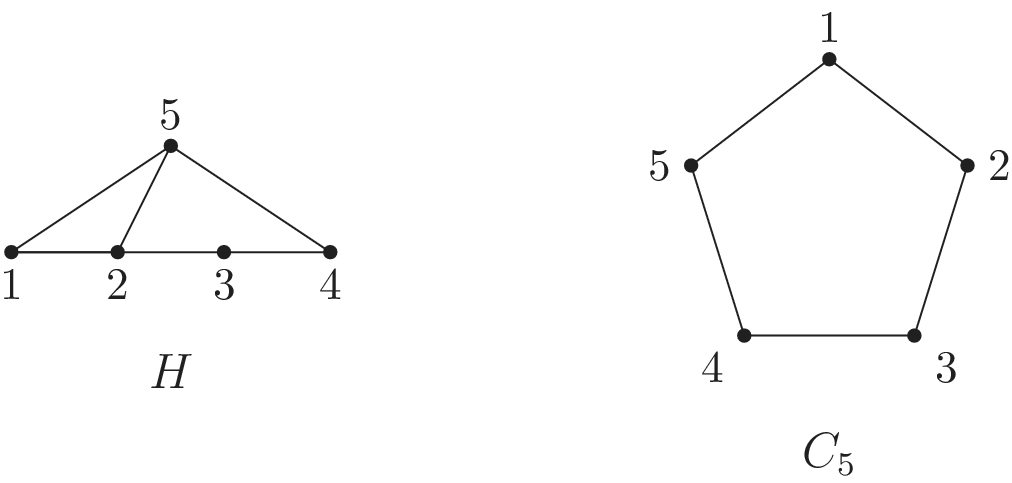
, then
$G\in \{K_5,C_5,H\},$
where H and
$C_5$
are the graphs depicted in Figure 1.Figure 1Graphs H and $C_5$
. -
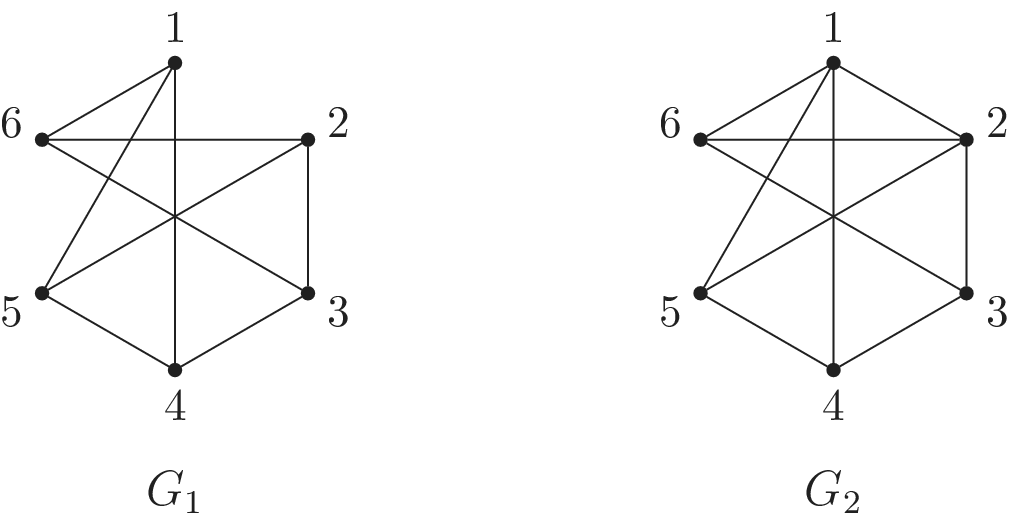
(iii) If $n=6$
, then G is either a Cohen–Macaulay forest or
$G\in \{K_6,G_1,G_2\},$
where
$G_1$
and
$G_2$
are the graphs depicted in Figure 2.Figure 2Graphs $G_1$
and
$G_2$
.Figure 2 Long description
The image contains two panels labeled G sub 1 on the left and G sub 2 on the right. Both panels feature six vertices arranged in a regular hexagon, numbered 1 through 6 starting from the top and moving clockwise.
In graph G sub 1 on the left, the following edges are present.
- Perimeter edges: 2 to 3, 3 to 4, 4 to 5, and 6 to 1.
- Internal edges: 1 to 4, 1 to 5, 2 to 5, 2 to 6, and 3 to 6.
In graph G sub 2 on the right, the following edges are present.
- Perimeter edges: 1 to 2, 2 to 3, 3 to 4, 4 to 5, and 6 to 1.
- Internal edges: 1 to 3, 1 to 4, 1 to 5, 2 to 5, 2 to 6, and 3 to 6.
Graph G sub 2 contains all the edges of G sub 1 plus two additional perimeter edges connecting 1 to 2 and 1 to 3.
-
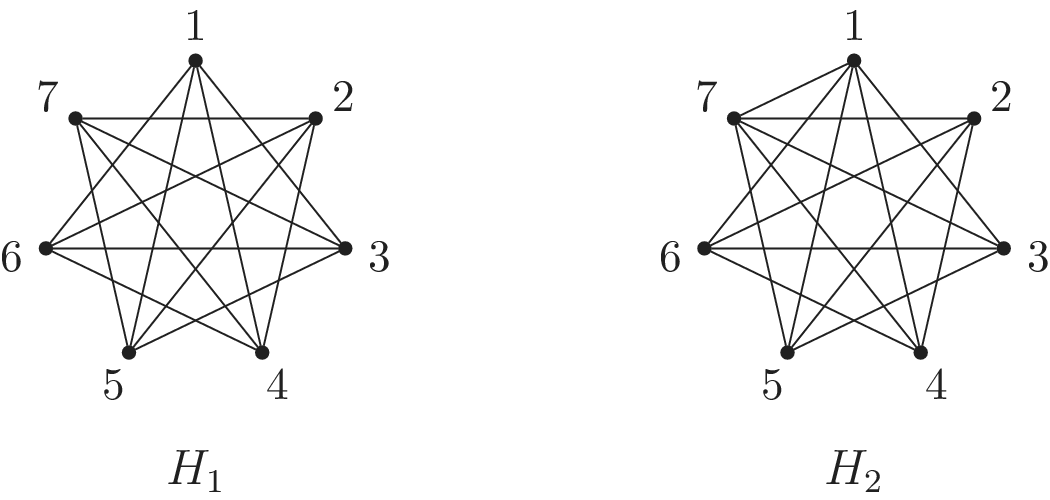
(iv) If $n=7$
, then
$ G\in \{K_7,H_1,H_2\}$
, where
$H_1$
and
$H_2$
are the graphs depicted in Figure 3.Figure 3Graphs $H_1$
and
$H_2$
.Figure 3 Long description
Two panels showing seven-vertex graphs.
Left panel, H sub 1. Seven vertices are arranged in a circle and numbered 1 through 7 clockwise starting from the top. Vertex 1 is connected to vertices 3, 4, 5, and 6. Vertex 2 is connected to 4, 5, 6, and 7. Vertex 3 is connected to 5, 6, 7, and 1. Vertex 4 is connected to 6, 7, 1, and 2. Vertex 5 is connected to 7, 1, 2, and 3. Vertex 6 is connected to 1, 2, 3, and 4. Vertex 7 is connected to 2, 3, 4, and 5. This forms a regular graph where each vertex has a degree of 4.
Right panel, H sub 2. The same seven vertices are arranged in a circle. In this graph, vertex 1 is connected to all other vertices except vertex 4 and vertex 5. Specifically, vertex 1 connects to 2, 3, 6, and 7. Vertex 2 connects to 1, 3, 4, and 7. Vertex 3 connects to 1, 2, 4, and 5. Vertex 4 connects to 2, 3, 5, and 6. Vertex 5 connects to 3, 4, 6, and 7. Vertex 6 connects to 4, 5, 7, and 1. Vertex 7 connects to 5, 6, 1, and 2. This also forms a regular graph of degree 4 but with a different edge distribution than H sub 1.


Conversely, for all graphs listed above,
$I(G)^{[k]}$
 is Cohen–Macaulay over any field for all
$1\le ~~k\le \nu (G)$
 .
Proof Assume that
$I(G)^{[k]}$
 is Cohen–Macaulay over any field for all
$1\le k\le \nu (G)$
 . Computations by Macaulay2 show that over the field
$\mathbb {Q}$
 we have the given characterization (i)–(iv) for a graph G on
$n\leq 7$
 vertices.
Conversely, consider a graph G in the above list. If G is a complete graph or a Cohen–Macaulay forest, then
$ I(G)^{[k]}$
 is Cohen–Macaulay over any field for all
$1\le k\le \nu (G)$
 (see Theorem 4.1). Moreover, for any graph
$G\in \{H,C_5,G_1,G_2,H_1,H_2\}$
 discovered above, it turns out that
$I(G)^{[k]}=\mathfrak {m}^{[2k]}$
 for all
$2\le k\le \nu (G)$
 , where
$\mathfrak {m}$
 is the graded maximal ideal of the polynomial ring. So,
$I(G)^{[k]}$
 is a squarefree Veronese ideal. Since the Cohen–Macaulay property of a squarefree Veronese ideal does not depend on the base field K, it follows that for the extra graphs
$G\in \{H,C_5,G_1,G_2,H_1,H_2\}$
 , we have that
$I(G)^{[k]}$
 is Cohen–Macaulay for all k and every field K.
It is well-known that up to
$10$
 vertices, the Cohen–Macaulay property of
$I(G)$
 is independent of the field K of
$S=K[x_i:i\in V(G)]$
 (see [Reference Katzman31]). Note that the Cohen–Macaulay property of the matching powers of complete graphs and Cohen–Macaulay forest is also independent of K.
Conjecture 5.2 The family of graphs G for which
$I(G)^{[k]}$
 is Cohen–Macaulay for all
$1\le k\le \nu (G)$
 does not depend on the characteristic of K.
The above experiments also suggest that the following question could have a positive answer.
Question 5.3 Is it true that for all
$n\ge 5$
 , up to isomorphism, there are only two graphs on n non-isolated vertices, non-isomorphic to the complete graph
$K_n$
 , and non-isomorphic to a Cohen–Macaulay forest, for which all the matching powers of their edge ideals are Cohen–Macaulay?
Acknowledgments
We thank the anonymous referee for their helpful suggestions and careful reading of the article.