Undoubtedly, a severe asymmetry in the distribution of relevant (political) viewpoints in any scientific community could endanger objectivity and progress. Duarte et al. assert that the majority of psychologists (personality and social psychologists in particular) these days self-identify as Democrats rather than Republicans (referring specifically to the two major parties in the United States) and conclude that the community is therefore biased to the left. This reasoning hinges on the presumption that U.S. Democrats occupy the left of the political spectrum, whereas U.S. Republicans occupy the right, implying that a moderate – and thus arguably unbiased – position would fall in between the two, so that a politically unbiased community would be constituted of an approximately equal ratio of scientists identifying as Democrats and Republicans. However, as we demonstrate below, this reasoning is fundamentally flawed because it results from an inappropriate categorization of the continuous left-right spectrum, invalidating Duarte et al.'s most fundamental basic premise.
In what follows, we rely on a vast, longitudinal, international database of content analyses of political party manifestos: the Manifesto Project Database compiled by the Manifesto Research on Political Representation project, which is one of the major data sources in comparative political science (König et al. Reference König, Marbach and Osnabrügge2013). In 2003, the project received the American Political Science Association's (APSA) award for the best data set in comparative politics. Much more information on the project, the coding, and many references providing further details can be found at the website: https://manifestoproject.wzb.eu/. The project is based on quantitative content analyses of parties' election programs from more than 50 countries, covering all free, democratic elections since 1945. It provides an estimate of parties' positions on a left–right scale based on coding of quasi-sentences into many different categories which capture a predefined set of political issues (Budge et al. Reference Budge, Klingemann, Volkens, Bara and Eric2001). We base our considerations on the recently proposed logit left–right scale (“LLR scale”; Lowe et al. Reference Lowe, Benoit, Mikhaylov and Laver2011).
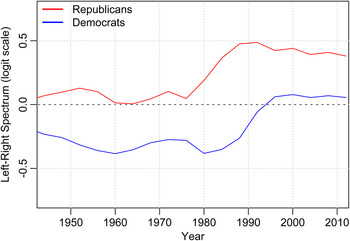
Duarte et al. identify the 1980s as the critical point tilting the field towards affiliating with the Democrats and thus allegedly to the left. However, the U.S.-party positions on the LLR scale over time (see Fig. 1) clearly show that both have strongly shifted towards the right of the political spectrum since the 1980s. As a result, Democrats currently hold a moderate position, whereas Republicans are positioned farther out on the right wing than they used to be. Thus, the relative increase in self-identified Democrats in the community can be explained through the simple notion that scientists tend to favor a moderate, balanced position. In turn, the increase in self-identified Democrats cannot be taken as evidence in favor of a pro-left bias in the community.
Figure 1.
Moving average (3 periods) of U.S.-party positions on the logit left–right (LLR) scale over time.
Moreover, Duarte et al. treat the community as though it were comprised exclusively of scientists from the United States (discussing evidence primarily referring to the latter) and refer exclusively to the political spectrum in the United States. However, according to the Web of Knowledge® publication database, across psychology, about 46% of all records since 2004 are published by U.S.-based scientists, whereas another 46% are by scientists from Great Britain, Germany, Canada, Australia, the Netherlands, Spain, Italy, France, Japan, Switzerland, Belgium, and Sweden. (Highly similar numbers are obtained when considering the 20 most impactful journals in psychology or the 10 most impactful journals in personality and social psychology.)
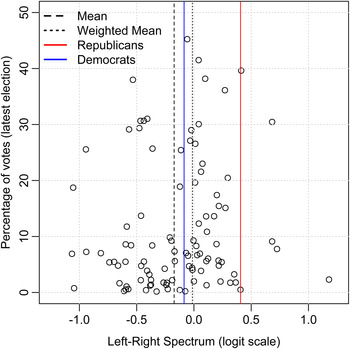
It is self-evident that the political parties of these countries will not map onto the Democrat-versus-Republican categorization from the United States. Comparing the position of U.S. Democrats and U.S. Republicans on the LLR scale to those of the 99 political parties of said 12 countries clearly reveals that U.S. Democrats are best characterized as holding a moderate (rather than left) position in a global context (results are virtually identical when considering all countries available in the manifesto database). Figure 2 plots the proportion of actual votes parties received in the most recent national elections against their position on the LLR scale. As can be seen, the “global midpoint” (both unweighted and weighted by actual votes that parties received) is close to the numerical neutral point of the left-right spectrum. In turn, this is essentially the current position of U.S. Democrats. By contrast, U.S. Republicans score approximately 1 standard deviation right of this global midpoint. Thus, in comparison to the political spectrum of all parties across these countries (which contribute just as much to psychological science as the United States), it is clear that the U.S. spectrum (Democrats vs. Republicans) can only discriminate among the right half. By implication, self-placement scales (particularly those with endpoints labeled “liberal” and “conservative”) are likely to show the same bias, as these are interpreted in reference to the national political spectrum as manifested in major political parties (Benoit & Laver Reference Benoit and Laver2006). Overall, a positive ratio of self-identified Democrats versus Republicans cannot be taken as evidence for a leftward bias – quite the contrary, an approximately equal ratio would be indicative of a bias to the right. If anything, the community appears to be aligned with a moderate position on the global left-right spectrum.
Figure 2.
Percentage of votes gained in most recent election conditional on party positions on the logit left–right (LLR) scale. The black lines indicate the unweighted (dashed) and weighted (dotted; weighting party positions by the proportion of actual votes received) mean across parties (mean and median differ by less than 2% of the scale). The red and blue lines indicate the LLR position of U.S. Republicans and U.S. Democrats (latest election only), respectively.
In summary, manifesto data from comparative political science indicates that U.S. Democrats currently hold a moderate (rather than leftist) position, whereas U.S. Republicans occupy the right wing of the political spectrum – more so than they used to and especially in global terms. Consequently, referring solely to the Democrats versus Republicans dichotomy severely misrepresents the underlying political spectrum. Thus, based on the evidence they present, Duarte et al. cannot assert that the field shows a pronounced pro-left bias; this in fact invalidates the basic premise of their reasoning.





Undoubtedly, a severe asymmetry in the distribution of relevant (political) viewpoints in any scientific community could endanger objectivity and progress. Duarte et al. assert that the majority of psychologists (personality and social psychologists in particular) these days self-identify as Democrats rather than Republicans (referring specifically to the two major parties in the United States) and conclude that the community is therefore biased to the left. This reasoning hinges on the presumption that U.S. Democrats occupy the left of the political spectrum, whereas U.S. Republicans occupy the right, implying that a moderate – and thus arguably unbiased – position would fall in between the two, so that a politically unbiased community would be constituted of an approximately equal ratio of scientists identifying as Democrats and Republicans. However, as we demonstrate below, this reasoning is fundamentally flawed because it results from an inappropriate categorization of the continuous left-right spectrum, invalidating Duarte et al.'s most fundamental basic premise.
In what follows, we rely on a vast, longitudinal, international database of content analyses of political party manifestos: the Manifesto Project Database compiled by the Manifesto Research on Political Representation project, which is one of the major data sources in comparative political science (König et al. Reference König, Marbach and Osnabrügge2013). In 2003, the project received the American Political Science Association's (APSA) award for the best data set in comparative politics. Much more information on the project, the coding, and many references providing further details can be found at the website: https://manifestoproject.wzb.eu/. The project is based on quantitative content analyses of parties' election programs from more than 50 countries, covering all free, democratic elections since 1945. It provides an estimate of parties' positions on a left–right scale based on coding of quasi-sentences into many different categories which capture a predefined set of political issues (Budge et al. Reference Budge, Klingemann, Volkens, Bara and Eric2001). We base our considerations on the recently proposed logit left–right scale (“LLR scale”; Lowe et al. Reference Lowe, Benoit, Mikhaylov and Laver2011).
Duarte et al. identify the 1980s as the critical point tilting the field towards affiliating with the Democrats and thus allegedly to the left. However, the U.S.-party positions on the LLR scale over time (see Fig. 1) clearly show that both have strongly shifted towards the right of the political spectrum since the 1980s. As a result, Democrats currently hold a moderate position, whereas Republicans are positioned farther out on the right wing than they used to be. Thus, the relative increase in self-identified Democrats in the community can be explained through the simple notion that scientists tend to favor a moderate, balanced position. In turn, the increase in self-identified Democrats cannot be taken as evidence in favor of a pro-left bias in the community.
Moving average (3 periods) of U.S.-party positions on the logit left–right (LLR) scale over time.
Moreover, Duarte et al. treat the community as though it were comprised exclusively of scientists from the United States (discussing evidence primarily referring to the latter) and refer exclusively to the political spectrum in the United States. However, according to the Web of Knowledge® publication database, across psychology, about 46% of all records since 2004 are published by U.S.-based scientists, whereas another 46% are by scientists from Great Britain, Germany, Canada, Australia, the Netherlands, Spain, Italy, France, Japan, Switzerland, Belgium, and Sweden. (Highly similar numbers are obtained when considering the 20 most impactful journals in psychology or the 10 most impactful journals in personality and social psychology.)
It is self-evident that the political parties of these countries will not map onto the Democrat-versus-Republican categorization from the United States. Comparing the position of U.S. Democrats and U.S. Republicans on the LLR scale to those of the 99 political parties of said 12 countries clearly reveals that U.S. Democrats are best characterized as holding a moderate (rather than left) position in a global context (results are virtually identical when considering all countries available in the manifesto database). Figure 2 plots the proportion of actual votes parties received in the most recent national elections against their position on the LLR scale. As can be seen, the “global midpoint” (both unweighted and weighted by actual votes that parties received) is close to the numerical neutral point of the left-right spectrum. In turn, this is essentially the current position of U.S. Democrats. By contrast, U.S. Republicans score approximately 1 standard deviation right of this global midpoint. Thus, in comparison to the political spectrum of all parties across these countries (which contribute just as much to psychological science as the United States), it is clear that the U.S. spectrum (Democrats vs. Republicans) can only discriminate among the right half. By implication, self-placement scales (particularly those with endpoints labeled “liberal” and “conservative”) are likely to show the same bias, as these are interpreted in reference to the national political spectrum as manifested in major political parties (Benoit & Laver Reference Benoit and Laver2006). Overall, a positive ratio of self-identified Democrats versus Republicans cannot be taken as evidence for a leftward bias – quite the contrary, an approximately equal ratio would be indicative of a bias to the right. If anything, the community appears to be aligned with a moderate position on the global left-right spectrum.
Percentage of votes gained in most recent election conditional on party positions on the logit left–right (LLR) scale. The black lines indicate the unweighted (dashed) and weighted (dotted; weighting party positions by the proportion of actual votes received) mean across parties (mean and median differ by less than 2% of the scale). The red and blue lines indicate the LLR position of U.S. Republicans and U.S. Democrats (latest election only), respectively.
In summary, manifesto data from comparative political science indicates that U.S. Democrats currently hold a moderate (rather than leftist) position, whereas U.S. Republicans occupy the right wing of the political spectrum – more so than they used to and especially in global terms. Consequently, referring solely to the Democrats versus Republicans dichotomy severely misrepresents the underlying political spectrum. Thus, based on the evidence they present, Duarte et al. cannot assert that the field shows a pronounced pro-left bias; this in fact invalidates the basic premise of their reasoning.