



R1. Introduction
Our hope in writing our target article was to start a conversation between cultural evolution and behavioral genetics. These two disciplines occupy the same space in attempting to explain variation in human behavior but haven't sufficiently engaged with one another. And yet, a richer understanding of the role of culture and genes on behavior has implications for the broader human sciences, as well as public discourse. The commentaries we received reinforced the importance of this discussion and we hope the discussion continues beyond the pages of Behavioral and Brain Sciences.
A truly interdisciplinary group of scholars responded. Not just researchers in behavioral genetics and cultural evolution, but also evolutionary biology more broadly, anthropology, psychology, psychiatry, education research, and philosophy. We are overwhelmed by the response, and we thank the authors of these commentaries for refocusing, challenging, amplifying, and expanding the arguments in our target article.
The goal of our reply is to push forward cultural evolutionary behavioral genetics. To do this, we focus on the challenges and extensions to our proposed framework. Our reply is organized as follows: First, we deal with the discrepancies and misconceptions about key concepts, particularly related to heritability and culture. Next, we address commentaries related to how culture and genes interact to produce behavior. Finally, we respond to the many proposals, questions, and critiques that serve to expand the scope of our proposed cultural evolutionary behavioral genetic framework.
R2. Conceptual clarifications
The first challenge for interdisciplinary work is developing a common language. We agonized over phrasings and definitions, recognizing that our readers represent such different disciplines with unfamiliar jargon and even common words for different concepts, and yet the curse of knowledge left some key terms undefined. The few discrepancies and misconceptions revealed by the commentaries, particularly around the concepts of heritability, culture, and related terms, reveals that there's more work to be done in developing common language and common understanding. Let's begin with heritability.
R2.1. Heritability
Shuker & Dickins emphasize that there is no general heritability for a trait nor is heritability a measure of the genetic basis of traits. They frame their commentary as an argument against the way in which they read heritability as being discussed in our target article, which we must admit was surprising to us. We completely agree with both emphases. Indeed, the context-dependence of heritability was the crux and starting point for our framework. We described various processes that empirically and hypothetically shape or should shape heritability estimates across social and cultural environments. In the Appendix, we presented a set of mathematical models that show how changes in cultural variance alone (i.e., even in the absence of culture–gene interactions, which would provide further modulation of heritability) could influence the heritability of traits in systematic and predictable ways. So yes, we fully agree that there is no general heritability nor is heritability an indication of the genetic basis of a trait.
Indeed, amplifying our argument, Heine & Dar-Nimrod list various ways in which the target article undermines some uses of the heritability concept, including expectations about its stability and generalizability. And furthermore, Shuker & Dickins mirror several of the arguments we make in the target article, though we sometimes go further. For example, they note that, “within a species, variation in heritabilities with age, for example, can give us hypotheses about (a) how selection acts at different ages, or (b) how developmental processes, and the genes and environments they influence and call upon, change over the lifetime.” As we describe in the target article, it is not only hypotheses about selection and development, genes and environment that can be recovered from variation in heritabilities, but in the human species, also specific hypotheses about cultural transmission and cultural clustering.
Where we do disagree with Shuker & Dickins is where we make a more radical argument regarding how to think about the concept of heritability from a dual inheritance perspective. For example, on phenotypic transmission they state that “controlling for cultural exposure may help reveal patterns in variation in heritability that can lead to interesting hypotheses and further tests.” This view is accurate but remains grounded in the conventional framework of behavioral genetics. In contrast, as our target article argues, culture is not something to be simply controlled for as a grouping variable. Cultural transmission perpetually reorganizes environmental distributions, and this dynamic character of the cultural environment is what often makes heritability non-generalizable. But this also means that if we can model cultural transmission, then we can track the cultural component of the heritability statistic, rendering it useful under certain conditions. An example from the target article is how cross-cultural variation in curricula influences the heritability of literacy in kindergarteners (sect. 2.2.1). It is currently rare for cultural transmission to be measured alongside genetic effects, but as the simultaneous estimation of both becomes regular practice, the utility of heritability may become more apparent. That is to say, the non-generalizability of heritability is not an Achilles heel but rather a resource that can be refined through careful analysis of cultural transmission, allowing us to understand the interplay between cultural dynamics and genetic effects.
Heritability appears intractable from a conventional behavioral genetics perspective because of the narrow attention on genetic variation, even though it is clear from the statistical formula that environmental variation is just as relevant. That is, heritability is often thought of as being about genetic variation but could equally be thought of as a measure of cultural variation. This point is echoed by Turkheimer who reemphasizes arguments he first made two decades ago: that high heritability indicates that genetic effects are easier to detect and quantify, not that genes are more influential (Turkheimer, Reference Turkheimer2000). Indeed, as Larsen notes, within education research, high heritability is often interpreted to indicate an optimal education environment.
Researcher priors affect whether they think the heritability statistic is useful. If one believes in either the general stability of environments, convergence over time, or commonality between cultural clusters, one might reify the heritability statistic; if one believes in either the general instability of environments or unpredictability and intractable dynamics within environments, one might dismiss the heritability statistic. The approach we advocate is to spend as much effort in understanding how the environment, particularly culture, varies and changes, as one does in measuring the additive effects of single-nucleotide polymorphisms (SNPs) correlated with outcomes or on clever designs to estimate heritability in one time and place (but often without stating or measuring the temporal, geographic, and cultural-group bounds of the finding).
The cultural evolutionary approach described in the target article offers tools and methods for capturing cultural distributions, and importantly, changes over time. This allows us to move beyond the relatively simple (e.g., one-dimensional monotonic) models of environmental variation that are common in gene–environment interaction analyses. Such an approach can help advance our understanding of human behavior across many domains. Two commentaries offer clear examples. Larsen considers the application of the framework to the educational context and Amato considers the application to psychopathology. As Amato argues, a cultural evolutionary framework may explain the global incidence of schizophrenia and could be used to guide interventions to instill resilience. We are intrigued by this proposal and look forward to further research in this area.
A few commentaries go further, calling for heritability as a concept to be retired. Heine & Dar-Nimrod amplify many arguments developed in the target article but argue that these ultimately discredit the heritability statistic as being in any way useful. They further argue that due to the essentializing tendencies of human psychology when it comes to questions about nature and nurture, heritability will inevitably be interpreted as being about genes by most people, and genes will ultimately be viewed as primary explanations for human phenotypes (see Heine [Reference Heine2017] for a book-length exposition of this argument). Given its lack of utility and ultimate misuse, they argue that it would be better to discard the concept of heritability altogether. Downes & Kaplan express a similar sentiment: that heritability as a concept should be discarded due to the purportedly intractable nature of environmental complexity. We address their critique in more detail in R3.3.
Turkheimer and Bates each describe how the standard view of heritability has already undergone considerable refinement among a new generation of scientists who work on the genetics of human behavior. Turkheimer summarizes the historical progression of nature–nurture debates within behavioral genetics, arguing that in the past behavioral geneticists assumed high heritability demonstrated the overarching influence of genetics on phenotypes, but today no longer debate nature versus nurture. There is no dichotomy; nature and nurture are interwoven. We fully agree. The goal of our target article was not to litigate between nature and nurture (which we agree is nonsensical beyond highly specific time, geographic, population, and cultural-group bounds). Instead, it was to offer a framework for understanding this interweaving between culture and genes. Bates reviews the overlap between the framework and the forefront of behavioral genetics, with several provocative clarifying questions. These questions are instructive, so we address them in more detail in R3.1
Overall, we agree with these commentaries – that our target article undermines some interpretations of heritability – but calls for the concept to be retired seem premature. Behind many of these calls is an intuition or assumption that environmental distributions and their dynamics cannot be measured or theorized. We argue this is incorrect. Even models and measurement aside, developing an intuition for how environmental distributions can, for example, become compressed by cultural diffusion or broadened by cultural innovation in specific terms, can reduce the reflexive association between heritability and genetic causation and reframe the questions we ask in understanding the role of culture and genes in creating behavior. Such shifts in intuition have occurred in other domains. For example, learning about visual processing as a reconstructive rather than camera-like process shifts our intuitions about seeing. Similarly, learning about supply and demand, market frictions, or comparative advantage shifts our intuitions about markets. Here, learning more about cultural evolution should shift our intuitions about the role of genes. Thus, what is required is a more mature understanding of human environments and how they are shaped by the forces of cultural transmission. Our target article is an initial attempt to shift these intuitions and move beyond disputes about whether or not environments are stable enough to support the validity of heritability estimates and toward an investigation of how environmental stability and instability manifest.
Fogarty & Creanza amplify our arguments but conclude that calculating heritability for behavior adds little to our understanding of human evolution and behavior. However, the bulk of their commentary focuses on how one might model the effect of culture. We discuss this in more detail in R3.3.
Fuentes & Bird too question the utility of heritability but make a further related argument about the ostensible misuse of terminology, including in our target article. For example, they critique the use of phrases such as “phenotypic variance explained by the environment [or genes]” or “phenotypic effects due to the environment [or genes]” (emphases ours) because they seem to imply a causal relationship. We are sympathetic to this argument but are personally not convinced that these phrases imply causality (at least among researchers). “Explained variance” and “explained sum of squares” are commonplace in statistics, without any causal implication. As for “due to,” we do agree that this phrase implies causality, but we also use this phrase intentionally only when explicitly proposing a causal explanation and never in the context of a statement about correlated variance per se.
Fuentes & Bird also critique our use of the terms “masking” and “unmasking” whereby genetic effects become amplified or attenuated by culturally transmitted traits. Citing Mathieson's (Reference Mathieson2021) excellent review of the omnigenic model for the effect of genes – which, for the record, we suspect is ultimately correct – they suggest that usage of these terms “implies that there is a ‘true’ genetic architecture to the trait.” However, in our view, an omnigenic model and Mathieson's (Reference Mathieson2021) explanation for cross-population differences are isomorphic to many of the arguments and framework developed in our target article. Here, masking and unmasking are why some SNPs may be identified in one population and others in another, most obvious in the sickle cell trait and malaria example. We also disagree that the terms “masking” and “unmasking” require fixed or true genetic architecture. To this point, Lupyan; Kolodny, Feldman, Lotem, & Ram (Kolodny et al.); and Waring, Wood, & Xue (Waring et al.) offer elaborations on our argument for how cultural masking/unmasking occur, without implying or presupposing a fixed or true genetic architecture.
R2.2. Culture
Burt and Syed & Nguyen point out our lack of a formal definition of culture or cultural traits, despite culture being the central theme of the target article. Burt offers a characterization of culture by enumerating a diverse set of elements such as beliefs, values, skills, habits, and styles. In a similar manner, Syed & Nguyen map cultural traits onto the notion of “cultural syndromes” (Triandis, Reference Triandis1996) which consist of beliefs, attitudes, and norms. These proposals represent an itemizing or enumerative approach to the conceptualization of culture, which has a long but contentious history (Bennett, Reference Bennett2015). It is not hard to see how disagreement could arise around such extensional definitions – any list of items is necessarily contestable. Note how the notion of “syndrome” is itself a canonical example of an enumerative approach, whose weaknesses and pre-theoretical status have been pointed out repeatedly within psychopathology (Fried, Reference Fried2021; Lilienfeld & Treadway, Reference Lilienfeld and Treadway2016). Downes & Kaplan may also be seeing the problem through this same lens when they express that they “don't see a good way to separate environments into ‘culture’ and ‘non-culture’.”
Our use of the term “culture” follows the standard definition within the field of cultural evolution, as described by two of its founders in various publications, for example: “Culture is information capable of affecting individuals’ behavior which they acquire from other members of their species through teaching, imitation, and other forms of social transmission. By information we mean any kind of mental state, conscious or not, that is acquired or modified by social learning and affects behavior” (Richerson & Boyd, Reference Richerson and Boyd2005). Here culture is conceptualized not as a collection of enumerable traits, but rather by its mode of acquisition and the effect of this acquisition on behavior. In their enumerative definitions, both Burt and Syed & Nguyen add the qualification that when something is cultural, it is “shared” (Burt) or “culturally shared” (Syed & Nguyen). However, a trait, behavior, or mental state could be shared among people due to shared genes, individual trial-and-error learning, or social transmission. In the cultural evolutionary framework, it is only the last of these that makes something cultural. This perspective also implies that many traits are only partly cultural, insofar as modes of transmission can be mixed. Culture is thus a graded rather than categorical attribute: a point that cannot be captured by an extensional definition.
Syed & Nguyen's criticism of the cultural fixation index (CFST) and WEIRD (western, educated, industrialized, rich, and democratic) acronym is similarly motivated. As Muthukrishna et al. (Reference Muthukrishna, Bell, Henrich, Curtin, Gedranovich, McInerney and Thue2020) describe, CFST is a theoretically-defensible measure of cultural distance that describes between-group differentiation caused by cultural selection, migration, and social-learning mechanisms deviating from random social influence in a well-mixed population (just as the fixation index [FST] describes deviation from random mating over a well-mixed population). They offer an aggregate measure but advocate subsetting questions where there is theoretical justification for doing so. CFST is robust to the choice of cultural traits as long as these are sufficiently broad, because cultural traits cluster within cultural groups through social learning and institutions (the authors conduct several robustness tests to confirm this, showing that even 50% or more randomly removed data or questions result in the same CFST). Therefore, through selective subsetting on the part of the researcher, CFST is able to accommodate enumerative definitions of culture. However, the measure works just as well without committing to any particular definition. This is because it aggregates a broad array of attitudes, values, ideas, and beliefs, all of which we hypothesize are at least partially acquired or shaped by cultural transmission. Because human psychology and behavior are extensively influenced by cultural transmission in this manner, even an unsystematic aggregation of responses (as Syed & Nguyen put it) is able to capture systematic variation that arises from cultural clustering and segregated transmission. With respect to the WEIRD backronym: its components were never meant to be taken comprehensively or even literally but were instead a consciousness-raising device (Apicella, Norenzayan, & Henrich, Reference Apicella, Norenzayan and Henrich2020). To treat its constituent parts as an enumeration for the purposes of measurement would be like measuring the Big Bang by how much “big” and how much “bang.” Indeed, as suggested in Muthukrishna et al. (Reference Muthukrishna, Bell, Henrich, Curtin, Gedranovich, McInerney and Thue2020), CFST can be used to develop a more nuanced proxy for a WEIRD scale.
R3. On the relationship between culture and genes
With conceptual concerns and misconceptions out of the way, we turn to the commentaries that focused on different aspects of the interplay between culture and genes. We begin with commentaries that focus on the role of genes, then those that focus on culture–gene interactions. Finally, we focus on commentaries that assume that culture can only impact genetic effects through culture–gene interactions.
R3.1. Genes
Here we address commentaries that focus on the role of genes, in particular the commentary by Bates.
R3.1.1. Collective cleverness is more important than genes for genius
Bates poses three questions and an additional point that are useful for both vetting our proposed framework and revealing where our target article diverges from cutting-edge behavioral genetics. The first of these is: “for how long could a population thrive if furnished with all of today's inventions and institutions, but shorn of ability-associated genetic polymorphisms?” This question is an interesting inversion of the “lost European explorer experiment,” a didactic scenario often invoked by Boyd and Henrich in the cultural evolutionary literature (Boyd, Richerson, & Henrich, Reference Boyd, Richerson and Henrich2011; Henrich, Reference Henrich2016). The scenario describes historical cases in which teams of well-equipped European explorers are forced to sustain themselves in an unfamiliar ecological environment. From Burke and Wills in the Australian outback to Franklin in the Arctic, these lost European explorers typically fail despite having every advantage except for the cultural knowledge possessed by the local population (e.g., Henrich, Reference Henrich2016). These anecdotes are used as illustrations of the broader literature on how human ecological adaptation is to a large extent dependent on cumulative culture with genetic adaptation playing an unexpectedly small role. To put it another way, when most animals encounter a new environment, they are forced to genetically adapt – powerful muscles to outrun local predators, fur and fat to keep from freezing, proteins to make plants less poisonous. Our species has some local genetic adaptations (for a review, see Fan, Hansen, Lo, & Tishkoff, Reference Fan, Hansen, Lo and Tishkoff2016; on adaptation to UV radiation, see Jablonski & Chaplin, Reference Jablonski and Chaplin2017; on malaria, see Kwiatkowski, Reference Kwiatkowski2005; on altitude, see Yi et al., Reference Yi, Liang, Huerta-Sanchez, Jin, Cuo, Pool and Wang2010), but has largely culturally adapted to live in almost every ecosystem on Earth (Barsbai, Lukas, & Pondorfer, Reference Barsbai, Lukas and Pondorfer2021; Henrich, Reference Henrich2016).
Bates's counterfactual genetic-mirror of the lost European explorers is a provocative thought experiment. But specifically, what is meant by ability-linked polymorphisms is important. Obviously, to some degree the social and institutional infrastructure that supports modern industrialized societies is dependent upon the genes that make us human, no doubt many of which coevolved with culture. Attempts to acculturate other great apes have failed; we are unable to bequeath our civilization to any other primate. The commentator probably has in mind the polymorphisms associated with high intelligence, educational attainment, and so on, within the variation present in genome-wide association study (GWAS): What would happen if these specific polymorphisms disappeared? It is of course difficult to predict what the consequence of such a sudden dramatic shift in the genetic makeup of a population might be, but if culture and institutions are retained, a collapse and halting of future progress is not a foregone conclusion.
As background, the cultural brain hypothesis (Muthukrishna, Doebeli, Chudek, & Henrich, Reference Muthukrishna, Doebeli, Chudek and Henrich2018) suggests there is a selection pressure toward larger brains that can store, manage, organize, and use more information to keep up with a growing corpus of cumulative culture. Even today, larger heads are linked to a greater likelihood of an emergency birth intervention – an emergency cesarean or an emergency instrumental birth (Lipschuetz et al., Reference Lipschuetz, Cohen, Ein-Mor, Sapir, Hochner-Celnikier, Porat and Yagel2015) – consistent with both ongoing selection pressures and sufficient variation within the population. Thus, we are in no way denying that there are genetic differences between people. The question is to what degree is, for example, innovation dependent on these large-brained individuals? Here the model is also informative: The switch toward greater reliance on socially transmitted information – culture – can lead to a decline in brain size (here a proxy for ability-associated polymorphisms) with innovation continuing to increase. Why? Social transmission offers a more efficient way to arrive at the same adaptive outcome than learning by oneself. Humans are like a child in class who cheats on an exam instead of studying by themselves. But who are the clever students that they're relying on? Not geniuses, but on the endowed cultural package of thousands of years of accumulated knowledge of past generations. A low-ability individual or even population can do quite well given modern technology and infrastructure. Empirically, there is some evidence of a decline in brain size over the last 10,000–20,000 years (Ruff, Trinkaus, & Holliday, Reference Ruff, Trinkaus and Holliday1997) in support of the model, although the explanations for this finding are debated. More recently, there is evidence for genetic selection against educational attainment coinciding with a Flynn effect rise in IQ test performance (Beauchamp, Reference Beauchamp2016). But what of innovation and future progress? Here, the field of cultural evolution might diverge considerably from Bates's assumption about where all that knowledge and progress comes from, and the role and reason for genius (individuals with cognitive performance several sigma higher than the mean).
As argued in depth in Muthukrishna and Henrich (Reference Muthukrishna and Henrich2016), innovation and progress are not driven by heroic geniuses and then passed on to the masses any more than your thoughts hinge on a particular neuron. Rather, innovation is dependent upon our societies and social networks. Increasing innovation isn't driven by a sudden increase in genetic geniuses, but by features such as population size, interconnectedness, the ability to transmit information, and tolerance for diversity (but also see the paradox of diversity; Schimmelpfennig, Razek, Schnell, & Muthukrishna, Reference Schimmelpfennig, Razek, Schnell and Muthukrishna2022). That is, innovation is a population-level process, creating more geniuses culturally rather than genetically by making each of us more intelligent through cumulative cultural evolution. None of this is to deny that people differ in their cognitive abilities, including because of genes, but only that geniuses aren't created by genetic differences alone – genes are not sufficient and may not be necessary either. A question sometimes posed is: Where have all the geniuses gone? The answer is that thanks to the spread of education, opportunity, and increasing cultural complexity, there are too many today for any to stand out. But there are still many lost Einsteins not because of inequality of ability, but because of inequality of opportunity (Bell, Chetty, Jaravel, Petkova, & Van Reenen, Reference Bell, Chetty, Jaravel, Petkova and Van Reenen2019).
R3.1.2. The apparent immutability of cognitive phenotypes
We reemphasize that we are not arguing that genes are unimportant, only that the scope and speed of cognitive change is dominated by cultural change, which has historically had a far greater impact on human behavior and, we argue, still has far greater scope and speed for future behavior. This naturally leads to Bates's second question which refers to what he describes as “the intransigence of phenotypes.” Beyond relatively simple examples like vitamins masking genetic effects, Bates asks whether our theory works for more complex behavioral phenotypes like mental illness and education, which seem unyielding to interventions.
Many mental illnesses can have multiple alternative explanations: “genes that break” (sect. 3.3.1), environmental factors, stochastic developmental variation (SDV), and deviation from healthy variation. Abdellaoui and Zeng & Henrich offer examples of polygenic scores associated with autism, bipolar disorder, and schizophrenia that are linked to positive outcomes, while Amato offers a sketch of how the proposed framework can help elucidate the genetic basis of psychiatric illnesses like schizophrenia. Although the cross-cultural variation in the outcomes associated with mental illness based on the local context (e.g., Larøi et al., Reference Larøi, Luhrmann, Bell, Christian, Deshpande, Fernyhough and Woods2014; Luhrmann, Padmavati, Tharoor, & Osei, Reference Luhrmann, Padmavati, Tharoor and Osei2015) hint at the possibility of interventions, we are not expecting yet-to-be-discovered interventions that will resolve these illnesses.
In contrast, the often cited failure of educational interventions is more interesting and seems to contradict the overall effect of education on intelligence cited by Bates (Ritchie & Tucker-Drob, Reference Ritchie and Tucker-Drob2018). We would argue that this apparent contradiction exists primarily due to the ubiquity of education and the marginal ability to make large educational changes.
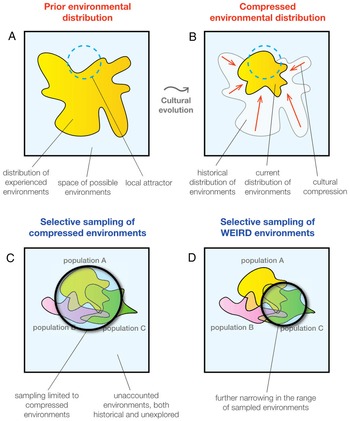
The peculiar Western-style formal educational institution we call “school” has spread to most corners of the globe, at least to some degree. This has been a boon for human development, but a challenge for the scientific study of exactly how education has rewired our brains, and consequently, our societies. Two centuries ago, only 12% of the world could read and write. Today, only 14% are unable to read and write. And that's thanks to school. But with everyone, everywhere, exposed to school, we no longer know what people without any schooling look like. The variation in schooling we see is an extreme and clear example of the narrowing illustrated in Figure R1.
Restricted sampling of environments due to historical trajectories of cultural evolution and selective (WEIRD) sampling. (a) The yellow region represents the distribution of experienced environments of a hypothetical society at a past time point. The unoccupied light blue area represents the unexplored regions of the space of possible, viable environments. The blue dashed circle represents a set of environmental states that are better adapted to ecological challenges and functions as a local attractor on an adaptive landscape. (b) The environmental distribution at a later time point. Through cultural evolutionary dynamics such as conformist transmission and selective imitation, the society has converged around the local attractor. (c) Even if researchers were able to obtain samples from all extant populations, their observations would be limited to a particular subspace of possible environments that is contingent upon cultural history. Because genetic effects can only be evaluated with respect to particular environments, genes may have vastly different effect sizes or functions outside of this observable range. (d) In practice, researchers conduct the majority of their analyses within a handful of societies that represent a small fraction of global genetic and cultural variation. This limitation further narrows down the range of observed environments and thus impedes generalizability of genetic effects.

Schooling delivers not only what we learn, but also how we learn – teaching delayed gratification, sitting and studying for exams in a distant future; self-control in focusing on a single task for long periods; abstract, logical reasoning necessary for a variety of modern tasks; and mental models of cultural technologies like numbers and mathematics. Evidence suggests that when children develop reading and math skills, they learn to derive meaning from symbols, such as letters and numbers (Blair, Gamson, Thorne, & Baker, Reference Blair, Gamson, Thorne and Baker2005). By “learning to learn” more effectively, via the written word, diagrams, or graphics, children may improve abstract problem-solving skills (Adams, Reference Adams1994; Reis & Castro-Caldas, Reference Reis and Castro-Caldas1997). School-derived skills may also enhance knowledge-seeking desires and behavior, in addition to domain-specific competence, and by affecting skills such as analytic perception, epistemic norms (what constitutes a good argument), and by facilitating a transition from concrete to formal operational thinking (Blair et al., Reference Blair, Gamson, Thorne and Baker2005; Cain & Oakhill, Reference Cain and Oakhill2009; Oakhill & Cain, Reference Oakhill and Cain2012).
But causally quantifying the effects of schooling is challenging because in almost all contexts, a lack or poorer quality of education is thoroughly confounded with poverty, pollution, disease, war, or other insults. But even in these contexts, interventions can bring children closer to parity with those with fewer insults. For example, Chetty et al. (Reference Chetty, Friedman, Hilger, Saez, Schanzenbach and Yagan2011) show that when low-socioeconomic status (SES) children are randomly assigned to higher quality classrooms from K-3, they are more likely to attend college, save for retirement, and eventually live in better neighborhoods. Depending on the degree of deprivation, we should be surprised that educational interventions have even the small and temporary results that they do. Such interventions are often on people who have experienced adverse prenatal and early childhood environments and who aside from the intervention lack the invisible cultural pillars that support education, such as educated parents, educated adults in the community, and a value placed on learning. Indeed, when interventions are earlier, such as prebirth, the effects are larger (e.g., micronutrients to malnourished mothers; Prado et al., Reference Prado, Sebayang, Apriatni, Adawiyah, Hidayati, Islamiyah and Shankar2017). Thus, Ritchie and Tucker-Drob (Reference Ritchie and Tucker-Drob2018) are likely underestimating the effect of education on intelligence and skepticism about potential interventions and educational innovations are likely a product of the challenges of radical reform restricted by path dependence. As an example, although Programme for International Student Assessment (PISA) scores indicate that some national curricula perform better in subjects such as math (Singapore and Shanghai are prominent examples), importing these curricula to even developed countries like the United Kingdom and United States are stymied by the challenges of teacher retraining, expected examinations, student prior preparation, and so on.
High heritability estimates, as high as 80% for cognitive ability among high-SES groups (Hanscombe et al., Reference Hanscombe, Trzaskowski, Haworth, Davis, Dale and Plomin2012); or even effectively 100% for core executive function (Engelhardt, Briley, Mann, Harden, & Tucker-Drob, Reference Engelhardt, Briley, Mann, Harden and Tucker-Drob2015; Friedman et al., Reference Friedman, Miyake, Young, DeFries, Corley and Hewitt2008), have led to conclusions, mistaken in our opinion, that these aspects of our psychology are highly genetically determined. This work fails to account for the tremendous variability in culture and education across the globe and over time and the potential change the future holds. Where interventions take place, they fail to account for the broader cultural infrastructure, such as the presence of successful, educated adults in families and the broader community. More causal research, perhaps natural experiments in the few locations that have yet to receive education, may help resolve these debates and shed light on the true plasticity of intelligence.
In a related third question, Bates asks us what fraction of DNA variants associated with traits such as cognition or reading skill we believe will reverse their effects under conditions that raise mean educational outcomes, given that such reversals in genetic main effects have not yet been found. It would be presumptuous of us to estimate the proportion of DNA variants that could plausibly undergo such a reversal. However, we would predict that such variants do exist and that most of these reversals are currently hidden due to severely restricted sampling from the range of possible environments (Fig. R1) and the restricted time range – data for GWAS at best represent the last two decades. Moreover, we may expect to see shifts in what traits are valuable in the future, especially if it is true that genetic variants are additive in their effects (Crow, Reference Crow2010; Hill, Goddard, & Visscher, Reference Hill, Goddard and Visscher2008; Hivert et al., Reference Hivert, Sidorenko, Rohart, Goddard, Yang, Wray and Visscher2021). For example, once upon a time, traits associated with semantic memory were highly associated with educational outcomes and lifetime earnings – think knowledge-based careers such as law and medicine that required storage of information in memory. But increasingly, the ability to multitask or to seek out relevant information in a noisy informational environment may be more predictive of educational and professional success. As our economies and technologies change, the content of school curricula and the character of work also changes, shifting genetic effects associated with these domains. The same can be said for autistic traits: The social challenges that characterize this phenotype may have conferred grave disadvantages in traditional societies, but today, many individuals embodying such traits are able to thrive in novel behavioral niches like the tech industry. If we were able to sample across these gradients of social, economic, and technological variation, we might be able to obtain a better picture of how genetic effects change – at times possibly even reversing their sign.
R3.1.3. Culture and genes are interwoven in human cognition
In a final point, Bates appeals for a principled distinction between the learning machinery provided by genes – what he refers to as the “blank slate,” invoking Locke – and the specific content that is learned by this system. In making this point, he references a study that finds a common latent factor of executive function that is 100% heritable in a sample of American children (Engelhardt et al., Reference Engelhardt, Briley, Mann, Harden and Tucker-Drob2015) and another that finds a direct effect of education on domain-specific cognitive skills but not through general intelligence as a mediating factor (Ritchie, Bates, & Deary, Reference Ritchie, Bates and Deary2015). We addressed this point in part above, but would add that it is an epistemological fallacy to identify these findings with insights about the structure of cognition and learning. The metaphor of a blank slate or tabula rasa does indeed carve up the sphere of mental activity into substrate and information, but this is a poor model for understanding the computational mechanisms that support learning. We are not blank slates, but culture is as biological as genes. In nervous systems, unlike digital computers, there is no clear distinction between activity and structure. For example, rather than encode information in designated memory stores, the mammalian brain sculpts mnemonic representations out of the same circuits that are used for the analysis of sensory input (Hasson, Chen, & Honey, Reference Hasson, Chen and Honey2015; Lee, Nader, & Schiller, Reference Lee, Nader and Schiller2017; Postle, Reference Postle2006). Moreover, in humans, the input itself adapts to the processing demands of the brain through cumulative cultural evolution (Christiansen & Chater, Reference Christiansen and Chater2008; Dehaene & Cohen, Reference Dehaene and Cohen2007; Uchiyama & Muthukrishna, Reference Uchiyama and Muthukrishnain press), rendering the input or content non-independent from the properties of the computational machinery. Psychometric findings may appear to suggest the idea of a separation between the mechanics and content of cognition, but there is little evidence for such a structural distinction in the contemporary cognitive and neural sciences. It would be a mistake to interpret these psychometric findings as an ontology of brain function.
From literacy and numerical ability to conceptual categories and social cognition, human cognitive function is thoroughly shaped by cumulative culture. We easily lose sight of this fact when comparisons between individuals are typically conducted within a single culture – indeed, a culture in which we all are endowed by the accumulated skills of generations past through education and in which almost all consume some similar cultural input. Cognitive machinery is thus installed through cultural transmission – the effect of culture is as biological as the effect of genes. And indeed, even if a gene is linked to some cognitive ability, it remains ambiguous whether the gene is associated with the ability itself (e.g., the ease with which the ability is acquired even in the absence of cultural input), whether the gene is associated through aspects of the process of cultural transmission of that ability, or with some mix of both. Kitayama & Yu offer the example of the dopamine D4 receptor gene DRD4, which appears to be associated with enculturation itself (Kitayama et al., Reference Kitayama, King, Yoon, Tompson, Huff and Liberzon2014). The commentators speculate that this gene may have played a significant role in human evolution. However, evolutionary scenarios involving DRD4 would need to look outside of the gene itself and conceptualize the coevolution of the gene and the cumulative culture that makes its effect meaningful. Such an analysis would also lend itself well to interactive processes that are hypothesized to drive phenotypic development – for example, how does DRD4 modulate the processes of “reciprocal causation” (Bronfenbrenner & Ceci, Reference Bronfenbrenner and Ceci1994; Dickens & Flynn, Reference Dickens and Flynn2001; Scarr, Reference Scarr1992) that we had discussed in the target article? Kitayama & Yu focus on static relationships between variation in the DRD4 genotype and local cultural traits such as independence/interdependence, but longitudinal interactions between gene and environment may prove informative (see also Kievit, Logan, & Hart [Kievit et al.]).
We nonetheless agree with Kitayama & Yu that the implications of culture-gene coevolution for behavioral genetics will only be fully fleshed out through more comprehensive analyses that encompass genetic evolution – a point also expanded on by Waring et al.. In our target article, we made the prediction that all else being equal, societies with greater cultural homogeneity will exhibit higher heritability of culturally transmissible traits, due to there being less variance in the cultural environment to explain phenotypic variation. If the 7/2-R allele of DRD4 is associated with higher fidelity of cultural transmission, as Kitayama & Yu argue, then we would predict societies with higher frequencies of this allele to exhibit higher heritability of the class of traits whose transmission fidelity is supposed to be increased by this genotype (e.g., independence/interdependence).
This deep intertwining of culture and genes also provides a window onto the issue raised by Racine, namely the implications of our framework for evolutionary psychology – in the programmatic sense of the term associated with the work of researchers such as Buss (Reference Buss1995) and Tooby and Cosmides (Reference Tooby and Cosmides1992). We suggest that the most promising way forward is a coevolutionary psychology (Henrich & Muthukrishna, Reference Henrich and Muthukrishna2021) that places sufficient weighting on both genetic and cultural transmission, and is able to study evolutionary trajectories that arise through the interaction of the two. If culture can mask and unmask genetic effects, as we suggest in the target article, there is little meaning to focusing on just one at the expense of the other, and this dynamic should be taken into account when assessing cognitive abilities in humans, including general intelligence as discussed by Lupyan. Like the argument presented by Bates, evolutionary psychology has often made an implicit theoretical distinction between the genetically specified neural hardware and the culturally acquired informational software, but this separation breaks down at a functional level in the case of human cumulative culture. A coevolutionary psychology would place theoretical priority on neither genetic nor cultural evolution, but rather on their interaction and coupled dynamics. This would likely require refinement in methods for understanding not only when apparent genetic differences are better explained by cultural transmission, but also perhaps when apparent differences due to cultural transmission are better explained by differential gene expression due to ecological differences – an analytical balance advocated for by Fischer.
R3.2. Culture–gene interaction
Waring et al. hypothesize that the balance between cultural and genetic transmission may itself be shifting over time, with culture playing a progressively more dominant role relative to genes in influencing the distribution of human phenotypes. They call this long-term trend “cultural pre-emption” (Waring & Wood, Reference Waring and Wood2021). Waring et al. argue that phenotypic variance explained by culture (Vc in the Appendix model) has been increasing over human history due to the continual emergence of complex cultural-group-level adaptations across domains such as food production, medical treatment, and defense, and predict a continued decrease in heritability of relevant traits into the foreseeable future. Abdellaoui pushes this scenario further by raising the possibility of forthcoming cultural technologies such as polygenic embryo selection (Turley et al., Reference Turley, Meyer, Wang, Cesarini, Hammonds, Martin and Visscher2021) playing an outsized role in the decrease of phenotypic variance explained by genes (VG), a societal shift that may contribute to the trend of declining heritability predicted by Waring et al.
Waring et al. and Abdellaoui's mechanisms seem plausible to us as specific instantiations of forces that change cultural and genetic variance. From the cultural dynamics angle, whether the long-term trend skews toward an increase or decrease in heritability depends upon which of the following dominates: the processes of increasing cultural complexity and genetic masking discussed by Waring et al. and by ourselves in the target article, or the process of increasing cultural connectivity and progressively far-reaching diffusion that we also discuss in the target article. The former is expected to decrease heritability, while the latter is expected to increase it.
Focusing on the genetic rather than environmental component of phenotypic variation, Zeng & Henrich provide an overview of how modern culture and gradual changes in social organization within developed countries have also been shaping genetic variation through assortative mating. They argue that assortative mating has been increasing and thus increasing phenotypically consequential genetic variation over recent history, a dynamic that is expected to increase heritability if the environmental component of phenotypic variance were held constant. This contrasts with the processes described by Waring et al. and Abdellaoui, which predict reduced heritability over time. Of course, both heritability-increasing and heritability-decreasing processes could be operating simultaneously. Assortative mating alone could drive an increase in both the genetic and cultural components of unstandardized phenotypic variance, if the increasing assortativity in the sexual domain described by the Zeng & Henrich is accompanied by increasing assortativity in the cultural domain through cultural clustering (see target article sect. 3.2). The long-term trend of genetic effects will depend upon the balance between these various processes. Assortative mating has implications for not only heritability but also analytical methods like Mendelian randomization, as Campbell, Munafò, Sallis, Pearson, & Smith (Campbell et al.) point out. Therefore, the interpretation of Mendelian randomization and related methods over longer time horizons may depend upon the dynamics of assortative mating described by Zeng & Henrich.
R3.3. Cultural evolutionary dynamics outside of culture–gene interaction
Fogarty & Creanza question how useful calculating heritability is for culturally complex traits like many behavioral traits with several critiques of the simple model presented in the paper. These are important considerations. First, they point out that although we exclude gene–environment interactions for simplicity, these interactions are critical in assessing the influence of culture inheritance on genetic effects. We completely agree and point readers to the cited foundational work of Lewontin, Feldman, and others that discuss this at length. Our goal here was to demonstrate in the simplest possible way that even without these interactions (which are familiar to behavioral geneticists) heritability is nonetheless thoroughly confounded by culture. Indeed, this confounding occurs at multiple levels as Kolodny et al. describe (see our reply in R4.1).
Next, Fogarty & Creanza address technical details in building models that assess the effect of culture on heritability for the purposes of understanding the evolution of traits. Regarding the assumption of a Gaussian phenotypic distribution, we assume the commentators have in mind future models building on this framework that attempt to understand the evolution of a trait. In the model presented in our paper, we don't model the phenotypic distribution, only its variance. Thus, a uniform distribution, with a lower bound of 0 is appropriate for the points being made. This simple model is agnostic to the underlying phenotypic distributions but modeling the evolution of the trait would remove this abstraction. The commentators also point out that genetic evolutionary models assume constant phenotypic variance, which is also observed empirically (e.g., Arnold, Bürger, Hohenlohe, Ajie, & Jones, Reference Arnold, Bürger, Hohenlohe, Ajie and Jones2008). In contrast, we do assume fluctuation in cultural phenotypes and even convergence contra the genetic evolutionary models, but there are reasons to believe this assumption can be violated. Cultural evolution does not require discrete replicators or memes, which may maintain variance, and thus the assumptions made for genetic evolutionary models cannot be assumed to also apply to cultural evolutionary models. Cumulative, adaptive evolution has been theoretically and empirically studied for continuous traits within cultural evolution (for a clear discussion, see Henrich, Boyd, & Richerson [Reference Henrich, Boyd and Richerson2008]). Cultural evolution allows for blending, which means variances can fluctuate. But of course, all evolutionary models require some variance. In cultural evolution, the Jenkin (Reference Jenkin1867) swamping critique is overcome through forces such as mistakes during cultural transmission, serendipity, and recombination (for further discussion, see Muthukrishna and Henrich, Reference Henrich2016). And empirically, fluctuating cultural variances is consistent with changes over time (Jackson, Gelfand, De, & Fox, Reference Jackson, Gelfand, De and Fox2019) in tightness–looseness and the effect of ecological and material threats of different kinds (Jackson, Gelfand, & Ember, Reference Jackson, Gelfand and Ember2020).
Finally, the suggestion for including culture in the numerator is similar to the point about including interactions. This too is a better reflection of reality for all the reasons mentioned in the target article and by Fogarty & Creanza as well as by Zeng & Henrich. As Fogarty & Creanza argue, and we agree, this further complicates modeling and measuring the role of genes in explaining human behavior. Many of these points are only obvious in light of cultural evolution and we welcome future integrative work in this area.
Downes & Kaplan also comment on the importance of incorporating gene–environment interactions, which we agree with as mentioned above. Where we diverge from their interpretation is on the reason why environmental enrichment (often indexed by SES in humans) and the heritability of cognitive ability commonly exhibit a positive correlation in humans (Bates, Lewis, & Weiss, Reference Bates, Lewis and Weiss2013; Rowe, Jacobson, & Van den Oord, Reference Rowe, Jacobson and Van den Oord1999; Scarr-Salapatek, Reference Scarr-Salapatek1971; Tucker-Drob & Bates, Reference Tucker-Drob and Bates2016; Tucker-Drob, Briley, & Harden, Reference Tucker-Drob, Briley and Harden2013) but are negatively correlated in the mouse study of Sauce et al. (Reference Sauce, Bendrath, Herzfeld, Siegel, Style, Rab and Matzel2018) – discussed in section 4.1.2 of the target article. These commentators draw from the study of Cooper and Zubek (Reference Cooper and Zubek1958) to argue that this apparent cross-species reversal can be attributed to a nonlinear reaction norm, where the between-allele variability in genetic effects (for a given trait, e.g., maze-running ability) increases with moderate degrees of environmental enrichment, but then decreases again (with a higher average effect) with further enrichment. Downes & Kaplan appear to be proposing that the Scarr-Rowe Effect is only an intermediate outcome on the spectrum of environmental enrichment, and that if it were possible to induce even greater enrichment in already high-SES groups (or perhaps to sample from only the top sliver of SES), we should see a reduction in the variability of genetic effects as in their Figure R1b. This would result in a reduction in the heritability of traits that are affected by enrichment, just as we see in the mice of Sauce et al. (Reference Sauce, Bendrath, Herzfeld, Siegel, Style, Rab and Matzel2018). The described scenario is possible and an open empirical question, but without stronger theoretical justification, we see little reason to expect it to be true.
Downes & Kaplan interpret the target article exclusively through the lens of gene–environment interaction. For instance, they write,
we can see no way to predict how the heritability of a trait will respond to changes in the environment, independently of knowing an implausible amount about the development of the trait in question… Depending on how development responds to environmental change, the same kind of environmental change might cause the heritability of a trait to increase, decrease, or to stay the same
This narrow focus on gene–environment interaction as the primary cause of the manifestation of phenotypes is useful for explanatory purposes, because of how widespread this perspective is. In contrast, we reemphasize that the target article focused primarily on cultural dynamics that shape environmental variation through cultural connectivity, and how this is expected to influence heritability. In particular, section 2.2.3 described how processes like cultural diffusion and innovation could decrease, increase, or leave unchanged the heritability of a phenotype depending on whether relevant cultural traits mask, unmask, or are neutral with respect to relevant genes. Downes & Kaplan are thus entirely correct in their recognition of multivalent outcomes. However, the cultural dynamics that we describe are able to shape heritability separately from such gene–environment or gene–culture interactions, by acting upon cultural transmission networks that regulate the distribution of environmental exposure. All else being equal, societies with rapid diffusion will tend to have higher heritability due to greater environmental homogeneity, and societies with rapid innovation will tend to have lower heritability due to reduced environmental homogeneity (or greater heterogeneity). Unless cultural dynamics are systematically confounded with the directionality of culture–gene interactions (masking/unmasking), the approach described in the target article will be able to statistically predict trends and patterns in the heritability of traits. This framework does not require an implausible amount of knowledge about the development of a trait in order to predict its change in heritability over time, or to predict its relative heritability compared to societies with different cultural dynamics. However, the accuracy of these predictions can only be verified by future empirical work.
R4. Extensions to the framework
Several commentaries raised issues that help expand the scope of the framework laid out in the target article. We first discuss extensions to the notion of cultural clusters (R4.1), then about development (R4.2) and finally power (R4.3).
R4.1. Cultural clusters
A key construct that we discussed in our target article was the notion of cultural clusters. When cultural transmission within a society is fractured into subgroups that are more connected within themselves than they are to other subgroups, then the society has high cultural clustering. Obvious sources of cultural clusters are regions within a country or linguistic groups within a population, but our discussion touched upon how dimensions of social organization such as socioeconomic status and social class can also be seen through the lens of differential cultural transmission, rather than being limited to their standard conceptualization in the social sciences. Several commentators homed in on this construct and proposed various ways to expand its range of conceptual utility.
Peréz Velilla, Moser, & Smaldino (Peréz Velilla et al.) argue that the presence of hidden clusters has not received sufficient attention in the social sciences in general. They describe epistemological problems that arise from the conflation of conventional group identities with the actual structure of trait distributions and cultural transmission. Detailed ethnographic studies like Moya and Boyd (Reference Moya and Boyd2015) and Tucker et al. (Reference Tucker, Ringen, Tsiazonera, Tombo, Hajasoa, Gérard and Garçon2021) support their argument, demonstrating that group boundaries are much more porous, contingent, and multilayered than a narrow focus on ethnicity would suggest. This argument is also made by Wiessner, who further highlights the importance of consulting the ethnographic record to find internal cultural clustering and other within-group forces.
Approaching the same problem from a different angle, Götz, Ebert, & Rentfrow (Götz et al.) describe research on the hidden geographic clustering of psychological traits, which can be made visible with big data approaches. Although country-level comparisons have long been the mainstay of cross-cultural psychological research (e.g., Hofstede, Reference Hofstede2001), the commentators highlight the value of studying psychological variation among subnational units such as regions or cities. They claim that cities, for example, are more prone to rapid cultural change than are countries. We look forward to the deeper confluence of cultural evolution, geography, and urban science in the future.
Boothroyd & Cross invoke cultural clustering as an explanatory factor for gender differences. These commentators discuss how cultural traits are transmitted within genders and how this dynamic can produce differential effects depending upon ecological and economic context. For example, modern WEIRD societies tend to mask the effect of sexually dimorphic anatomical and physiological traits in people's choices of what kind of social and behavioral niches to occupy (e.g., most jobs do not rely on physical strength), while also offering a greater diversity of such niches (Smaldino, Lukaszewski, von Rueden, & Gurven, Reference Smaldino, Lukaszewski, von Rueden and Gurven2019) compared to, for example, plow-based agricultural societies (Alesina, Giuliano, & Nunn, Reference Alesina, Giuliano and Nunn2013). The commentators argue that under these WEIRD societal parameters, choices about which niches to occupy (e.g., choice of career or lifestyle) becomes less constrained, and thus a more arbitrary and complex decision. This choice complexity in turn engenders a reliance on within-gender cultural transmission, and gives rise to the well-known paradoxical finding of larger sex differences in psychology and behavior among more gender-equal societies (e.g., Falk & Hermle, Reference Falk and Hermle2018). A common interpretation of this paradox is that sexually dimorphic traits selected by genetic evolution are more strongly expressed in developed, gender-equal societies (Lippa, Reference Lippa2010; Schmitt et al., Reference Schmitt, Long, McPhearson, O'Brien, Remmert and Shah2017) – an explanatory approach that has advantages over classical theories that emphasize the socialization of gender roles. The hypothesis explored in the commentary of Boothroyd & Cross offers an alternative explanation for how gender phenotypes may be influenced by cultural dynamics that systematically respond to societal organization.
Although we did not consider the cultural clustering of gender in the target article, we did mention various levels of organization at which clustering of cultural transmission may occur, including socioeconomic status, religious and political affiliation, and exposure to mass media or online communities. Kolodny et al. argue that hidden clustering of cultural traits can also occur at the level of families, family lineages, or individuals, in a manner that is responsive to genetic traits. According to these commentators, our discussions of the Causal Locus Problem (sect. 3.3) and the Cultural Simpson's Paradox (sect. 3.4) in the target article are therefore pertinent to the interpretation of cultural effects at these more fine-grained levels of organization, a perspective that goes back to Cavalli-Sforza and Feldman (Reference Cavalli-Sforza and Feldman1973). This commentary mirrors some of the arguments made by Fogarty & Creanza, who call for a more substantial incorporation of genotype–environment interactions into the target article's theory and model.
R4.2. Development
Although the target article briefly discussed the interaction of cultural transmission with development, the full depths of this rich topic were left unexplored. Fortunately, several commentators extended the discussion into various aspects of human development. Kievit et al. rightly point out that the developmental examples included in the target article revolve around cross-sectional methods, and that the conclusions we derive from these studies may be restricted by this methodological scope. Most of the progress in the psychological sciences has come from studying constructs primarily at the population level, using psychology's standard statistical armamentarium. This is largely true for the study of psychological development as well, but the commentators argue that alternative methods for studying detailed longitudinal change within individuals are critical for understanding development in general, and for understanding constructs like heritability in particular.
One major strength of a cultural evolutionary approach to behavioral genetics is its capacity to represent environments with greater complexity and in a theory-driven manner, compared to more common approaches such as reaction norms or even “exposome” analyses (Niedzwiecki et al., Reference Niedzwiecki, Walker, Vermeulen, Chadeau-Hyam, Jones and Miller2019; Wild, Reference Wild2012), essentially high-dimensional reaction norms. In particular, a cultural evolutionary approach is able to model the population distributions of environmental exposures as well as their dynamics – either across a single lifespan or across cross-generational timespans – by viewing them through the networks of cultural transmission that organize environmental exposure in humans. Because local network topologies (e.g., number of connections, centrality) vary between individuals within societies, and global topological properties (e.g., degree distribution, clustering/modularity) vary between societies, a cultural evolutionary analysis takes it as a starting point that environments are person-specific constructs that cannot be captured by any assumption of within-group homogeneity. We agree.
The person-specific or “intraindividual” (Molenaar & Campbell, Reference Molenaar and Campbell2009; Molenaar, Huizenga, & Nesselroade, Reference Molenaar, Huizenga, Nesselroade, Staudinger and Lindenberger2003) approach advocated by Kievit et al. demonstrates the inadequacy of statistical methods such as standard factor analysis for many developmental phenomena in the face of within-person variation over time. Cultural evolution can complement this analytic strategy, by offering a richer framework for representing environments as dynamic and person-specific constructs. For example, Smaldino et al. (Reference Smaldino, Lukaszewski, von Rueden and Gurven2019) propose a model that explains cross-cultural variation in the factor structure of personality – a Big Five in WEIRD societies, but fewer factors in small-scale societies (Gurven, von Rueden, Massenkoff, Kaplan, & Lero Vie, Reference Gurven, von Rueden, Massenkoff, Kaplan and Lero Vie2013; Lukaszewski, Gurven, von Rueden, & Schmitt, Reference Lukaszewski, Gurven, von Rueden and Schmitt2017) – as an outcome of variation in the diversity of social and ecological niches across societies. Although the model focuses on between-society rather than within-society variation, there is nothing in the model that limits its implications to differences between separate societies. Real societies clearly contain meaningful within-society variation in niche complexity, and Smaldino et al.'s (Reference Smaldino, Lukaszewski, von Rueden and Gurven2019) model can therefore offer predictions for the person-specific environmental factors that causally contribute to both between- and within-society heterogeneity in the factor structure of personality and other traits. A confluence with cultural evolutionary understanding of environmental structure and its causal role in the dynamics that underlie intraindividual (developmental) heterogeneity may lead to a comprehensive framework for human development.
A complementary commentary by Markon, Krueger, & South (Markon et al.) uses the example of age-period-cohort (APC) models to stress the need for longitudinal behavioral genetics research, further highlighting limitations of cross-sections in making dynamic inferences. APC models are epidemiological models that are used to study how development (age), specific events in particular years (period), for example, wars or pandemics, and shared experiences of those developing within the same cohort, results in changes in outcome, for example, tuberculosis mortality (Fosse & Winship, Reference Fosse and Winship2019). These models have been applied to cultural traits such as alcohol consumption (Livingston et al., Reference Livingston, Raninen, Slade, Swift, Lloyd and Dietze2016) and religion (Schwadel, Reference Schwadel2011). The commentators suggest that APC models could be extended to include genetic and environmental effects. Cultural transmission poses an additional level of complexity to be incorporated into APC models due to the many mechanisms of social learning.
Adding additional complexity, Mitchell calls for SDV, to be added to our framework. SDV is random noise that causes different phenotypes to be produced from the same genotype, in the same environment (Vogt, Reference Vogt2015). Along with genetic and environmental variation, SDV is an additional source of variation on development outcomes. The current exclusion of SDV in behavioral genetic research has been criticized, and it has been proposed that the nonshared environment be split into an external and internal nonshared environment, where the latter is the portion explained by SDV (Tikhodeyev & Shcherbakova, Reference Tikhodeyev and Shcherbakova2019) – a possibly useful distinction, but at the expense of overstretching the meaning of “environment.”
As Mitchell notes, potentially interesting scenarios come to the fore when we consider how SDV might be exposed or masked by the cultural environment. For example, handedness, and perhaps to some extent sexual orientation, are traits that are partly shaped by SDV (Mitchell, Reference Mitchell2018). We know that different cultures allow these traits to be exposed in different ways, thus modifying their phenotypic consequences. Such examples suggest that culture can interact directly with SDV independently of its interaction with genotypes. These examples also suggest that there may be forms of latent phenotypic variation – either stochastic or genotypic – that are masked in our cultural milieu but would be revealed under different conditions. As Lupyan argues, greater sensitivity to the role of cultural contingency on gene expression is necessary for a deeper understanding of traits like intelligence. Newson & Richerson highlight how this cultural masking and unmasking guides the direction of whole societies, by shaping choices in domains such as career preferences and childbearing.
Ragsdale & Foley argue that our framework should be expanded to include epigenetics. Epigenetics and SDV are interlinked as SDV is moderated by epigenetic processes. Epigenetics maybe a useful mediator between genetics and culture, but we disagree with Ragsdale & Foley's example of the candidate gene, serotonin receptor gene (SERT or 5-HTT). Associations between SERT and depression have repeatedly failed to replicate (Border et al., Reference Border, Johnson, Evans, Smolen, Berley, Sullivan and Keller2019; Culverhouse et al., Reference Culverhouse, Saccone, Horton, Ma, Anstey, Banaschewski and Bierut2018). Better examples are the influence of cultural factors such as diet and smoking on epigenetic profiles (Jablonka, Reference Jablonka2016). Differences in methylation between population subgroups reflect both genetic differences and differences in cultural practices (Galanter et al., Reference Galanter, Gignoux, Oh, Torgerson, Pino-Yanes, Thakur and Zaitlen2017).
R4.3. Power
Burt and Syed & Nguyen argue for the need to include the role of “societal power structures” (Syed & Nguyen) and “social structures” (Burt) in our discussions about culture. These commentators use these terms in the sense of power hierarchies that impose asymmetrical constraints on cultural dynamics, advantaging some subset of the population at the expense of others in the process of cultural transmission. We agree that power structures play a substantial role in cultural transmission, for example, through privileged access to more adaptive cultural innovations and practices or asymmetric influence in social transmission. Indeed, such asymmetries can persist over generations. We support the inclusion of these factors but are unsure how they might be included – there is a need for greater theoretical expansion of these forces within cultural evolution. Part of the challenge is the lack of clear definitions of power.
Syed & Nguyen express that in the target article we “seem to suggest that these conditions just emerge as part of a natural process rather than being intentional acts by those in power” but provide no rationale for why they believe individual intentions to be the appropriate analytic unit for a scientific understanding of societal structure, how people acquire power, where the range of intentional actions come from, the motivating incentives and norms, the origins, and dynamics. For example, how people acquire wealth or political power has changed substantially over the centuries as has the behavior and “intentional acts” of wealthy and powerful people and this requires explanation. Also unexplained are why “intentional acts” are mutually exclusive with explanations that suggest underlying cultural changes that “emerge as part of a natural process,” that is, a population- or systems-level perspective. It is difficult to imagine how an account based on individual intentions can explain, for example, how relatively egalitarian hunter-gatherer bands transition into feudal societies with stark power hierarchies. Similarly, it would be a mistake to assume that intentions are sufficient for understanding how power operates within our contemporary world. Cultural evolution offers conceptual and modeling tools for understanding how human group organizations emerge, and how these are sustained and amplified over time. These group dynamics in turn allow one to engage with the topic of power structures without the need to postulate individual actions as primary, ultimate explanations. While explanations of power based on individual intentions may be rhetorically effective, integration into our proposed framework would require an ultimate-level approach that generates hypotheses about causal structure and consequent testable predictions. For examples, see Henrich (Reference Henrich2020), Henrich, Chudek, and Boyd (Reference Henrich, Chudek and Boyd2015), Henrich and Muthukrishna (Reference Henrich and Muthukrishna2021), Muthukrishna, Henrich, and Slingerland (Reference Muthukrishna, Henrich and Slingerland2021), Norenzayan et al. (Reference Norenzayan, Shariff, Gervais, Willard, McNamara, Slingerland and Henrich2016), and Schulz, Bahrami-Rad, Beauchamp, and Henrich (Reference Schulz, Bahrami-Rad, Beauchamp and Henrich2019).
R5. Closing remarks
The commentaries that were submitted in response to the target article not only cover a wide range of disciplines, but also a wide range of topics from conceptual interpretation and philosophical argumentation to empirical examples and evolutionary scenarios. In some cases, the commentaries amplified our arguments, taking them further; in others they directly expanded the scope of our discussion; and in others still they pointed out valuable sources of misunderstandings or discrepancies with respect to our arguments that hopefully have enabled us to build bridges between divergent viewpoints. One point that stands out is the enormous variability in the extent to which the notion of a culturally evolved and evolving environment was intuitive for our commentators that reflected relevant disciplinary backgrounds. In responding to these commentaries, we hoped to facilitate a valuable conversation in our reply. The outcomes, conclusions, and remaining questions that have emerged further underscore the need for greater convergence between the fields of cultural evolution and behavioral genetics in the study of how we become us.



Target article
Cultural evolution of genetic heritability
Related commentaries (29)
(Super-)cultural clustering explains gender differences too
A cultural evolutionary behavior genetics will need a more sophisticated conceptualization of cultural traits
Changes in heritability: Unpredictable and of limited use
Cultural dynamics add multiple layers of complexity to behavioural genetics
Cultural evolution and behavior genetic modeling: The long view of time
Cultural evolution may influence heritability by shaping assortative mating
Cultural evolution: The third component of mental illness heritability
Cultural evolutionary theory is not enough: Ambiguous culture, neglect of structure, and the absence of theory in behavior genetics
Culture and causal inference: The impact of cultural differences on the generalisability of findings from Mendelian randomisation studies
Culture is reducing genetic heritability and superseding genetic adaptation
Developmental noise is an overlooked contributor to innate variation in psychological traits
Differential application of cultural practices at the family and individual levels may alter heritability estimates
Evolving the blank slate
From the trajectory of heritability to the heritability of trajectories
Genetic solutions to cultural problems?
Going beyond heritability: Mechanisms of gene–culture coevolution
Heritability is a poor, if not unhelpful, measure of complex human behavioral processes
Hidden clusters beyond ethnic boundaries
Interpreting and reinterpreting heritability estimates in educational behavior genetics
Measuring heritability: Why bother?
Models of gene–culture evolution are incomplete without incorporating epigenetic effects
The dubious precision and utility of heritability estimates
The evolutionary dance between culture, genes, and everything in between
The implications of the cultural evolution of heritability for evolutionary psychology
The many geographical layers of culture
There is no such thing as culture-free intelligence
This time I mean it: The nature–nurture debate is over
Understanding cultural clusters: An ethnographic perspective
Unpackaging cultural variability in behavioral phenotypes
Author response
Integrating cultural evolution and behavioral genetics