






No CrossRef data available.
Article contents
Changes in heritability: Unpredictable and of limited use
Published online by Cambridge University Press: 13 September 2022
Abstract
We argue that heritability estimates cannot be used to make informed judgments about the populations from which they are drawn. Furthermore, predicting changes in heritability from population changes is likely impossible, and of limited value. We add that the attempt to separate human environments into cultural and non-cultural components does not advance our understanding of the environmental multiplier effect.
Information
- Type
- Open Peer Commentary
- Information
- Copyright
- Copyright © The Author(s), 2022. Published by Cambridge University Press
References
Beam, C. R., & Turkheimer, E. (2013). Phenotype–environment correlations in longitudinal twin models. Development and Psychopathology, 25(1), 7–16. https://doi.org/10.1017/S0954579412000867.CrossRefGoogle ScholarPubMed
Cooper, R. M., & Zubek, J. P. (1958). Effects of enriched and restricted early environments on the learning ability of bright and dull rats. Canadian Journal of Psychology/Revue Canadienne de Psychologie, 12(3), 159–164. https://doi.org/10.1037/h0083747.CrossRefGoogle Scholar
Crabbe, J. C., Wahlsten, D., & Dudek, B. C. (1999). Genetics of mouse behavior: Interactions with lab environment. Science (New York, N.Y.), 284, 1670–1672.CrossRefGoogle Scholar
Harden, K. P. (2021). “Reports of my death were greatly exaggerated”: Behavior genetics in the Postgenomic era. Annual Review of Psychology, 72(1), 37–60. https://doi.org/10.1146/annurev-psych-052220-103822.CrossRefGoogle ScholarPubMed
Laland, K. N., Oddling-Smee, J., & Feldman, M. W. (2000). Niche construction, biological evolution, and cultural change. Behavioral and Brain Sciences, 23, 131–175.CrossRefGoogle ScholarPubMed
Lewontin, R. C. (1974). Analysis of variance and analysis of causes. American Journal of Human Genetics, 26, 400–411.Google ScholarPubMed
Lewontin, R. C. (1983). The organism as the subject and object of evolution. Scientia; Rivista di Scienza, 118, 65–95.Google Scholar
Lewontin, R. C. (1992). Biology as ideology: The doctrine of DNA (1st U.S. ed). Harper Perennial.Google Scholar
Sauce, B., Bendrath, S., Herzfeld, M., Siegel, D., Style, C., Rab, S., … Matzel, L. D. (2018). The impact of environmental interventions among mouse siblings on the heritability and malleability of general cognitive ability. Philosophical Transactions of the Royal Society B: Biological Sciences, 373(1756), 20170289. https://doi.org/10.1098/rstb.2017.0289.CrossRefGoogle ScholarPubMed
Turkheimer, E. (2004). Spinach and Ice cream: Why social science is so difficult. In DiLalla, L. F. (Ed.), Behavior genetics principles: Perspectives in development, personality, and psychopathology (pp. 161–189). American Psychological Association. https://doi.org/10.1037/10684-011.Google Scholar
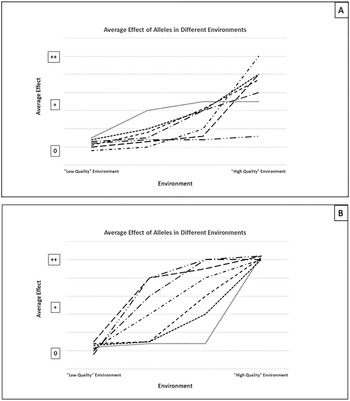
Figure 1. When Uchiyama et al. suggest, first, that populations in higher quality environments (for the development of a particular trait) will tend to have higher heritability, and second, that reductions in environmental variation will increase heritability, they likely have a picture like (A) in mind. However, there is nothing implausible about (B) (adapted very loosely from Cooper & Zubek's [1958] study on maze-running ability in rats). In such a case, higher quality environments would have lower heritability, and some ways of eliminating environmental variation would actually tend to decrease heritability.
Target article
Related commentaries (29)
Culture is reducing genetic heritability and superseding genetic adaptation
From the trajectory of heritability to the heritability of trajectories
Going beyond heritability: Mechanisms of gene–culture coevolution
While we agree with Uchiyama et al. that there are many complex interactions between cultural variation and genetic variation, and that heritability estimates are influenced by culture, we take issue with some of the ways in which the authors approach the establishment of this claim. We view the authors' central claims as consistent with work by Lewontin, Turkheimer, Dickinson, and Flynn and others who emphasize the role of environment and gene–environment interaction in the development of traits. Like these researchers, Uchiyama et al. highlight the failure of heritability estimates to provide a meaningful entry into understanding the causal role(s) played by genes in development.
We, however, have two concerns. First, we can see no way to predict how the heritability of a trait will respond to changes in the environment, independently of knowing an implausible amount about the development of the trait in question (so much so that the heritability of the trait would no longer be of any use). Depending on how development responds to environmental change, the same kind of environmental change might cause the heritability of a trait to increase, decrease, or to stay the same, and there is no way to know independently of having gained an understanding of the development of the trait across those environments, as each situation crucially depends on what the relevant genes do in those different environments. Sauce et al.'s (Reference Sauce, Bendrath, Herzfeld, Siegel, Style, Rab and Matzel2018) work, discussed by Uchiyama et al., on the heritability of cognitive traits in mice is relevant here. As Uchiyama et al. note, Sauce et al. show that enriched environments reduce heritability of cognitive traits in mice, whereas in children in the United States we see an increase in heritability in enriched environments (see also Beam and Turkheimer, Reference Beam and Turkheimer2013). In some ways, this should not be a surprise – if we thought that cognitive ability in mice worked like maze-running ability in Cooper & Zubek's (Reference Cooper and Zubek1958) rats, we would expect high heritability in the “normal” environment, and low in the enriched one (see Fig. 1B).
When Uchiyama et al. suggest, first, that populations in higher quality environments (for the development of a particular trait) will tend to have higher heritability, and second, that reductions in environmental variation will increase heritability, they likely have a picture like (A) in mind. However, there is nothing implausible about (B) (adapted very loosely from Cooper & Zubek's [Reference Cooper and Zubek1958] study on maze-running ability in rats). In such a case, higher quality environments would have lower heritability, and some ways of eliminating environmental variation would actually tend to decrease heritability.
In humans, heritability can depend, as Uchiyama et al. argue, on how culture features in different situations and for different traits. However, given what we say above, Uchiyama et al. should, perhaps, not agree with Harden's (Reference Harden2021) suggestion that one can use the heritability of a trait in humans to measure the degree and equality of “opportunity” in a culture. Increasing the degree and equality of “opportunity” can increase heritability, but sometimes it won't, and whether it will or not depends on the details of the trait's development across different environments given the genetic variation in that population.
This target article is further illustrated by realized ability to see well: In cultures with lots of opportunity, reasonably equally distributed, everyone gets checked by optometrists, and gets glasses if they need them, masking the effect of poor eyesight (in just the way that “sunscreen” can mask the effects of light skin in high ultraviolet [UV] regions – see sect. 2.1, paras 2, 4, and 5); in a culture with less opportunity, the effects of bad eyesight are not masked. The former will have lower heritability of realized poor eyesight than the latter. The insight that different environments can produce different interaction effects is one of the central claims in Lewontin's “Analysis of Variance and Analysis of Causes” (Reference Lewontin1974). Figures 1A and 1B illustrate different partial reaction norms corresponding to these alternate relations between environment and heritability (interpreted in this case as being about the average effect of an allele on the trait in question).
In short, without knowledge of the relevant reaction norm, one simply cannot predict how a trait will respond to changes in the environment, or how heritability estimates will change in response to environmental changes. Uchiyama et al.'s own discussion of the Flynn effect, and the current lack of any consensus about its cause, highlights this. As Lewontin forcefully noted, the only way to find out how much say IQ test-taking performance will change in response to an intervention is to try it, because merely knowing the heritability of the trait tells you nothing of any import (Reference Lewontin1992, p. 35). On the contrary, if one already has access to the information provided by the relevant norms of reaction (you know how organisms with particular genotypes will, in fact, respond to the proposed changes in the environment), the need for or usefulness of heritability estimates falls away, and one can instead work directly with the anticipated changes.
Our second concern is about the idea that we can separate out different parts of an organism's environment. For example, we don't see a good way to separate environments into “culture” and “non-culture” and worry that Uchiyama et al. invoke some hidden assumptions here. Lewontin's work has also been influential on this issue. In “The Organism as the Subject and Object of Evolution” (Reference Lewontin1983), he introduced the idea that organisms “construct” their own environments by determining what is relevant to them, providing the founding idea for the niche construction approach in evolutionary biology (see e.g., Laland, Oddling-Smee, and Feldman, Reference Laland, Oddling-Smee and Feldman2000). The key takeaway here is that even in the apparently trivial case of temperature as a human environmental factor, there is no good way to separate the “actual” temperature outside from the experience of the temperature, as mediated by culture. More generally, there is no “natural” environment that humans face independently of the social/cultural context in which they live. We are always enmeshed in a complex culture which determines our experiences of the world. This thinking also leads us to skepticism about the authors' idea that we can rank environments by how “favorable” they are for phenotypic development, even in cases in which we can hold genotypes fixed, such as in pure strains of mice (see e.g., Crabbe, Wahlsten, and Dudek, Reference Crabbe, Wahlsten and Dudek1999). As a result, Uchiyama et al.'s claim “For simplicity, we model cultural environmental variation as a uniform continuous distribution that is bound by k min, the most unfavorable environmental state (for some given phenotype) within the experienced range of environments, and k max, the most favorable” (Appendix, sect. A.1, para. 2) is far too optimistic (see e.g., Turkheimer, Reference Turkheimer and DiLalla2004).
Financial support
This research received no specific grant from any funding agency, commercial, or not-for-profit sectors.
Conflict of interest
None.