1 Introduction
For a function
$f \in L^1(\mathbb {R}^d)$
 , its Fourier transform is defined by

If
$f \in L^2(\mathbb {R}^d)$
 , then, since
$L^1(\mathbb {R}^d)$
 is dense in
$L^2(\mathbb {R}^d)$
 , the Fourier transform extends naturally to
$L^2(\mathbb {R}^d)$
 .
The Fourier transform is a fundamental mathematical tool that allows us to analyze functions and signals in terms of their frequency components. It decomposes a function into oscillatory modes, revealing its spectral structure and providing a powerful framework for studying differential equations and signal processing. For further details, see [Reference Bracewell2, Reference Fourier3, Reference Stein and Shakarchi11].
Let
$A \subseteq \mathbb {R}^d$
 . The characteristic function (or indicator function) of A is defined by

Thus,
$\widehat {1}_A$
 denotes the Fourier transform of the characteristic function of the set A.
The measurable set
$A \subset \mathbb {R}^d$
 is said to k-tile
$\mathbb {R}^d$
 with the translation set
$\Lambda $
 if almost every point in
$\mathbb {R}^d$
 is covered exactly k times by the translates
$A+\lambda $
 for
$\lambda \in \Lambda $
 , that is,

A set with this property is called a multi-tiler. In the special case
$k=1$
 , we simply say that A tiles
$\mathbb {R}^d$
 . Tilings and multi-tilings naturally arise in diverse areas, such as quasicrystals, Fourier analysis, and the theory of lattices. For further details, see [Reference Agora, Antezana and Cabrelli1, Reference Fuglede4, Reference Grepstad and Lev6, Reference Iosevich and Kolountzakis7, Reference Kolountzakis and Lev9] and the references therein.
In this article, we construct a counterexample to the following conjecture.
Conjecture 1.1 (Robins, 2024)
Let
$\mathcal {P},\mathcal {Q}\subset \mathbb {R}^d$
 be two convex, central symmetric bodies. Suppose
$P,Q$
 are not multi-tilers. Then
$\widehat {1}_{\mathcal {P}} (\xi )=\widehat {1}_{\mathcal {Q}} (\xi )$
 for all
$\xi \in \mathbb {Z}^d$
 if and only if
$\mathcal {P}=\mathcal {Q}$
 up to rigid motions, except on a set of measure zero.
Next, we briefly describe the motivation behind the conditions in the conjecture. The Fourier transform at integer points is equivalent to the equality of the corresponding Fourier series. In particular, for two measures supported on
$[0,1]^d$
 , equality at
${\xi \in \mathbb {Z}^d}$
 implies that the measures themselves coincide. More generally, for two measures
$\mu _1$
 and
$\mu _2$
 with unbounded support, equality of their Fourier series implies that they agree on the factor space
$\mathbb {R}^d / \mathbb {Z}^d$
 . In the case of measures uniformly distributed on convex bodies
$B_1$
 and
$B_2$
 , this condition can be interpreted as a geometric or combinatorial property.
Furthermore, the class of convex and centrally symmetric bodies is a natural class of geometric objects to study, appearing in classical results, such as Minkowski’s theorem and the second Minkowski theorem.
Finally, without the condition on multiple tilers, any two convex polytopes that tile
$\mathbb {R}^d$
 with the same lattice
$\Lambda \subset \mathbb {Z}^d$
 , as described in Lemma 2.1, provide a natural source of counterexamples to the conjecture.
In this article, we only address one direction of the equivalence:

The main result of the article can be formulated as the following theorem.
Theorem 1.2 Conjecture 1.1 is false for
$d\geq 4$
 .
The article is organized as follows. Section 2 presents the proof of Theorem 1.2 together with related remarks, while Section 3 states and proves a result illustrating the importance of convexity in Conjecture 1.1.
2 Proof of the main result
First, we recall a well-known result, which can be found, for example, in [Reference Kolountzakis8, Formula (1.5) in Lecture 1].
Lemma 2.1 Let
$Q \subset \mathbb {R}^d$
 be a measurable set of positive and finite measure, and let
$\Lambda \subset \mathbb {R}^d$
 be a full-rank lattice. Then

where
$\Lambda ^{*} = \{\, \xi \in \mathbb {R}^d : \xi \cdot \lambda \in \mathbb {Z} \text { for all } \lambda \in \Lambda \,\}$
 is the dual lattice.
Let R be the rhombus with vertices

and let H be the hexagon with vertices

Before proceeding to the proof of the main theorem, we state the following proposition.
Proposition 2.2

for all
$\xi \in \mathbb {Z}^2$
 .
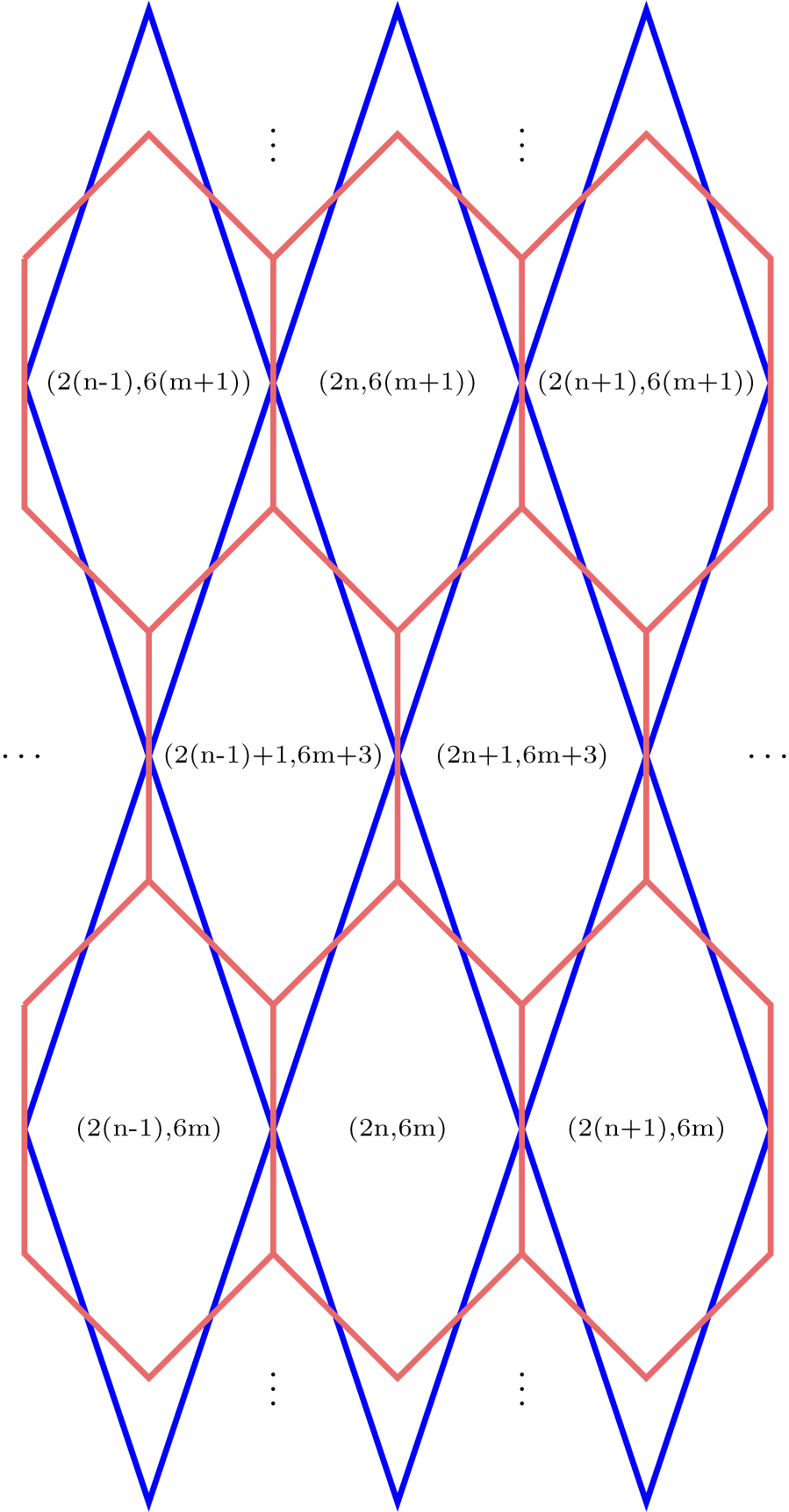
Proof Both R and H tile
$\mathbb {R}^2$
 by translations with the lattice

Since
$\Lambda \subset \mathbb {Z}^2$
 , it follows that
$(\mathbb {Z}^2)^*\subset \Lambda ^*$
 , so by Lemma 2.1,
$\widehat {1}_R(\xi )=\widehat {1}_H(\xi )=0$
 for
$\xi \in \mathbb {Z}^2 \setminus \{0\}$
 .
A tiling of
$\mathbb {R}^2$
 by the translational lattice
$\Lambda $
 using the rhombus R (blue) and the hexagon H (red).

Figure 1 Long description
The diagram shows a repeating pattern of vertically elongated blue rhombi overlaid with red hexagons. The shapes are organized in a staggered lattice.
Bottom row from left to right
- A blue rhombus labeled 2 open parenthesis n minus 1 close parenthesis comma 6 m.
- A central blue rhombus labeled 2 n comma 6 m.
- A blue rhombus labeled 2 open parenthesis n plus 1 close parenthesis comma 6 m.
Middle row, staggered between the bottom and top columns
- A blue rhombus on the left labeled 2 open parenthesis n minus 1 close parenthesis plus 1 comma 6 m plus 3.
- A blue rhombus on the right labeled 2 n plus 1 comma 6 m plus 3.
Top row from left to right
- A blue rhombus labeled 2 open parenthesis n minus 1 close parenthesis comma 6 open parenthesis m plus 1 close parenthesis.
- A central blue rhombus labeled 2 n comma 6 open parenthesis m plus 1 close parenthesis.
- A blue rhombus labeled 2 open parenthesis n plus 1 close parenthesis comma 6 open parenthesis m plus 1 close parenthesis.
Vertical and horizontal ellipses indicate the pattern continues infinitely in all directions. Red hexagons are centered at the intersections of the blue rhombi, creating a dual-tiling effect where each hexagon contains the center of one rhombus and parts of adjacent ones.
For
$\xi = (0,0)$
 , a direct computation gives

Now, we are ready to prove the main result.
Proof of Theorem 1.2
Let
$d\geq 4$
 . We consider two sets in
$\mathbb {R}^2$
 , rhombus R with vertices (2.1) and hexagon H with vertices (2.2). Both R and H are centrally symmetric and convex. Moreover, the Fourier transforms of the characteristic functions of R and H satisfy (2.3).
Next, let
$B \subset \mathbb {R}^{d-2}$
 denote the unit ball centered at the origin. We define two sets:
$\mathcal {P} = R \times B$
 and
$\mathcal {Q} = H \times B$
 . Since they are Cartesian products of centrally symmetric convex sets, both
$\mathcal {P}$
 and
$\mathcal {Q}$
 are themselves centrally symmetric and convex.
Note that if a convex body P admits a k-tiling, then P must be a polytope [Reference Gravin, Robins and Shiryaev5, Introduction]. Since neither
$\mathcal {P}$
 nor
$\mathcal {Q}$
 is a polytope, they cannot be multi-tilers.
Using (2.3), we see that for all
$\xi _1 \in \mathbb {Z}^2$
 and
$\xi _2 \in \mathbb {Z}^{d-2}$
 , with
$\xi = (\xi _1, \xi _2)$
 ,

Therefore, the conjecture is false for
$d\geq 4$
 .
2.1 Remarks
-
(1) Conjecture 1.1 has not appeared in the published literature; however, it has been stated by Sinai Robins in several of his talks, for example, in “Multi-tilings and the geometry of numbers, using the Siegel–Bombieri approach,”Footnote 1 presented at the 1st Brazilian Workshop in Analytic Number Theory. A revised version of the conjecture will appear in [Reference Robins10].
-
(2) The proof of Theorem 1.2 remains valid if H and R are replaced by any other multi-tilers whose Fourier transforms agree on the lattice $\mathbb {Z}^2$
 .
-
(3) The method described in Section 3 does not apply for $d < 4$
, since in this case, one of the sets must be one-dimensional. In dimension
$1$
, however, all convex and centrally symmetric sets are intervals, and hence trivially multi-tile
$\mathbb {R}$
. Moreover, since
$|I| = \widehat {1}_I(0)$
for any interval
$I \subset \mathbb {R}$
, it is impossible to find two distinct intervals (up to rigid motions) whose Fourier transforms agree on the lattice
$\mathbb {Z}$
.


3 Counterexample to the conjecture without the Convexity Assumption
Theorem 3.1 Conjecture 1.1 without the Convexity Assumption is false for
$d\geq ~2$
 .
Proof We consider two sets in
$\mathbb {R}$
 :
$I=[0,1]$
 and
$J=[-1,-1/2)\cup [1/2,1]$
 . Note that I and J have measure
$1$
 and tile
$\mathbb {R}$
 with the same lattice
$\mathbb {Z}$
 . So, by Lemma 2.1, we conclude that

for all
$\xi \in \mathbb {Z}$
 .
Next, for
$d\geq 3$
 , let
$B \subset \mathbb {R}^{d-1}$
 denote the unit ball centered at the origin. We define two sets:
$\mathcal {P} = I \times B$
 and
$\mathcal {Q} = J \times B$
 . Since they are Cartesian products of centrally symmetric sets, both
$\mathcal {P}$
 and
$\mathcal {Q}$
 are themselves centrally symmetric. Note that
$\mathcal {P}$
 is a ball and
$\mathcal {Q}$
 is the union of two disjoint balls in
$\mathbb {R}^d$
 , so neither of them can be a multi-tiler.
Using (3.1), we see that for all
$\xi _1 \in \mathbb {Z}$
 and
$\xi _2 \in \mathbb {Z}^{d-1}$
 , with
$\xi = (\xi _1, \xi _2)$
 ,

Thus, the conjecture without the Convexity Assumption is false for
$d\geq 3$
 .
For the case
$d=2$
 , we use the same strategy; however, since a ball in one dimension is just a segment, we must instead consider a more intricate set that does not multi-tile
$\mathbb {R}$
 . For example, we may take

where e denotes Euler’s number. This set is centrally symmetric and does not multi-tile
$\mathbb {R}$
 . Thus, the argument for
$d \geq 3$
 can be adapted to this choice of B, and the conclusion follows. Therefore, the conjecture without the Convexity Assumption is false for
$d\geq 2$
 .
Acknowledgements
The author would like to acknowledge Sinai Robins for valuable mathematical discussions and remarks.
Also, the author would like to thank the anonymous referee for their careful reading of the manuscript and for valuable comments and suggestions that helped improve the clarity and presentation of the article.