




No CrossRef data available.
Article contents
Is liberal bias universal? An international perspective on social psychologists
Published online by Cambridge University Press: 08 September 2015
Abstract
Based on our comparison of political orientation and research interests of social psychologists in capitalist Western countries versus post-Communist Eastern European countries, we suggest that Duarte and colleagues' claim of liberal bias in the field seems American-centric. We propose an alternative account of political biases which focuses on the academic tendency to explain attitudes of lower status groups.
Information
- Type
- Open Peer Commentary
- Information
- Copyright
- Copyright © Cambridge University Press 2015
References
Bilewicz, M., Górska, P., Cichocka, A. & Szabó, Z. (in press) Ideological distinction. The political ideologies of social psychologists in the East and West. Czechoslovak Psychology.Google Scholar
Bilewicz, M. & Olechowski, M. (2014) Psychologia społeczna: W pułapkach zaangażowania – Polska i świat [Social psychology: Engagement trap – Poland and the world]. Stan Rzeczy [State of Affairs]
6:159–76.Google Scholar
Bourdieu, P. (1984) Distinction: A social critique of the judgment of taste. Harvard University Press.Google Scholar
Golec, A. (2001) Konserwatyzm polityczny i potrzeba poznawczego domkniecia w badaniach polskich [Political conservatism and the need for cognitive closure in Polish studies]. Studia Psychologiczne [Psychological Studies]
1:423–58.Google Scholar
Greenwald, A. G. & Banaji, M. R. (1995) Implicit social cognition: Attitudes, self-esteem, and stereotypes. Psychological Review
102:4–27.Google Scholar
Greenwald, A. G., McGhee, D. E. & Schwartz, J. L. (1998) Measuring individual differences in implicit cognition: The implicit association test. Journal of Personality and Social Psychology
74:1464–80.Google Scholar
Haidt, J. (2011) The bright future of post-partisan social psychology. Talk given at the Annual Meeting of the Society for Personality and Social Psychology, San Antonio, TX, January 27, 2011. Transcript available at: http://people.stern.nyu.edu/jhaidt/postpartisan.html
Google Scholar
Hegarty, P. & Bruckmüller, S. (2013) Asymmetric explanations of group differences: Experimental evidence of Foucault's disciplinary power. Social and Personality Psychology Compass
7:176–86.Google Scholar
Henrich, J., Heine, S. J. & Norenzayan, A. (2010a) Most people are not WEIRD. Nature
466:29.Google Scholar
Inbar, Y. & Lammers, J. (2012) Political diversity in social and personality psychology. Perspectives on Psychological Science
7(5):496–503.Google Scholar
Jost, J. T., Federico, C. M. & Napier, J. L. (2009) Political ideology: Its structure, functions, and elective affinities. Annual Review of Psychology
60:307–37.Google Scholar
Kossowska, M. & van Hiel, A. (2003) The relationship between need for closure and conservative beliefs in Western and Eastern Europe. Political Psychology
24:501–18.Google Scholar
Maison, D., Greenwald, A. G. & Bruin, R. H. (2001) The Implicit Association Test as a measure of implicit consumer attitudes. Polish Psychological Bulletin
32:61–69.Google Scholar
Maison, D., Greenwald, A. G. & Bruin, R. H. (2004) Predictive validity of the Implicit Association Test in studies of brands, consumer attitudes, and behavior. Journal of Consumer Psychology
14:405–15.Google Scholar
McConnell, A. R. & Leibold, J. M. (2001) Relations among the Implicit Association Test, discriminatory behavior, and explicit measures of racial attitudes. Journal of Experimental Social Psychology
37:435–42.Google Scholar
World Values Survey Association (2014) World Values Survey: 2005–2009. Official aggregate, v.20140429, ASEP/JDS, Madrid, Spain [Data set]f. Available at: http://www.worldvaluessurvey.org/
Google Scholar
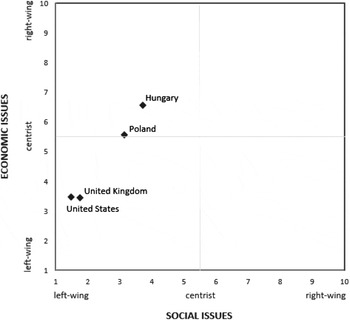
Figure 1. Political orientation of social psychologists in Western and Eastern-European countries (United States N = 52, United Kingdom N = 22, Hungary N = 32, and Poland N = 26).
“The field is shifting leftward” claim Duarte et al. in the target article (sect. 2, para. 4). Their analysis suggests that the social psychological research is conducted in a politically homogeneous environment that includes mainly political liberals and lacks a conservative voice. In this commentary we highlight some limitations of such an American-centric view on social psychology and present an alternative explanation of psychologists' political skew – based on their opposition to the attitudes prevalent in their societies, particularly among the low-status groups.
Duarte et al.'s analysis relies mainly on a unidimensional understanding of political ideology, in which political orientation in terms of economic issues is highly correlated with political orientation in terms of social issues (see Jost et al. Reference Jost, Federico and Napier2009). This overlap of economic and political liberalism seems more prevalent in the Western capitalist countries, particularly in the United States. In other parts of the world, such as the post-Communist nations of Eastern Europe, free-market economic worldviews are often linked to social liberalism (Golec Reference Golec2001; Kossowska & van Hiel Reference Kossowska and van Hiel2003). By ignoring the differences between economic and social attitudes, Duarte and colleagues inaccurately generalize the political leanings of American social psychologists to the rest of the world (see Henrich et al. Reference Henrich, Heine and Norenzayan2010a).
The claim about psychological field “shifting leftward” comes from Jonathan Haidt's observation during the 2011 Society for Personality and Social Psychology (SPSP) annual meeting (Haidt Reference Haidt2011), as well as Inbar and Lammers's (Reference Inbar and Lammers2012) analysis of SPSP members' political attitudes. The SPSP is an American non-profit institution, holding its meetings in the United States, with 72.5% of members being American. Indeed, more than 80% of psychologists participating in both studies by Inbar and Lammers (Reference Inbar and Lammers2012) were American. Duarte et al.'s observation about psychologists' liberalism might then be a local American specificity rather than a universal phenomenon. We decided to examine this phenomenon with a more internationally diverse sample.
For international comparison, we selected two Western traditionally capitalist nations (the United Kingdom and the United States) and two East European post-Communist nations (Hungary and Poland). We focused on comparing these countries because of their diverse political-economic history, as well as differences in support for state interventionism in economy. Indeed, support for state interventions tends to be higher in Hungary and Poland than in United Kingdom and the United States, and this difference is particularly strong among people of lower socio-economic status (World Values Survey Association 2014).
In a recent online study of 132 social psychologists from the United Kingdom, United States, Hungary, and Poland (Bilewicz et al., in press), we asked participants to indicate their political views with respect to social issues (e.g., religion or gender roles) and economic issues (e.g., taxes or welfare state) (Fig. 1). Social psychologists working in the post-Communist East European countries expressed rather right-wing political orientation with respect to economic issues and left-wing political orientation with respect to social issues, whereas Western social psychologists expressed left-wing orientation on both dimensions. Although East European social psychologists were overall more right-wing than Western social psychologists, this difference was more pronounced for economic than for social issues. Despite a relatively small sample size, this study serves as a preliminary illustration of the differences between Western and Eastern social psychology.
Political orientation of social psychologists in Western and Eastern-European countries (United States N = 52, United Kingdom N = 22, Hungary N = 32, and Poland N = 26).
It then seems that Duarte et al.'s conclusions of about “the field” might be limited to Western countries with a long tradition of free-market economy and liberal democracy. Moreover, by overseeing the situational context of political opinions and focusing on self-selection and hostile climate as the main reasons for liberal bias, they essentialize psychologists' political opinions. We propose an alternative explanation of dominant political leanings in psychology.
American and British social psychologists function in societies in which support for state interventions in economy is relatively low, even among low-status groups. In Hungary and Poland, however, low-status groups support economic interventions (World Values Survey Association 2014). We suggest that psychologists – usually part of the middle class – tend to accentuate their political attitudes in opposition to attitudes prevalent among low-status groups in their societies. Such accentuation is a typical distinction strategy of the middle class, allowing for reproduction of cultural and social capital in opposition to the working class rather than in opposition to higher classes (Bourdieu Reference Bourdieu1984). This opposition seems to be reflected in the research interests of social psychologists.
In the case of Western social psychology, some of the commonly studied topics are: ethnic prejudice, climate-change denial, and system justification (see the target article). All of them can be attributed to the political Right rather than Left. However, in the case of East European social psychology, the most commonly studied topics include: complaining, belief in an unjust world, entitlement attitudes, conspiracy theories, nationalism, and non-competitiveness (Bilewicz & Olechowski Reference Bilewicz and Olechowski2014). These issues combine anti-capitalism and social conservatism – a mix common among the low-status groups in post-Communist countries. East European social psychologists tend to perceive these topics in terms of pathologies. This stigmatizes negative evaluations of current economic and political order, and delegitimizes collective action.
Another good illustration of regional differences in research topics is the use of the implicit association test, a measure of unconscious attitudes (Greenwald et al. Reference Greenwald, McGhee and Schwartz1998). This method, originally developed in the USA to explain stereotyping, discrimination, and racial biases (see Greenwald & Banaji Reference Greenwald and Banaji1995; McConnell & Leibold Reference McConnell and Leibold2001), has been used by Polish social psychologists as a tool for measuring consumer attitudes toward corporate brands (e.g., Maison et al. Reference Maison, Greenwald and Bruin2001; Reference Maison, Greenwald and Bruin2004). The same technique can then be used in the interest of groups that are discriminated against (in the West) or in the interest of the market and the power-brokers (in Eastern Europe). This example seems to further illustrate the differences in the economic worldviews of social psychologists.
Social identities of social psychologists are construed in opposition to the “participants” – the low-status out-group members worth studying (Hegarty & Bruckmüller Reference Hegarty and Bruckmüller2013). Thus, social psychological research might not be biased because of liberal political inclinations, but rather, by the opposition between researchers and the values of the low-status groups in their societies.
ACKNOWLEDGMENT
This research was funded by the Polish Ministry of Science and Higher Education Iuventus Plus Grant IP2014 002273 to the first author, Michal Bilewicz.