





No CrossRef data available.
Article contents
Chimpanzees' technical reasoning: Taking fieldwork and ontogeny seriously
Published online by Cambridge University Press: 10 August 2020
Abstract
Following the tradition of comparing humans with chimpanzees placed under unfavorable conditions, the authors suggest many uniquely human technological abilities. However, chimpanzees use spontaneously tools in nature to achieve many different goals demonstrating technological skills and reasoning contradicting the authors contrast. Chimpanzees and humans develop skills through the experiences faced during their upbringing and neglecting this leads to fake conclusions.
Information
- Type
- Open Peer Commentary
- Information
- Copyright
- Copyright © The Author(s), 2020. Published by Cambridge University Press
References
Bania, A., Harris, S., Kinsley, H. & Boysen, S. (2009) Constructive and deconstructive tool modification by chimpanzees (Pan troglodytes). Animal Cognition 12:85–95.CrossRefGoogle Scholar
Bard, K. & Leavens, D. (2014) The importance of development for comparative primatology. Annual Review of Anthropology 43:183–200.CrossRefGoogle Scholar
Boesch, C. (1991) Teaching among wild chimpanzees. Animal Behaviour 41:530–32.CrossRefGoogle Scholar
Boesch, C. (2007) What makes us human (Homo sapiens)? The challenge of cognitive cross-species comparison. Journal of Comparative Psychology 121:227–40.CrossRefGoogle ScholarPubMed
Boesch, C. (2012) Wild cultures: A comparison between chimpanzee and human cultures. Cambridge University Press.CrossRefGoogle Scholar
Boesch, C. & Boesch, H. (1983) Optimization of nut-cracking with natural hammers by wild chimpanzees. Behaviour 83:265–86.CrossRefGoogle Scholar
Boesch, C. & Boesch, H. (1984) Mental map in wild chimpanzees: An analysis of hammer transports for nut cracking. Primates 25:160–70.CrossRefGoogle Scholar
Boesch, C. & Boesch, H. (1990) Tool use and tool making in wild chimpanzees. Folia Primatologica 54:86–99.CrossRefGoogle ScholarPubMed
Boesch, C., Bombjakova, D., Meier, A. & Mundry, R. (2019) Learning curves and teaching when acquiring nut-cracking in humans and chimpanzees. Scientific Reports 9:1515.CrossRefGoogle ScholarPubMed
Boesch, C., Head, J. & Robbins, M. (2009) Complex toolsets for honey extraction among chimpanzees in Loango National Park, Gabon. Journal of Human Evolution 56:560–69.CrossRefGoogle Scholar
Buchanan, K., Grindstaff, J. & Pravosudov, V. (2013) Condition dependence, developmental plasticity, and cognition: Implications for ecology and evolution. Trends in Ecology and Evolution 28:290–96.CrossRefGoogle ScholarPubMed
Byrne, R. (1997) The technical intelligence hypothesis: An additional evolutionary stimulus to intelligence? In: Machiavellian intelligence II: Extensions and evaluations, eds. Whiten, A. & Byrne, W., pp. 289–311. Cambridge University Press.CrossRefGoogle Scholar
Byrne, R. & Whiten, A. (1989) Machiavellian intelligence: Social expertise and the evolution of intellect in monkeys, apes and humans. Oxford Science Publishing.Google Scholar
Carpendale, J. & Lewis, C. (2004) Constructing an understanding of mind: The development of children's social understanding within social interaction. Behavioral and Brain Sciences 27:79–151.CrossRefGoogle ScholarPubMed
Clutton-Brock, T. & Harvey, P. (1980) Primates, brains and ecology. Journal of Zoology 190:309–23.CrossRefGoogle Scholar
Dunbar, R. I. M. (1992) Neocortex size as a constraint on group size in primates. Journal of Human Evolution 22(6):469–93.CrossRefGoogle Scholar
Estienne, V., Cohen, H., Wittig, R. & Boesch, C. (2019a) Maternal influence on the development of nut-cracking skills in the chimpanzees of the Taï forest, Côte d'Ivoire (Pan troglodytes verus). American Journal of Primatology, e23022. doi: 10.1002/ajp.2302.Google Scholar
Estienne, V., Robira, B., Mundry, R., Deschner, T. & Boesch, C. (2019b) Acquisition of a complex extractive technique by the immature chimpanzees of Loango National Park, Gabon. Animal Behaviour 147:61–76.CrossRefGoogle Scholar
Fares, R., Belmeguenai, A., Sanchez, P., Kouchi, H., Bodennec, J., Morales, A., Georges, B., Bonnet, C., Bouvard, S., Sloviter, R. & Bezin, L. (2013) Standardized environmental enrichment supports enhanced brain plasticity in healthy rats and prevents cognitive impairment in epileptic rats. PLoS ONE 8:e53888.CrossRefGoogle ScholarPubMed
Furlong, E., Boose, K. & Boysen, S. (2008) Raking it in: The impact of enculturation on chimpanzee tool use. Animal Cognition 11:83–97.CrossRefGoogle ScholarPubMed
Goodall, J. (1968) Behaviour of free-living chimpanzees of the Gombe Stream area. Animal Behaviour Monograph 1:163–311.Google Scholar
Goodall, J. (1970) Tool-using in primates and other vertebrates. In: Advances in the study of behavior, eds. Lehrmann, D. S., Hinde, R. A. & Shaw, E., vol. 3, pp. 195–249. Academic Press.Google Scholar
Hackman, D. & Farah, M. (2009) Socioeconomic status and the developing brain. Trends in Cognitive Science 13:65–73.CrossRefGoogle ScholarPubMed
Hauser, M. (2001) Elementary my dear chimpanzee. Science (New York, N.Y.) 291:440–41.CrossRefGoogle Scholar
Humphrey, N. K. (1976) The social function of intellect. In: Growing points in ethology, eds. Bateson, P. P. and Hinde, R., pp. 303–317. Cambridge University Press.Google Scholar
Lambourne, K. & Tomporowski, P. (2010) The effect of exercise-induced arousal on cognitive task performance: A meta-regression analysis. Brain Research 1341:12–24.CrossRefGoogle ScholarPubMed
Leeuwen, E., Mulenga, I. & Chidester, D. (2014) Early social deprivation negatively affects social skill acquisition in chimpanzees (Pan troglodytes). Animal Cognition 17:407–14.CrossRefGoogle Scholar
Luncz, L., Mundry, R. & Boesch, C. (2012) Evidence for cultural differences between neighboring chimpanzee communities. Current Biology 22:922–26.CrossRefGoogle ScholarPubMed
Middleton, L., Mitnitski, A., Fallah, N., Kirkland, S. & Rockwood, K. (2008) Changes in cognition and mortality in relation to exercise in late life: A population based study. PLoS ONE 3:e3124.CrossRefGoogle ScholarPubMed
Musgrave, S., Lonsdorf, E., Morgan, D., Prestipino, M., Bernstein-Kurtycz, L., Mundry, R. & Sanz, C. (2020) Teaching varies with task complexity in wild chimpanzees. Proceedings of the National Academy of Sciences of the United States of America 117(2):969–76. doi: 10.1073/pnas.1907476116.CrossRefGoogle ScholarPubMed
Musgrave, S., Morgan, D., Lonsdorf, E., Mundry, R. & Sanz, C. (2016) Tool transfers are a form of teaching among chimpanzees. Scientific Reports 6:34783. doi: 10.1038/srep34783.CrossRefGoogle ScholarPubMed
Noble, K., Houston, S., Brito, N., Bartsch, H., Kan, E., Kuperman, J., Akshoomoff, N., Amaral, D., Bloss, C., Libiger, O., Schork, N., Murray, S., Casey, B., Chang, L., Ernst, T., Frazier, J., Gruen, J., Kennedy, D., Van Zijl, P., Mostofsky, S., Kaufmann, W., Kenet, T., Dale, A., Jernigan, T. & Sowell, E. (2015) Family income, parental education and brain structure in children and adolescents. Nature Neuroscience 18:773–80.CrossRefGoogle ScholarPubMed
Normand, E., Ban, S. & Boesch, C. (2009) Forest chimpanzees (Pan troglodytes verus) remember the location of numerous fruit trees. Animal Cognition 12:797–807.CrossRefGoogle ScholarPubMed
Normand, E. & Boesch, C. (2009) Sophisticated Euclidian maps in forest chimpanzees. Animal Behaviour 77:1195–201.CrossRefGoogle Scholar
Pike, T., Ramsey, M. & Wilkinson, A. (2018) Environmentally induced changes to brain morphology predict cognitive performance. Philosophical Transactions of the Royal Society B: Biological Sciences 373:20170287.CrossRefGoogle ScholarPubMed
Povinelli, D. (2000) Folk physics for apes: The chimpanzee's theory of how the world works. Oxford University Press.Google Scholar
Povinelli, D. (2012) World without weight: Perspectives on an Alien mind. Oxford University Press.Google Scholar
Rowe, C. & Healy, S. (2014) Measuring variation in cognition. Behavioral Ecology 25:1287–92.CrossRefGoogle Scholar
Russell, J., Lyn, H., Schaeffer, J. & Hopkins, W. (2011) The role of socio-communicative rearing environment in the development of social and physical cognition in apes. Developmental Science 14:1459–70.CrossRefGoogle ScholarPubMed
Sallet, J., Mars, R., Noonan, M., Andersson, J., O'Reilly, J., Jbabdi, S., Croxson, P., Jenkinson, M., Miller, K. & Rushworth, M. (2011) Social network size affects neural circuits in macaques. Science (New York, N.Y.) 334:697–700.CrossRefGoogle ScholarPubMed
Salvanes, A., Moberg, O., Ebbesson, L. O. E., Nilsen, T., Jensen, K. & Braithwaite, V. (2013) Environmental enrichment promotes neural plasticity and cognitive ability in fish. Proceedings of the Royal Society B: Biological Sciences 280:20131331.CrossRefGoogle ScholarPubMed
Sanz, C. M., Call, J. & Morgan, D. (2009) Design complexity in termite-fishing tools of chimpanzees (Pan troglodytes). Biology Letters 5:293–96.CrossRefGoogle Scholar
Sanz, C. & Morgan, D. (2007) Chimpanzee tool technology in the Goualougo Triangle, Republic of Congo. Journal of Human Evolution 52:420–33.CrossRefGoogle ScholarPubMed
Sanz, C. & Morgan, D. (2009) Flexible and persistent tool-using strategies in honey-gathering by wild chimpanzees. International Journal of Primatology 30:411–27.CrossRefGoogle Scholar
Sanz, C., Morgan, D. & Gulick, S. (2004) New insights into chimpanzees, tools, and termites from the Congo Basin. American Naturalist 164:567–81.CrossRefGoogle ScholarPubMed
Segall, M., Dasen, P., Berry, J. & Poortinga, Y. (1999) Human behavior in global perspective: An introduction to cross-cultural psychology, 2nd ed. Pergamon Press.Google Scholar
Sirianni, G., Mundry, R. & Boesch, C. (2015) When to choose which tool: Multidimensional and conditional selection of nut-cracking hammers in wild chimpanzees. Animal Behaviour 100:152–65.CrossRefGoogle Scholar
Sirianni, G., Wittig, R. M., Gratton, P., Mundry, R., Schuler, A. & Boesch, C. (2018) Do chimpanzees anticipate an object's weight? A field experiment on the kinematics of hammer-lifting movements in the nut-cracking Taï chimpanzees. Animal Cognition 21:109–18.CrossRefGoogle Scholar
Smulders, T., Gould, K. & Leaver, L. (2010) Using ecology to guide the study of cognitive and neural mechanisms of different aspects of spatial memory in food-hoarding animals. Philosophical Transactions of the Royal Society B: Biological Sciences 365:883–900.CrossRefGoogle Scholar
Sugiyama, Y. (1994) Tool use by wild chimpanzees. Science (New York, N.Y.) 367:327.Google ScholarPubMed
Sugiyama, Y. & Koman, J. (1979) Tool-using and -making behavior in wild chimpanzees at Bossou, Guinea. Primates 20:513–24.CrossRefGoogle Scholar
Thornton, A. & Lukas, D. (2012) Individual variation in cognitive performance: Developmental and evolutionary perspectives. Philosophical Transactions of the Royal Society B: Biological Sciences 367:2773–83.CrossRefGoogle ScholarPubMed
Tomasello, M. (2019b) On becoming human: A theory of ontogeny. Harvard University Press.CrossRefGoogle Scholar
Toyoshima, M., Yamada, K., Sugita, M. & Ichitani, Y. (2018) Social enrichment improves social recognition memory in male rats. Animal Cognition 21:345–51.CrossRefGoogle ScholarPubMed
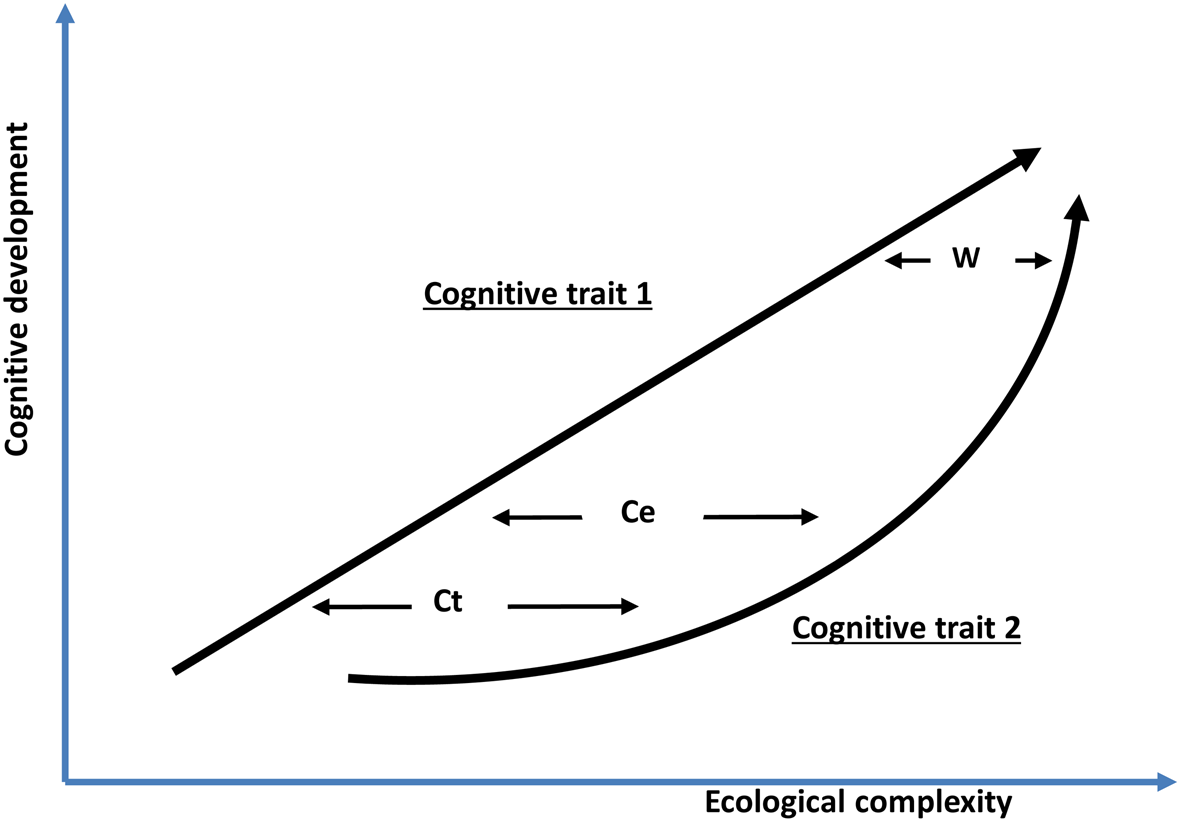
Figure 1. The eco-cultural model for cognitive development: Four main factors have been shown to affect the development of cognition in animals, including age, ecological complexity, social, and cultural complexity. The potential effects of ecological complexity on two different cognitive traits when animals develop in traditional captive conditions (Ct), in environmental enriched captive conditions (Ce), or in the wild (W) are shown.
Target article
Related commentaries (26)
A cognitive developmental approach is essential to understanding cumulative technological culture
 You have
Access
The authors in their review of technological culture are proposing a series of unique human abilities that seem to distinguish humans from other animals. By doing this, they are following an unfortunate tendency to erect “Golden Barriers,” as said Stephen Jay Gould, to set us apart from the rest of the animal kingdom. This is commonly done with a simple trick: Namely, place the species compared with humans under unfavorable conditions (Allen Reference Allen2002; Bard & Leavens Reference Bard and Leavens2014; Rowe & Healy Reference Rowe and Healy2014). The result being that humans always fare better. Thus, the real “elephant in the room” is if this is science!
In their otherwise thorough review, the authors base all their comparative arguments on a few captive chimpanzee studies. Whenever they mention results on wild chimpanzees they regularly contradict them with captive experimental studies to which they give priority. Why is such a comparison unfair?
First, all leading hypotheses about the evolution of cognition have proposed the importance of ontogeny and socio-ecological factors. This is true for the ecological-intelligence hypothesis (Byrne Reference Byrne, Whiten and Byrne1997; Clutton-Brock & Harvey Reference Clutton-Brock and Harvey1980), the social intelligence (Dunbar Reference Dunbar1992; Humphrey Reference Humphrey, Bateson and Hinde1976), the cultural intelligence (Byrne & Whiten Reference Byrne and Whiten1989), as well as the eco-cultural hypotheses (Boesch Reference Boesch2007; Carpendale & Lewis Reference Carpendale and Lewis2004; Segall et al. Reference Segall, Dasen, Berry and Poortinga1999). Second, all studies evaluating the effects on cognition of the physical or social environment, as well as of experience, agreed to conclude that all these factors have a measurable positive effect on its development (e.g., Bard & Leavens Reference Bard and Leavens2014; Buchanan et al. Reference Buchanan, Grindstaff and Pravosudov2013; Fares et al. Reference Fares, Belmeguenai, Sanchez, Kouchi, Bodennec, Morales, Georges, Bonnet, Bouvard, Sloviter and Bezin2013; Hackman & Farah Reference Hackman and Farah2009; Lambourne & Tomporowski Reference Lambourne and Tomporowski2010; Leeuwen et al. Reference Leeuwen, Mulenga and Chidester2014; Middleton et al. Reference Middleton, Mitnitski, Fallah, Kirkland and Rockwood2008; Noble et al. Reference Noble, Houston, Brito, Bartsch, Kan, Kuperman, Akshoomoff, Amaral, Bloss, Libiger, Schork, Murray, Casey, Chang, Ernst, Frazier, Gruen, Kennedy, Van Zijl, Mostofsky, Kaufmann, Kenet, Dale, Jernigan and Sowell2015; Pike et al. Reference Pike, Ramsey and Wilkinson2018; Russell et al. Reference Russell, Lyn, Schaeffer and Hopkins2011; Sallet et al. Reference Sallet, Mars, Noonan, Andersson, O'Reilly, Jbabdi, Croxson, Jenkinson, Miller and Rushworth2011; Salvanes et al. Reference Salvanes, Moberg, Ebbesson, Nilsen, Jensen and Braithwaite2013; Thornton & Lukas Reference Thornton and Lukas2012; Toyoshima et al. Reference Toyoshima, Yamada, Sugita and Ichitani2018).
Figure 1 illustrates how two different cognitive traits, such as technical skills (trait 1, Sirianni et al. Reference Sirianni, Mundry and Boesch2015; Reference Sirianni, Wittig, Gratton, Mundry, Schuler and Boesch2018) or spatial knowledge (trait 2, Normand et al. Reference Normand, Ban and Boesch2009), could be affected by the ecological complexity in which the individual lives. The strongly limited access to objects in captivity has been shown to reduce the development of an understanding of the function of tools that could partially be improved with increased access to tools (see Bania et al. Reference Bania, Harris, Kinsley and Boysen2009; Furlong et al. Reference Furlong, Boose and Boysen2008), and will further be favored in the wild where tools are of a real value (Sirianni et al. Reference Sirianni, Mundry and Boesch2015; Reference Sirianni, Wittig, Gratton, Mundry, Schuler and Boesch2018). Although, spatial skills will remain very limited in captivity because of the strong space restriction of the environment (Premack & Premack Reference Premack and Premack1983), they can develop in the wild when foraging in kilometers-wide territories (Normand & Boesch Reference Normand and Boesch2009).
The eco-cultural model for cognitive development: Four main factors have been shown to affect the development of cognition in animals, including age, ecological complexity, social, and cultural complexity. The potential effects of ecological complexity on two different cognitive traits when animals develop in traditional captive conditions (Ct), in environmental enriched captive conditions (Ce), or in the wild (W) are shown.
The chimpanzees studied by Povinelli and Tomasello cited extensively by the authors have for the first had only very limited access to objects in an artificial small peer-group without any adult models, whereas the second ones started in a medical research center subject to invasive experiments before experiencing better living conditions at the Leipzig zoo. As could have been expected both groups of chimpanzees show striking deficiencies in their understanding of tool function and integrity, notion of weight, space as well as in the social cognition, like the absence of cooperation and imitations (reviewed in Povinelli Reference Povinelli2000; Reference Povinelli2012; Tomasello Reference Tomasello2019b). Basing themselves on such human-shaped chimpanzees and rejecting field observations if they disagree with the formers, the authors built some nice dichotomy endorsing so-called human superiorities.
How would a fair comparison look like? What if free-ranging socially natural living chimpanzees were compared with humans living under similar conditions? In this way, natural differences would be identified to understand the evolution of human uniqueness. To restrict myself to technology, all chimpanzee groups studied throughout Africa use flexibly extended tool kits and often fashion the tools before use. Furthermore, they often plan the future needs of tools resulting in tool transports, with precise selection and/or modification of tools as a function of distance transported (Boesch & Boesch Reference Boesch and Boesch1983; Reference Boesch and Boesch1984; Reference Boesch and Boesch1990; Boesch et al. Reference Boesch, Head and Robbins2009; Estienne et al. Reference Estienne, Cohen, Wittig and Boesch2019a; Reference Estienne, Robira, Mundry, Deschner and Boesch2019b; Goodall Reference Goodall1968; Reference Goodall, Lehrmann, Hinde and Shaw1970; Luncz et al. Reference Luncz, Mundry and Boesch2012; Sanz & Morgan Reference Sanz and Morgan2007; Reference Sanz and Morgan2009; Sanz et al. Reference Sanz, Morgan and Gulick2004; Reference Sanz, Call and Morgan2009; Sirianni et al. Reference Sirianni, Mundry and Boesch2015; Reference Sirianni, Wittig, Gratton, Mundry, Schuler and Boesch2018; Sugiyama Reference Sugiyama1994; Sugiyama & Koman Reference Sugiyama and Koman1979). Mothers teach youngsters to stimulate the learning of tools in different populations of chimpanzees (Boesch Reference Boesch1991; Boesch et al. Reference Boesch, Bombjakova, Meier and Mundry2019; Musgrave et al. Reference Musgrave, Morgan, Lonsdorf, Mundry and Sanz2016; Reference Musgrave, Lonsdorf, Morgan, Prestipino, Bernstein-Kurtycz, Mundry and Sanz2020). None of these complex characteristics of tool use have been found in captive chimpanzees. Just one example, Taï chimpanzees select an optimal hammer out of an average of 16 available ones by considering five factors, including weight, hardness, distance to the anvil, and nut species, just by looking at them (Boesch & Boesch Reference Boesch and Boesch1984; Sirianni et al. Reference Sirianni, Mundry and Boesch2015) and this selection is condition-dependent on the distance to the nut-cracking site. This requires a complex form of conditional reasoning combining visible and imperceptible properties of the objects. New selections are repeated in numerous new situations throughout the 5 months of the two nut-cracking seasons (Sirianni et al. Reference Sirianni, Mundry and Boesch2015). Sure, in the forest, tools contribute to the survival of the animals, which is never the case in a captive environment. The value of captive experiments without any ecological validity has been amply critically discussed in the literature (e.g., Boesch Reference Boesch2012; Rowe and Healy Reference Rowe and Healy2014; Smulders et al. Reference Smulders, Gould and Leaver2010), but the authors seem not aware of this.
Comparisons with ecological and ontogenic validity would lead to totally different results than the target paper. As a reviewer of the paper, I informed the authors about the problem, but they were allowed by the journal to ignore this and perpetuating the simple trick to make humans look superior.
Financial support
This research received no specific grant from any funding agency, commercial, or not-for-profit sectors.
Conflict of interest
None.