In “The Emperor's New Markov Blankets,” Bruineberg and colleagues present a stimulating treatment of developments in conceptually distinct uses of the concept of Markov blankets. The authors attribute the original definition of Markov blankets to Pearl and then explain how it differs from a more recent conception of Markov blankets, which they attribute to Friston. Their narrative is of the cautionary sort, warning readers against the conflation of these distinct uses. Bruineberg and I mentioned similar points in our co-authored commentary (Bruineberg & Hesp, Reference Bruineberg and Hesp2018) calling researchers to move “beyond blanket terms.” It was an early prelude to some of the concerns raised in the target article – namely that associating the physical boundaries of living systems with Markov blankets still leaves us with thorny issues and edge cases, requiring further theoretical, empirical, and computational work. The authors emphasize the following distinction between two “types” of Markov blankets:
(a) Pearl introduced the definition of a Markov blanket as the minimal set of nodes in a directed acyclic graph that render a given target node conditionally independent from all the other nodes in the network: parents, children, and co-parents.
(b) Friston's characterization of Markov blankets emphasizes circular causality by partitioning a given system of interest in terms of its external and internal states, whose recursive influences are mediated by “blanket states,” which entail sensory and active states. Given a designated set of internal states, sensory states mediate inward influences (from external to internal states), while active states mediate outward influences (from internal to external states).
In the target article, the authors argue that Pearl's characterization of Markov blankets is more innocuous than that of Friston – as presented in “Life as we know it” (Friston, Reference Friston2013). I will pay particular attention to the following technical points made by Bruineberg and colleagues:
(1) Friston's formulation focuses explicitly on circular causality and bi-directional connectivity, while Pearl's formulation focuses on directed acyclic graphs.
(2) There is an ambiguous mapping between Friston's formulation and Pearl's definition of a Markov blanket: If the internal states are designated as the target set, then sensory states are parent nodes and active states are child nodes, but this leaves co-parent nodes unaccounted for.
(3) The identification of internal states depends heavily on thresholding parameters and other modelling choices.
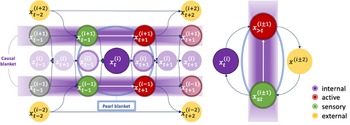
First, we consider the causal (in)dependency structure imposed on complex dynamical systems by temporal and physical constraints of interactions. Figure 1 illustrates that a combination of localized interactions combined with a separation of convergence time scales (as induced by the rate parameter in Friston's primordial soup) speaks to the first two points. Firstly, dynamical relationships are causally directed due to the arrow of time and exhibit recurrence when considering multiple time steps. Second, separation of time scales in localized interactions means that all co-parents of a target state are also its parents. As shown in Figure 1, these conditions allow for a correspondence between the Markov blanket of a target node – as originally defined by Pearl – and its causal blanket – as defined by Rosas, Mediano, Biehl, Chandaria, and Polani (Reference Rosas, Mediano, Biehl, Chandaria and Polani2020). The significance of blanket leakage versus blanket closure is that unaccounted co-parents will act as confounding variables for any inferential process. Temporal separability minimizes such confounding relationships, affording some “probabilistic grip” to the target node. As such, investigating the sufficient conditions for the stability of such “blanket closure” would be a valuable avenue for research into the emergence of life.
Figure 1.On the left, a directed acyclic graph describing a complex system consisting of five variables at five time points (t − 2, t − 1, t, t + 1, t + 2), with localized interactions and a separation of time scales where the target node i changes twice as fast as its neighbours (i − 1, i + 1), which in turn change twice as fast as their next neighbours (i − 2, i + 2). On the top right, the associated “Friston blanket,” showing the resulting correspondence between the “Pearl blanket” (in blue) and the causal blanket in purple (as in Rosas et al., Reference Rosas, Mediano, Biehl, Chandaria and Polani2020), induced by the combination of localized interactions and separation of time scales.
With respect to the dependence on modelling assumptions, I would echo George Box: “All models are wrong, but some are useful.” Methods for partitioning systems will reveal different kinds of information about them, but for given variables of interest they can be evaluated against each other. The authors rightly noted the additional complexity given the fact that predictive accounts of cognition tend to involve “models within models.” These nuances do not detract from the utility of such formalisms as modelling heuristics. For any given living system, any model being modelled is – by logical necessity – epistemologically bounded by influences crossing its causal blanket. Furthermore, such models should be biased towards those aspects of the environment that are relevant to organismic integrity and function. Because their capacity to maintain such a probabilistic grip would depend heavily on the stability of blanket closure, this approach naturally emphasizes the functional relevance of autopoiesis and – in extension – self-modelling (Ramstead et al., Reference Ramstead, Hesp, Tschantz, Smith, Constant and Friston2021; Sandved-Smith et al., Reference Sandved-Smith, Hesp, Mattout, Friston, Lutz and Ramstead2021). At this point, we can consider “models of models within models” to characterize the heterarchical structure of cognition. Perhaps to the frustration of those who prefer philosophical clarity, I would argue that, when territories are devoted to mapping (sub)sections of themselves recursively on different levels of description, maps and territories can mingle – blurring their conceptual boundaries.
Allegorical implications of “The Emperor's New Clothes”
The authors have selected a pithy title that fits with the theme of publicly calling into question a common belief. However, Anderson's original story suggests a much darker allegorical message. Intentional deceit was attributed explicitly to every single character in this story except the “little child,” who heroically disrupted the echo chamber. The echoes were started by the weavers, who falsely claimed that “a simpleton, or one unfit for his job would be unable to see the cloth.” While everyone was taken hostage by their own social insecurities, only the little child dared to speak out loud.
Transposed to our context, this allegory appears to suggest that researchers have formed an echo chamber – driven by reliance on hearsay and intellectual dishonesty – for fear of being seen as a “simpleton.” Bruineberg and colleagues associate their own message with the little child – exposing an obvious lie. The implied accusation appears to run counter to the principle of charity, which is essential for effective academic discourse.Footnote 1 Presumably this was not intended, but the authors could have steered clear of such ambiguities by explaining their choice of title in-text – as is common practice when academics use popular references. Hopefully, if nothing else, my commentary could elicit such clarification from the authors.







In “The Emperor's New Markov Blankets,” Bruineberg and colleagues present a stimulating treatment of developments in conceptually distinct uses of the concept of Markov blankets. The authors attribute the original definition of Markov blankets to Pearl and then explain how it differs from a more recent conception of Markov blankets, which they attribute to Friston. Their narrative is of the cautionary sort, warning readers against the conflation of these distinct uses. Bruineberg and I mentioned similar points in our co-authored commentary (Bruineberg & Hesp, Reference Bruineberg and Hesp2018) calling researchers to move “beyond blanket terms.” It was an early prelude to some of the concerns raised in the target article – namely that associating the physical boundaries of living systems with Markov blankets still leaves us with thorny issues and edge cases, requiring further theoretical, empirical, and computational work. The authors emphasize the following distinction between two “types” of Markov blankets:
(a) Pearl introduced the definition of a Markov blanket as the minimal set of nodes in a directed acyclic graph that render a given target node conditionally independent from all the other nodes in the network: parents, children, and co-parents.
(b) Friston's characterization of Markov blankets emphasizes circular causality by partitioning a given system of interest in terms of its external and internal states, whose recursive influences are mediated by “blanket states,” which entail sensory and active states. Given a designated set of internal states, sensory states mediate inward influences (from external to internal states), while active states mediate outward influences (from internal to external states).
In the target article, the authors argue that Pearl's characterization of Markov blankets is more innocuous than that of Friston – as presented in “Life as we know it” (Friston, Reference Friston2013). I will pay particular attention to the following technical points made by Bruineberg and colleagues:
(1) Friston's formulation focuses explicitly on circular causality and bi-directional connectivity, while Pearl's formulation focuses on directed acyclic graphs.
(2) There is an ambiguous mapping between Friston's formulation and Pearl's definition of a Markov blanket: If the internal states are designated as the target set, then sensory states are parent nodes and active states are child nodes, but this leaves co-parent nodes unaccounted for.
(3) The identification of internal states depends heavily on thresholding parameters and other modelling choices.
First, we consider the causal (in)dependency structure imposed on complex dynamical systems by temporal and physical constraints of interactions. Figure 1 illustrates that a combination of localized interactions combined with a separation of convergence time scales (as induced by the rate parameter in Friston's primordial soup) speaks to the first two points. Firstly, dynamical relationships are causally directed due to the arrow of time and exhibit recurrence when considering multiple time steps. Second, separation of time scales in localized interactions means that all co-parents of a target state are also its parents. As shown in Figure 1, these conditions allow for a correspondence between the Markov blanket of a target node – as originally defined by Pearl – and its causal blanket – as defined by Rosas, Mediano, Biehl, Chandaria, and Polani (Reference Rosas, Mediano, Biehl, Chandaria and Polani2020). The significance of blanket leakage versus blanket closure is that unaccounted co-parents will act as confounding variables for any inferential process. Temporal separability minimizes such confounding relationships, affording some “probabilistic grip” to the target node. As such, investigating the sufficient conditions for the stability of such “blanket closure” would be a valuable avenue for research into the emergence of life.
On the left, a directed acyclic graph describing a complex system consisting of five variables at five time points (t − 2, t − 1, t, t + 1, t + 2), with localized interactions and a separation of time scales where the target node i changes twice as fast as its neighbours (i − 1, i + 1), which in turn change twice as fast as their next neighbours (i − 2, i + 2). On the top right, the associated “Friston blanket,” showing the resulting correspondence between the “Pearl blanket” (in blue) and the causal blanket in purple (as in Rosas et al., Reference Rosas, Mediano, Biehl, Chandaria and Polani2020), induced by the combination of localized interactions and separation of time scales.
With respect to the dependence on modelling assumptions, I would echo George Box: “All models are wrong, but some are useful.” Methods for partitioning systems will reveal different kinds of information about them, but for given variables of interest they can be evaluated against each other. The authors rightly noted the additional complexity given the fact that predictive accounts of cognition tend to involve “models within models.” These nuances do not detract from the utility of such formalisms as modelling heuristics. For any given living system, any model being modelled is – by logical necessity – epistemologically bounded by influences crossing its causal blanket. Furthermore, such models should be biased towards those aspects of the environment that are relevant to organismic integrity and function. Because their capacity to maintain such a probabilistic grip would depend heavily on the stability of blanket closure, this approach naturally emphasizes the functional relevance of autopoiesis and – in extension – self-modelling (Ramstead et al., Reference Ramstead, Hesp, Tschantz, Smith, Constant and Friston2021; Sandved-Smith et al., Reference Sandved-Smith, Hesp, Mattout, Friston, Lutz and Ramstead2021). At this point, we can consider “models of models within models” to characterize the heterarchical structure of cognition. Perhaps to the frustration of those who prefer philosophical clarity, I would argue that, when territories are devoted to mapping (sub)sections of themselves recursively on different levels of description, maps and territories can mingle – blurring their conceptual boundaries.
Allegorical implications of “The Emperor's New Clothes”
The authors have selected a pithy title that fits with the theme of publicly calling into question a common belief. However, Anderson's original story suggests a much darker allegorical message. Intentional deceit was attributed explicitly to every single character in this story except the “little child,” who heroically disrupted the echo chamber. The echoes were started by the weavers, who falsely claimed that “a simpleton, or one unfit for his job would be unable to see the cloth.” While everyone was taken hostage by their own social insecurities, only the little child dared to speak out loud.
Transposed to our context, this allegory appears to suggest that researchers have formed an echo chamber – driven by reliance on hearsay and intellectual dishonesty – for fear of being seen as a “simpleton.” Bruineberg and colleagues associate their own message with the little child – exposing an obvious lie. The implied accusation appears to run counter to the principle of charity, which is essential for effective academic discourse.Footnote 1 Presumably this was not intended, but the authors could have steered clear of such ambiguities by explaining their choice of title in-text – as is common practice when academics use popular references. Hopefully, if nothing else, my commentary could elicit such clarification from the authors.
Financial support
The work of this author is supported by funding from a NWO Research Talent Grant of the Dutch Government (no. 406.18.535).
Conflict of interest
None.