






No CrossRef data available.
Article contents
Deconstructing the process of change in cognitive behavioral therapy: An alternative approach focusing on the episodic retrieval mode
Published online by Cambridge University Press: 08 June 2015
Abstract
Lane et al. view the process of memory reconsolidation as a main ingredient of psychotherapeutic change. They ascertain that in cognitive behavioral therapy (CBT) high priority is given to the “semantic structure.” We argue that memory-related mechanisms of change in CBT are more nuanced than the target article presents. Furthermore, we propose to partially shift the focus from the process of reconsolidation to the retrieval operations.
Information
- Type
- Open Peer Commentary
- Information
- Copyright
- Copyright © Cambridge University Press 2015
References
Alston, L. L., Kratchmer, C., Jeznach, A., Bartlett, N. T., Davidson, P. S. & Fujiwara, E. (2013) Self- serving episodic memory biases: Findings in the repressive coping style. Frontiers in Behavioral Neurosciences
7:117. Available at: http://doi.org/10.3389/fnbeh.2013.00117.Google Scholar
Beck, A. T. (2008) The evolution of the cognitive model of depression and its neurobiological correlates. American Journal of Psychiatry
165(8):969–77.Google Scholar
Dorahy, M. & van der Hart, O. (2007) Relationship between trauma and dissociation. In: Traumatic dissociation. Neurobiology and treatment, ed. Vermetten, E., Dorahy, M. J. & Spiegel, D., pp. 3–30. American Psychiatric Association.Google Scholar
Eich, E., Nelson, A. L., Leghari, M. D. & Handy, T. C. (2009) Neural systems mediating field and observer memories. Neuropsychologia
47:2239–51.Google Scholar
Fujiwara, E., Brand, M., Kracht, L., Kessler, J., Diebel, A., Netz, J. & Markowitsch, H. J. (2008) Functional retrograde amnesia: A multiple case study. Cortex
44:29–45.CrossRefGoogle ScholarPubMed
Heeren, A., Van Broeck, N. & Philippot, P. (2009) The effects of mindfulness on executive processes and autobiographical memory specificity. Behaviour Research and Therapy
47:403–409.CrossRefGoogle ScholarPubMed
Ingvar, D. H. (1985) “Memory of the future”: An essay on the temporal organization of conscious awareness. Human Neurobiology
4:127–36.Google Scholar
Kopelman, M. D., Wilson, B. A. & Baddeley, A. (1990) The autobiographical memory interview. Thames Valley Test Company.Google Scholar
Lemogne, C., Bergouignan, L., Piolino, P., Jouvent, R., Allilaire, J. F. & Fossati, P. (2009) Cognitive avoidance of intrusive memories and autobiographical memory: Specificity, autonoetic consciousness, and self-perspective. Memory
17:1–7.CrossRefGoogle ScholarPubMed
Lemogne, C., Piolino, P., Friszer, S., Claret, A., Girault, N., Jouvent, R., Allilaire, J. F. & Fossati, P. (2006) Episodic autobiographical memory in depression: Specificity, autonoetic consciousness, and self perspective. Consciousness and Cognition
15:258–68.Google Scholar
Lepage, M., Ghaffar, O., Nyberg, L. & Tulving, E. (2000) Prefrontal cortex and episodic memory retrieval mode. Proceedings of the National Academy of Sciences of the USA
97(1):506–11.CrossRefGoogle ScholarPubMed
Levine, B., Svoboda, E., Hay, J. F., Winocur, G. & Moscovitch, M. (2002) Aging and autobiographical memory: Dissociating episodic from semantic retrieval. Psychology and Aging
17:677–89.CrossRefGoogle ScholarPubMed
Libby, L. K., Eibach, R. P. & Gilovich, T. (2005) Here's looking at me: The effect of memory perspective on assessments of personal change. Journal of Personality and Social Psychology
88:50–62.Google Scholar
Markowitsch, H. J. & Staniloiu, A. (2011a) Amygdala in action: Relaying biological and social significance to autobiographical memory. Neuropsychologia
49:718–33.Google Scholar
Markowitsch, H. J. & Staniloiu, A. (2011b) Memory, autonoetic consciousness, and the self. Consciousness and Cognition
20:16–39.Google Scholar
Markowitsch, H. J. & Staniloiu, A. (2012) Amnesic disorders. Lancet
380(9851):1229–40.Google Scholar
Markowitsch, H. J. & Staniloiu, A. (2013) The impairment of recollection in functional amnesic states. Cortex
49(6):1494–510.Google Scholar
Markowitsch, H. J., Vandekerckhove, M. M. P., Lanfermann, H. & Russ, M. O. (2003) Engagement of lateral and medial prefrontal areas in the ecphory of sad and happy autobiographical memories. Cortex
39:643–65.Google Scholar
McBride, C., Segal, Z., Kennedy, S. & Gemar, M. (2007) Changes in autobiographical memory specificity following cognitive behavior therapy and pharmacotherapy for major depression. Psychopathology
40(3):147–52.Google Scholar
Parikh, S. V., Hawke, L. D., Zaretsky, A., Beaulieu, S., Patelis-Siotis, I., Macqueen, G., Young, L. T., Yatham, L., Velyvis, V., Belanger, C., Poirier, N., Enright, J. & Cervantes, C. (2013) Psychosocial interventions for bipolar disorder and coping style modification: Similar clinical outcomes, similar mechanisms?
Canadian Journal of Psychiatry
58(8):482–86.Google Scholar
Parikh, S. V., Velyvis, V., Yatham, L., Beaulieu, S., Cervantes, P., Macqueen, G., Siotis, I., Streiner, D. & Zaretsky, A. (2007) Coping styles in prodromes of bipolar mania. Bipolar Disorders
9(6):589–95.Google Scholar
Piolino, P., Desgranges, B. & Eustache, F. (2009) Episodic autobiographical memories over the course of time: Cognitive, neuropsychological and neuroimaging findings. Neuropsychologia
47:2314–29.CrossRefGoogle ScholarPubMed
Sharot, T., Riccardi, A. M., Raio, C. M. & Phelps, E. A. (2007) Neural mechanisms mediating optimism bias. Nature
450:102–105.Google Scholar
Söderlund, H., Moscovitch, M., Kumar, N., Daskalakis, Z. J., Flint, A., Herrmann, N. & Levine, B. (2014) Autobiographical episodic memory in major depressive disorder. Journal of Abnormal Psychology
123:51–60.Google Scholar
Staniloiu, A. & Markowitsch, H. J. (2012) Dissociation, memory, and trauma narrative. Journal of Literary Theory
6:103–30.Google Scholar
Staniloiu, A., Markowitsch, H. J. & Brand, M. (2010) Psychogenic amnesia – a malady of the constricted self. Consciousness and Cognition
19:778801.CrossRefGoogle ScholarPubMed
Sutin, A. R. (2009) Visual perspective and genetics: A commentary on Lemogne and colleagues. Consciousness and Cognition
18:831–33.Google Scholar
Szpunar, K. K., Addis, D. R., McLelland, V. C. & Schacter, D. L. (2013) Memories of the future: New insights into the adaptive value of episodic memory. Frontiers in Behavioral Neurosciences
7:47. Available at: http://doi.org/10.3389/fnbeh.2013.00047.Google ScholarPubMed
Tulving, E. (2005) Episodic memory and autonoesis: Uniquely human? In: The missing link in cognition: Origins of self-selective consciousness, ed. Terrace, H. S. & Metcalfe, J., pp. 3–56. Oxford University Press.Google Scholar
Tulving, E. & Markowitsch, H. J. (1998) Episodic and declarative memory: Role of the hippocampus. Hippocampus
8:198–204.Google Scholar
Valentino, K., Toth, S. L. & Cicchetti, D. (2009) Autobiographical memory functioning among abused, neglected, and nonmaltreated children: The overgeneral memory effect. Journal of Child Psychology and Psychiatry
50:1029–38.Google Scholar
Watkins, E., Teasdale, J. D. & Williams, R. M. (2000) Decentring and distraction reduce overgeneral autobiographical memory in depression. Psychological Medicine
30(4):911–20.Google Scholar
Williams, J. M. & Broadbent, K. (1986) Autobiographical memory in suicide attempters. Journal of Abnormal Psychology
95:144–49. Available at: http://doi.org/10.1037/0021-843X.95.2.144.Google Scholar
Williams, J. M., Ellis, N. C., Tyers, C., Healy, H., Rose, G. & MacLeod, A. K. (1996) The specificity of autobiographical memory and imageability of the future. Memory and Cognition
24(1):116–25.CrossRefGoogle ScholarPubMed
Williams, J. M. & Scott, J. (1988) Autobiographical memory in depression. Psychological Medicine
18:689–95.Google Scholar
Williams, J. M., Teasdale, J. D., Segal, Z. V. & Soulsby, J. (2000) Mindfulness-based cognitive therapy reduces overgeneral autobiographical memory in formerly depressed patients. Journal of Abnormal Psychology
109(1):150–55.Google Scholar
Zaretsky, A, Rosenbluth, M. & Silver, D. (2005) Clinical strategies to efficiently treat major depressive disorder complicated by personality disorder. In: Personality dimensions, disorders and depression: Models and implications for treatment, ed. Bagby, M., Kennedy, S. & Rosenbluth, M., pp. 121–55. APA.Google Scholar
Zaretsky, A. E., Rizvi, S. & Parikh, S. V. (2007) How well do psychosocial interventions work in bipolar disorder?
Canadian Journal of Psychiatry
52(1):14–21.CrossRefGoogle ScholarPubMed
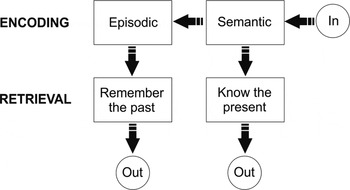
Figure 1. Functional process-specific relations between episodic-autobiographical and semantic memory, as described in Tulving's SPI-model. Information can be encoded into the semantic memory system independently of the episodic-autobiographical memory system. However, it must be encoded into the episodic-autobiographical memory system through the semantic one. Corresponding information can be stored in both systems (“parallelity of storage“). Stored information is potentially available for retrieval from one of the two systems, or from both of them. (Modified after Fig. 1 from Tulving and Markowitsch [1998] and from comments from Tulving [2005].)
Both what individuals recall and how individuals retrieve mnemonic information are of crucial importance for therapeutic work (Lemogne et al. Reference Lemogne, Piolino, Friszer, Claret, Girault, Jouvent, Allilaire and Fossati2006; Parikh et al. Reference Parikh, Velyvis, Yatham, Beaulieu, Cervantes, Macqueen, Siotis, Streiner and Zaretsky2007; Staniloiu & Markowitsch Reference Staniloiu and Markowitsch2012; Zaretsky et al. Reference Zaretsky, Rosenbluth, Silver, Bagby, Kennedy and Rosenbluth2005; Reference Zaretsky, Rizvi and Parikh2007). Active ingredients of the therapeutic change in cognitive behavioral therapy (CBT) encompass the alteration of retrieval style and retrieval mode (Lepage et al. Reference Lepage, Ghaffar, Nyberg and Tulving2000) and the revision (shift) of the rememberer's (Tulving Reference Tulving, Terrace and Metcalfe2005) perspective (see also Alston et al. Reference Alston, Kratchmer, Jeznach, Bartlett, Davidson and Fujiwara2013; Lemogne et al. Reference Lemogne, Piolino, Friszer, Claret, Girault, Jouvent, Allilaire and Fossati2006; McBride et al. Reference McBride, Segal, Kennedy and Gemar2007; Williams et al. Reference Williams, Teasdale, Segal and Soulsby2000).
As the authors of the target article are likely aware, Tulving described the SPI (serial, parallel, independent) model, which posits that mnemonic information is encoded serially, may be stored in parallel in different long term memory systems and can be retrieved independently of the long term memory system in which encoding occurred (Fig. 1). The retrieval of information from episodic (i.e., episodic-autobiographical) memory system (the recollection) is assumed to engage the so-called episodic retrieval mode (Lepage et al. Reference Lepage, Ghaffar, Nyberg and Tulving2000). Mnemonic information recollected via the episodic retrieval mode has several cardinal characteristics. The recollected information is made of unique personal events (experiences), which feature a time and spatial situation. It has perceptual details, affective connotation, self-relevance, and a particular rememberer's perspective (first-person or field perspective versus third-person or observer perspective). Furthermore, it is accompanied by a special phenomenological conscious experience (the autonoetic consciousness) (see Markowitsch & Staniloiu Reference Markowitsch and Staniloiu2013; Markowitsch et al. Reference Markowitsch, Vandekerckhove, Lanfermann and Russ2003; Piolino et al. Reference Piolino, Desgranges and Eustache2009). As Markowitsch and Staniloiu (Reference Markowitsch and Staniloiu2011a; Reference Markowitsch and Staniloiu2011b), Piolino et al. (Reference Piolino, Desgranges and Eustache2009), Lemogne et al. (Reference Lemogne, Bergouignan, Piolino, Jouvent, Allilaire and Fossati2009), and other authors described, the rememberer's perspective reflects the degree of emotional involvement with past experiences and/or the personal meaning or relevance of the mnemonic material at the time of the retrieval; it may have specific neural underpinnings (Eich et al. Reference Eich, Nelson, Leghari and Handy2009). The third-person retrieval perspective can be construed as an avoidant mechanism that may subserve successful coping with certain personal memories in healthy individuals but also may take pathological dimensions and hinder treatment in various psychiatric conditions, such as dissociative disorders (Fujiwara et al. Reference Fujiwara, Brand, Kracht, Kessler, Diebel, Netz and Markowitsch2008; Lemogne et al. Reference Lemogne, Bergouignan, Piolino, Jouvent, Allilaire and Fossati2009; Markowitsch & Staniloiu Reference Markowitsch and Staniloiu2011a; Reference Markowitsch and Staniloiu2011b; Reference Markowitsch and Staniloiu2012).
Functional process-specific relations between episodic-autobiographical and semantic memory, as described in Tulving's SPI-model. Information can be encoded into the semantic memory system independently of the episodic-autobiographical memory system. However, it must be encoded into the episodic-autobiographical memory system through the semantic one. Corresponding information can be stored in both systems (“parallelity of storage“). Stored information is potentially available for retrieval from one of the two systems, or from both of them. (Modified after Fig. 1 from Tulving and Markowitsch [Reference Tulving and Markowitsch1998] and from comments from Tulving [Reference Tulving, Terrace and Metcalfe2005].)
Altering retrieval styles and promoting in particular the retrieval of positively valenced personal experiences via the episodic retrieval mode have been an explicit or implicit focus of CBT interventions in patients with active or remitted major depressive disorder. The overgeneral memory (as assessed with the Autobiographical Memory Test [AMT]) (Williams & Broadbent Reference Williams and Broadbent1986) was identified as a cognitive vulnerability for depression and linked to an increased risk for suicide in actively depressed individuals (Williams & Scott Reference Williams and Scott1988); furthermore, this characteristic was found in abused and neglected children (Valentino et al. Reference Valentino, Toth and Cicchetti2009). Studies have shown that this cognitive vulnerability is, however, amenable to CBT interventions, which might manipulate and influence the retrieval style (McBride et al. Reference McBride, Segal, Kennedy and Gemar2007; Watkins et al. Reference Watkins, Teasdale and Williams2000; Williams et al. Reference Williams, Teasdale, Segal and Soulsby2000). Enhanced cognitive flexibility might partly account for reducing the overgeneral memories after Mindfulness-Based Cognitive Therapy (MBCT) (Heeren et al. Reference Heeren, Van Broeck and Philippot2009). This finding is in agreement with the largely accepted contribution of executive functions to the episodic-autobiographical memory recall; however, which subcomponents of the executive system are involved in different components of the episodic-autobiographical memory is still a matter of debate. Although the AMT paradigm does not explicitly incorporate Tulving's distinction between episodic and semantic memory systems, the description of specific memories seems to share certain similarities with that of episodic memories, whereas that of general memories reminds to a certain degree of semantic memories (Söderlund et al. Reference Söderlund, Moscovitch, Kumar, Daskalakis, Flint, Herrmann and Levine2014).
Using different instruments for assessing episodic (i.e., episodic-autobiographical) memory than the ones employed by Williams et al., such as the Autobiographical Interview (Levine et al. Reference Levine, Svoboda, Hay, Winocur and Moscovitch2002) or adaptations of the Autobiographical Memory Interview (Kopelman et al. Reference Kopelman, Wilson and Baddeley1990), retrieval deficits in the episodic-autobiographical memory domain were confirmed in major depressive disorder and attributed to multifaceted mechanisms. Lemogne et al. (Reference Lemogne, Piolino, Friszer, Claret, Girault, Jouvent, Allilaire and Fossati2006, Reference Lemogne, Bergouignan, Piolino, Jouvent, Allilaire and Fossati2009) found that patients with major depressive disorder have a “global” episodic impairment of positive memories with respect to specificity, level of consciousness (autonoesis), and self-perspective. Markowitsch and Staniloiu (Reference Markowitsch and Staniloiu2011a) argued that in patients with major depressive disorder an increase in the suicidal risk might partly arise from a diminished capacity to imagine (construct) positive personal future episodes (Szpunar et al. Reference Szpunar, Addis, McLelland and Schacter2013). They linked this particular deficiency in self projection to the impaired ability of depressed patients to retrieve positive personal experiences (events) via the episodic retrieval mode; they argued that this valence-dependent deficit might reflect the possible existence of different neural substrates for processing negative versus positive memories (Markowitsch et al. Reference Markowitsch, Vandekerckhove, Lanfermann and Russ2003; Sharot et al. Reference Sharot, Riccardi, Raio and Phelps2007). These considerations suggest that therapeutic techniques focused on enhancing the capacity to retrieve positive personal events might augment the capacity to generate specific positive personal memories of the future (Ingvar Reference Ingvar1985; Sharot et al. Reference Sharot, Riccardi, Raio and Phelps2007; Szpunar et al. Reference Szpunar, Addis, McLelland and Schacter2013; Williams et al. Reference Williams, Ellis, Tyers, Healy, Rose and MacLeod1996) and reduce the psychopathological load.
Another target of therapeutic intervention that might promote change is the rememberer's perspective. Studies carried out in patients with active and remitted major depressive disorder indicated that the retrieval of positive (but not negative) personal experiences from a third-person (observer or theatrical) perspective is a marker of cognitive vulnerability for depression (Lemogne et al. Reference Lemogne, Piolino, Friszer, Claret, Girault, Jouvent, Allilaire and Fossati2006; Reference Lemogne, Bergouignan, Piolino, Jouvent, Allilaire and Fossati2009). The third-person-perspective retrieval of positive past experiences might lead to discarding positively valenced memories of personal experience and subsequently to strengthening maladaptive patterns of discounting the positive (Beck Reference Beck2008; Dorahy & van der Hart Reference Dorahy, van der Hart, Vermetten, Dorahy and Spiegel2007; Staniloiu & Markowitsch Reference Staniloiu and Markowitsch2012; Staniloiu et al. Reference Staniloiu, Markowitsch and Brand2010). These findings and considerations support therapeutic interventions that concentrate on the revision (manipulation) of the rememberer's perspective for positive personal memories in patients with major depressive disorder or in individuals with vulnerabilities for depression (Libby et al. Reference Libby, Eibach and Gilovich2005; Sutin Reference Sutin2009).
In conclusion, the framework for memory-related modifications in psychotherapy that the authors of the target article put forth has several merits. However, additional memory-related mechanisms might be at stake, and their incorporation in the proposed model might aid the “deconstruction” of the process of therapeutic change (Beck Reference Beck2008; Parikh et al. Reference Parikh, Hawke, Zaretsky, Beaulieu, Patelis-Siotis, Macqueen, Young, Yatham, Velyvis, Belanger, Poirier, Enright and Cervantes2013).