






No CrossRef data available.
Article contents
Focus on emotion as a catalyst of memory updating during reconsolidation
Published online by Cambridge University Press: 08 June 2015
Abstract
We share the idea of Lane et al. that successful psychotherapy exerts its effects through memory reconsolidation. To support it, we add further evidence that a behavioral interference may trigger memory update during reconsolidation. Furthermore, we propose that – in addition to replacing maladaptive emotions – new emotions experienced in the therapeutic process catalyze reconsolidation of the updated memory structure.
Information
- Type
- Open Peer Commentary
- Information
- Copyright
- Copyright © Cambridge University Press 2015
References
Akirav, I. & Maroun, M. (2013) Stress modulation of reconsolidation. Psychopharmacology
226(4):747–61. Available at: http://doi.org/10.1007/s00213-012-2887-6.CrossRefGoogle ScholarPubMed
Anderson, A. K., Wais, P. E. & Gabrieli, J. D. (2006) Emotion enhances remembrance of neutral events past. Proceedings of the National Academy of Sciences of the USA
103(5):1599–604. Available at: http://doi.org/10.1073/pnas.0506308103.CrossRefGoogle ScholarPubMed
Besnard, A., Caboche, J. & Laroche, S. (2012) Reconsolidation of memory: A decade of debate. Progress in Neurobiology
99(1):61–80. Available at: http://doi.org/10.1016/j.pneurobio.2012.07.002.CrossRefGoogle ScholarPubMed
Cahill, L. (2000) Neurobiological mechanisms of emotionally influenced, long-term memory. Progress in Brain Research
126:29–37. Available at: http://doi.org/10.1016/S0079-6123(00)26004-4.CrossRefGoogle ScholarPubMed
Canli, T., Zhao, Z., Brewer, J., Gabrieli, J. D. & Cahill, L. (2000) Event-related activation in the human amygdala associates with later memory for individual emotional experience. Journal of Neuroscience
20(19):RC99.CrossRefGoogle ScholarPubMed
Chan, J. C. & LaPaglia, J. A. (2013) Impairing existing declarative memory in humans by disrupting reconsolidation. Proceedings of the National Academy of Sciences of the USA
110(23):9309–13. Available at: http://doi.org/10.1073/pnas.1218472110.CrossRefGoogle ScholarPubMed
Coccoz, V., Maldonado, H. & Delorenzi, A. (2011) The enhancement of reconsolidation with a naturalistic mild stressor improves the expression of a declarative memory in humans. Neuroscience
185:61–72. Available at: http://doi.org/10.1016/j.neuroscience.2011.04.023.CrossRefGoogle ScholarPubMed
Forcato, C., Burgos, V. L., Argibay, P. F., Molina, V. A., Pedreira, M. E. & Maldonado, H. (2007) Reconsolidation of declarative memory in humans. Learning and Memory
14(4):295–303. Available at: http://doi.org/10.1101/lm.486107.CrossRefGoogle ScholarPubMed
Forcato, C., Rodriguez, M. L., Pedreira, M. E. & Maldonado, H. (2010) Reconsolidation in humans opens up declarative memory to the entrance of new information. Neurobiology of Learning and Memory
93(1):77–84. Available at: http://doi.org/10.1016/j.nlm.2009.08.006.CrossRefGoogle Scholar
Hupbach, A., Gomez, R., Hardt, O. & Nadel, L. (2007) Reconsolidation of episodic memories: A subtle reminder triggers integration of new information. Learning and Memory
14(1–2):47–53. Available at: http://doi.org/10.1101/lm.365707.CrossRefGoogle ScholarPubMed
Hupbach, A., Hardt, O., Gomez, R. & Nadel, L. (2008) The dynamics of memory: Context-dependent updating. Learning and Memory
15(8):574–79. Available at: http://doi.org/10.1101/lm.1022308.CrossRefGoogle ScholarPubMed
Johansen, J. P., Cain, C. K., Ostroff, L. E. & LeDoux, J. E. (2011) Molecular mechanisms of fear learning and memory. [Review]. Cell
147(3):509–24. Available at: http://doi.org/10.1016/j.cell.2011.10.009.CrossRefGoogle ScholarPubMed
Lustig, C. & Hasher, L. (2001) Implicit memory is not immune to interference. [Research support, U.S. government, non-P.H.S. research support, U.S. government, P.H.S. Review]. Psychology Bulletin
127(5):618–28.CrossRefGoogle Scholar
Nader, K. & Hardt, O. (2009) A single standard for memory: The case for reconsolidation. Nature Reviews Neuroscience
10(3):224–234. Available at: http://doi.org/10.1038/nrn2590.CrossRefGoogle ScholarPubMed
Phelps, E. A. (2004) Human emotion and memory: Interactions of the amygdala and hippocampal complex. Current Opinion in Neurobiology
14(2):198–202. Available at: http://doi.org/10.1016/j.conb.2004.03.015.CrossRefGoogle ScholarPubMed
Schwabe, L., Nader, K. & Pruessner, J. C. (2013) β-Adrenergic blockade during reactivation reduces the subjective feeling of remembering associated with emotional episodic memories. Biological Psychology
92(2):227–32. Available at: http://doi.org/10.1016/j.biopsycho.2012.10.003.CrossRefGoogle ScholarPubMed
Schwabe, L. & Wolf, O. T. (2009) New episodic learning interferes with the reconsolidation of autobiographical memories. PLoS One
4(10):e7519. Available at: http://doi.org/10.1371/journal.pone.0007519.CrossRefGoogle ScholarPubMed
Strange, B. A., Kroes, M. C., Fan, J. E. & Dolan, R. J. (2010) Emotion causes targeted forgetting of established memories. Frontiers in Behavioral Neuroscience
4:175. Available at: http://doi.org/10.3389/fnbeh.2010.00175.CrossRefGoogle ScholarPubMed
Wichert, S., Wolf, O. T. & Schwabe, L. (2011) Reactivation, interference, and reconsolidation: Are recent and remote memories likewise susceptible?
Behavioral Neuroscience
125(5):699–704. Available at: http://doi.org/10.1037/a0025235.CrossRefGoogle ScholarPubMed
Wichert, S., Wolf, O. T. & Schwabe, L. (2013) Updating of episodic memories depends on the strength of new learning after memory reactivation. Behavioral Neuroscience
127(3):331–38. Available at: http://doi.org/10.1037/a0032028.CrossRefGoogle ScholarPubMed
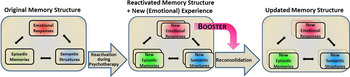
Figure 1. Illustration of the proposed mechanism: After reactivation, updating of the integrated memory structure is boosted by emotion.
We applaud the authors for their Integrative Memory Model, which finally brings together what belongs together: Basic science on the dynamic nature of memory with clinical science on what makes people change. Lane et al. conceive of psychotherapeutic change as the result of memory change. In the process of memory change, maladaptive emotions are substituted with more adaptive emotions. In our commentary, we want to foster the Integrative Memory Model by (1) adding pertinent empirical evidence supporting its claim of memory updating through behavioral interference and (2) proposing a second function of aroused emotion during psychotherapy: Emotions catalyze the process of memory updating during reconsolidation.
Our first comment concerns additional reconsolidation literature that supports the Integrative Memory Model and thereby strengthens the laid-out bridge between basic memory research and clinical psychotherapy research. Following reactivation, old memory traces re-enter an active, fragile state, the so-called reconsolidation period. During reconsolidation, old memories may either be strengthened or, if confronted with interfering material, updated and hence altered. We still need to know more about the circumstances, under which a behavioral interference – the analogue to psychotherapy – is capable of updating memories during reconsolidation. Recent studies have shown that the presentation of interfering material after reactivation has the potential to alter memory traces for semantic (Forcato et al. Reference Forcato, Burgos, Argibay, Molina, Pedreira and Maldonado2007, Reference Forcato, Rodriguez, Pedreira and Maldonado2010), episodic (Chan & LaPaglia Reference Chan and LaPaglia2013; Hupbach et al. Reference Hupbach, Gomez, Hardt and Nadel2007; Reference Hupbach, Hardt, Gomez and Nadel2008; Strange et al. Reference Strange, Kroes, Fan and Dolan2010; Wichert et al. Reference Wichert, Wolf and Schwabe2011; Reference Wichert, Wolf and Schwabe2013), and autobiographical (Schwabe & Wolf Reference Schwabe and Wolf2009) memories. Three of these studies allow inferences about the role of emotional arousal during reconsolidation. Wichert et al. (Reference Wichert, Wolf and Schwabe2013) had their participants reactivate old picture memories shortly before they took three runs of new picture encoding. New as well as old pictures had either neutral or emotional content. When memory for old pictures was tested one week later, the decrease in memory accuracy was mainly a result of the incorporation of new emotional picture information in the old memory traces. Strange et al. (Reference Strange, Kroes, Fan and Dolan2010) had participants learn neutral words. One day later, reactivation of these word memories was triggered in a cued recall test where word stems served as cues. On a trial-by-trial basis, the presentation of a word stem cue was in 20% of the cases immediately followed by a picture of a face that displayed an emotional or neutral expression. The presentation of emotional but not neutral expressions impaired the recall of learned words at one day and at one week following the interference manipulation. These results suggest that during reconsolidation of nonpersonal, declarative memories, emotional items provide a stronger interference than neutral ones. In the study by Schwabe and Wolf (Reference Schwabe and Wolf2009), old memories contained either neutral or emotional autobiographical information, whereas the interfering information given following reactivation of autobiographical memories consisted of a nonpersonal story. This nonpersonal interference reduced only the recall of memories that contained neutral but not emotional autobiographical information. Studies investigating the impact of personalized, emotional interference on the reconsolidation of emotional autobiographic memories would provide for an experimental analogue to psychotherapy and are necessary to further elucidate the role of emotional arousal in this context.
That brings us to our second comment: We propose that new emotions not only replace old, maladaptive emotions, but also catalyze the fixation of the updated memory structure in the course of reconsolidation. When describing the psychotherapeutic effects of emotional arousal, Lane et al. state that an emotional reaction is needed because “the new and more positive emotional experience [is needed] to take place of former response” (sect. 9.2, para. 2). In this view, the emotional reaction is updated through the integration of new emotional responses much as the semantic structure is updated through the integration of new semantic information. We propose that aroused emotion has a second function in the therapeutic process: It boosts memory updating during reconsolidation. It is widely known that emotional arousal boosts initial consolidation (e.g., Anderson et al. Reference Anderson, Wais and Gabrieli2006) – an effect that Lane et al. mention in their article – and that is neurally mediated by the interaction between amygdala and hippocampus (e.g., Cahill Reference Cahill2000; Canli et al. Reference Canli, Zhao, Brewer, Gabrieli and Cahill2000; Phelps Reference Phelps2004). It is very likely that emotional arousal also boosts reconsolidation. Although differences do exist, consolidation and reconsolidation share neurotransmitters that trigger the process and intracellular signaling cascades that mediate it (Besnard et al. Reference Besnard, Caboche and Laroche2012; Johansen et al. Reference Johansen, Cain, Ostroff and LeDoux2011; Nader & Hardt Reference Nader and Hardt2009). Furthermore, consolidation and reconsolidation also share psychological components such as a susceptibility to interference that varies in strength depending on the intensity (e.g., number of repetitions) and the content (e.g., emotional vs. neutral) of the interfering information (e.g., Lustig & Hasher Reference Lustig and Hasher2001; Wichert et al. Reference Wichert, Wolf and Schwabe2013). It therefore seems intuitive that emotional arousal catalyzes both memory consolidation and reconsolidation, a possibility that has been discussed in animal studies (e.g., Akirav & Maroun Reference Akirav and Maroun2013) and in studies with humans (e.g., Schwabe et al. Reference Schwabe, Nader and Pruessner2013). As noted above, emotional interferences boosted the reconsolidation of episodic memories to a larger extent than neutral interferences (Strange et al. Reference Strange, Kroes, Fan and Dolan2010; Wichert et al. Reference Wichert, Wolf and Schwabe2013). Furthermore, when memory reactivation coincides with emotional arousal in the absence of interfering material, reconsolidation of the original memory trace is enhanced. This was shown in a study by Coccoz et al. (Reference Coccoz, Maldonado and Delorenzi2011), where the reactivation of learned syllable-pairings was immediately followed by a cold pressor stress test that induced moderate levels of emotional arousal. Taken together, these findings indicate that emotional arousal influences the reconsolidation of episodic and/or semantic memories. Accordingly, aroused emotion during psychotherapy may boost the update of the integrated memory structure in the course of reconsolidation (Fig. 1). Such a mechanism is also in line with psychotherapy process research that emphasizes the importance of aroused emotion during effective psychotherapy sessions.
Illustration of the proposed mechanism: After reactivation, updating of the integrated memory structure is boosted by emotion.
We conclude that aroused emotion during psychotherapy serves two functions, not just one: (1) replacing maladaptive by adaptive emotions and (2) boosting memory updating during reconsolidation of the therapeutically altered memory traces.