Menninghaus et al. propose that a group of psychological distancing mechanisms can “satisfactorily explain the pleasure in art reception that is associated with negative emotions” (sect. 1, point C) when combined with at least one embracing mechanism. The schemata that are central to their conceptualization of distancing mechanisms require familiarity with art forms. Information processing models of art (Leder et al. Reference Leder, Belke, Oeberst and Augustin2004) highlight the role of previous experience and knowledge and suggest that the proposed distancing mechanisms are better developed and more accessible for experts than novices. Art experts, in turn, show more profound aesthetic experiences (Leder et al. Reference Leder, Gerger, Dressler and Schabmann2012). These considerations predict that experts and novices will differ in their response to negative emotion–eliciting art. But at which processing stage will these differences emerge? Are experts' initial affective reactions similar to those of novices? Do differences between experts and novices emerge only after knowledge-based distancing mechanisms have had a chance to do their work? Or is the mere categorization of the emotion-eliciting stimulus as art sufficient to dampen experts' negative affective responses from the beginning?
In a study that bears on these issues, Leder et al. (Reference Leder, Gerger, Brieber and Schwarz2014) exposed participants with different levels of art expertise to positively and negatively valenced artworks and assessed their affective responses with facial electromyography (fEMG), capturing corrugator supercilii (frowning muscle) and zygomaticus (smiling muscle) activity. Participants also rated how much they liked the artworks, as well as their emotional valence and familiarity. The left panel of Figure 1 shows the corrugator activity over the 7 seconds of exposure to the artworks. Compared with positively valenced art (dashed lines), negatively valenced art (solid lines) elicited stronger negative responses. More important, compared with non-experts, experts showed attenuated physiological reactions with less extreme corrugator activations; they also self-reported less extreme negative affect and liked the negatively valenced art more. This expertise effect is consistent with the distancing mechanism proposed by Menninghaus et al. However, analyses of the temporal trajectory revealed only small temporal changes in emotion and no shift from negative to positive responses (within the 7 seconds). Importantly, the differences between experts and novices were apparent immediately after exposure and did not differentiate further over time. Menninghaus et al. note that their model is not a model of emotion conversion. Instead, negative emotions are assumed to be incorporated into positive enjoyment. In Figure 1, such enjoyment should be visible in increased zygomaticus response. However, the observed smiling response was not moderated by perceivers' expertise in this way, nor does it provide evidence for increased enjoyment as time passes. Although the observed expertise differences provide some support for the model, the temporal pattern is not easily compatible with the assumption of an initial negative affective response that is overridden by the employment of cognitive distancing mechanisms.
The Leder et al. (Reference Leder, Gerger, Brieber and Schwarz2014) data were not collected to test the Distancing-Embracing model, although perceivers' art expertise and the physiological and self-reported affective responses assessed in the study are closely related to model variables. The noted ambiguities highlight that the empirical testability of the Menninghaus et al. model would benefit from clearer specification of what counts as supporting evidence, including measurement issues and the nature of the expected – and precluded – response trajectories. In our reading, a combination of physiological and self-report measures (Forster et al. Reference Forster, Leder and Ansorge2016; Gernot et al. Reference Gernot, Pelowski and Leder2017; Leder et al. Reference Leder, Gerger, Brieber and Schwarz2014) seems promising. Note, however, that any measure attempting to capture the enjoyment of negative emotions in the context of art needs to heed the nature of “mixed” feelings, that is, the simultaneous presence of positive and negative responses. Unfortunately, many measurement attempts fail to do so. Mixed feelings can be identified only by assessing the presence and intensity of each feeling separately (e.g., “not at all” to “very much”). When this is done, even well-established “neutral” stimuli, such as the allegedly neutral pictures of the International Affective Picture System (IAPS), turn out to elicit mixed feelings (Schneider et al. Reference Schneider, Veenstra, van Harreveld, Schwarz and Koole2016; Schneider & Schwarz Reference Schneider and Schwarz2017). Without the ability to clearly identify mixed feelings and their respective sources, differential responses to different components of the experience may be misinterpreted as reflecting an integrative evaluation of the one component on which a given study happens to focus.
These measurement issues aside, we also note that complex assumptions about differential processing styles may not be needed to account for many expertise effects in art appreciation. A parsimonious model of aesthetic pleasure, Reber et al.'s (Reference Reber, Schwarz and Winkielman2004) fluency theory holds that the “more fluently perceivers can process an object, the more positive their aesthetic response” (p. 364). Fluency increases with repeated exposure, which is part of why an initial dislike for avant-garde art frequently turns into affection as the art form becomes familiar. Supporting this interpretation, repeated exposure to a disfluent art style has been shown to selectively increase liking for that style (Leder Reference Leder2003). Repeated exposure to initially disliked art is also a key component of acquiring expertise through art education, and the resulting differences in processing fluency may account for many differences observed in the hedonic responses of novices and experts. From this perspective, the acquisition of schemata that are considered crucial for distancing is likely to be closely associated with differences in processing fluency that offer a more parsimonious account.
As these conjectures indicate, Menninghaus et al.'s (2017) Distancing-Embracing model provides a fruitful heuristic framework for the puzzle of why people enjoy negative emotions in the context of art. Its empirical testing, however, will require more precision with respect to the interplay of the numerous model variables, the temporal trajectory of distancing and embracing processes, and the assessment of the simultaneous experience of negative emotions and enjoyment. We look forward to future empirical tests and the further refinement of the model.





Menninghaus et al. propose that a group of psychological distancing mechanisms can “satisfactorily explain the pleasure in art reception that is associated with negative emotions” (sect. 1, point C) when combined with at least one embracing mechanism. The schemata that are central to their conceptualization of distancing mechanisms require familiarity with art forms. Information processing models of art (Leder et al. Reference Leder, Belke, Oeberst and Augustin2004) highlight the role of previous experience and knowledge and suggest that the proposed distancing mechanisms are better developed and more accessible for experts than novices. Art experts, in turn, show more profound aesthetic experiences (Leder et al. Reference Leder, Gerger, Dressler and Schabmann2012). These considerations predict that experts and novices will differ in their response to negative emotion–eliciting art. But at which processing stage will these differences emerge? Are experts' initial affective reactions similar to those of novices? Do differences between experts and novices emerge only after knowledge-based distancing mechanisms have had a chance to do their work? Or is the mere categorization of the emotion-eliciting stimulus as art sufficient to dampen experts' negative affective responses from the beginning?
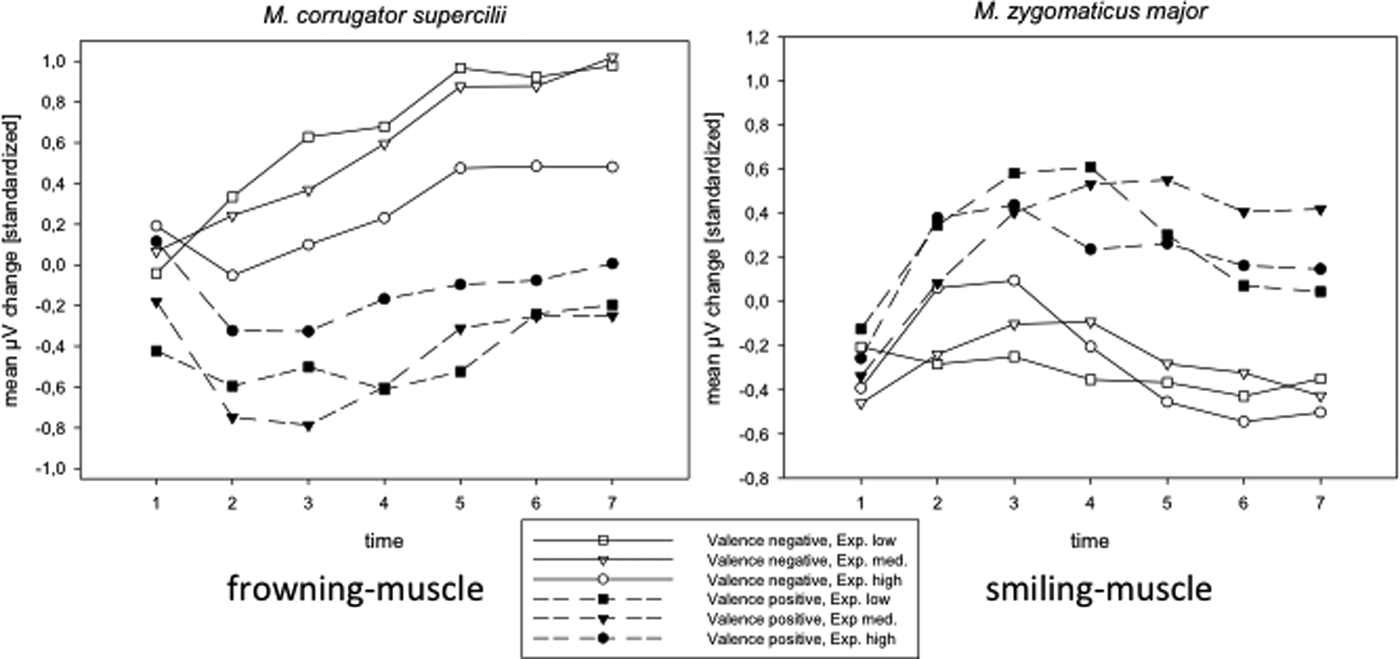
In a study that bears on these issues, Leder et al. (Reference Leder, Gerger, Brieber and Schwarz2014) exposed participants with different levels of art expertise to positively and negatively valenced artworks and assessed their affective responses with facial electromyography (fEMG), capturing corrugator supercilii (frowning muscle) and zygomaticus (smiling muscle) activity. Participants also rated how much they liked the artworks, as well as their emotional valence and familiarity. The left panel of Figure 1 shows the corrugator activity over the 7 seconds of exposure to the artworks. Compared with positively valenced art (dashed lines), negatively valenced art (solid lines) elicited stronger negative responses. More important, compared with non-experts, experts showed attenuated physiological reactions with less extreme corrugator activations; they also self-reported less extreme negative affect and liked the negatively valenced art more. This expertise effect is consistent with the distancing mechanism proposed by Menninghaus et al. However, analyses of the temporal trajectory revealed only small temporal changes in emotion and no shift from negative to positive responses (within the 7 seconds). Importantly, the differences between experts and novices were apparent immediately after exposure and did not differentiate further over time. Menninghaus et al. note that their model is not a model of emotion conversion. Instead, negative emotions are assumed to be incorporated into positive enjoyment. In Figure 1, such enjoyment should be visible in increased zygomaticus response. However, the observed smiling response was not moderated by perceivers' expertise in this way, nor does it provide evidence for increased enjoyment as time passes. Although the observed expertise differences provide some support for the model, the temporal pattern is not easily compatible with the assumption of an initial negative affective response that is overridden by the employment of cognitive distancing mechanisms.
Facial electromyographic activity in response to artworks. Based on Leder et al. ( Reference Leder, Gerger, Brieber and Schwarz2014).
The Leder et al. (Reference Leder, Gerger, Brieber and Schwarz2014) data were not collected to test the Distancing-Embracing model, although perceivers' art expertise and the physiological and self-reported affective responses assessed in the study are closely related to model variables. The noted ambiguities highlight that the empirical testability of the Menninghaus et al. model would benefit from clearer specification of what counts as supporting evidence, including measurement issues and the nature of the expected – and precluded – response trajectories. In our reading, a combination of physiological and self-report measures (Forster et al. Reference Forster, Leder and Ansorge2016; Gernot et al. Reference Gernot, Pelowski and Leder2017; Leder et al. Reference Leder, Gerger, Brieber and Schwarz2014) seems promising. Note, however, that any measure attempting to capture the enjoyment of negative emotions in the context of art needs to heed the nature of “mixed” feelings, that is, the simultaneous presence of positive and negative responses. Unfortunately, many measurement attempts fail to do so. Mixed feelings can be identified only by assessing the presence and intensity of each feeling separately (e.g., “not at all” to “very much”). When this is done, even well-established “neutral” stimuli, such as the allegedly neutral pictures of the International Affective Picture System (IAPS), turn out to elicit mixed feelings (Schneider et al. Reference Schneider, Veenstra, van Harreveld, Schwarz and Koole2016; Schneider & Schwarz Reference Schneider and Schwarz2017). Without the ability to clearly identify mixed feelings and their respective sources, differential responses to different components of the experience may be misinterpreted as reflecting an integrative evaluation of the one component on which a given study happens to focus.
These measurement issues aside, we also note that complex assumptions about differential processing styles may not be needed to account for many expertise effects in art appreciation. A parsimonious model of aesthetic pleasure, Reber et al.'s (Reference Reber, Schwarz and Winkielman2004) fluency theory holds that the “more fluently perceivers can process an object, the more positive their aesthetic response” (p. 364). Fluency increases with repeated exposure, which is part of why an initial dislike for avant-garde art frequently turns into affection as the art form becomes familiar. Supporting this interpretation, repeated exposure to a disfluent art style has been shown to selectively increase liking for that style (Leder Reference Leder2003). Repeated exposure to initially disliked art is also a key component of acquiring expertise through art education, and the resulting differences in processing fluency may account for many differences observed in the hedonic responses of novices and experts. From this perspective, the acquisition of schemata that are considered crucial for distancing is likely to be closely associated with differences in processing fluency that offer a more parsimonious account.
As these conjectures indicate, Menninghaus et al.'s (2017) Distancing-Embracing model provides a fruitful heuristic framework for the puzzle of why people enjoy negative emotions in the context of art. Its empirical testing, however, will require more precision with respect to the interplay of the numerous model variables, the temporal trajectory of distancing and embracing processes, and the assessment of the simultaneous experience of negative emotions and enjoyment. We look forward to future empirical tests and the further refinement of the model.