





No CrossRef data available.
Article contents
Narratives need not end well; nor say it all
Published online by Cambridge University Press: 08 May 2023
Abstract
To fully embrace situations of radical uncertainty, we argue that the theory should abandon the requirements that narratives, in general, must lead to affective evaluation, and that they have to explain (and potentially simulate) all or even the bulk of the current decisional context. Evidence from studies of incidental learning show that narrative schemata can bias decisions while remaining fragmentary, insufficient for prediction, and devoid of utility values.
Information
- Type
- Open Peer Commentary
- Information
- Copyright
- Copyright © The Author(s), 2023. Published by Cambridge University Press
Footnotes
*
Current address: School of Humanities, Univerza v Novi Gorici, Vipavska 13, SI-5000 Nova Gorica, Slovenia
†
Current address: Postbus 9010 6500 GL Nijmegen, the Netherlands
References
Andreetta, S., Soldatkina, O., Boboeva, V., & Treves, A. (2021). In poetry, if meter has to help memory, it takes its time. Open Research Europe, 1, 59. https://doi.org/10.12688/openreseurope.13663.1CrossRefGoogle Scholar
Gottschiel, J. (2012). The storytelling animal: How stories make us human. Houghton Mifflin Harcourt.Google Scholar
Rubin, D. C. (1995). Memory in oral traditions: The cognitive psychology of epic, ballads, and counting-out rhymes. Oxford University Press on Demand.Google Scholar
Rumelhart, D. E. (1975). Notes on a schema for stories. In Bobrow, D. G. & Collins, A. (Eds.), Representation and understanding: Studies in Cognitive Science (pp. 211–236). Academic Press.CrossRefGoogle Scholar
Spalla, D., Cornacchia, I. M., & Treves, A. (2021). Continuous attractors for dynamic memories. Elife, 10(2021), e69499.CrossRefGoogle ScholarPubMed
Zheng, J., Schjetnan, A. G., Yebra, M., Gomes, B. A., Mosher, C. P., Kalia, S. K., … Rutishauser, U. (2022). Neurons detect cognitive boundaries to structure episodic memories in humans. Nature Neuroscience, 25(3), 358–368.CrossRefGoogle ScholarPubMed
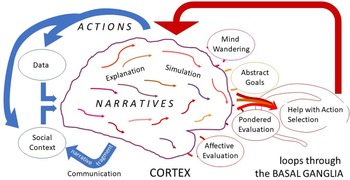
Figure 1. A proposed modification of Figure 2 in the target article, separating internal (warm colors) and external (blue) processes.
Target article
Related commentaries (27)
Embodied choices bypass narratives under radical uncertainty
Hierarchical Bayesian narrative-making under variable uncertainty
High-stakes decisions do not require narrative conviction but narrative flexibility
Narratives of crisis: From affective structures to adaptive functions
 You have
Access
Conviction Narrative Theory (CNT) is a welcome broadening of traditional perspectives on decision-making. It can impact a neural computation-based understanding of cognitively intense situations such as economic evaluation, cultural behavior, and social learning, among others. For the latter in particular, the authors highlight the role of causal schemata, memorable analogies, and emotions, as well as of certain constraints on encoding, communication, and action, in order for these narrative fragments to socially propagate.
A core strength of the theory is in its free articulation in several component features. We argue that the theory is weakened, however, by imposing them as necessary components. CNT promises a liberation from the artificial intelligence quagmire of decision trees and reward optimization, but the actual liberation hinges on recognizing the fragmentary character of many narratives, and their a priori independence from considerations of affective value.
Consider, for example, the features of narratives which make them easier to remember: Their abstracted scripts, or what has been specifically defined as “story grammars” (Rumelhart, Reference Rumelhart, Bobrow and Collins1975). These patterns have facilitated the transmission of knowledge in oral form for centuries (Rubin, Reference Rubin1995), to the point that some scholars have placed the contribution of narrative schemata among the most salient enabling characteristics of human cognition (Ferretti, Reference Ferretti2022; Gottschiel, Reference Gottschiel2012). To serve as a memory facilitator, a narrative schema obviously does not have to be exact; nor does it have to be complete, or tinged with a reward value.
An example is provided by metric structures in poetry that can be regarded as non-verbal narrative schemata. While fragmentary, their constrained and repetitive nature makes them a suitable model for a quantitative assessment of the contribution of an underlying “narrative” to memory-related decision-making. A recent study of ours (Andreetta, Soldatkina, Boboeva, & Treves, Reference Andreetta, Soldatkina, Boboeva and Treves2021) focuses on the role of metric schemata in remembering poetry: Activating such schemata was shown to help, incrementally, in retrieving nonsense words from a previously heard meaningless “poem,” in the absence of any affective value or conventional narration. Therefore, a simple form of decision-making (choosing the previously heard non-word from a choice of three) can be facilitated by the “narrative schema” even if the latter is unrelated to the former (all three options would fit the metric pattern). An interpretation is that the metric narration pushes the flow of neural activation forward, enhancing associative retrieval dynamics.
A mechanistic network model of such neural dynamics, streamlined to mathematically tractable form, has been analyzed by Spalla et al. (Reference Spalla, Cornacchia and Treves2021).
This study shows how narrative fragments can be acquired incidentally through Hebbian self-organization, without any notion of utility, and stored as dynamical attractors in simple recurrent networks, ubiquitously in the cortex (as indicated schematically in Fig. 1). In addition, their unfolding in time (the feature that makes such attractors dynamical, and thus suitable to represent fragments of narratives in the brain) does not consume extra storage resources, as shown by a mathematical analysis of the network model. It even pays off for the stored attractors to represent dynamical narratives rather than static scenes.
A proposed modification of Figure 2 in the target article, separating internal (warm colors) and external (blue) processes.
Finally, the relevance of narrative fragments in shaping brain activity finds experimental support in a recent study by Zheng et al. (Reference Zheng, Schjetnan, Yebra, Gomes, Mosher, Kalia and Rutishauser2022), indicating that neurons in the human medial temporal lobe “detect cognitive boundaries” in episodic memories.
Therefore, we believe that CNT can be extended from a purely cognitive domain to that of cortical operations, to inform neuroscience research and bridge the socially relevant gap between semi-rational decision-making and the computational constraints that (loosely) bound our thinking.
Acknowledgement
None.
Financial support
Research funded by Human Frontier Science Program grant RGP0057/2016.
Competing interest
None.