

The standard Latin text of the treatise Expositio et ratio omnium formarum (Systematic presentation of all figures) (c. AD 100), commonly ascribed to the agrimensor Balbus, is still the one by Karl Lachmann, published in 1848 in his edition of the Corpus Agrimensorum Romanorum (CAR): Gromatici veteres, Berlin, pp. 91–108.Footnote 1 Two recently published contributions to our understanding of this treatise are the following works: Jean-Yves Guillaumin (Reference Guillaumin1996) Balbus. Présentation systématique de toutes les figures. […]. Introduction, traduction et notes […], Naples, and Brian Campbell (Reference Campbell2000) The writings of the Roman land surveyors. Introduction, text, translation and commentary, London. However, both Guillaumin and Campbell printed Lachmann's text (with some alterations of their own, either made in the text itself or suggested in their commenting notes).
According to Lachmann's edition, the final part of the treatise is spurious and should be excised: Qualemcumque rectorum angulorum formam … normam facturas (pp. 107.10–108.8 L). In this respect, however, neither Guillaumin nor Campbell followed Lachmann.Footnote 2 Nicolaus Bubnov and Carl Thulin, on the other hand, held the Expositio to be incompletely preserved and the final part to be a fragment of some geometrical work by Sextus Iulius Frontinus; for in two manuscripts (J and V; see the section on the textual witnesses below) the transmitted explicit of the treatise runs Explicit liber Frontonis [read Frontini] primus, whereas the incipit in the oldest extant manuscript (Codex Arcerianus, B; see below) reads Incipit liber Balbi ad Celsum Expositio et ratio omnium formarum. Lachmann's excision was thus endorsed by Bubnov and Thulin.Footnote 3 Another view of the matter, which has received little notice among recent CAR scholars, has been that Frontinus, not Balbus, is the author of the whole treatise (pp. 91–108 L), for in yet another manuscript (P; see below) the incipit runs Iulius Frontinus Celso. In his doctoral dissertation on Frontinus, Gerhard Bendz discusses this view and concludes:Footnote 4
Dass die Schrift Expositio et ratio omnium formarum nicht mit Lachmann und Mommsen dem Balbus, sondern mit Goesius und Dederich dem Frontin zuzuschreiben ist, dürfte nach alledem freilich nicht unwiderruflich bewiesen, aber sehr wahrscheinlich sein.Footnote 5
The final part of the treatise has also been studied by Anne Roth Congès in an article published in 1996: ‘Modalités pratiques d'implantation des cadastres romains: quelques aspects […]’, MEFRA 108, 370–4. And one particular part of it (p. 107.12–16 L) has been treated by Jelle Bouma (Reference Bouma1993), in his work Marcus Iunius Nypsus: Fluminis varatio. Limitis repositio. Introduction, text, translation and commentary, Frankfurt am Main, 109.
In this paper, the supposed fragment is subjected to renewed philological scrutiny. It focuses mainly on the text itself and its interpretation. The question of authorship, however, is not addressed to any further extent than pointing out some common features in the supposed fragment and the Expositio – features which, in my view, seem to indicate that the supposed fragment was written by the same author as the Expositio and hence is a genuine part of this treatise, rather than the opposite. In any case, Bubnov and Thulin did not ground their view on any other form of evidence than the varying statements of the manuscript incipits and explicits.
Although the text poses several problems, to many of which convincing solutions seem far out of reach, it nonetheless deserves attention. For it is an important example – as is the whole Expositio – of how elementary Greek geometry was rendered in Latin and adopted to serve in a Roman instructional context. Menso Folkerts has described the supposed fragment thus: ‘Der Text befindet sich in einem korrupten Zustand; obwohl der Name “Euklid” genannt wird, kann von exakter Mathematik keine Rede sein.’Footnote 6 In my view, however, Folkerts' statement can be regarded as somewhat unfair. If we look beyond the present state of the text, its content, consisting of fundamental geometrical constructions of right angles, seems to be compendiously but yet correctly treated by the author.
The textual witnessesFootnote 7
The text, pp. 107.10–108.8 L, is partly or completely preserved in the following known manuscripts:Footnote 8
J Jena, Thüringer Universitäts- und Landesbibliothek, Prov. f. 156 (sixteenth century):Footnote 9 ff. 69v–70v
V Vatican City, Biblioteca Apostolica Vaticana, Vat. lat. 3132 (sixteenth century):Footnote 10 f. 110rv (pp. 107.10–22; 107.24–108.8 L)
VV Vatican City, Biblioteca Apostolica Vaticana, Barb. lat. 164 (sixteenth century):Footnote 11 f. 14rv
VP Paris, Bibliothèque Nationale, lat. 7229 (sixteenth century):Footnote 12 f. 87rv
H London, British Library, Add. 47679 (twelfth century):Footnote 13 ff. 46v–47r (pp. 107.10–19; 107.23–108.8 L)
HL Leiden, Bibliotheek der Rijksuniversiteit, Scal. 6 (sixteenth–seventeenth century):Footnote 14 ff. 14v–15r
J and V are two independent copies of the so-called Codex Arcerianus (Wolfenbüttel, Herzog-August-Bibliothek, 36.23 Aug. 2° (late fifth century–early sixth century); in two parts: A and B), the earliest extant manuscript of the CAR, in which our text, originally located in B, has unfortunately been lost.Footnote 15 The Codex Arcerianus and its copies constitute one class of CAR manuscripts, the so-called ‘AB-recension’. Although both J and V exhibit alterations – for the most part erroneous emendations – of the text of the Codex Arcerianus, J is generally considered to be more faithful to the original than V.Footnote 16 In J and V, moreover, our text is illustrated with figures. Thulin argued that they stem from a common source and were drawn by a later hand in the margin of B (whence they were copied into J and V). He also suggested that they were, in turn, either inserted into B from some older and more complete manuscript of the so-called ‘PG-recension’ – another class of CAR manuscripts in which we find P (Vatican City, Biblioteca Apostolica Vaticana, Pal. lat. 1564 (ninth century)) and G (Wolfenbüttel, Herzog-August-Bibliothek, 105 Gud. lat. 2° (ninth century)) – or invented by the drawer himself.Footnote 17 As this study shows, however, the latter alternative can now be dismissed: the figures were not created by the drawer.Footnote 18
VV and VP are copies of V, and they are of no particular critical value.Footnote 19
For his editing of the text in question, Lachmann used J and V, whereas H was held to be lost. In 1969, however, Folkerts brought H to light and described it.Footnote 20 H belongs to a third class of CAR manuscripts which originate from a compilation for which a manuscript related to the Codex Arcerianus and a manuscript related to P and G were used; hence the name the ‘mixed class’.Footnote 21 Although the group of manuscripts to which H belongs suffers from severe displacements and corruptions, one may nevertheless find readings of our text in H which are less corrupt than in J and V. And if our passage was included in the manuscript related to P and G (which we unfortunately do not know), readings of H could represent the ‘PG-recension’. As in J and V, moreover, in H our text is illustrated with figures.
HL, finally, is a copy of H by the hand of Joseph Justus Scaliger (1540–1609).
In the following section of this paper, Lachmann's text is presented together with a revised and extended critical apparatus, in which the readings of J, V and H and Lachmann's emendations are recorded. The readings of VV, VP and HL have been excluded with one single exception (see the critical apparatus at p. 107.16 L). Abbreviations etc. are usually expanded, unless they are likely to be of critical significance.
The text according to Lachmann with a new critical apparatus
[p. 107.10]
Qualemcumque rectorum angulorum formam rectis | lineis comprehendere. |
Ex data recta linea ducere posito signo <*> | relato in utramque partem circino, aequali | punctorum diastemate circulos scribere opor- | [15]tet, per quorum conexionem recta linea transeat factura | normales in data linea angulos. sed quo in rec- | tarum linearum forma circularis linea non interueniat rec- | tis, a circumferentiarum parte chiasmi cuiusdam ratione | utamur. |
[20]Quod si ab eadem recta linea ducenda fuerit quae | rectum angulum faciat, ex quolibet puncto qui per caput | recta linea transeat rectam lineam eicere, per cuius signum | quod est in circumferentem lineam a capite rectae lineae | recta linea transeat factura in data linea rectum angulum. | [p. 108.1]in hanc autem rationem sublata circumferentia | chiasmis utendum est. nam quod ad extremam lineae | normationem pertinet, uulgaris consuetudinis est sex octo | et decem: haec de qua supra disputauimus cir- | [5]culi ratio magis artificialis est, quae numeros non prae- | finit: habemus enim apud Eucliden, quocumque loco ad | circumferentem lineam ex signis dimensionis duae lineae | concurrerint, normam facturas.
p. 107.10formam VH forma J | 12ex JV et H | ducere JV ducere uolueris H | post signo lacunam indicavit Lachm. | 13relato J lato V et relato H | utramque partem H et Lachm. ex utraque (-roque V) parte JV | circino JH circinio V | 14punctorum Lachm. iunctorum JV iuncturarum H | circulos VH circulus J | 15quorum Jp.c.VH quattuor quorum Ja.c.| conexionem VH (conn- perperam legit Lachm. in V) connexione J | 16normales in data Lachm. normalis in recta JV normationis in recto H | linea JV om. H | angulos V angulus J angulo H | quo in Lachm. quoniam J qm V qm in H quando in HL| 17non interueniat V non interuenit J normaliter uenit H | rectis a JV recisa H | 18circumferentiarum JV circumferentia linearum H | parte chiasmi Lachm. parte chiasmis J partem chiasinis V om. H | cuiusdam ratione Lachm. eiusdem rationis JH eiusdem rationem V | 19utamur JV norma utamur H | 20–23Quod si … quod est om. H | 21puncto Lachm. iuncto JV | 22transeat J transceat V | 22–24rectam lineam … transeat om. V | 23a capite J inclusio H | 24recta linea J om. H | p. 108.1in hanc autem rationem JV in agratione H | 2chiasmis J chiasinis V thomis H | extremam JV extremae H | 3sex octo JV VI VIII H | 4et decem JV uel X numeros ponere H | haec JV haec autem H | circuli JV circularis H | 5quae J quā V quia H | numeros JV numerum H | non JV om. H | 6Eucliden (quare?) Lachm. Euclidem JV Euclẏdem H | 7ex JV intra semicirculum H | signis JV signi H | dimensionis V demensionis J dimensionem H | duae JV in qua si duae H | 8concurrerint JH concurrunt V | normam Lachm. norma V nonma J normalis H | facturas JV factura est H | post facturas leguntur haec: Explicit liber Frontonis primus J Explicit liber Frontonis Primus. Amen. V om. H
NotesFootnote 22
p. 107.10–11 Qualemcumque rectorum angulorum formam rectis lineis comprehendere:
In accordance with Guillaumin and Campbell, I translate thus:Footnote 23 ‘To contain by straight lines whatever rectangular figure.’
This sentence, which begins our text, is obviously some type of heading, indicating the purpose of the geometrical methods subsequently described. In the text that follows three different methods of constructing right angles are presented. In order to draw exact rectangular and rectilinear figures, it is of course necessary to be able to construct right angles. In this respect, hence, the sentence makes good sense.Footnote 24
Perhaps the sentence will seem oddly expressed: what is the reason for pointing out that a rectangular figure shall be contained by straight lines, not simply consist thereof? The answer is that in Euclidean geometry a figure is defined thus: Σχῆμά ἐστι τὸ ὑπό τινος ἤ τινων ὅρων περιεχόμενον (Euc. Elementa 1 def. 14), ‘A figure is that which is contained by any boundary or boundaries.’Footnote 25 Cf. the Latin translation of this definition in the Expositio p. 104.1–2 L: Forma est quae sub aliquo aut aliquibus finibus continetur. The figure square, for example, is defined not as its boundaries, that is, the four straight lines, but as the plane surface contained by them.Footnote 26
It may seem unnecessary to say that straight lines are to contain a rectangular figure. In fact, it is not unnecessary. For from the account of angles in the Expositio pp. 100.5–103.21 L it follows that rectangular figures are not necessarily contained by straight lines; there are different types of right angles depending on the type(s) of the two lines that form the angle: right angle between two straight lines, right angle between two circular lines, right angle between one straight and one circular line. From the Expositio p. 101.13–16 L, for example, we infer that a semicircle is considered a rectangular figure. The semicircle is contained by a circular line (half a circumference) and a straight line; where the lines meet, they form right angles; consequently the two angles of the semicircle are right angles, which renders the figure rectangular.Footnote 27
In his translation Campbell indicates that something is lost before qualemcumque: ‘… to enclose’ etc. Presumably the lack of a finite verb governing comprehendere was his reason. However, neither Lachmann nor Guillaumin was troubled by this. In my view, the transmitted text (MSS JVH (forma in MS J being, of course, a banal error)) is most likely sound. The infinitive can be satisfactorily explained as an example of the well-attested usage of infinitives in headings, especially common in technical literature; see Löfstedt (Reference Löfstedt1936) 189, Hofmann and Szantyr (Reference Hofmann and Szantyr1965) 367, and Svennung (Reference Svennung1935) 418–24. Cf. e.g. the initial enunciation of the first proposition in Euclid's Elements: Ἐπὶ τῆς δοθείσης εὐθείας πεπερασμένης τρίγωνον ἰσόπλευρον συστήσασθαι (Euc. Elementa 1 prop. 1), ‘On a given finite straight line to construct an equilateral triangle.’Footnote 28
According to Guillaumin, the three figures preserved in MS J f. 70r, appended to Lachmann's edition as figure 122, have nothing to do with the context.Footnote 29 It is true that these figures make no sense at the location given to them in MS J: between the words diastemate and circulos (p. 107.14 L). But taken with Qualemcumque … comprehendere, they aptly serve as illustrations of rectangular and rectilinear figures.
The figure at the bottom of MS H f. 46v is most likely a variant of one such figure.Footnote 30 Furthermore, since the figures in MS H are obviously related to those found in MSS JV, and since MS B itself was not used for the original compilation of the ‘mixed class’ (to which MS H belongs), the figures cannot have been invented by the drawer of the figures in MS B; see the section ‘The textual witnesses’ above and the note on quorum (p. 107.15 L) below.
No diagram illustrating rectangular and rectilinear figures has been preserved in MS V.
p. 107.12–16 Ex data recta linea … in data linea angulos:
If – which seems quite reasonable – the portions of text before and after Lachmann's suggested lacuna (indicated in the text thus: <*>) are to be taken together, this passage describes how to draw a straight line at right angles to a given straight line, that is to say, to drop a perpendicular, which will pass through a point on or beside the given straight line.
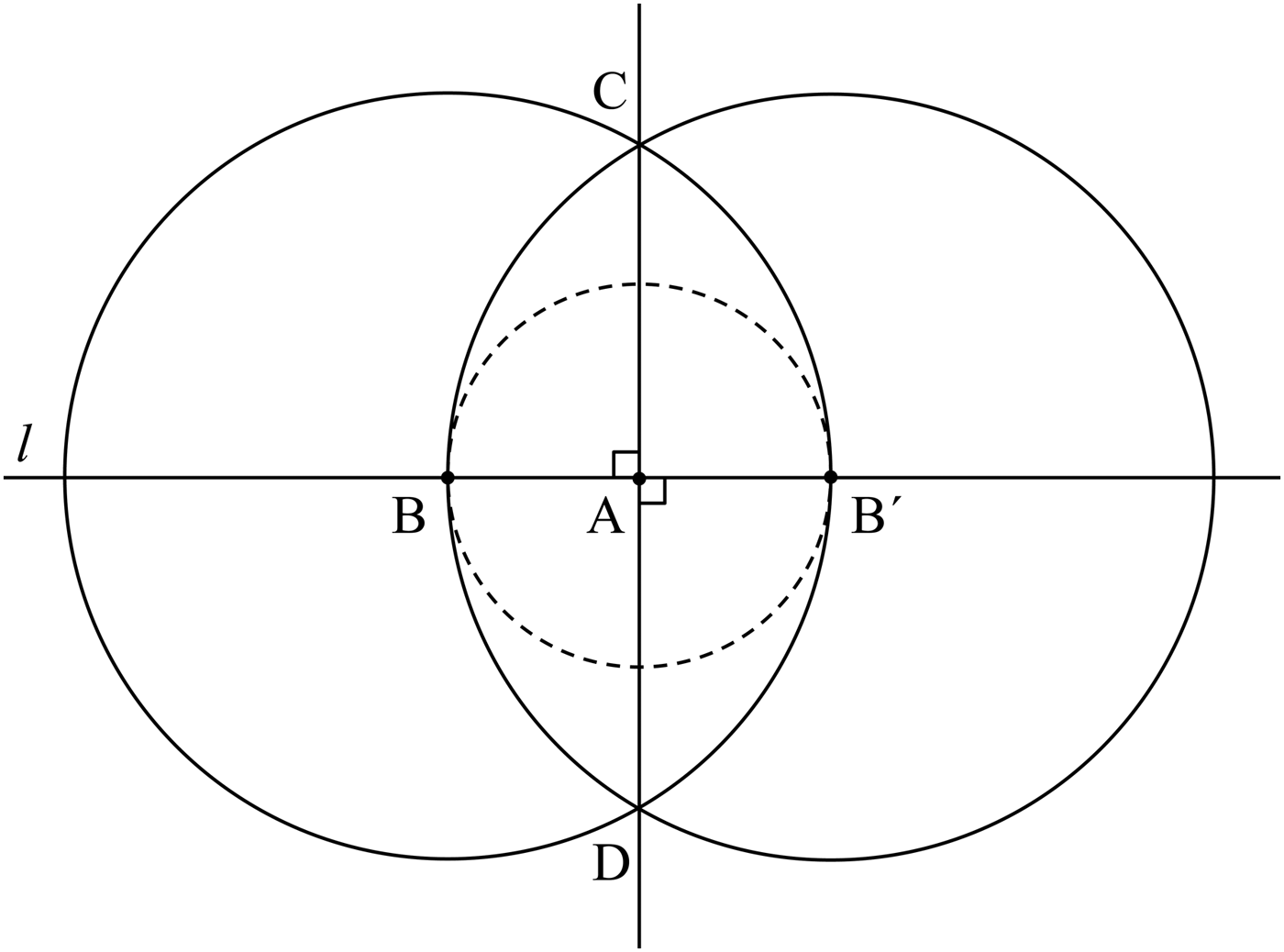
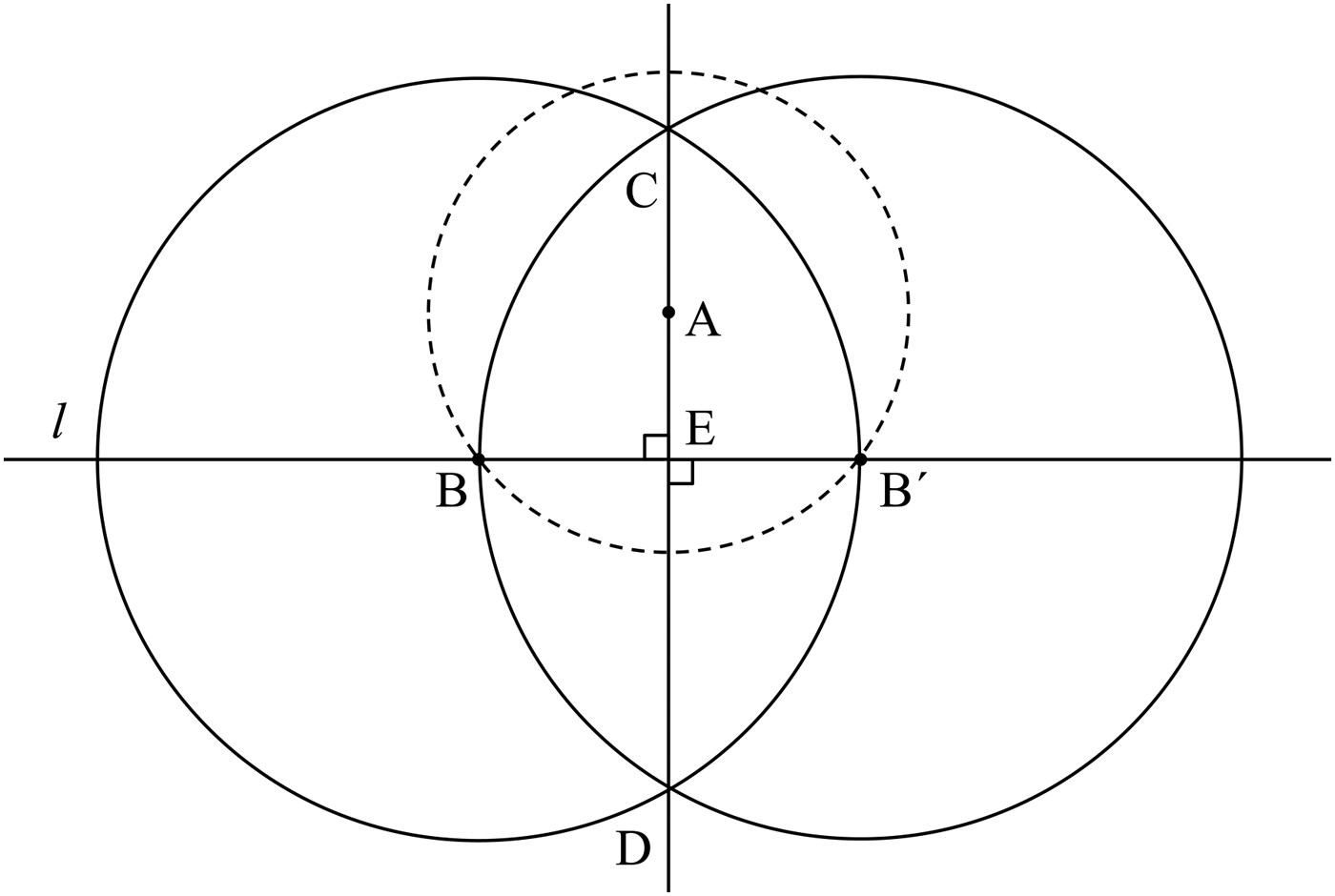
Figures 1 and 2 are modern illustrations of the construction, to which I shall be referring in the following notes. Figure 1 illustrates the construction if the point A is placed on the given straight line l, whereas Figure 2 displays the construction if the point A is placed beside the given straight line l.
Fig. 1

Fig. 2
Guillaumin translates the passage thus:
D'une droite donnée, mener, en un point que l'on a placé, <une droite perpendiculaire à la première, puis,> portant le compas de part et d'autre, décrire des cercles de rayon égal à la distance entre leurs centres, par les intersections desquels passera une droite qui fera des angles droits sur la droite donnée.
Roth Congès' translation runs as follows:
Depuis une ligne droite donnée, élever, après avoir posé un jalon, [une ligne droite perpendiculaire à la première]: ayant tracé des repères au compas de part et d'autre, il faut décrire des cercles de rayon égal à la distance des centres, par l'intersection desquels une ligne droite passe, pour faire des angles droits sur la ligne donnée.
Campbell, finally, renders the passage thus:
To draw from a given straight line when a marker has been positioned … when the compass has been moved to both sides, it is appropriate to draw circles with a radius equal to the distance between their two centres, and where they intersect, a straight line should pass through, and will make right angles at a given line.
As the illustrating figures in Guillaumin and Roth Congès show, they describe only the case when the point A is placed on the given straight line l.Footnote 31 Bouma, for his part, offers a different description of the construction, which has been adopted by Campbell in his commentary;Footnote 32 it will be discussed in the excursus ‘Bouma's explanation of Ex data recta linea … in data linea angulos (p. 107.12–16 L)’ below.
p. 107.12 Ex:
Giving sense to data recta linea (the straight line l in Figs. 1 and 2), the preposition ex (MSS JV) can safely be preferred to et (MS H).
p. 107.12 ducere:
The infinitive evidently lacks an object; this indicates that the passage suffers from a lacuna; see further the separate note on the lacuna below.
The infinitive ducere is probably a so-called infinitivus imperativus, which is not uncommon in technical literature; see e.g. Hofmann and Szantyr (Reference Hofmann and Szantyr1965) 366–7, Löfstedt (Reference Löfstedt1936) 186–90, and Svennung (Reference Svennung1935) 436–38. It is best rendered in English with the imperative: ‘draw’. Another instance of this type of infinitive in our text is eicere; see the note on it below (p. 107.22 L).
The uolueris which MS H has added to ducere is most likely an erroneous scribal emendation; it has been added in order to supply ducere (and comprehendere (p. 107.11 L)) with a governing finite verb.
p. 107.12 posito signo:
Most likely an ablative absolute, meaning literally ‘a point having been placed’. As Figures 1 and 2 show, the point, which is called A, can be placed arbitrarily (wherever the perpendicular is intended to be drawn).
Guillaumin translates posito signo thus: ‘D'une droite donnée, mener, en un point que l'on a placé, <une droite perpendiculaire à la première, […] > ’ (my emphasis). To be precise, however, the Latin text as preserved does not explicitly state that the straight line to be drawn (the straight line CD in Figs. 1 and 2) will pass through the point referred to in posito signo (the point A in Figs. 1 and 2); but as a consequence of the construction, this will of course be the case.
p. 107.12 signo:
I think that ‘point’ is the appropriate translation of the word signum (so Guillaumin), since the description of the construction seems to be a theoretical demonstration, not a direct account of a procedure performed in the field. Roth Congès, however, renders signum as ‘jalon’, and Campbell uses the word ‘marker’. In our text signum also occurs at p. 107.22 L and p. 108.7 L in the sense of ‘point’.
In its geometrical sense of ‘point’ the Latin word signum corresponds to the Greek σημεῖον; see e.g. Mugler (Reference Mugler1958–9) s.v. σημεῖον and OLD s.v. signum 1b. Cf. e.g. Expositio p. 97.15 L signum est cuius pars nulla est = Euc. Elementa 1 def. 1 σημεῖόν ἐστιν οὗ μέρος οὐθέν; Expositio p. 98.15–16 L […] lineae autem fines signa = Euc. Elementa 1 def. 3 γραμμῆς δὲ πέρατα σημεῖα.
p. 107.12 <*>:
As Lachmann indicated in his edition, the passage evidently suffers from a lacuna; see the note on ducere (p. 107.12 L) above. Exactly what and how much has been lost is in my view not completely clear; nor is the location of the lacuna itself certain.
In his translation, Guillaumin supplied this: ‘D'une droite donnée, mener, en un point que l'on a placé, <une droite perpendiculaire à la première, puis,> […].’ As he mentions in a footnote, he was using an earlier draft of Roth Congès' article.Footnote 33 In Roth Congès' published article, then, the lacuna is filled similarly: ‘Depuis une ligne droite donnée, élever, après avoir posé un jalon, [une ligne droite perpendiculaire à la première] […].’ In my view, Guillaumin and Roth Congès may well be on the right track in principle.
On the one hand, Lachmann's suggested location of the lacuna is plausible; it seems reasonable that posito signo and relato … circino were originally not asyndetically coordinated (MSS JV) but separated by some portion of text. If, on the other hand, the reading et in MS H is genuine, not a banal scribal emendation, the lacuna could be located either thus: Ex data recta linea <*> ducere posito signo et relato in utramque partem circino etc. Or thus: Ex data recta linea ducere <*> posito signo et relato in utramque partem circino etc.
p. 107.13 relato in utramque partem circino:
As regards this phrase, MS H offers the correct reading. However, the minor errors in MSS JV were easily corrected by Lachmann.
Guillaumin, Roth Congès and Campbell take relato … circino to be an ablative absolute. Guillaumin translates ‘portant le compas de part et d'autre’; Roth Congès translates literally ‘après avoir envoyé le compas de part et d'autre’,Footnote 34 and then interprets ‘ayant tracé des repères au compas de part et d'autre’; finally, Campbell: ‘when the compass has been moved to both sides’.
Roth Congès explains the purpose of the movement of the compass thus: ‘[…] pour déterminer sur la ligne droite les deux centres des cercles à décrire’.Footnote 35 With Roth Congès' explanation, the idea is that by using the compass one point on each side of and at equal distance to the point A is obtained on the given straight line l (see Figs. 1 and 2). In other words, a circle (or at least two circular arcs) is drawn with its centre at point A and with an arbitrarily taken radius AB, so that the circle intersects the straight line l at two points B and B′ (hence, AB = AB′). These two points, B and B′, will then constitute the centres of two circles that are to be drawn next.
Admittedly, the phrase relato … circino is rather compressed. As it describes such an important part of the construction, one would have wished it to be somewhat more elaborate.
p. 107.13–14 aequali punctorum diastemate:
A condensed expression – due to the twofold meaning of the word diastema: ‘distance’ and ‘radius’ (see the separate note on diastemate (p. 107.14 L) below) – which goes with the subsequent circulos scribere oportet. It is most likely to be understood as if it said diastemate diastemati punctorum aequali scribere oportet circulos;Footnote 36 that is to say, the radius (diastemate) of the circles is equal (aequali) to the distance (diastemati) between the centres (punctorum; see the separate note on punctorum (p. 107.14 L) below) of the circles (BB′ = B′B; see Figs. 1 and 2). Cf. these two passages in the Expositio:
quotiens ex uno duorum punctorum diastemateduo circuli pares exeunt, ad conexionem circumferentiarum interiores rectos angulos facient. (Expositio p. 102.13–16 L)
Whenever two equal circles are drawn from one and the same radius and distance between the two centres, the circles will make the interior angles at the junction (= intersections) of the circumferences right angles.Footnote 37
circumferentiarum linearum rectos angulos ideo quod si tres circuli pares inter se fuerint aequali diastemate [sc. punctorum] conexi […]. (Expositio p. 102.18–20 L)
(We also have) right angles of circular lines for the reason that, if three equal circles with the same radius/distance (between their centres) are joined together […].Footnote 38
As there are no other attestations in ancient Latin of diastema used in its two senses at the same time, I think that this feature, common to the supposed fragment and the Expositio, can be adduced as one piece of evidence favouring the view that the supposed fragment rightly belongs to the Expositio.
p. 107.14punctorum:
The word punctum is used in the sense of ‘centre’, thus corresponding to the Greek κέντρον; see e.g. Mugler (Reference Mugler1958–9) s.v. κέντρον, OLD s.v. punctum 3b, TLL s.v. punctum 10:2.2648.27 ff.
Lachmann rightly, I think, corrected the transmitted iunctorum (MSS JV) to punctorum; MS H has iuncturarum, which could be an erroneous scribal emendation of iunctorum. In our text the word punctum also occurs at p. 107.21 L, where Lachmann corrected the transmitted iuncto (MSS JV) to puncto; see the note on ex quolibet puncto … rectam lineam eicere (p. 107.21–2 L) below. The attestations of the word punctum ‘centre’ in the Expositio are: pp. 101.15; 102.1; 102.7; 102.14 L.
In a footnote to her translation Roth Congès tries to defend iunctorum by suggesting that the participle iunctus could be used as a noun in the sense of ‘ouverture de compas’ or ‘écartement des branches’: aequali iunctorum diastemate ‘à une distance égale à celle des (deux) ouvertures de compas’.Footnote 39 But since there is no support whatsoever to be found in ancient Latin literature for this sense of iunctus, and since the attestation of punctorum diastemate in the Expositio p. 102.14 L – quoted in the note above on aequali punctorum diastemate (p. 107.13–14 L) – is critically certain, Lachmann's correction is in my view as right as an emendation can be.
p. 107.14diastemate:
In geometrical contexts the Greek neuter noun διάστημα usually appears in one of two senses: ‘distance’ or ‘radius’ (that is, in the specific sense of the distance between centre and perimeter); see Mugler (Reference Mugler1958–9) s.v. διάστημα 1. In Roman literature the Greek term διάστημα in the sense of ‘radius’ is also found translated as e.g. interuallum (Ps. Censorinus fr. 8.1), interstitium (Martianus Capella 6.722), and spatium (Euc. elem. vers. M l. 51 ed. Folkerts (Reference Folkerts1970)).
p. 107.14–15circulos scribere oportet:
Two circles are drawn. As their radii (BB′ and B′B; see Figs. 1 and 2) are equal to the distance between the centres (BB′ = B′B), each circumference will pass through the centre of the other circle.
On the meaning of the word circulus, see the note on conexionem (p. 107.15) below.
p. 107.15quorum:
The antecedent is circulos.
The erroneous reading quattuor quorum in MS Ja.c. may well have something to do with the fact that two practically identical pairs of intersecting circles are drawn in MS J f. 70r between angulos (p. 107.16 L) and sed (p. 107.16 L); they are reproduced in Lachmann's edition as figure 123. These four circles, which, as Thulin suggests, were drawn in the margin of MS B and then copied into MS J,Footnote 40 may have led the scribe of MS J to commit the error.
On the one hand, the two pairs of intersecting circles could be the result of duplication of one original pair, which, if so, probably had already occurred in some ancestor to the drawings of MS B (see below in this note). On the other hand, it is also possible that both pairs are genuine and originally illustrated different stages of the construction, but, having lost their distinguishing details in the process of copying, now appear identical in MS J.
The four circles found in MS H f. 46v are most likely related to the circles found in MS J, but they appear in a more corrupt state. Their existence in MS H proves that the drawer of the figures in MS B did not draw at his own discretion; see the section ‘The textual witnesses’ and the note on Qualemcumque … comprehendere (p. 107.10–11 L) above.
In MS V f. 110r one pair of intersecting circles is found in the margin. As both MS J and MS H have four circles, I think that MS B had two pairs of intersecting circles and only one such pair was copied into MS V.
p. 107.15conexionem:
Literally conexio means ‘junction’, etc.; see e.g. OLD s.v. conexio 1. But here ‘intersections’ is quite an apt translation. Since the circumferences intersect at two points (C and D; see Figs. 1 and 2), one would perhaps have expected the plural conexiones; but cf. Expositio p. 102.13–16 L, where conexio in the phrase ad conexionem circumferentiarum also occurs in the singular (this passage is quoted in the note on aequali punctorum diastemate (p. 107.13–14 L) above). Hence, both intersections are included in the singular expression.
In Euclid κύκλος ‘circle’ usually means the plane figure, the surface, if you will, which is contained by the circumference, that is, ‘disk’, not the circumference of the circle;Footnote 41 see e.g. the Euclidean definition of the circle, which also appears translated into Latin in the Expositio:
Euc. Elementa 1 def. 15 Κύκλος ἐστὶ σχῆμα ἐπίπεδον ὑπὸ μιᾶς γραμμῆς περιεχόμενον, πρὸς ἣν ἀϕ' ἑνὸς σημείου τῶν ἐντὸς τοῦ σχήματος κειμένων πᾶσαι αἱ προσπίπτουσαι εὐθεῖαι ἴσαι ἀλλήλαις εἰσίν.
circulus autem est plana forma ab una linea conprehensa, ad quam ab uno signo intra formam posito omnes accidentes rectae lineae sunt inter se pares. (Expositio pp. 104.17–105.1 L)Footnote 42
A circle is a plane figure contained by one line such that all straight lines falling upon it from one point lying within the figure are equal to one another.Footnote 43
Sometimes, however, Euclid evidently uses κύκλος in the sense of ‘circumference of a circle’; see e.g. Euc. Elementa 3 prop. 10 Κύκλος κύκλον οὐ τέμνει κατὰ πλείονα σημεῖα ἢ δύο. ‘A circle does not cut a circle at more points than two.’Footnote 44
Now, as the antecedent to the genitive quorum which qualifies conexionem is circulos, this suggests that our author is not using the word circulus here in the usual sense of ‘disk’, but in the sense of ‘circumference of a circle’.
p. 107.16normales in data linea angulos:
The right angles are attained at the intersection of the straight line CD and the given straight line l (see Figs. 1 and 2); that is, either at A (if point A was placed on l) or at E (if point A was placed beside l).
MSS JV read: normalis in recta linea angulos (angulus MS J). MS H reads: normationis in recto angulo. Most likely MSS JV exhibit a more genuine text (Lachmann's minor change of normalis to normales seems to be in order, since there are no indications in the Expositio of a regular use of the ending –is in the accusative plural). Even if normationis were changed to normationem or normationes, the reading of MS H remains awkward and obscure. Perhaps normationis in recto angulo is the futile result of scribal emendation after loss of linea: normalis/–es in recta linea angulos > *normalis/–es in recta angulos > normationis in recto angulo. On the adjective normalis, see the next note.
Lachmann's emendation data for the transmitted recta seems to be supported by factura in data linea rectum angulum at p. 107.24 L; but by comparing ex data recta linea at p. 107.12 L one could also suggest that data should be supplied before recta: in <data> recta linea. In addition, the reading recto in MS H may be adduced in support of maintaining recta. Although these conjectures make the meaning clearer to the reader, I tend to think that they are unnecessary; the author may well have been somewhat vague, and for an attentive reader it is evident that the recta linea in question is the given straight line l, not the straight line CD (see Figs. 1 and 2).
p. 107.16normales:
At first glance the adjective normalis (from the noun norma ‘set square’; see the note on normam (p. 108.8 L) below) seems to be used here as a synonym of rectus: normalis angulus = rectus angulus ‘right angle’. There may, however, be a yet unnoticed terminological difference: that normalis angulus is the special type of rectus angulus which consists of two straight lines. In the Expositio pp. 100.8–101.11 L angles consisting of two straight lines are described, and in this section we find the right angle called normalis angulus. However, in the sections which describe angles consisting of one straight and one circular line (pp. 101.12–102.11 L) and of two circular lines (pp. 102.12–103.5 L), the right angles of these two types are never called normales. See especially the following passages in the Expositio:
Rectarum ergo linearum species angulorum generis sui tres, recta ebes acuta. rectus angulus est euthygrammos, id est ex rectis lineis conprehensus, qui Latine normalis appellatur. (Expositio p. 100.8–11 L)
Thus, there are three types of the kind of angles which consist of straight lines: right, obtuse, acute. The right angle is euthygrammos (= rectilinear), that is, contained by straight lines; in Latin it is called normalis.Footnote 45
rectus ergo angulus est normalis, ebes plus normalis, acutus minus normalis. (Expositio p. 101.10–11 L)
Thus, the right angle is normalis, the obtuse is greater than the normalis, the acute less than the normalis.Footnote 46
Cf. the following passage in the so-called Fragmentum Censorini, where normalis (sc. linea) is given as a Latin equivalent to the Greek κάθετος (sc. εὐθεῖα (sc. γραμμή)) ‘perpendicular (straight line)’ (see Mugler (Reference Mugler1958–9) s.v. κάθετος):
Ps. Cens. fr. 6.3 si recta linea supra rectam lineam stans continuos angulos inter se pares facit, tum uterque ex paribus angulis rectus dicitur, et ea linea Graece κάθετος, Latine normalis dicitur. Footnote 47
If a straight line standing on a straight line makes the adjacent angles equal to one another, then each of the equal angles is called right, and the line is called κάθετος in Greek, normalis in Latin.
It should finally be noted that, granted the difference between normalis angulus and rectus angulus suggested above, the author of our text obviously did not hesitate to use the wider term rectus angulus, although the stricter normalis angulus could have been used instead; see p. 107.24 L.
Excursus: Bouma's explanation ofEx data recta linea … in data linea angulos(p. 107.12–16):
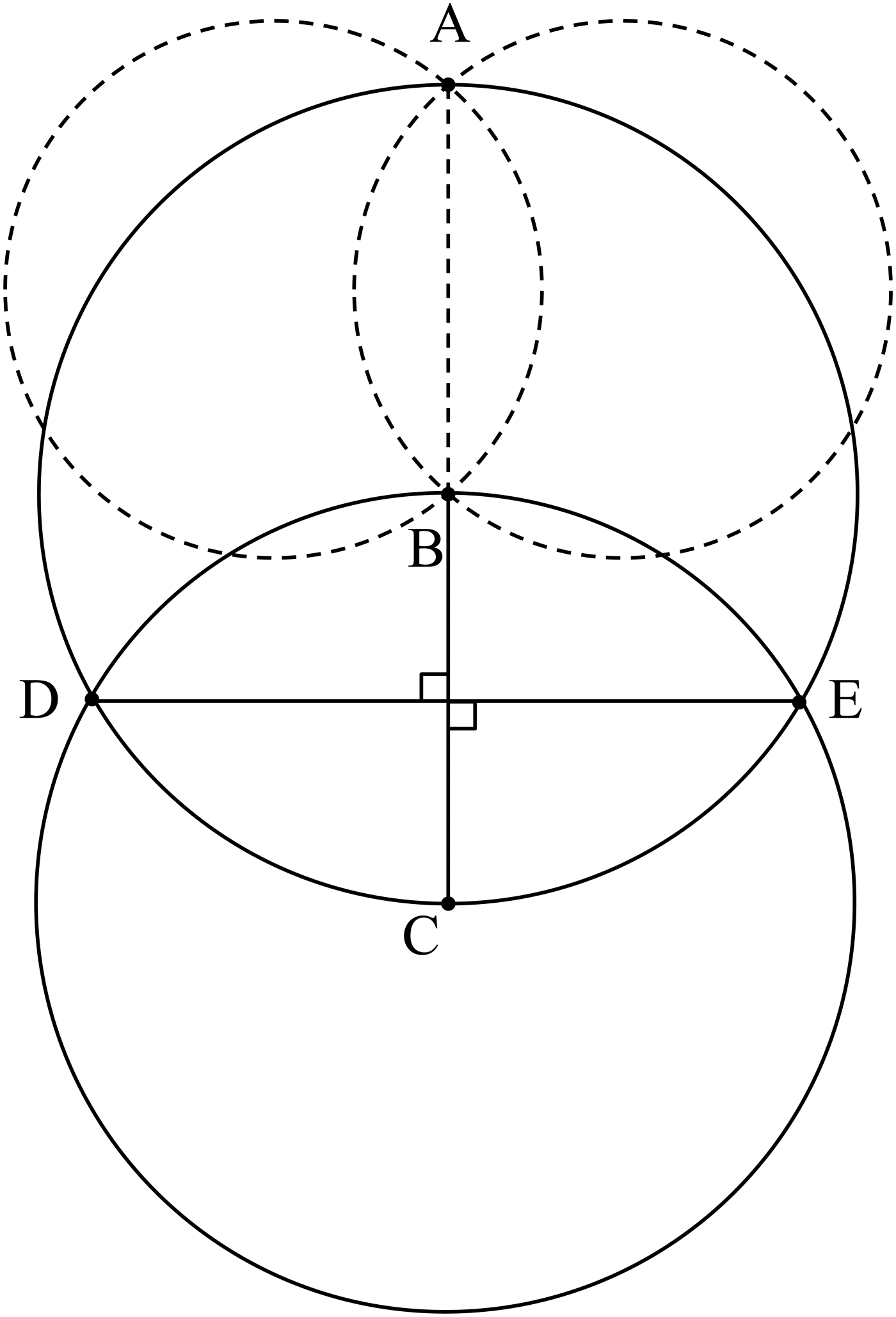
Evidently Bouma's tentative and highly unconvincing description of the geometrical construction does not take the following portion of text into account: Ex data recta linea ducere posito signo <*> relato in utramque partem circino (p. 107.12–13 L).Footnote 48 Consequently he suggests that the straight line to which the perpendicular shall be dropped is first to be constructed, although it is most likely already given (ex data recta linea). This is done by drawing two intersecting circles with equal radii and then by drawing the straight line AB through their intersections (see
Fig. 3below). As the phrases posito signo and relato in utramque partem circino are neglected, the construction proceeds by drawing one circle with the centre at B and the radius BA and then by extending the straight line AB to C, so that another circle with the centre at C and the radius CB can be drawn. By drawing the straight line DE, finally, the intersection of DE and AC will be at right angles.
Fig. 3
Furthermore, a great drawback is that the constructed right angles will end up at a location difficult to foresee at the beginning of the construction; this renders Bouma's construction impractical, even in theory.
Unfortunately, Bouma's explanation was uncritically adopted by Campbell in his commenting note.Footnote 49
p. 107.16–19sed quo … ratione utamur:
The exact meaning of this passage is uncertain, and Lachmann obviously considered it necessary to subject the paradosis to conjectural criticism. Guillaumin, Roth Congès and Campbell interpret the passage somewhat differently, yet they all follow Lachmann's text.
Guillaumin, to begin with, translates thus:
Mais pour que dans une figure formée de lignes droites la ligne circulaire ne coupe pas les droites, servons-nous du procédé du chiasme, sans utiliser les circonférences.
As regards the phrase a circumferentiarum parte, Guillaumin states in a footnote: ‘[O]n peut hésiter entre deux traductions: “sans utiliser les circonférences”, ou “à partir de segments de circonférences”.’Footnote 50
Roth Congès, then, interprets as follows:
Mais là où, dans une figure à lignes droites, la ligne circulaire ne recoupera pas les droites, servons-nous du procédé du chiasme, à partir d'arcs de cercles.
In a footnote to this portion of text, Roth Congès gives the following comment: ‘C'est-à-dire qu'on se contente de tracer aux endroits nécessaires deux arcs de cercle, dont l'intersection marque le point recherché. Ce sont ces traits croisés en forme de χ que l'on appelle “chiasme”.’Footnote 51
Campbell, finally, renders the passage thus:
But in a figure consisting of straight lines, where a circular line does not intersect the straight lines, starting from part of the circumference we must use the method involving chiasmus.
I for my part do not profess to have found a definitive solution to this difficult passage; but in the following notes I tentatively suggest that a text at least as good – or bad – as Lachmann's can be obtained without resorting to conjectural criticism:
sed quoniam in rectarum linearum forma circularis linea non interuenit rectis, a circumferentiarum parte chiasmis eiusdem rationis utamur.
This text could be translated thus:
But since in a rectilinear figure a circular line is not combined with straight lines, we may use χ-shaped marks from segments of circumferences according to the same method.
Or perhaps more freely:
But since circular lines do not belong among the straight lines which contain a rectilinear figure, we may use χ-shaped marks according to the same method which are obtained from segments of circumferences.
p. 107.16–17sed quo … interueniat rectis:
MS J reads as follows: sed quoniam rectarum linearum forma circularis linea non interuenit rectis; MS V: sed qm rectarum linearum forma circularis non interueniat rectis; MS H: sed qm (quando MS HL) in rectarum linearum forma circularis linea normaliter uenit recisa.
As stated in the section ‘The textual witnesses’ above, Lachmann used only MSS JV for his edition. Starting from the transmitted readings quoniam (MS J) and qm (= quoniam) (MS V),Footnote 52 Lachmann conjectured quo in, whereby a desired in was restored: in rectarum linearum forma. Possibly he imagined this chain of corruption: *q in (abbreviated quo) > qm (MS B?, MS V) > quoniam (MS J). Exactly what sense of quo he had in mind is unclear, however. According to Guillaumin's translation, quo is interpreted as a final subordinating conjunction, whereas in Roth Congès' and Campbell's translations quo is interpreted as a pronominal adverb; see the preceding note on sed quo … ratione utamur (p. 107.16–19 L). Furthermore, Lachmann preferred interueniat (MS V) to interuenit (MS J).
As we now are able to consult MS H, there is reason to reconsider the text. Unfortunately, however, MS H seems to offer a generally more corrupt text of this passage than MSS JV, but it might still provide us with some clues. First, it could be that qm in (= quoniam in) is the genuine reading, not merely a scribal emendation of a previous qm.Footnote 53 Secondly, the awkward normaliter uenit could, I think, speak in favour of reading the indicative interuenit, although, of course, scribal emendation of a previous ueniat cannot be totally excluded. And thirdly, the reading recisa (MS H) seems to support the genuineness of rectis a (MSS JV), as it is far more likely that rectis a has been corrupted to recisa than vice versa.
The intended sense of the verb interuenire is not perfectly clear; Guillaumin renders it with the verb ‘couper’, Roth Congès with ‘recouper’, and Campbell with ‘intersect’. In my opinion, however, one may compare the following passage in the Expositio:
Aeque multas ac uarias figuras habent formae, quotiens flexuosae lineae rationalis siue recta siue circularis linea interuenit. (Expositio p. 104.10–12 L)
Figures have equally many varied shapes, whenever a measurable line, straight or circular, is combined with a curved line.
If the verb interuenire is taken in this sense, ‘be combined with’, one may read the passage in question with quoniam in and interuenit thus: sed quoniam in rectarum linearum forma circularis linea non interuenit rectis ‘but since in a rectilinear figure a circular line is not combined with straight lines’. In other words: by definition a rectilinear figure is not contained by any circular line; however, the previously described method of constructing right angles in such a figure involves the drawing of circles (p. 107.12–16 L). Consequently, the clause reminds the reader of the obvious fact that those circular lines are merely auxiliary, not constituent parts of the figure being constructed.
p. 107.18–19a circumferentiarum … utamur:
MS J reads as follows: a circumferentiarum parte chiasmis eiusdem rationis utamur; MS V: a circumferentiarum partem chiasinis eiusdem rationem utamur; MS H: recisa circumferentia linearum eiusdem rationis norma utamur.
Lachmann printed a circumferentiarum parte with MS J and then adopted his conjecture chiasmi cuiusdam ratione. In my view, however, there seems to be no need for emendation; I suggest that chiasmis eiusdem rationis be read with MS J. At p. 108.2 L, MS J has preserved the genuine reading chiasmis (the ablative is governed by utendum est), whereas MS V has the corrupt chiasinis (in instead of m); see the note on in hanc autem … utendum est (p. 108.1–2 L) below. Hence there is reason to assume that chiasmis is the genuine reading here too, where MS V also exhibits the corrupt chiasinis. The reading eiusdem, then, is supported by all three MSS, and rationis is supported by MSS JH; rationem in MS V is presumably an ungrammatical emendation introduced by the scribe (with the intention of recovering an “object” for utamur). The text of MS H, finally, is likely to be the result of omissions (recisa for rectis a and parte chiasmis omitted) and subsequent scribal emendations (circumferentia linearum for circumferentiarum and norma added).
As Guillaumin, Roth Congès and Campbell have noted, the word chiasmus here denotes a mark of intersection between two line segments in the shape of the Greek letter χ.Footnote 54 According to the TLL s.v. chiasmus 3.1007.76 ff., p. 107.18 L and p. 108.2 L are the only attestations of this Latinised Greek word (cf. LSJ s.v. χιασμός) in ancient Latin gromatical literature. They have also observed that the noun decussis is attested in ancient Latin in a similar sense; see TLL s.v. decussis 5:1.248.57–66 and 77–83. Cf. also TLL s.vv. decusso 5:1.249.5 ff.; decussatio 5:1.248.26 ff.; decussatim 5:1.248.13 ff.
The prepositional expression a circumferentiarum parte is somewhat obscure. It seems to go with the following chiasmis, stating that the intersections may be accomplished by drawing only a part, that is, segments, of the circumferences; for it is not necessary to draw the entire circumferences in order to obtain the intersections.
Consequently the whole clause a circumferentiarum parte chiasmis eiusdem rationis utamur could be translated thus: ‘we may use χ–shaped marks from segments of circumferences according to the same method’; or more freely: ‘we may use χ–shaped marks according to the same method (as described previously) which are obtained from segments of circumferences’.
p. 107.20–4Quod si ab … linea rectum angulum:
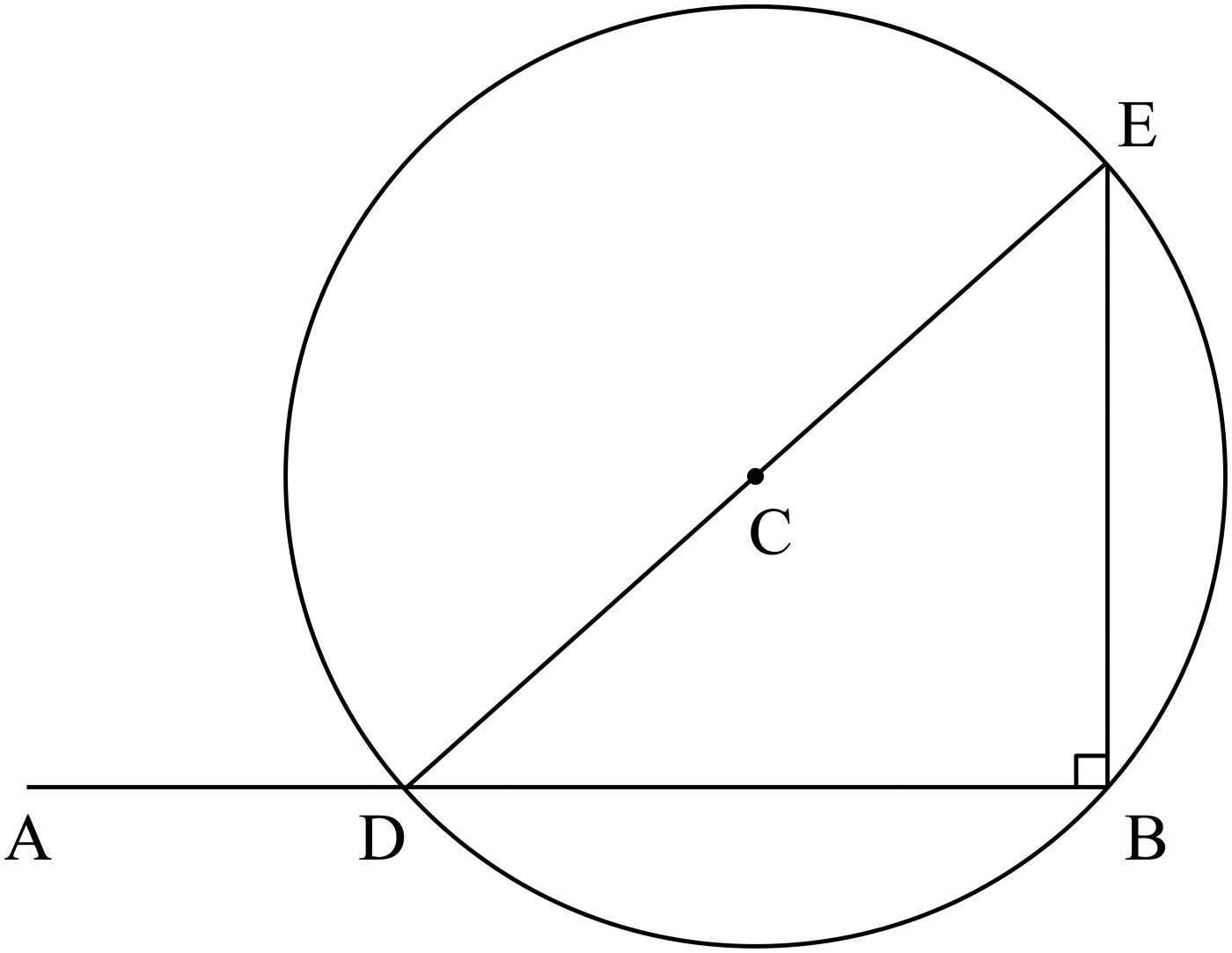
In this passage another method of dropping a perpendicular is described. It is an application of the so-called theorem of Thales, which states that the diameter of a circle always subtends a right angle at any point on the circumference of the circle.Footnote 55Figure 4 is a modern illustration of the construction, to which I shall be referring in the following notes. Let the straight line AB be the given straight line, and the straight line EB be the constructed straight line at right angles to the given straight line. Cf. the figures given by Guillaumin, Roth Congès and Campbell.Footnote 56
Fig. 4
MSS JV have preserved a figure which is a simple illustration of this construction (it is reproduced in Lachmann's edition as figure 124): MS J f. 70r, between utamur (p. 107.19 L) and Quod si (p. 107.20 L); MS V f. 110r, at the bottom of the folio, after angulum (p. 107.24 L). The figure in the top right corner of MS H f. 47r may be a corrupt version of this figure.
p. 107.20–1Quod si ab … rectum angulum faciat:
The paradosis (MSS JV) is most likely sound. The phrase recta linea may be taken either with ab eadem or with ducenda fuerit. In either case, another recta linea is easily supplied in thought: ab eadem rectā lineā (sc. rectă lineă) ducenda fuerit quae etc. or ab eadem (sc. rectā lineā) rectă lineă ducenda fuerit quae etc.Footnote 57 I translate: ‘But if from the same straight line (AB; see Fig. 4) a straight line (BE) shall be drawn which is to make a right angle.’
p. 107.21–2ex quolibet puncto … rectam lineam eicere:
MS J reads as follows: ex quolibet iuncto qui per caput recta linea transeat rectam lineam eicere; MS V: ex quolibet iuncto qui per caput recta linea transceat (lacuna after transceat). Lachmann obviously followed the paradosis, but rightly changed iuncto to puncto (see the note on punctorum (p. 107.14 L) above) and discarded the evidently erroneous reading transceat. Still, Lachmann's text is unsatisfactory.
As Lachmann's text runs, the transmitted qui makes no sense; it cannot refer to puncto either grammatically or factually. Guillaumin tentatively suggested that et diastemate be supplied before qui, so that the relative pronoun would refer to diastemate, and that recta linea be changed to rectae lineae (since ‘[…] il est inutile de préciser qu'un rayon va en ligne droite’): ex quolibet puncto <et diastemate> qui per caput recta<e> linea<e> transeat rectam lineam eicere ‘d'un centre quelconque [C; see Fig. 4] <et avec un rayon [CB]> ’ ‘qui passe par l'extrémité [B] de la ligne droite [AB]’ ‘prolonger une droite [DCE]’.Footnote 58 However, as diastema ought to be a neuter noun (see the note on diastemate (p. 107.14 L) above), should qui not also be changed to quod?
Roth Congès, for her part, tried, unconvincingly in my view, to retain iuncto (masc.) thus: ex quolibet iuncto qui per caput recta linea transeat rectam lineam eicere ‘à partir de n'importe quelle ouverture de compas qui passe en ligne droite (CB) par l'extrémité (B), tracer une droite (DCE)’. Or: ex quolibet iuncto qui per caput recta<e> linea<e> transeat rectam lineam eicere ‘à partir de n'importe quelle ouverture de compas (CB) qui passe par l'extrémité de la ligne droite (B), tracer une droite’.Footnote 59
Campbell translates Lachmann's text as follows: ‘from the central point (C) (of the circle) extend a straight line which passes through the extremity of the circle (D) in a straight line’. Obviously, Campbell (inadvertently?) translates as if quae were read, not qui. Moreover, he renders per caput as ‘through the extremity of the circle (D)’, which seems awkward; the circumference of a circle, which is a complete circular line, does not have any extremity. Nor is it likely that caput means ‘circumference’, as it is used in the sense of ‘extremity (of a line)’ at p. 107.23 L (see the note on caput (p. 107.21 L) below). In addition, if the centre C is placed at will (ex quolibet puncto; Campbell does not translate quolibet), the point D will not necessarily coincide with the extremity A of the straight line AB (see Fig. 4), although the figure preserved in MSS JV suggests this; see the note on Quod si ab … linea rectum angulum (p. 107.20–4 L) above.
If the transmitted qui be regarded as genuine, one could venture to emend thus: ex quolibet puncto <et circino> qui per caput recta<e> linea<e> transeat rectam lineam eicere ‘from whatever centre (C) and drawing/trace of the compass, which shall pass through the extremity (B) of the straight line (AB), extend a straight line (DCE)’. Cf. the following occurrences of circinus = ‘drawing/trace of the compass’ in the Expositio:
forma anguli unius ex tribus circinis, ut in opere marmoreo. duorum angulorum forma e duobus circinis, trium angulorum ex tribus circinis, quattuor angulorum ex quattuor circinis […]. (Expositio p. 105.4–7 L)
A figure containing one angle can be produced from three traces of the compass, as in marble work. A figure containing two angles can be produced from two traces of the compass, containing three angles from three traces of the compass, and containing four angles from four traces of the compass.Footnote 60
However, in a note to this passage in the Expositio, Guillaumin suggests that the reason why circinus is used instead of circulus is that the traces of the compass are not complete circles, but arcs.Footnote 61 If so, one may of course object that the restoration ought to be <et circulo> rather than <et circino>: ex quolibet puncto <et circulo> qui per caput recta<e> linea<e> transeat rectam lineam eicere ‘from whatever centre (C) and circle, which shall pass through the extremity (B) of the straight line (AB), extend a straight line (DCE)’. Moreover, the required sense of the word circulus here ought to be ‘circle’ = ‘circumference of a circle’, not ‘circle’ = ‘disk’; see the note on conexionem (p. 107.15 L) above.
If the transmitted qui be regarded as a corruption, one could, on the other hand, emend by changing qui and supplying some other word(s) meaning ‘circumference’ attested in our text: ex quolibet puncto <et circumferenti linea> quae per caput recta<e> linea<e> transeat rectam lineam eicere or ex quolibet puncto <et circumferentia> quae per caput recta<e> linea<e> transeat rectam lineam eicere ‘from whatever centre (C) and circumference, which shall pass through the extremity (B) of the straight line (AB), extend a straight line (DCE)’.
p. 107.21caput: The noun caput in the sense of ‘extremity (of a line)’ occurs in our text also at p. 107.23 L. For further attestations, see TLL s.v. caput 3:2.411.83 ff.
p. 107.22eicere: The verb eicere is used in the sense of ‘extend’, ‘produce’; see TLL s.v. eicio 5:2.310.68 ff. Most likely it corresponds to the Greek verb ἐκβάλλειν (see Mugler (Reference Mugler1958–9) s.v. ἐκβάλλειν), as in the following passage of the Expositio, which is a translation of the Euclidean definition of parallel straight lines:
ordinatae rectae lineae sunt quae in eadem planitia positae et eiectaein utramque partem in infinitum non concurrunt. (Expositio pp. 98.16–99.2 L)
Euc. Elementa 1 def. 23 Παράλληλοί εἰσιν εὐθεῖαι, αἵτινες ἐν τῷ αὐτῷ ἐπιπέδῳ οὖσαι καὶ ἐκβαλλόμεναι εἰς ἄπειρον ἐϕ' ἑκάτερα τὰ μέρη ἐπὶ μηδέτερα συμπίπτουσιν ἀλλήλαις.
Parallel straight lines are straight lines which, being in the same plane and being produced indefinitely in both directions, do not meet one another in either direction.Footnote 62
The infinitive eicere is a so-called infinitivus imperativus; see the note on the infinitive ducere (p. 107.12 L) above.
p. 107.22–4per cuius signum … linea rectum angulum:
Lachmann printed the text according to MS J, which, as far as I can see, is sound. Because of an omission, MS V has only preserved the last words (which agree with the testimony of MS J): factura in data linea rectum angulum. MS H, too, suffers from omissions; it reads: in circumferentem lineam inclusio rectae lineae transeat factura in data linea rectum angulum. Here inclusio is undoubtedly an erroneous scribal emendation.
I translate as follows: ‘through/to the point (E; see Fig. 4) of which (i.e. the straight line DCE), that is, to the circumference, a straight line (BE) shall pass from the extremity (B) of the straight line (AB) and make a right angle on the given straight line (AB)’.
As my translation shows, the antecedent to cuius is rectam lineam at p. 107.22 L.
Guillaumin, Roth Congès and Campbell seem to have taken signum to be the antecedent to quod. In my view, however, quod est is to be understood rather as id est ‘that is’, clarifying the direction of the straight line BE.
On the terms signum ‘point’ and caput ‘extremity’, see the notes on signo (p. 107.12 L) and caput (107.21 L) above.
p. 108.1–2in hanc autem … utendum est:
Most likely, MSS JV exhibit the genuine text, except for the erroneous chiasinis of MS V; see the note on a circumferentiarum … utamur (p. 107.18–19 L) above. Presumably the reading in agratione in MS H is the result of omission (autem) and corruptions in the following sequence: in hanc rationem > *in hac ratione > in agratione. The reading thomis in MS H is most likely an erroneous scribal emendation.
In translating this passage I mainly follow Guillaumin's interpretation:Footnote 63 ‘But if the circumference is eliminated for this method, one must use χ-shaped marks.’ In my view, this sentence states that if the method described at p. 107.20–4 L is applied but, for some reason, a complete circumference is not to be used, it suffices to draw arcs at the points D and E (see Fig. 4). At the point D there will be an intersection between an arc and the straight line AB; the intersection will resemble the Greek letter χ. At the point E, if the straight line DCE is produced somewhat beyond the point E, there will be an intersection between an arc and the straight line; and even if the straight line DCE stops at the point E, a mark will be accomplished which can be described as similar to the letter χ.
On the word chiasmus, see the note on a circumferentiarum … utamur (p. 107.18–19 L) above.
p. 108.2–4nam quod ad extremam … sex octo et decem:
Another way of constructing a right angle is compendiously presented. If the sides of a triangle are of six, eight and ten units of length, the triangle is right-angled, that is to say, one of its angles is a right angle.Footnote 64 So, of course, is every triangle of the same proportions (for example, if the sides are of three, four and five units of length).
MSS JV have preserved a triangle which is most likely intended to illustrate this construction: MS J f. 70r, between angulum (p. 107.24 L) and In hanc (p. 108.1 L), reproduced in Lachmann's edition as figure 125; MS V f. 110v, between disputauimus (p. 108.4 L) and circuli (p. 108.4–5 L). However, in MS J the triangle has been corrupted to an equilateral triangle, and in MS V its proportions are somewhat distorted, so that it resembles an isosceles triangle.
The MSS JV read: nam quod ad extremam lineae normationem pertinet, uulgaris consuetudinis est sex octo et decem. MS H reads: nam quod ad extremae lineae normationem pertinet, uulgaris consuetudinis est VI VIII uel X numeros ponere. On the one hand, the reading of MSS JV may be considered more likely to be genuine than that of MS H. The reading extremam lineae normationem (MSS JV) may be regarded as lectio difficilior in relation to extremae lineae normationem (MS H), as the adjective extremus is more easily understood as qualifying the concrete noun linea than the verbal noun normatio; the reading uel (MS H) is most likely not original (the required sense is ‘and’, not ‘or’, etc., and uel = et is not attested elsewhere in our text or in the Expositio); numeros ponere (MS H), finally, may be considered to be a later addition. On the other hand, it could be argued that extremae lineae normationem (MS H) is better than the corresponding reading of MSS JV and that MS H has indeed preserved an original numeros ponere, which makes sense of the otherwise elliptical main clause.
I for my part am inclined to think that extremae (MS H) should be preferred to extremam (MSS JV) and that numeros ponere is to be regarded as, at least, a plausible emendation to the text of MSS JV, which, in my view, seems too elliptical. Hence I translate thus: ‘Moreover, as regards the dropping of a perpendicular to the extremity of a line, the common procedure is to employ the numbers six, eight and ten.’
See further the notes on extremam lineae normationem (p. 108.2–3 L) and sex octo et decem (p. 108.3–4 L) below.
p. 108.2nam:
In the sense of ‘moreover’, ‘then’; see OLD s.v. nam 4. Cf. Expositio p. 92.17–18 L nam quod ad synopsim pontium pertinet […].
p. 108.2–3extremam lineae normationem:
Here the verbal noun normatio obviously means ‘dropping of a perpendicular’. Cf. OLD s.v. normatio, where another sense, inapplicable to this instance, is recorded. The genitive lineae is most likely objective: lineae normatio = ‘the dropping of a perpendicular to a line’.
As stated in the note on nam quod ad extremam … sex octo et decem (p. 108.2–4 L) above, I tend to think that extremae (MS H) should be preferred to extremam (MSS JV). If the reading of MS H is chosen, the expression extremae lineae normatio means ‘the dropping of a perpendicular to the extremity of a line’ (the adjective extremus is taken partitively), which immediately makes perfect sense. If the reading of MSS JV were preferred, the expression extrema lineae normatio would literally mean ‘the extreme dropping of a perpendicular to a line’, which, in turn, ought to convey the same meaning as ‘the dropping of a perpendicular to the extremity of a line’.Footnote 65 Although the reading of MSS JV seems to be both difficilior and possible, the reading of MS H is in my opinion simply more to the point and hence more likely to be genuine.
p. 108.3uulgaris:
The adjective uulgaris ‘common’ stands in opposition to the following artificialis ‘being in accordance with the art (i.e. of geometry)’ (p. 108.5 L). Hence, uulgaris does not imply that the procedure described is commonly used in the art of geometry, but that it is common in areas of applied geometry, notably land surveying; see the note on haec de qua … non praefinit (p. 108.4–6 L) below.
p. 108.3–4sex octo et decem:
As stated in the note on nam quod ad extremam … sex octo et decem (p. 108.2–4 L) above, I tentatively adopt the additional numeros ponere of MS H: sex octo et decem numeros ponere. This addition – genuine or scribal conjecture – remedies the awkward brevity of the reading in MSS JV.
p. 108.4–6haec de qua … non praefinit:
Here I endorse Lachmann's text, which is that of MSS JV (quae, however, is read only in MS J). Possibly one could also adopt the reading autem of MS H: haec autem de qua etc. The other variant readings of MS H are less attractive: circularis for circuli (banalisation/assimilation (perhaps induced by the adjectives uulgaris and artificialis in the vicinity)), quia for quae (presumably lectio facilior), numerum praefinit for numeros non praefinit (impossible).
I translate thus: ‘The method with a circle, which we have talked about above, is more in accordance with the art (of geometry); it does not prescribe numbers.’ The method referred to is evidently the one described at pp. 107.20–108.2 L.
In strict Euclidean geometry, measurement of, for example, lengths is not a valid operation in constructions and proofs. As the method of constructing a right angle by using a triangle with sides of six, eight and ten units of length (p. 108.2–4) requires numbers, that is, measuring, it is rightly pointed out that the method without measurement is magis artificialis ‘more in accordance with the art (of geometry)’.
Finally, it should be mentioned that because of erroneous punctuation (full stop after disputauimus) in Guillaumin's and Roth Congès' Latin text the passage has been mistranslated and misinterpreted by Guillaumin, Roth Congès and even Campbell.Footnote 66
p. 108.6–8habemus enim … normam facturas:
This sentence explains, with reference to Euclid, why the method described at pp. 107.20–108.2 L is more in accordance with the art of geometry. For, as Guillaumin, Roth Congès and Campbell point out,Footnote 67 it is proved in Elementa 3 prop. 31 that in a circle the angle in the semicircle is a right angle; that is to say, wherever on the circumference of a circle two straight lines, one from each endpoint of the diameter, meet, they will make a right angle.
Except for the unjustified alteration Eucliden for the transmitted Euclidem (MSS JV, Euclẏdem MS H), I here agree with Lachmann's text. The text of MS H, which, I think, suffers from omissions and erroneous scribal emendations, is as far as I can see nonsensical (it does, however, support the reading concurrerint of MS J against the concurrunt of MS V).
The words normam facturas, governed by habemus, are of course to be understood thus: (sc. eas duas lineas) normam facturas (sc. esse).
I translate thus: ‘For we have it in Euclid that at whatever place on the circumference two (straight) lines from the (end)points of the diameter meet, they will make a right angle.’
MS J has preserved two figures which seem to serve as illustrations to this passage: MS J f. 70v, between disputauimus (p. 108.4 L) and circuli (p. 108.4 L), reproduced in Lachmann's edition as figure 126. One of them is correct, the other not. In MS V f. 110v, in the right margin next to the explicit, only the incorrect figure is found. MS H f. 47r, in the middle of the folio, has three erroneous figures, of which the third one from the left is similar to the incorrect figures found in MSS JV. Now, the incorrectness of the figures found in MSS JV seems to originate from misinterpretation of ex signis dimensionis, literally ‘from the points of the diameter’; apparently the author of the figures interpreted ‘from (whichever) points on the diameter’, instead of ‘from the (end)points of the diameter’.
p. 108.7dimensionis:
The word dimensio ‘diameter’ is attested four times in the Expositio: p. 101.14; 101.18; 102.3; 102.9 L. Unfortunately, this sense of the word is not recorded in OLD s.v. dimensio. And in the TLL the attestations of this specific sense are not singled out under a separate heading, but lumped together with attestations of other senses; see TLL s.v. dimensio 5:1.1192.72–1193.12.
p. 108.8normam:
The original sense of the word norma is ‘set square’ (see OLD s.v. norma 1), but here it is used in the sense of ‘right angle’. The only attestation of norma = ‘right angle’ adduced in OLD is Vitruvius 9 praef. 6. In my view, however, that attestation is invalid, as norma is used there in the sense of ‘set square’; in Vitruvius 1.1.4, on the other hand, norma = ‘right angle’ (so also Callebat and Fleury (Reference Callebat and Fleury1995) s.v. norma (col. 89)).
Although several textual and interpretative uncertainties remain, I hope that this paper may at least to some extent contribute to a better understanding of this important piece of geometry in the Roman tongue.