Refine search
Actions for selected content:
42 results
EXTREME LEAST SINGULAR VALUES OF GAUSSIAN ROW SUBMATRICES AND A PHASE RETRIEVAL STABILITY PROBLEM
- Part of
-
- Journal:
- Bulletin of the Australian Mathematical Society , First View
- Published online by Cambridge University Press:
- 14 October 2026, pp. 1-9
-
- Article
-
- You have access
- Open access
- HTML
- Export citation
-
Let $\mathbb {F}$
 be either $\mathbb {R}$
 or $\mathbb {C}$
 , and put $d_{\mathbb {F}}=\dim _{\mathbb {R}}\mathbb {F}$
 . Let $A_m\in \mathbb {F}^{N_m\times m}$
 have independent standard Gaussian entries and assume $N_m/m\to \gamma>1$
 . We determine the exponential scale of the smallest least singular value among all square row submatrices: $$ \begin{align*} M_m^{\mathbb{F}}=\min_{T\subset [N_m],\, |T|=m}\sigma_{\mathrm{min}}(A_{m,T}). \end{align*} $$

With $c_\gamma =\gamma ^\gamma /(\gamma -1)^{\gamma -1}$
 , we prove $m^{-1}\log M_m^{\mathbb {F}}\xrightarrow {P}-d_{\mathbb {F}}^{-1}\log c_\gamma $
 and, when $N_m=\gamma m+O(1)$
 , the convergence holds at rate $O(m^{-1})$
 . As an application, for real phase retrieval at the critical number $N=2m-1$
 of measurements, the Balan–Wang stability parameter satisfies $\omega (A_m)=4^{-m+o_P(m)}$
 , so the sharp exponential base in the Gaussian Balan–Wang problem is $1/4$
 . The lower estimate extends to all bounded-density ensembles and continuity is necessary.


Galois groups of random integer matrices
- Part of
-
- Journal:
- Mathematical Proceedings of the Cambridge Philosophical Society , First View
- Published online by Cambridge University Press:
- 12 August 2026, pp. 1-16
-
- Article
-
- You have access
- Open access
- HTML
- Export citation
-
We study the number
 $M_n(T)$ of integer
 $n\times n$ matrices A with entries bounded in absolute value by T such that the Galois group of the characteristic polynomial of A is not the full symmetric group
 $S_n$. One knows
 $M_n(T) \gg T^{n^2 - n + 1} \log T$, which we conjecture is sharp. We first use the large sieve to get
 $M_n(T) \ll T^{n^2 - 1/2}\log T$. Using Fourier analysis and the geometric sieve, as in Bhargava’s proof of van der Waerden’s conjecture, we improve this bound for some classes of A.


Eigenvalue–eigenvector identity for dual Hermitian matrices
- Part of
-
- Journal:
- Canadian Mathematical Bulletin , First View
- Published online by Cambridge University Press:
- 20 July 2026, pp. 1-15
-
- Article
-
- You have access
- HTML
- Export citation
Linear damping estimates for periodic roll wave solutions of the inviscid Saint-Venant equations and related systems of hyperbolic balance laws
- Part of
-
- Journal:
- Journal of Nonlinear Waves / Volume 1 / 2025
- Published online by Cambridge University Press:
- 05 December 2025, e21
-
- Article
-
- You have access
- Open access
- HTML
- Export citation
-
Substantially extending previous results of the authors for smooth solutions in the viscous case, we develop linear damping estimates for periodic roll-wave solutions of the inviscid Saint-Venant equations and related systems of hyperbolic balance laws. Such damping estimates, consisting of
 $H^s$ energy estimates yielding exponential slaving of high-derivative to low-derivative norms, have served as crucial ingredients in nonlinear stability analyses of traveling waves in hyperbolic or partially parabolic systems, both in obtaining high-frequency resolvent estimates and in closing a nonlinear iteration for which available linearized stability estimates apparently lose regularity. Here, we establish for systems of size
 $n\leq 6$ a Lyapunov-type theorem stating that such energy estimates are available whenever strict high-frequency spectral stability holds; for dimensions
 $7$ and higher, there may be in general a gap between high-frequency spectral stability and existence of the type of energy estimate that we develop here. A key ingredient is a dimension-dependent linear algebraic lemma reminiscent of Lyapunov’s Lemma for ODE that is to our knowledge new.


Tunable localisation in parity-time-symmetric resonator arrays with imaginary gauge potentials
- Part of
-
- Journal:
- Forum of Mathematics, Sigma / Volume 13 / 2025
- Published online by Cambridge University Press:
- 26 September 2025, e157
-
- Article
-
- You have access
- Open access
- HTML
- Export citation
Groups of matrices with approximately submultiplicative spectra
- Part of
-
- Journal:
- Canadian Mathematical Bulletin / Volume 69 / Issue 2 / June 2026
- Published online by Cambridge University Press:
- 16 September 2025, pp. 431-441
- Print publication:
- June 2026
-
- Article
-
- You have access
- Open access
- HTML
- Export citation
On the edge eigenvalues of the precision matrices of nonstationary autoregressive processes
- Part of
-
- Journal:
- Advances in Applied Probability / Volume 57 / Issue 3 / September 2025
- Published online by Cambridge University Press:
- 27 May 2025, pp. 907-939
- Print publication:
- September 2025
-
- Article
-
- You have access
- Open access
- HTML
- Export citation
CHARACTERISTIC POLYNOMIALS OF THE MATRICES WITH
 $(\,j,k)$-ENTRY
 $q^{\,j\pm k}+t$
- Part of
-
- Journal:
- Bulletin of the Australian Mathematical Society / Volume 111 / Issue 2 / April 2025
- Published online by Cambridge University Press:
- 03 June 2024, pp. 228-237
- Print publication:
- April 2025
-
- Article
-
- You have access
- HTML
- Export citation
-
We determine the characteristic polynomials of the matrices
 $[q^{\,j-k}+t]_{1\le \,j,k\le n}$ and
 $[q^{\,j+k}+t]_{1\le \,j,k\le n}$ for any complex number
 $q\not =0,1$. As an application, for complex numbers
 $a,b,c$ with
 $b\not =0$ and
 $a^2\not =4b$, and the sequence
 $(w_m)_{m\in \mathbb Z}$ with
 $w_{m+1}=aw_m-bw_{m-1}$ for all
 $m\in \mathbb Z$, we determine the exact value of
 $\det [w_{\,j-k}+c\delta _{jk}]_{1\le \,j,k\le n}$.


ON GENERALISED LEGENDRE MATRICES INVOLVING ROOTS OF UNITY OVER FINITE FIELDS
- Part of
-
- Journal:
- Bulletin of the Australian Mathematical Society / Volume 110 / Issue 2 / October 2024
- Published online by Cambridge University Press:
- 22 April 2024, pp. 199-210
- Print publication:
- October 2024
-
- Article
-
- You have access
- HTML
- Export citation
-
Motivated by the work initiated by Chapman [‘Determinants of Legendre symbol matrices’, Acta Arith. 115 (2004), 231–244], we investigate some arithmetical properties of generalised Legendre matrices over finite fields. For example, letting
 $a_1,\ldots ,a_{(q-1)/2}$ be all the nonzero squares in the finite field
 $\mathbb {F}_q$ containing q elements with
 $2\nmid q$, we give the explicit value of the determinant
 $D_{(q-1)/2}=\det [(a_i+a_j)^{(q-3)/2}]_{1\le i,j\le (q-1)/2}$. In particular, if
 $q=p$ is a prime greater than
 $3$, then
 $$ \begin{align*}\bigg(\frac{\det D_{(p-1)/2}}{p}\bigg)= \begin{cases} 1 & \mbox{if}\ p\equiv1\pmod4,\\ (-1)^{(h(-p)+1)/2} & \mbox{if}\ p\equiv 3\pmod4\ \text{and}\ p>3, \end{cases}\end{align*} $$
where
 $(\frac {\cdot }{p})$ is the Legendre symbol and
 $h(-p)$ is the class number of
 $\mathbb {Q}(\sqrt {-p})$.


Block perturbation of symplectic matrices in Williamson’s theorem
- Part of
-
- Journal:
- Canadian Mathematical Bulletin / Volume 67 / Issue 1 / March 2024
- Published online by Cambridge University Press:
- 15 August 2023, pp. 201-214
- Print publication:
- March 2024
-
- Article
-
- You have access
- Open access
- HTML
- Export citation
-
Williamson’s theorem states that for any
 $2n \times 2n$ real positive definite matrix A, there exists a
 $2n \times 2n$ real symplectic matrix S such that
 $S^TAS=D \oplus D$, where D is an
 $n\times n$ diagonal matrix with positive diagonal entries known as the symplectic eigenvalues of A. Let H be any
 $2n \times 2n$ real symmetric matrix such that the perturbed matrix
 $A+H$ is also positive definite. In this paper, we show that any symplectic matrix
 $\tilde {S}$ diagonalizing
 $A+H$ in Williamson’s theorem is of the form
 $\tilde {S}=S Q+\mathcal {O}(\|H\|)$, where Q is a
 $2n \times 2n$ real symplectic as well as orthogonal matrix. Moreover, Q is in symplectic block diagonal form with the block sizes given by twice the multiplicities of the symplectic eigenvalues of A. Consequently, we show that
 $\tilde {S}$ and S can be chosen so that
 $\|\tilde {S}-S\|=\mathcal {O}(\|H\|)$. Our results hold even if A has repeated symplectic eigenvalues. This generalizes the stability result of symplectic matrices for non-repeated symplectic eigenvalues given by Idel, Gaona, and Wolf [Linear Algebra Appl., 525:45–58, 2017].


LEFT AND RIGHT EIGENVECTORS OF A VARIANT OF THE SYLVESTER–KAC MATRIX
- Part of
-
- Journal:
- Bulletin of the Australian Mathematical Society / Volume 109 / Issue 2 / April 2024
- Published online by Cambridge University Press:
- 19 June 2023, pp. 316-326
- Print publication:
- April 2024
-
- Article
-
- You have access
- Open access
- HTML
- Export citation
ON THE SIZE, SPECTRAL RADIUS, DISTANCE SPECTRAL RADIUS AND FRACTIONAL MATCHINGS IN GRAPHS
- Part of
-
- Journal:
- Bulletin of the Australian Mathematical Society / Volume 108 / Issue 2 / October 2023
- Published online by Cambridge University Press:
- 13 January 2023, pp. 187-199
- Print publication:
- October 2023
-
- Article
-
- You have access
- HTML
- Export citation
Flip signatures
- Part of
-
- Journal:
- Ergodic Theory and Dynamical Systems / Volume 43 / Issue 10 / October 2023
- Published online by Cambridge University Press:
- 26 September 2022, pp. 3413-3447
- Print publication:
- October 2023
-
- Article
-
- You have access
- HTML
- Export citation
-
A
 $D_{\infty }$-topological Markov chain is a topological Markov chain provided with an action of the infinite dihedral group
 $D_{\infty }$. It is defined by two zero-one square matrices A and J satisfying
 $AJ=JA^{\textsf {T}}$ and
 $J^2=I$. A flip signature is obtained from symmetric bilinear forms with respect to J on the eventual kernel of A. We modify Williams’ decomposition theorem to prove the flip signature is a
 $D_{\infty }$-conjugacy invariant. We introduce natural
 $D_{\infty }$-actions on Ashley’s eight-by-eight and the full two-shift. The flip signatures show that Ashley’s eight-by-eight and the full two-shift equipped with the natural
 $D_{\infty }$-actions are not
 $D_{\infty }$-conjugate. We also discuss the notion of
 $D_{\infty }$-shift equivalence and the Lind zeta function.


ON THE NONNEGATIVITY OF THE DIRICHLET ENERGY OF A WEIGHTED GRAPH
- Part of
-
- Journal:
- Bulletin of the Australian Mathematical Society / Volume 106 / Issue 2 / October 2022
- Published online by Cambridge University Press:
- 17 December 2021, pp. 301-305
- Print publication:
- October 2022
-
- Article
-
- You have access
- HTML
- Export citation
AN EIGENVALUE CHARACTERISATION OF THE DUAL EDM CONE
- Part of
-
- Journal:
- Bulletin of the Australian Mathematical Society / Volume 106 / Issue 1 / August 2022
- Published online by Cambridge University Press:
- 18 November 2021, pp. 67-69
- Print publication:
- August 2022
-
- Article
-
- You have access
- HTML
- Export citation
Non-negative integral matrices with given spectral radius and controlled dimension
- Part of
-
- Journal:
- Ergodic Theory and Dynamical Systems / Volume 42 / Issue 10 / October 2022
- Published online by Cambridge University Press:
- 21 September 2021, pp. 3246-3269
- Print publication:
- October 2022
-
- Article
-
- You have access
- HTML
- Export citation
-
A celebrated theorem of Douglas Lind states that a positive real number is equal to the spectral radius of some integral primitive matrix, if and only if, it is a Perron algebraic integer. Given a Perron number p, we prove that there is an integral irreducible matrix with spectral radius p, and with dimension bounded above in terms of the algebraic degree, the ratio of the first two largest Galois conjugates, and arithmetic information about the ring of integers of its number field. This arithmetic information can be taken to be either the discriminant or the minimal Hermite-like thickness. Equivalently, given a Perron number p, there is an irreducible shift of finite type with entropy
 $\log (p)$ defined as an edge shift on a graph whose number of vertices is bounded above in terms of the aforementioned data.

Spectral gap in random bipartite biregular graphs and applications
- Part of
-
- Journal:
- Combinatorics, Probability and Computing / Volume 31 / Issue 2 / March 2022
- Published online by Cambridge University Press:
- 23 July 2021, pp. 229-267
-
- Article
-
- You have access
- Open access
- HTML
- Export citation
STRUCTURED SINGULAR VALUES OF SOME GENERALISED STOCHASTIC MATRICES
- Part of
-
- Journal:
- Bulletin of the Australian Mathematical Society / Volume 105 / Issue 1 / February 2022
- Published online by Cambridge University Press:
- 09 July 2021, pp. 58-67
- Print publication:
- February 2022
-
- Article
-
- You have access
- HTML
- Export citation
Spectral distribution of symmetrized circulant matrices
- Part of
-
- Journal:
- Canadian Mathematical Bulletin / Volume 65 / Issue 2 / June 2022
- Published online by Cambridge University Press:
- 03 June 2021, pp. 431-446
- Print publication:
- June 2022
-
- Article
-
- You have access
- HTML
- Export citation
Derivatives of symplectic eigenvalues and a Lidskii type theorem
- Part of
-
- Journal:
- Canadian Journal of Mathematics / Volume 74 / Issue 2 / April 2022
- Published online by Cambridge University Press:
- 02 December 2020, pp. 457-485
- Print publication:
- April 2022
-
- Article
-
- You have access
- Export citation
-
Associated with every
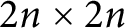 $2n\times 2n$ real positive definite matrix
 $A,$ there exist n positive numbers called the symplectic eigenvalues of
 $A,$ and a basis of
 $\mathbb {R}^{2n}$ called the symplectic eigenbasis of A corresponding to these numbers. In this paper, we discuss differentiability and analyticity of the symplectic eigenvalues and corresponding symplectic eigenbasis and compute their derivatives. We then derive an analogue of Lidskii’s theorem for symplectic eigenvalues as an application.


