To save content items to your account,
please confirm that you agree to abide by our usage policies.
If this is the first time you use this feature, you will be asked to authorise Cambridge Core to connect with your account.
Find out more about saving content to .
To save content items to your Kindle, first ensure no-reply@cambridge.org
is added to your Approved Personal Document E-mail List under your Personal Document Settings
on the Manage Your Content and Devices page of your Amazon account. Then enter the ‘name’ part
of your Kindle email address below.
Find out more about saving to your Kindle.
Note you can select to save to either the @free.kindle.com or @kindle.com variations.
‘@free.kindle.com’ emails are free but can only be saved to your device when it is connected to wi-fi.
‘@kindle.com’ emails can be delivered even when you are not connected to wi-fi, but note that service fees apply.
This article examines artificial intelligence (AI) in artistic practice not as an autonomous creative subject or a mere labour-saving device, but as a field of models, affordances and constraints through which artists may think, test and transform their materials. Against commercial narratives that identify intelligence with efficiency, productivity and the automation of economically valuable work, it argues for the continuing centrality of embodied craft intelligence: the tacit, historically situated, perceptual and ethical knowledge developed through practice. Drawing on Leo Apostel’s theory of models, James Gibson’s concept of affordances, Michael Polanyi’s tacit knowledge, Walter Benjamin’s aura, Theodor W. Adorno’s critique of fetishism and Isaac Asimov’s story Profession, the article proposes a critical, feedback-based understanding of human–AI interaction. It distinguishes serendipitous exploration from template-driven production and suggests that the artist’s responsibility lies in judging when machine outputs become meaningful deviations rather than seductive shortcuts. The future of AI in the arts depends less on the technology’s generative power than on whether artists can preserve slow perception, historical memory, critique and responsibility within increasingly automated cultural infrastructures. Its central claim is that AI becomes artistically valuable only when kept visible as a contestable tool rather than accepted as a substitute for artistic judgement.
Data-centric socialities are media-centric socialities. One way to make sense of the novelty of digital media is to ask what scientists can do with them that they could not do before. This chapter does so for digital imaging in astronomy. It explores two arithmetic operations – adding and subtracting digital exposures pixel by pixel – and their surprising practical and organizational consequences. Setting out from a lecture on image processing to undergraduate students, it traces astronomers’ understandings of digital data’s affordances. It argues that the introduction of charge-coupled devices in the 1980s provided solutions to a set of practical problems that astronomers had formulated with increasing clarity since the 1950s. Subsequently, new organizational possibilities for astronomical research emerged. These include mobilizing data beyond local contexts, rendering abstract time as an object of management, sharing data as nonrivalrous goods, assessing others’ work remotely, and building new forms of collaboration – elements of a novel medial middle ground in data-rich science.
The field of drug studies is increasingly challenged by the rapid digitalisation of drug markets, raising the importance of reconsidering how drug laws and policies respond to the role of technologies in the drug trade, and their social impact. This chapter considers the famous case of Maximilian Schmidt, who was accused of setting up Germany’s largest digital drug shop under the alias Shiny Flakes and became the subject of media stories and Netflix TV productions. The case offers an opportunity to explore how the move to digitally mediated drug supply has altered the ways in which phenomena such as the ‘dealer’ and ‘dealing’ are constituted in socio-technical and legal contexts.1 Research shows that digital drug markets pose serious challenges to jurisdictional and regulatory frameworks and governments require costly and laborious police operations to adapt to the rapid development of these markets (EU Drugs Strategy 2021–2025, 2021; UNODC, 2022). Following the transition of drug markets and traditional dealer activities to digitally mediated formats, it has become important to consider how drug dealers and dealing are constituted and handled in law, and whether the technological means of dealing are reshaping how questions of responsibility, ‘harm’ and entrepreneurship are being understood.
This introduction to the volume explains the origin of these essays, which began as papers given at a workshop to support the development of the Virtual Reality Oracle, which created a virtual reality experience of visiting the ancient Greek oracle of Dodona. An ancient Greek oracular site comprised an encounter with ‘unknowing’: the sanctuary was a space to which visitors brought questions concerned with many different areas of their lives. In that respect, we also drew a parallel with the experience of those who ‘visit’, as researchers, an oracle about which little is certain. The essay then reflects on this process of research, to consider how in examining the way our historical subjects engage with the affordances of their environments, we, in turn, as historians, ourselves engage with the affordances of our historical evidence, using Bakhtin’s theory of the chronotope.
Literary and archaeological evidence suggests that the Roman world was profoundly unequal. What did this mean in material terms for people at the bottom of the social hierarchy? Astrid Van Oyen here investigates the lived experiences of non-elite people in the Roman world through qualitative analysis of archaeological data. Supported by theoretical insights from the material turn, development economics, and feminist studies, her study of precarity cuts across the experiences of workers, the enslaved, women, and conquered populations. Van Oyen considers how precarity shaped these people's relation to production, consumption, time, place, and community. Drawing on empirically rich archaeological data from Roman Italy, Britain, Gaul, and the Iberian Peninsula, Van Oyen challenges long-held assumptions and generates new insights into the lives of the non-elite population. Her novel approaches will inspire future studies, enabling archaeologists, historians, and anthropologists to retrieve the unheard voices of the past.
Chapter 3 explores the “The Metaphors We Read With.” Here we find books rhetorically manufacturing a new kind of consciousness, as the affordances of text technologies provide a way to describe human experience. This chapter shows that, whether it is poets claiming love “is printed on my heart,” or physicians claiming a man’s sickness is his “comma” and not his “period,” or a botanist saying an animal is a plant “bound up in one volume,” the symbols of the book reshaped the intellectual and linguistic makeup of English culture. Books have affordances, which in turn provide figurative resources for writers.
The issue of whether technology is inherently motivating for learners and teachers has often been discussed in the literature around computers and language learning. Yet, there is more to this relationship than initially meets the eye. This chapter outlines the ways in which symbolic power plays a part in both personal and institutional motivations for the adoption of technology. The chapter also looks at the way motivation is often credited as a key to success, though rarely with much empirical evidence. Finally, the article takes on a practitioner’s viewpoint to share several motivational techniques that can assist with practice and research.
Most existing literature treats family culture as a static and deterministic factor with a double-edged effect on the competitive advantage (CA) of family firms while overlooking its dynamic nature. Moreover, limited literature addresses how to solve this double-edged problem. This study fills these gaps by examining how family culture can generate sustainable CA from the lens of the affordance perspective. A three-stage process model is developed based on a longitudinal case study of Baiyun, a Chinese family firm with over a 100-year family history. This model suggests that family firms should intentionally adopt appropriate sensemaking and sensegiving strategies tailored to different stakeholders and dynamic entrepreneurship situations to effectively leverage the natural and designed affordances of family culture. By cultivating efficiency, emotional, and value identifications among internal and external stakeholders, these sensegiving strategies facilitate family collaboration, continuous trust, strategic focus, and extensive ecological synergy, which serve as the key sources of CA. Ultimately, the model emphasizes that the key to managing the double-edged effect lies in the four sensemaking strategies taken by family firm leaders. This study sheds light on the dynamic interplay between family culture, environment, strategies, and CA, offering actionable insights for family firms.
The last three decades of work in cognitive science have challenged the idea that thinking occurs entirely in the head, claiming instead that cognition is embodied, embedded, extended, and enactive. The claims of 4E cognition challenge the dominance of computational approaches to cognition, and music scholars have explored Gibson's notion of affordances to propose a new understanding of musical performance as primarily grounded in action. This Element draws from paradigms such as enactive cognition, cybernetic and systems-theoretical approaches, phenomenological perspectives on practice, Gibson's theory of affordances, and aspects of the author's own practice as a multi-instrumentalist to consider cases of how the interface between musician and instrument influences performance.
This article seeks to contribute to the growing scholarship on object-focused Roman histories by expanding the conversation to previously overlooked archaeological finds from Roman Palestine. This case study focuses on “Northern Collar-Neck Lamps,” which have been found throughout Roman Galilee and date to the first two centuries CE. I argue that their distinctive high collar, perhaps designed to reduce spillage, also served as an affordance that invited additional modes of interaction, namely placing a supplemental reservoir for oil – such as a pierced eggshell – over the filling hole. Once set up, this would allow for a slow drip of oil to prolong illumination time without human intervention. This usage is suggested from chronologically and geographically proximate sources, namely early rabbinic literature: Hebrew and Aramaic writings from the first centuries that reference physical details and uses of hundreds of objects and could prove helpful for future material histories of the Roman era.
Through close analyses of a wide range of Minoan animalian things, we have explored the specificity of their involvements in the experiences of people, and how those engagements contributed to the unique character of sociocultural life in the Aegean, on various levels. Here we draw out key points from across the foregoing analyses. Special attention has come to the objects’ inter-corporeal relationships with living humans and the connections that would have been realized through the objects’ particular qualities—connections with other animals, things, and spaces. Such relations were afforded through different dynamics, including bodily juxtaposition, cultivation of formal assonance, the sharing of specific features (e.g., a forward gaze), and embodiment with the same substances, as well as through similarities in size, composition (e.g., in friezes), and contextualization. Moreover, by working beyond an implicit focus on the design of the objects, to instead emphasize people’s actual experiences with them, we have opened the space for appreciating how both intended and unintended associations involving these complex things were in play together. We should view these not as alternative lenses on the objects, but as forces working concurrently, and upon one another, in the creative realizations that the animalian objects were.
The sociocultural spaces of the “Minoan” Aegean were teeming with animal bodies. Many of these animals were alive, but many were not—and never had been; the latter are our focus here. Realized across a range of media, such as zoomorphic vessels, frescoes, and seal stones, animals’ bodies took on a rich diversity of material and spatial qualities that could afford distinctive interactive experiences that the notion of “representations” fails to capture. By recognizing both biological and fabricated entities as real embodiments of animals, which could coexist and interact in Aegean spaces, the nature of our discussion changes. We see that the dynamics of representation were caught up in a much wider field of relationships involving these crafted bodies, which characterized their engagements with people. Doing so moves us beyond questions of signification and intentional design, and toward a fuller recognition of people’s actual experiences of animalian bodies. Looking closely at a variety of venues, ranging from palatial courts to a modest house bench, our focus thus can turn to how the world of animalian things was a crucial part of social life in Aegean spaces, and how direct interactions with these other animal bodies were central, yet often overlooked and minimized, components of human relations with nonhuman beasts.
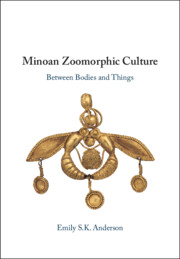
Since the earliest era of archaeological discovery on Crete, vivid renderings of animals have been celebrated as defining elements of Minoan culture. Animals were crafted in a rich range of substances and media in the broad Minoan world, from tiny seal-stones to life-size frescoes. In this study, Emily Anderson fundamentally rethinks the status of these zoomorphic objects. Setting aside their traditional classification as 'representations' or signs, she recognizes them as distinctively real embodiments of animals in the world. These fabricated animals-engaged with in quiet tombs, bustling harbors, and monumental palatial halls-contributed in unique ways to Bronze Age Aegean sociocultural life and affected the status of animals within people's lived experience. Some gave new substance and contour to familiar biological species, while many exotic and fantastical beasts gained physical reality only in these fabricated embodiments. As real presences, the creatures that the Minoans crafted artfully toyed with expectation and realized new dimensions within and between animalian identities.
Ecological psychology is one of the main alternative theories of perception and action available in the contemporary literature. This Element explores and analyzes its most relevant ideas, concepts, methods, and experimental results. It discusses the historical roots of the ecological approach. The Element then analyzes the works of the two main founders of ecological psychology: James and Eleanor Gibson. It also explores the development of ecological psychology since the 1980s until nowadays. Finally, the Element identifies and evaluates the future of the ecological approach to perception and action.
This chapter shows that language works as a physical tool by impacting how we perceive our body (interoception) and how we perceive and interact with the external world (perception and action). First, I contend that language might help us detect bodily inner signals and states . Then, I show that language recruits object affordances, the opportunities to act objects offer us, but that it does so in its own distinctive way. Language exploits previously originated structures and mechanisms, those of the motor system, but uses them flexibly. Consistent with this, I show that language shapes perception and object manipulation, extends the space we perceive as near, and modulates our perception of objects in space. Finally, using an example of the concept of color, I suggest that not only the faculty of language but also the different languages we use, through spoken words or signs, shape our world differently.
Building on the notions of markedness (which accounts for the special value attached to particular choices in language display) and affordances (which indicate what languages can be used for what purposes in specific contexts) in the Linguistic Landscape (LL), this chapter develops a social indexicality model to account for the role of language choices in pointing to communities of language users. These communities range from the local (such as graffiti crews or friendship groups) through various configurations of territory and community to the truly global. Language choices may make existential claims for marginalised social groups, and they allow for the status enhancement of local communities by enregisterment. Two case studies focus on territory and community. One presents a ‘village model’ in comparing the predominantly Protestant town of Kilkeel with the predominantly Catholic town of Warrenpoint in Northern Ireland, while the other examines ‘urban diversity’ with regard to displays of Greekness in Astoria (New York) and Greektown in Chicago. The chapter further examines the role of transient visitors and remote multinational organisations in shaping the LL.
The ‘ethical turn’ in anthropology has charted alternatives to some prevailing philosophical, psychological, and anthropological approaches. This engagement forces anthropologists to reconsider old antinomies such as constraint and agency, relativism and universalism, individualism and collectivism. Like other anthropologists of ethics, we resist forms of determinism that would reduce ethical life to the putatively universal constraints of biology and psychology, the logic of rationality, or the workings of power and ideology. Instead, we consider the processes through which what seem to be constraints or universals serve as affordances that are ethicalized through historically contingent reflexive practices. Rather than being forced to choose between the individual and the collective in terms of who (or what) the ethical subject is, we demonstrate how social interaction is a critical site in which and through which such ethicalization occurs.
Drawing on recent developments from translanguaging theory, we argue in this chapter that translating and interpreting are by default translanguaging practices of meaning-making, during which process multilayered “translanguaging spaces” are being constantly and accumulatively created by dynamic interactional “moments” (Li, 2011) between the translator/interpreter and the external environment within the broader social–cultural contexts. These emerging insights from the key tenets of the translanguaging lens give rise to the construction of a unified theory of translating and interpreting aptitude consisting of a Macro level, Meso level, and Micro level (i.e., the 3M model), each level subsuming multiple interplaying elements interacting dynamically to generate multilayered translanguaging spaces of meaning-making.
The article examines the relationship of women and the objects surrounding them in the light of the term ‘affordance’. Coined by psychologist James J. Gibson, the term refers to the potentialities held by an object for a particular set of actions, stemming from its material properties. Through focusing on two case studies in which women use mundane objects (mainly pins and pestles) in violent situations – (a) stories (told by Herodotus and Euripides) about women attacking with pins, and (b) a group of vases representing women attacking with pestles – the article seeks to uncover a fundamental aspect of the engagement of women with the objects surrounding them, as envisioned by the men creating the literature and art. Deprived of almost any access to real weapons, these women are depicted as turning to objects in their immediate environment. Perceiving the affordances of these objects, stemming from their shape and material and the inherent potentialities for action, the women make use of them in acts of self-defence, anger, or revenge.
Drawing on existing research with a holistic stance toward multimodal meaning-making, this paper takes an analytic approach to integrating eye-tracking data to study the perception and use of multimodality by teachers and learners. To illustrate this approach, we analyse two webconference tutoring sessions from a telecollaborative project involving pre-service teachers and learners of Mandarin Chinese. The tutoring sessions were recorded and transcribed multimodally, and our analysis of two types of conversational side sequences shows that the integration of eye-tracking data into an ecological approach provides richer results. Specifically, our proposed approach provided a window on the participants’ cognitive management of graphic and visual affordances during interaction and uncovered episodes of joint attention.