To save content items to your account,
please confirm that you agree to abide by our usage policies.
If this is the first time you use this feature, you will be asked to authorise Cambridge Core to connect with your account.
Find out more about saving content to .
To save content items to your Kindle, first ensure no-reply@cambridge.org
is added to your Approved Personal Document E-mail List under your Personal Document Settings
on the Manage Your Content and Devices page of your Amazon account. Then enter the ‘name’ part
of your Kindle email address below.
Find out more about saving to your Kindle.
Note you can select to save to either the @free.kindle.com or @kindle.com variations.
‘@free.kindle.com’ emails are free but can only be saved to your device when it is connected to wi-fi.
‘@kindle.com’ emails can be delivered even when you are not connected to wi-fi, but note that service fees apply.
Demand for clientelism in low-income countries distorts political incentives and constrains growth. Informal workers are seen as a strong clientelist constituency because they rely on forbearance and targeted benefits, yet they also constitute an electoral bloc that could coordinate in support of beneficial programmatic policies. We examine whether—and how—such demand for clientelism can be attenuated. We implement an information experiment with firm owners ahead of Senegal’s 2022 local elections, during which an upstart political faction campaigned on programmatic reform. Reminding informal workers of their coordination capacity reduced engagement with dominant clientelistic networks. This shift did not translate into support for programmatic alternatives but into political disengagement. Demand for clientelism can be mitigated, but programmatic mobilization remains a challenge.
Interethnic marriage is commonly employed as an indicator of social cohesion. However, intermarriages are a reflection of both preferences and opportunities. If we are to interpret intermarriage rates as indicators of people’s willingness to cross group boundaries, we must find a way of controlling for exposure to out-group members in local marriage markets. In this Note, I exploit census data from Zambia to demonstrate how this can be done. The findings, which reveal significant differences across estimates that do and do not control for local exposure to out-group members, underscore a significant weakness in common approaches. The findings also point to important substantive implications for understanding changes in social cohesion in Zambia—and likely other African societies—over time.
As the first foreign policy issue Nigeria debated, the controversy around France’s nuclear tests, conducted in Algeria during the War of Independence there, allowed Lagos to rehearse its envisioned African role even before formal independence in October 1960. Nigerian opposition to France eventually culminated in the expulsion of the French ambassador on 5 January 1961, after the third French atomic test in the Algerian Sahara. This seemingly straightforward anti-colonial and anti-nuclear act was in fact largely driven by inter-African dynamics, particularly Nigeria’s complicated relationship with Ghana. By reconstructing this episode, the article demonstrates how international affairs uniquely crystallized interactions between domestic and regional politics in decolonizing states. This in turn encourages us to look beyond the paradigms of the Cold War and decolonization when writing the Global South into world history.
The debate on the ‘perils of presidentialism’ has been raging for over 30 years and gone through at least three waves. It began with the influential work of Juan Linz and most recently has seen the emergence of a rich literature on coalitional presidentialism, which has demonstrated the capacity of presidents to manage fragmented multi-party legislatures, and hence overcome the dangers of political deadlock. Jean Blondel’s last book (African Presidential Republics, Oxford, Routledge, 2019) belongs to this latest wave in the sense that he argues that presidential systems can overcome their limitations, and that certain aspects of the presidential models actually give them an advantage over parliamentary equivalents. This article reviews Blondel’s argument against the latest developments in African politics. I suggest that there are fewer instances of positive presidentialism today than Blondel hoped for, in part because democratic progress has often proved to be particularly vulnerable to later autocratization due to a tendency not to entrench gains via constitutional reforms. Despite this cautionary note, however, I conclude that Blondel is right to reject the idea that African cases provide support for the ‘perils of presidentialism’. This is not only because Blondel highlights a number of presidents who played a benign or positive role in their country’s political development, but also because the coalitional presidentialism literature suggests that there is little evidence that parliamentary systems would perform significantly better.
Although it has gained wide currency in the analysis of African politics, civil society remains a “mysterious” concept in need of proper grounding and understanding as an integral part of African social formation. This paper argues that one of the widely acclaimed canonical works in African studies, Peter Ekeh’s theory of colonialism and the two publics in Africa provides one of the most original perspectives for locating and understanding the character of modern civil society as a product of colonialism. In particular, the theory provides an explanation for why primordial attachments have remained fundamental to the structuration of civil society and why state–civil society relations have largely been fractured, instrumentalist, and dialectical in the post-colonial period.
In a political wave that has been emulated across many African states, state-sponsored homophobia is being entrenched via draconian laws. Social movements grapple with countering these state-driven initiatives and altering ingrained anti-LGBTQ societal attitudes. Drawing on a survey experiment developed with guidance from Zimbabwean activists, this study tests the effectiveness of locally rooted messages that affirm queer indigeneity and contest claims that homosexuality is ‘un-African’. We find that ‘rooted’ messages incite no backlash, while an indigenous message reduces prejudice towards LGBTQ neighbors and a liberation message may increase support for LGBTQ-equal rights. These findings are important as they provide empirical support for effective strategies to combat anti-LGBTQ sentiments in challenging contexts. They also speak to broader political science debates on norm contestation and the limits of universal human-rights framing in nationalist and post-colonial contexts, demonstrating that activist-informed rooted messages offer a powerful alternative in shaping opinion on contested rights.
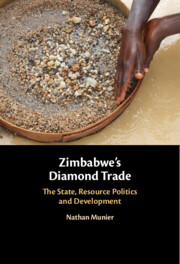
What happens when states experience a rapid increase in resource wealth? This book examines the significant diamond find in eastern Zimbabwe in 2006, possibly the largest in over 100 years, and its influence on the institutional trajectory of the country. Nathan Munier examines how this rapid increase in resource production shaped the policies available to political actors, providing a fresh understanding of the perpetuation of ZANU-PF rule and the variation in the trajectory of institutions in Zimbabwe compared to other Southern African states. This study places Zimbabwe amongst the overall population of resource-wealthy countries such as such as Angola, Botswana, Namibia and South Africa, especially those that experience a significant increase in production. In doing so, Munier contributes to the understanding of resource politics, political economy, and comparative African politics.
In The Autocratic Voter, Natalie Wenzell Letsa explores the motivations behind why citizens in electoral autocracies choose to participate in politics and support political parties. With electoral autocracies becoming the most common type of regime in the modern world, Letsa challenges the dominant materialist framework for understanding political behavior and presents an alternative view of partisanship as a social identity. Her book argues that despite the irrationality and obstacles to participating in autocratic politics, people are socialized into becoming partisans by their partisan friends and family. This socialization process has a cascading effect that can either facilitate support for regime change and democracy or sustain the status quo. By delving into the social identity of partisanship, The Autocratic Voter offers a new perspective on political behavior in electoral autocracies that has the potential to shape the future of these regimes.
Chapter 10 concludes by summarizing the argument of the book, outlining the contributions and implications of the argument, discussing its limitations, and, finally, reflecting on the ability of the argument to extend beyond the narrow scope condition of electoral autocracies.
Chapter 2 lays out the theory of the book, providing a broad overview of political science’s extant understanding of partisanship across diverse fields of study. It lays out the theory in three parts. First, it creates a framework for understanding how opposition partisanship and ruling party partisanship are unique social identities in electoral autocracies. Citizens who identify as partisans hold specific political beliefs that are common across all electoral autocracies (but not democracies). Second, it argues that these identities are produced at a grassroots level through a process of political socialization that occurs between friends and within families. Finally, the third part of theory argues that partisan social networks are fundamentally rooted within the unique political geography of electoral autocracies and elucidates a framework for understanding this geography, as well as its broader effects on beliefs about democracy and political legitimacy in such regimes.
Why do some citizens of electoral autocracies choose to support the ruling party while others support the opposition? Chapter 1 explains the puzzle of partisanship under dictatorship, presents existing theories to understand public opinion in such regimes, and briefly summarizes the argument of the book and the data and methods used to test it. It concludes by discussing what we gain by understanding partisanship as a social identity as opposed to a materialist response to regime strategies.
This chapter situates this book’s conceptual and theoretical approach with respect to earlier work on ethnicity and region in African countries and beyond. Earlier work has looked away from regional economic inequality as a political force in Africa, defaulting to theories centered on ethnicity, understood as a force orthogonal to programmatic policy interests and devoid of economic ideology. This work inverts these arguments, showing that regional economic inequalities and differentiation give rise to political cleavage and divergent policy interests. In Africa, the sources of subnational (regional) economic difference and inequality lie in unevenness of natural endowment, regionally specific patterns of state intervention in the economy that date to the colonial period, spatial–sectoral differentiation, and administrative structure. This chapter follows Lipset and Rokkan (1967) in theorizing the sources and nature of regional cleavages that arise in the course of state-building and national economic integration. It identifies institutions that contribute to the “regionalization” of national economies and politics in African countries. Section 2.5 of this chapter lays out the main elements of an approach to the analysis of regionalism that is fit for African contexts.
This theory of regional cleavages in African politics embeds the behavioral assumptions of microlevel, ethnicity-focused models in a broader spatial, institutional, and temporal frame. A theoretically grounded framework built on economic geography, economic inequalities, and institutions produces general findings about national-level political dynamics in African countries that are close to what classical and mainstream treatments in the comparative politics and comparative political economy literatures would lead us to expect. Leveraging this perspective, this chapter reconsiders questions of economic cleavage, urban–rural politics, institutions, class politics, policy interests, opposition and regional parties, and ethnic identities in African politics. The challenges of territorial politics in regionally divided countries that confront most African countries today are increasingly prominent in non-African, postindustrial countries. This makes research on the politics of spatial inequality in African countries relevant to general understandings of how economic and spatial inequalities may heighten the challenges of national politics. For policy and politics, the analysis lends weight to calls for place-based economic development strategies that are designed to support national cohesion.
Regional interests and tensions are manifest in regional bloc voting in multiparty elections (1990s–2010s). We present an electoral geography analysis of constituency-level voting in presidential elections in twelve countries from 1990 to 2015 (44 elections). We describe the economic attributes of the electoral blocs using forty rounds of DHS surveys for geocoded education and ethnicity data, nighttime luminosity, historical maps of producer regions, and raster data for population densities and contemporary crop production profiles. Most electoral blocs arise in rural regions that are wealthier, better educated, more densely populated, and more deeply incorporated into the national economy than other rural areas. Most are specialized in high-value export crops (or traded food crops.) Some have nonagricultural production profiles as labor-exporting or mining regions. Most coalesce within provincial-level administrative units. Almost all are multiethnic. The evidence is consistent with the argument that state institutions work to channel politics arising from uneven economic development into the national political arena. Microlevel mechanisms contributing to this outcome are related to interests, organizations, ideology, and actions of political agents and coalition-builders.
This chapter considers the structure of territorial cleavage from a national perspective. It focuses on patterns of polarization between regional electoral blocs, or “territorial oppositions,” in national politics. Axes of territorial cleavage arising between predominantly rural regions tend to take canonical forms associated with core–periphery politics in countries that are undergoing national economic integration and the growth of the central state. Stable axes of sectional competition, whereby leading regions square off against each other or against those on the periphery, are visible in the electoral data and in persistent policy cleavages in countries in this study. In broad outlines, these conform to models of territorial opposition in national politics advanced by earlier scholars (Lipset & Rokkan 1967; Gourevitch 1979; Bayart 2013). The analysis is built around four countries – Kenya, Zambia, Malawi, and Uganda – that serve as archetypes of different patterns of territorial opposition and core–periphery politics. Tanzania is a shadow case.
This chapter identifies the colonial origins of the institutional structures and patterns of uneven economic development that create the template for political regionalism in African countries. Functional economic regions and administrative regions tended to align in African colonies, defining patterns of regional difference and inequality that are often strongly visible today. This process established frameworks within which politically salient ethnic identities developed, and defined political constituencies in territorial terms. With the 1940s emergence of colony-wide politics, existing administrative and political structures channeled regional interests and ideologies of regional consciousness into the national arena. A boundary persistence analysis underscores the large extent to which colonial territorial grids have been reproduced over time. I explain this persistence in terms of how African political leaders, social elites, farmers, and members of rural communities found advantage in territorial institutions forged under colonialism. These regional cleavages and the territorial institutions that help to reproduce them have structured patterns of national-level political competition in many African countries for many decades.
Regional competition in African countries finds expression in tensions, debates, and competition over policy. Regional economic tensions in African countries tend to find expression in four persistently salient issue areas: (a) demand for redistributive policies and social policy, (b) region- and sector-specific development and regulatory policies, (c) land policy, where redistributive tensions and conflicts arise in the building of national land markets, and (d) issues around state structure and design (the territorial division of powers and prerogatives, as under federalism or decentralization). In most countries, regional cleavages trump class-like or interpersonal income inequalities as a driver of national contestation over issues of policy and collective choice. A 2x2 matrix predicts “regional preferences for decentralization and redistribution” based on a region’s relative economic standing and its political alignment with the center. South Africa, where regional inequality is lower and nationalizing institutions are stronger, is an outlier: Redistributive social policy is more developed than it is anywhere else in Africa, and the issue of national land market integration is less salient than it is in many African countries.
This chapter explores relationships between regional economic advantage and regional political advantage, making two arguments. The first is that relative political advantage among the regional electoral blocs tends to map onto the economic hierarchy of regions. This conforms to the theoretical expectation that politically dominant blocs tend to be economic leaders as well (see Gourevitch 1979). A corollary is that when relatively advantaged regions are out of power, they are likely to constitute a rival electoral bloc or an opposition-leaning zone. The second argument analyzes the formation of national winning electoral coalitions. Evidence from the 12-country study suggests that national electoral coalitions are built mainly via the ability of incumbent blocs to mobilize electoral support in constituencies in the weakly organized non-bloc areas. The most common alliance structure is alliances of the extremes (richest and poorest regions) against the middle. Similar patterns of alliance have been noted for countries cleaved by high spatial inequalities in other parts of the world. These coalition patterns tend to reproduce regionalism in national politics.
Does regional inequality give rise to political cleavages in African countries? If so, why and how? At what scale of politics? How do regional difference and inequality shape national politics and policy? The theory of regional politics advanced here is drawn from comparative politics theories of regional tensions that arise in the course of state-building and national economic integration. These are accentuated when socioeconomic inequality and territorial institutions align. This book argues that regional economic differentiation and spatial inequalities, in interaction with strongly territorial state institutions, shape politics and policy in African countries as they do in countries in other parts of the world. National economic integration and state-building activate subnational interests and fuel political tensions over the integration of subnational regions into the national polity and the national market. Regional economic and political heterogeneity and cross-regional inequalities shape both preferences and the relative bargaining power of subnational collectivities. These forces combine to produce persistent regional cleavage structures in national politics. Empirical support is drawn from electoral data from 44 elections across 12 countries, historical maps, and nighttime luminosity, household survey, and crop production data.
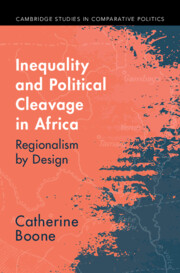
This pathbreaking work integrates African countries into broader comparative theories of how spatial inequality shapes political competition over the construction of markets, states, and nations. Existing literature on African countries has found economic cleavages, institutions, and policy choices to be of low salience in national politics. This book inverts these arguments. Boone trains our analytic focus on the spatial inequalities and territorial institutions that structure national politics in Africa, showing that regional cleavages find expression in both electoral competition and policy struggles over redistribution, sectoral investment, market integration, and state design. Leveraging comparative politics theory, Boone argues that African countries' regional and core-periphery tensions are similar to those that have shaped national economic integration in other parts of the world. Bringing together electoral and economic geography, the book offers a new and powerful map of political competition on the African continent.