To save content items to your account,
please confirm that you agree to abide by our usage policies.
If this is the first time you use this feature, you will be asked to authorise Cambridge Core to connect with your account.
Find out more about saving content to .
To save content items to your Kindle, first ensure no-reply@cambridge.org
is added to your Approved Personal Document E-mail List under your Personal Document Settings
on the Manage Your Content and Devices page of your Amazon account. Then enter the ‘name’ part
of your Kindle email address below.
Find out more about saving to your Kindle.
Note you can select to save to either the @free.kindle.com or @kindle.com variations.
‘@free.kindle.com’ emails are free but can only be saved to your device when it is connected to wi-fi.
‘@kindle.com’ emails can be delivered even when you are not connected to wi-fi, but note that service fees apply.
The contestation of international organizations (IOs) over past decades has inspired a rich research program. This essay takes stock of progress by reviewing key findings in existing scholarship and identifying critical areas for future study. We propose a typology that distinguishes between internal contestation, which criticizes the institutions or policies of an IO with the aim of reform, and external contestation, which challenges an IO’s foundational principles and very existence. Building on this conceptual distinction, we review the most important findings of existing research on three key themes: patterns of contestation, drivers of contestation, and responses to contestation. We also argue that this conceptualization helps us better understand the changing nature of contestation: while criticism of how IOs function has long been a staple of world politics, it recently appears to have shifted toward a deeper form involving more fundamental questioning of IOs themselves. We conclude by highlighting the need for dynamic theories and improved measurements to explain when and how IO contestation shifts from internal criticism to external rejection, and by outlining a forward-looking research agenda on organizational robustness, hegemonic contestation, and the relationship between IO contestation and the broader contestation of global governance.
International organizations (IOs) monitor compliance with international norms but public criticism of member states remains discretionary. We argue that such criticism depends not only on mandates or political incentives, but on whether IOs can access information they deem credible. This credibility is socially produced. Through repeated interaction, IO staff develop trust in specific local non-governmental organizations (NGOs), which become reliable conduits of mandate-aligned and verifiable information. These trust-based ties reduce uncertainty and reputational risk, enabling public criticism. We test this argument using original data on press releases and NGO participation in public hearings at the Inter-American Commission on Human Rights from 1996 to 2020. Combining statistical analysis, an instrumental variable strategy, text analysis, and interview evidence, we show that the Commission is more likely to issue and to sharpen critical press releases when it has established ties with local NGOs focused on the relevant country and issue.
Poststructuralist theory and postcolonial criticism represented the first major challenge to the institution of literary criticism as it had taken root in Britain and had been transported to Africa through the colonial university. This chapter discusses how the theories of literature, writing, and identity were geared toward a critique of the assumed relationship between language and identity and unsettled older forms of criticism and how this unsettling depended on the adoption of Africa as the quintessential zone of difference. A key question here is whether the notions of difference espoused by the new, poststructuralist criticism could rescue Africa from the old colonial accounts of the continent in which positioned Africa and Africanness as unmodern. Overall, the poststructuralist deconstruction of European systems of thought compelled intellectuals to rethink the location of Africa in global conceptual systems, leading to the rise of postcolonial criticism, a mode of thinking and reading whose goal was to question both the authority of English and American literary criticism and the nationalist foundations of earlier accounts of African literary criticism.
This chapter is a close examination of the politics of English in African literature, one that considers the language as an essential, but problematic part of the genealogy of imaginative writing in Africa. The chapter starts with a critical examination of the globalization of English and its expansive power in the postcolonial world. Why is it that of all the major languages of the world English has come to be celebrated as a tool of globalization, the conduit to modernity, modernization, and global citizenship? The chapter complicates the narrative of English as a hegemonic and compulsory system in modern culture by focusing on how, in the hands of formally colonized writers, it has been provincialized, relocated from its metropolitan centers, and turned into a force of imaginative works at odds with the dominant narrative of globalization. Using African examples, the chapter reflects on how a provincialized English has generated new modes of writing that challenge the traditional conception of English literary studies.
Ngugi’s career as artist and critic has reflected the development of Kenyan history and also the emergence of postcolonial criticism. This chapter delineates four main stages in the development of the critical understanding of Ngugi’s works over the past sixty years, though these stages are neither wholly distinct, sequential or definitive. The first stage is that of Commonwealth literature, and was often of the life and works variety. The second stage is that of postcolonial studies with its expansive focus on cultural politics. Stage three emerged primarily from African and especially Kenyan critics often focused on questions of translation. It drew on insider cultural knowledge and sometimes recollections of intergenerational trauma. Stage four witnessed the globalisation of Ngugi studies, with critics often from the Global South bringing international perspectives. These developments in Ngugi critical studies over sixty years do not sidestep the fact that Ngugi himself as scholar and educator has been a formidable and insightful interpreter as well as possibly the very best critic of his own work.
This chapter takes up the idea of African literature, history, and criticism as part of a larger project of cultural transformation and examines the role of literary criticism and a literary education in the shaping of postcolonial identities. Starting with a personal reflection on the role of English colonial Englishness in the making of an African literature, and originally published as an “Editor’s Column” when the author assumed the editorship of the PMLA, the chapter functions as an overture to the whole book. It opens up the multiple worlds and texts that came to define African literature against the background of decolonization and calls attention to the intimate relationship between reading, writing, and thinking in the making of colonial and postcolonial subjects.
The introduction focuses on how modern African writing has challenged the central categories that have shaped intellectual debates on the nature of literature and criticism in the twentieth century with particular attention to the problem of modernity and the narrative of decolonization. The chapter identifies the key moments and contours of African literature from the early twentieth century to the great period of decolonization in the second half of the century and identifies the critical traditions that have determined the nature of this literature and its relation to global cultural movements. Rejecting the idea of an African literary tradition that is either a prisoner of Euro-American critical traditions or one isolated from global treads, the introduction summarizes the key arguments in the book to show how, at a distinct moment in the twentieth century, African imaginaries were codified into a set of practices that changed theories and histories of modern literature.
The critical study of African literature has had a troubled relationship with different schools of European poststructuralism in general and postcolonial theory in particular. This chapter starts with a critique of the theoretical retreat from modernity that has been a signature gesture of poststructuralism and postcolonial theory since the 1990s. Poststructuralist theory attracted many critics of postcolonial literature at the end of the twentieth century because of its rejection of the universal theories of reason, history, and the human subject associated with modernity. What was the implication of this poststructuralist turn in the criticism of an Africa literary tradition that was bound up with the experience and expectation of modernity? The chapter discusses the tension between the experience and discourse of modernity, postcolonial criticism, and a set of African texts that complicated both modernist and postmodernist discourses. A central concern in this chapter is what happens when we read canonical African literary texts themselves as forms of theoretical intervention.
In African Literature in the World, Simon Gikandi asks: Why do debates on language continue to inform and haunt African writing? What happened when writing replaced orality as the primary form of creative expression? When, how, and why did the novel come to occupy such a dominant role in African literary history? This is a comprehensive study of the histories and theories of African literature in the twentieth century and shows how African writers adopted and transformed the English language and its traditions to account for African identities and experiences. Concerned with writing and reading as forms of mediation, Gikandi provides examples of how imaginative works shaped the public sphere in Africa in relation to decolonization and the politics of language. He explores how the emergence of a modern tradition of African writing has generated new forms of criticism in relation to the form of the novel, modernity, and modernism.
We present results from a qualitative analysis illustrating how people handle criticism in a workplace environment, including both the production of and responses to criticism. Our data comes from responses provided by 80 participants in a written Discourse Completion Task (DCT) in French. In the scenarios, relative power (equal vs. hierarchical) and social distance (close vs. distant) were manipulated. Our analysis focuses on three recurrent patterns. First, we illustrate how criticism and replies to criticism are the product of several speech acts, in line with the concept of speech act set. Second, we argue that criticism and replies to criticism are both impacted by external and internal downgrading and upgrading strategies. Third, we give examples of how pronouns can be used to increase or decrease the level of politeness. Our findings provide new insights into the preferred linguistics strategies for criticizing and responding to criticism in French.
Neruda’s temperament was not theoretical, yet several “canonical” poems of his are infused with Marxist thinking. Although there is no evidence that Neruda read Marxist theory, in his thirties he assimilated its totalizing thought from party activism, from his second wife Delia, and from his friend, Spanish poet Rafael Alberti, each a lifelong communist. As an instance, Neruda’s poem “La United Fruit Co.” brings together four types of corporations, economic control of the state, the transportation of product, and subordination of labor. “The Strike” depicts the role of class conflict in the production process. “Cristóbal Miranda (shoveler-Tocopilla)” is one of fifteen portraits of industrial workers focusing on ordinary folk-history-from-below. “Los dictadores,” with its monster engendered by the wealthy autocrat in his palace, demonstrates the functioning of the dialectic in history. Neruda’s Marxism, though more intuitive than discursive, shapes these and other related poems of his.
Modern scholarship has in general portrayed Mendelssohn as a composer held in high regard during his lifetime but posthumously downgraded. This chapter presents a more complex picture, arguing that his reception during his life moves through three distinct phases. It examines the themes present in the earliest reviews of his works (1824–9) revealing how German reviewers emphasised the young composer’s dependence on models. In contrast, English reviewers from the start acclaimed him as one of the leading composers of the age. It then explores the upturn in Mendelssohn’s critical fortunes in the 1830s and responses to key works such as the Piano Concerto in G minor and St Paul. It concludes by exploring negative assessments by Hegelian critics such as Franz Brendel in the 1840s, comparing Mendelssohn’s mixed reception in Germany with the continuing effusive praise he received from English critics such as George Macfarren.
The Mendelssohns were active at a time of contestation and change within music aesthetics and broader aesthetic theory. As well as outlining how they positioned themselves in relation to some of the key issues and debates of their time, the chapter examines their continuing investment in Enlightenment and classical aesthetic ideals and how this interacted with their engagement with Romanticism. It also explores the extent to which moral and aesthetic criteria are entwined in their judgements of contemporary music, fuelling their hostility towards French grand opera, the programmatic orchestral works of Berlioz, and French virtuoso pianism. Their own compositions frequently function as music-aesthetic interventions, aiming to counterbalance trends in musical life that they viewed negatively. Crucial is a discussion of the conceptions of truth and emotion at the heart of Felix’s aesthetics, explored through a comparison of his views with those of Georg Wilhelm Friedrich Hegel and Friedrich Schleiermacher.
Music criticism mushroomed in Germany and elsewhere in Europe during Felix Mendelssohn’s lifetime, playing a key role in the transformation of musical ideals and values. While Mendelssohn – unlike his contemporaries Schumann and Wagner – refrained from publishing his views on music, he was well acquainted with the major German, French and English critics of the day and acknowledged the importance of criticism in helping to drive musical reforms. The chapter examines the reasons behind Mendelssohn’s reluctance to write criticism, his attitudes towards different forms of music criticism and his troubled encounters with individual critics, including François-Joseph Fétis and Heinrich Heine. It also explores his relationships with critics who supported him over his career and in some cases helped shape his music, such as Ludwig Rellstab, Adolf Bernhard Marx, Henry Fothergill Chorley, James William Davison, Johann Christian Lobe and Alfred Julius Becher.
Hemingway’s work was well received from the moment he began to publish. Some of the key ways in which his work has been read were established from the beginning, as critics identified the core elements of Hemingway’s emergent style and as they responded to his resonant themes. Later generations of academic critics, however, brought to bear on Hemingway’s stories and novels the shifting frameworks that would emerge, become dominant, and linger residually in the institutions of literary studies. Chief among the frameworks that would enrich the reading of Hemingway’s work in subsequent decades were the attention to matters of gender and sexuality made legible by feminism and queer theory in the 1980s and 1990s and the attention to race as inextricable from the construction and focalization of Hemingway’s narratives in the 1990s and 2000s. Most recently, the rise of postcolonial studies, ecocriticism, and critical disability studies has enabled fresh readings of the work, readings that keep it alive in current cultural debates. Throughout these changes, attention to Hemingway’s achievements in narrative form continues to be important, and it is as a crafter of sentences, and of narratives from carefully constructed sentences, that Hemingway continues to influence fiction writers.
At the time of his death in 1964, Sean O’Casey left a substantial body of disparate writings. His poetry, journalism, short stories, diaries, and his history of the Irish Citizen Army have received scant scholarly attention, but give us important clues about his literary development and his debt to other writers. This chapter examines some of these diverse writings to show how O’Casey experimented with a number of different forms. It also shows how O’Casey remained committed to writing in different genres throughout his life, and the chapter reveals some of the literary touchstones that would inform his non-theatrical writings.
This chapter introduces the volume, explaining how O’Casey’s work has been widely read at school and university level, and frequently performed on the stage. The introduction points out that few major studies of O’Casey have been published in recent years, and argues that, by contrast with writers such as Joyce and Yeats, O’Casey is in need of updated critical reframing.
A committed student of vernacular literatures alongside classical ones, Shelley matured a deeply integrated vision of European literature as a transnational conversation including the English-language tradition. This conception informs his literary and theoretical writings, his reflections about and practice of translation, and his appropriations and recreations of foreign forms and modes, such as Dante’s terza rima or Petrarch’s Trionfi. His interests focused especially on the Renaissance (in France, Italy, and Spain) and the eighteenth century and Revolutionary period (especially in France) and on figures such as Michel de Montaigne, Pedro Calderón de la Barca, Johann Wolfgang von Goethe, or Madame de Staël and the members of her salon at Coppet. Shelley’s engagements with modern European literatures confirm him as a poet and thinker poised between classical and post-classical cultures, harnessing them to support his revolutionary approaches to versification and poiesis, political and philosophical reflection, and cultural-social activism, against the backdrop of an incessantly evolving modernity.
‘The task of criticism', Johnson writes, ‘is to establish principles.’ One principle which forms the background to much of Johnson’s literary criticism is that of human fallibility. Writers and their works usually contain a mixture of great virtues and serious defects, and Johnson often takes a balancing-scales approach. He is also keenly aware of historical context, arguing that authors must be understood through the books the authors themselves read, and taking an interest in the details of book production. As for critical judgement, Johnson approves of works which reveal the universality of human nature – hence his love of Homer, and, conversely, his strictures on the Metaphysical poets. As well as being accountable to truth and nature, the writer is also accountable to the reader, and by extension the ‘public’ and ‘mankind’. Above all, literature must pay its due to religion – though this is precisely the area where literature is likely to fall short.
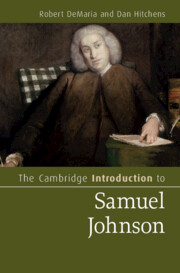
Samuel Johnson is a towering figure of eighteenth-century literature. As well as the celebrated Dictionary of the English Language, Johnson was the leading literary critic of his time, and a celebrated author who contributed to almost every genre from poetry to political pamphleteering. At the same time, an enduring legend developed around him, culminating in James Boswell's classic biography. This book offers a concise introduction to Johnson's many-sided work, and its complex and rich historical contexts. Presenting Johnson in his different guises – Journalist, Poet and Storyteller, Scholar, Critic, Political and Social Thinker, Biographer and Legend – it carefully guides the reader through Johnson's writings, and provides detailed expert treatments of his major texts.