To save content items to your account,
please confirm that you agree to abide by our usage policies.
If this is the first time you use this feature, you will be asked to authorise Cambridge Core to connect with your account.
Find out more about saving content to .
To save content items to your Kindle, first ensure no-reply@cambridge.org
is added to your Approved Personal Document E-mail List under your Personal Document Settings
on the Manage Your Content and Devices page of your Amazon account. Then enter the ‘name’ part
of your Kindle email address below.
Find out more about saving to your Kindle.
Note you can select to save to either the @free.kindle.com or @kindle.com variations.
‘@free.kindle.com’ emails are free but can only be saved to your device when it is connected to wi-fi.
‘@kindle.com’ emails can be delivered even when you are not connected to wi-fi, but note that service fees apply.
This study examines how citizens adapt to autocratization in Hong Kong following its post-2019 authoritarian transition. Existing research has examined distinct forms of citizen responses to political repression, such as emigration and self-censorship, often within separate scholarly literatures. Drawing on the exit-voice framework, we develop an integrated framework that links these adaptive responses to two psychological orientations: perceived powerlessness and secondary control. Powerlessness fosters system justification and curbs proactive engagement, whereas secondary control enables individuals to accommodate and adjust to prevailing circumstances. Drawing on two survey datasets, we find that powerlessness is associated with lower emigration intentions but higher self-censorship, while secondary control is associated with lower emigration intentions and, in most models, greater self-censorship. Additional analyses show that secondary control weakens the association between powerlessness and both outcomes, suggesting partially substitutable routes to adaptation. By integrating insights from the exit-voice framework and political psychology, the study contributes to broader scholarship on citizen adaptation under autocratization and political repression.
This paper investigates the impact of remittances from democratic countries on the political institutions of recipient nations. We argue that the democratic origin of remittances, rather than their aggregate level, is what matters for institutional outcomes. To test this proposition, we analyse a sample of 156 countries from 1970 to 2023, using a novel dataset that distinguishes between remittances from democratic and autocratic source countries. Our instrumental-variable strategy uses common-language exposure to democratic source countries, weighted by inverse bilateral distance and interacted with global trade openness. Results from our analysis and several robustness tests indicate that remittances from democratic countries significantly enhance democratic institutions. While the analysis is global in scope, the findings are particularly relevant to debates on political change in autocratic and weakly democratic regimes.
This article evolved from an unexpected line of enquiry that emerged while I was writing a book on the Italian petrochemical industry, and which developed into a complex investigation of genealogy and history. It focuses on the experiences of the Valerio family, whose story provides a unique insight into issues of identity, memory and racial persecution during Fascism and the Nazi occupation of Italy. Drawing on both conventional archival sources and non-traditional genealogical tools, the study explores the reasons why Giorgio Valerio fled to Switzerland with his family in 1943, while he was the managing director of Società Edison. The article examines the normative differences between Italian and German racial classifications, the family’s perception of risk and the impact of racial laws on their identity. What emerges is not only new biographical information, but also a broader reflection on the role of hidden or suppressed origins, the historiographical value of genealogy and the importance of avoiding retrospective bias in historical interpretation.
Chapter 2 examines several groups of persecuted and émigré jurists in concentration camps and exile. There are a few general themes of exile that shaped the postwar constitutional structures of West Germany. Primarily, political and interdenominational coalition-building was crucial in Western exile. In the United States, Social Democratic Party (SPD) members were sponsored by the Jewish Labor Delegation; Jewish émigrés formed alliances with Christian apologists in interdenominational anti-Nazi coalitions. In Switzerland, Wilhelm Hoegner, a Bavarian particularist, founded a group with Prussian civil servants. The divisions of German society were weakened in exile, with the notable exception of the divisions between the communist and non-communist left. The strengthening of anticommunism in exile made the postwar SPD more willing to work in coalition with the Christian Democrats.
The Sound of Music (1959), with a book not by Hammerstein but rather by Howard Lindsay and Russel Crouse, is perhaps Rodgers and Hammerstein’s best-known musical, largely because of its 1965 film version starring Julie Andrews. This chapter analyses the musical in terms of places (including nature and the German concept of Heimat), mobilities (within characters and spatially) and identities (specifically families and connections to Salzburg and Austria).
Retrieving the forgotten evidence of the relationship between the Girondins, the sans-culottes and the short-lived sans-culotte ministry that took France to war on 20 April 1792 makes it possible to throw new light on the revolution of 10 August 1792. This was the revolution that led to the fall of the French monarchy, the end of the constitutional regime established in 1791 and the proclamation of the first French republic on 5 September 1792. It was also, as in 1789, a mixture of what was expected, but did not happen, and what was unexpected, but really did happen. The part that was expected, but did not happen, was encapsulated by Pétion’s muted ultimatum to the Legislative Assembly on 3 August 1792 with its evocation of Britain’s Glorious Revolution of 1688 and its none-too-hidden message about how a determined legislature could dismiss a discredited king.
This chapter explores the legacies of indenture for international law in Asia through a survey of the existing scholarship and points to new directions for research. Focusing on indentured labor from India, which comprised the majority of labourers recruited under this system in the nineteenth and early twentieth century, it shows how indenture shifted definitions of emigrants and foreigners, shaped discourses on welfare in migration, and left its mark on international relations as they emerged in the aftermath of the two world wars. The chapter also discusses how questions of nationality and citizenship in the postcolonial period often overlooked the plight of the descendents of indenture in Asia, and concludes with speculations on what the new form of indenture is and the limits of drawing these historical analogies.
In 1967 Pablo Neruda wrote his only play, Fulgor y muerte de Joaquín Murieta, which recreated the popular legend of the Chilean emigrant in “gold rush” California, who ended up becoming a bandit, pursued, and killed by the rangers. With the data collected during his trip to the United States, Neruda wrote his piece with the collaboration of the director Pedro Orthous, a member of the Chilean National Theater and one of the best representatives of political theater in Latin America. Both in the staging and in the text, the influence of Bertolt Brecht, whose work began to be known throughout the world, is discernible, but also that of the political theater written in Spain before and during the Civil War, especially of Fermín Galán, the drama of another communist poet friend of Neruda, Rafael Alberti.
In independent Ireland, civil war threat receded in 1927 when Eamon de Valera led his anti-Treaty party, Fianna Fáil, into the Dáil, the lower, elected house of the Free State’s bicameral parliament. The pro-Treaty parties were Fine Gael and the Labour Party. Various short-lived parties challenged the supremacy of the Big Three over the decades. There was investment in infrastructure (electricity, transport, agriculture, food processing) and native industry flourished from the 1930s to the 1950s behind high tariff walls, but unemployment and emigration persisted. Health care was improved from the mid-1940s. The Catholic Church exercised huge power.
In Northern Ireland unionists’ majority led to systematic discrimination against Catholics (assumed nationalist) in elections, employment and housing. Economically, apart from the Second World War, Northern Ireland experienced decline but it shared in the social benefits of postwar Britain.
The 1960s brought more questioning of authority of all kinds, all over the island. In independent Ireland, new-found prosperity removed the safety-valve of emigration and free secondary education improved opportunities. Living standards rose. In the North, Catholic dissatisfaction was expressed in civil rights demonstrations which outraged unionists, and the British army was called in to maintain order.
According to the Roy–Borjas model, the most talented workers will choose to migrate to countries exhibiting high income inequalities to achieve the highest earnings. The purpose of this article is to highlight that income inequalities in the country of origin, particularly the nature of inequalities, will affect high-skilled emigration. If the home country rewards productive efforts and sanctions unproductive behaviours (such as rent-seeking), emigration declines. We test this hypothesis by relying on panel data of 30 OECD countries for the period from 1990 to 2010. Two econometric techniques are used: the ordinary least squares and the system-Generalized Method of Moments estimation to tackle the endogeneity issue. The results show that when income inequalities in the home country are conditioned by the institutions’ quality, there is a negative relationship between inequalities and high-skilled emigration, suggesting that productive inequalities are detrimental to emigration. Thus, developed countries facing high-skilled emigration must change the nature of inequalities by reforming their institutions in order to attract and retain the most talented workers. Implementing institutions that reward productive efforts would limit high-skilled emigration.
It is well established that attitudes towards immigration are linked to policy preferences and voting behaviour. However, we lack insights on the relevance of the other side of the migration coin: emigration. This is especially pertinent in the European Union (EU), which guarantees free movement of persons and where large-scale mobility gained momentum following the Eastern enlargement (East to West) and the euro crisis (South to North). Drawing on a 2021 survey conducted in nine peripheral EU countries, this study investigates whether concerns about emigration shape electoral behaviour. Findings indicate that such concerns reduce support for governing parties, but only among individuals with high levels of political trust, highlighting trust as a key moderating factor. At the country level, concerns about emigration favour radical-right parties, though not exclusively. In fact, the politicization of emigration can potentially benefit (or disadvantage) a range of parties depending on national political conditions.
Portuguese emigration has a long global history and, in recent decades, has increased substantially and diversified its range of destinations. Recent emigration, predominantly to the European Union and Lusophone countries in Africa, complemented the traditional 19th to twentieth centuries’ waves of emigration to the Americas. The Portuguese Diaspora is multigenerational and globally distributed, although diverse. How are those generations of migrants organized within the local spaces of the Diaspora? Based on an innovative survey of more than 500 Portuguese Diaspora organisations, this paper shows how migrant engagement policies and practices are evolving and dealing with the new types of Diaspora relations, organisations and institutions. The main output of this research is an exploratory typology of the contemporary apparatuses of these Portuguese Diaspora systems and their nodes. This typology characterises the modern political engagement of non-resident citizens through their participation in associations and other social networks. With this pioneering paper, we intend to open a discussion regarding the means and forms available to mobilise current and past emigrant groups within a meaningful Diaspora policy.
The essay reviews the ebb and flow of Jewish conversions to Catholicism, as well as the ambiguous process of categorizing religious identity. It examines the types of accusations launched against conversos, as well as the motivations for such accusals and their gendered nature. The essays discusses the truthfulness of surviving Inquisition records. It compares trials from the Spanish Inquisition’s first decades to those of later years, with particular attention to the presence of Jewish converts from Portugal. These trials demonstrate the complicated, ongoing interactions among Jews, New Christians, and so-called “Old Christians” throughout the Spanish Empire and around the world. The end of the chapter notes the decline of trials for Judaizing in the eighteenth century.
During the era of détente, Soviet and US leaders pursued common interests in controlling the spread of nuclear weapons, limiting the cost of the arms race, and expanding trade. Summit meetings brought agreements on nuclear non-proliferation, arms limitation, and space exploration. Yet, after a high point of friendly negotiation in the early 1970s, friction and competition overshadowed cooperation. While the unraveling of détente has often been blamed on Soviet adventurism in the “Third World,” this chapter presents a more balanced explanation. It notes that the United States too intervened around the world, argues that geopolitical competition was not the sole cause of tension, and highlights how domestic political dynamics disrupted relations between the superpowers. After the divisive and destructive US war in Vietnam, many Americans yearned to recover faith in their moral superiority. Denunciations of Soviet human rights violations, including restrictions on Jewish emigration and repression of dissidents, contributed to a revival of confidence in American virtues while irritating Soviet leaders. Long before the USSR invaded Afghanistan in 1979, acrimony eclipsed partnership.
The roster of industrial cities includes not only single-industry towns but also ports, capitals, suburban factory districts and regional clusters of manufacturing centres. Over time, technological changes turned all modern cities into industrialised cities. This chapter follows the spread of urban industrial production across Europe and into overseas empires and examines its impact on local environments. It then traces the planning efforts of state governments and architects to combat pollution and to redesign manufacturing towns. De-industrialisation in the second half of the twentieth century added unemployment and emigration to the challenges of industrial cities, which had to substitute new functions for manufacturing jobs. Multi-functional cities with well-educated workforces have found this transition easier than smaller, more specialised manufacturing towns.
Social networks are a valuable object of investigation in historical sociolinguistics, as they can contribute both to the onset of change and to the maintenance of linguistic norms. However, their characteristics make them complex to analyse, as their intrinsic variability may hinder the identification of phenomena that span different networks across time and space. This chapter is focused on Late Modern English materials, to present new resources through which network contiguities can be studied; this is the case, for instance, with the exchanges of emigrants, political activists, scholars and business correspondents. After addressing a few methodological issues, the chapter presents an overview of the materials at hand and outlines how networks and coalitions have had an impact, not only on the usage of participants (as shown in recent studies) but also on how language has been perceived, described and codified.
What are the consequences of selective emigration from a closed regime? To answer this question, I focus on socialist East Germany and leverage an emigration reform in 1983 that led to the departure of about 65,200 citizens. Analyzing panel data on criminal activity in a difference-in-differences framework, I demonstrate that emigration can be a double-edged sword in contexts where it is restricted. Emigration after the reform had benefits in the short run and came with an initial decline in crime. However, it created new challenges for the regime as time passed. Although the number of ordinary crimes remained lower, border-related political crimes rose sharply in later years. Analysis of emigration-related petitioning links this result to a rise in demand for emigration after the initial emigration wave. These findings highlight the complexities of managing migration flows in autocracies and reveal a key repercussion of using emigration as a safety valve.
Historians of the Indian Partition focus on the permit systems the governments of India and Pakistan put in place to stem refugee entry and prevent the return of evacuees. However, the prevention of exit became, alongside non-entrée and the prevention of return, part of an official strategy of immobility in South Asia directed at marginalized castes. At Partition, Pakistan saw the labour of ‘non-Muslim’ marginalized castes as essential to its national wealth. It believed it had to retain them at all costs. On the other side of the border, the article discusses the Indian government’s laggardly, and often indifferent, response to the struggles of caste-oppressed groups trying to migrate to India. The article builds on scholarship on mobility capital and partial citizenship in the aftermath of Partition to argue that with the prevention of exit, citizenship incorporated an imposed nationalization that embodied the status of marginalized castes as more than a minority and produced a form of bonded citizenship.
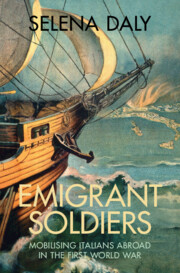
During the First World War, over 300,000 Italian emigrants returned to Italy from around the world to perform their conscripted military service, a mass mobilisation which was a uniquely Italian phenomenon. But what happened to these men following their arrival and once the war had ended? Selena Daly reconstructs the lives of these emigrant soldiers before, during and after the First World War, considering their motivations, combat experiences, demobilisation, and lives under Fascism and in the Second World War. Adopting a micro-historical approach, Emigrant Soldiers explores the diverse fates of four men who returned from the United States, Brazil, France, and Britain, interwoven with accounts of other emigrants from across Europe, the Americas, Africa, the Middle East and Australia. Through letters, diaries, memoirs, oral histories, newspapers, and diplomatic reports, Daly focuses on the experiences and voices of the emigrant soldiers, providing a new global account of Italians during the First World War.
Chapter 8 discusses how the Russian regime’s invasion of Ukraine in February 2022 concretely enacted Russian hawks’ conception of Russia as an imperial great power that should rely on its technological and military might to assert its civilizational distinction from the West. The chapter argues that the Russian regime has restored elements reminiscent of the Soviet-style “vertical,” facilitating the propagation of norms and principles through a bureaucratic chain of command. However, it has not completely reconstructed a cohesive institutionalized state apparatus. Its doctrinal framework remains adaptable. In addition to official state-led initiatives, the regime continued to oversee ideology formation through interactions and transactions with a variety of nonstate ideological entrepreneurs. This involvement of diverse actors across state and nonstate realms fostered a certain degree of polarization within policy circles. Moreover, the hawks’ production of narratives justifying Russia’s imperialism and war violence encountered resistance from recent intellectual emigrants who have established organizations in exile dedicated to fostering critical thinking and dissent in intellectual circles.