Refine search
Actions for selected content:
22 results
When tax authority and land authority diverge: property tax reform and institutional persistence in Ghana
-
- Journal:
- Journal of Institutional Economics / Volume 22 / 2026
- Published online by Cambridge University Press:
- 22 October 2026, e59
-
- Article
-
- You have access
- Open access
- HTML
- Export citation
6 - Is Increasing Competition a Way Out of the Trap?
-
- Book:
- Keeping the State Weak
- Print publication:
- 03 September 2026, pp 155-171
-
- Chapter
- Export citation
6 - Fiscal States, Geopolitical Competition, and Economic Interdependence
-
- Book:
- The Fraying Bonds of Peace
- Published online:
- 04 June 2026
- Print publication:
- 04 June 2026, pp 136-159
-
- Chapter
- Export citation
Investing in fiscal capacity: legislative debates, military pressures, and tax policy in the United Kingdom (1803–1913)
-
- Journal:
- Journal of Institutional Economics / Volume 21 / 2025
- Published online by Cambridge University Press:
- 02 January 2026, e47
-
- Article
-
- You have access
- Open access
- HTML
- Export citation
The early modern origins of contemporary European tax outcomes
-
- Journal:
- European Journal of Political Research / Volume 57 / Issue 1 / February 2018
- Published online by Cambridge University Press:
- 01 January 2026, pp. 47-67
-
- Article
- Export citation
5 - The Early Stuart Fiscal State
-
- Book:
- Institutional Change and Property Rights before the Industrial Revolution
- Published online:
- 23 October 2025
- Print publication:
- 06 November 2025, pp 134-149
-
- Chapter
- Export citation
3 - The Court of Wards and Liveries, 1540–1642
-
- Book:
- Institutional Change and Property Rights before the Industrial Revolution
- Published online:
- 23 October 2025
- Print publication:
- 06 November 2025, pp 43-77
-
- Chapter
- Export citation
Epilogue
-
- Book:
- The Individual in the Economic and Monetary Union
- Published online:
- 04 January 2024
- Print publication:
- 25 January 2024, pp 183-202
-
- Chapter
-
- You have access
- Open access
- HTML
- Export citation
The origins of fiscal states in developing economies: history, politics and institutions
-
- Journal:
- Journal of Institutional Economics / Volume 19 / Issue 3 / June 2023
- Published online by Cambridge University Press:
- 14 June 2023, pp. 303-313
-
- Article
-
- You have access
- Open access
- HTML
- Export citation
No taxation without informational foundation: on the role of legibility in tax state development
-
- Journal:
- Journal of Institutional Economics / Volume 19 / Issue 3 / June 2023
- Published online by Cambridge University Press:
- 14 June 2023, pp. 426-443
-
- Article
-
- You have access
- Open access
- HTML
- Export citation
Constraints on the executive and tax revenues in the long run
-
- Journal:
- Journal of Institutional Economics / Volume 19 / Issue 3 / June 2023
- Published online by Cambridge University Press:
- 14 June 2023, pp. 314-331
-
- Article
-
- You have access
- Open access
- HTML
- Export citation
The Fiscal State in Africa: Evidence from a Century of Growth
-
- Journal:
- International Organization / Volume 77 / Issue 1 / Winter 2023
- Published online by Cambridge University Press:
- 14 December 2022, pp. 65-101
- Print publication:
- Winter 2023
-
- Article
-
- You have access
- Open access
- HTML
- Export citation
Fiscal capacity in non-democratic states: the origins and expansion of the income tax
-
- Journal:
- Journal of Institutional Economics / Volume 19 / Issue 3 / June 2023
- Published online by Cambridge University Press:
- 11 October 2022, pp. 364-378
-
- Article
-
- You have access
- Open access
- HTML
- Export citation
Next Generation Eu: Legal Structure and Constitutional Consequences
-
- Journal:
- Cambridge Yearbook of European Legal Studies / Volume 24 / December 2022
- Published online by Cambridge University Press:
- 23 August 2022, pp. 45-66
-
- Article
-
- You have access
- Open access
- HTML
- Export citation
The Great Revenue Divergence
-
- Journal:
- International Organization / Volume 77 / Issue 2 / Spring 2023
- Published online by Cambridge University Press:
- 08 August 2022, pp. 363-404
- Print publication:
- Spring 2023
-
- Article
-
- You have access
- HTML
- Export citation
Explaining Out-Group Bias in Weak States: Religion and Legibility in the 1891/1892 Russian Famine
-
- Journal:
- World Politics / Volume 74 / Issue 2 / April 2022
- Published online by Cambridge University Press:
- 11 April 2022, pp. 205-248
- Print publication:
- April 2022
-
- Article
-
- You have access
- HTML
- Export citation
14 - On the Relevance of Institutional Quality
-
- Book:
- Regulating Public Services
- Published online:
- 27 January 2022
- Print publication:
- 21 October 2021, pp 335-361
-
- Chapter
- Export citation
6 - From Coast to Hinterland: Fiscal Capacity Building in British and French West Africa, c. 1880–1960
-
-
- Book:
- Fiscal Capacity and the Colonial State in Asia and Africa, c.1850–1960
- Published online:
- 15 November 2019
- Print publication:
- 05 December 2019, pp 161-192
-
- Chapter
- Export citation
1 - Fiscal Capacity and the Colonial State: Lessons from a Comparative Perspective
-
-
- Book:
- Fiscal Capacity and the Colonial State in Asia and Africa, c.1850–1960
- Published online:
- 15 November 2019
- Print publication:
- 05 December 2019, pp 1-35
-
- Chapter
- Export citation
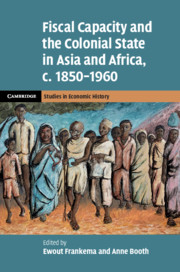
Fiscal Capacity and the Colonial State in Asia and Africa, c.1850–1960
-
- Published online:
- 15 November 2019
- Print publication:
- 05 December 2019
