To save content items to your account,
please confirm that you agree to abide by our usage policies.
If this is the first time you use this feature, you will be asked to authorise Cambridge Core to connect with your account.
Find out more about saving content to .
To save content items to your Kindle, first ensure no-reply@cambridge.org
is added to your Approved Personal Document E-mail List under your Personal Document Settings
on the Manage Your Content and Devices page of your Amazon account. Then enter the ‘name’ part
of your Kindle email address below.
Find out more about saving to your Kindle.
Note you can select to save to either the @free.kindle.com or @kindle.com variations.
‘@free.kindle.com’ emails are free but can only be saved to your device when it is connected to wi-fi.
‘@kindle.com’ emails can be delivered even when you are not connected to wi-fi, but note that service fees apply.
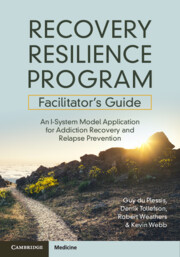
A manual for those working with addicted populations (from lay counsellors to psychiatrists) for delivering the evidence-based Recovery Resilience Program (RRP). RRP is a person-centered, strength and resiliency-based relapse prevention and recovery-oriented intervention that works in synergy with other models, especially 12-Step programs. Presenting practices that enhance 'recovery resilience' – an individual's capacity to effectively apply coping and self-regulation skills in dealing with cravings, triggers, stress, and high-risk situations without reverting to substance use. The program helps individuals to enhance and use their recovery capital at any stage of recovery, and ultimately reach recovery and life goals. It effortlessly integrates with other evidence-based relapse programs, from the original cognitive-behavioral approaches to the newer mindfulness-based and metacognitive approaches. Written by clinicians who have worked with addicts and their families for many decades, the program is easy-to-implement and very little preparation is necessary with handouts and PowerPoints included in each session.
This Postscript synthesizes the book’s central claim: that abandoning belief in free will and basic desert moral responsibility does not lead to nihilism or despair, but instead paves the way for a more humane, compassionate, and just society. Rather than seeing ourselves as autonomous agents wholly responsible for our successes and failures, free will skepticism encourages us to recognize the deep causal influences – biological, social, and environmental – that shape human behavior. This recognition invites not fatalism, but moral clarity: a shift from blame to understanding, from retribution to rehabilitation, and from judgment to empathy. The Postscript highlights the real-world implications of this paradigm shift, especially in areas such as criminal justice, where punitive attitudes can be replaced with restorative, forward-looking models that aim to reduce harm and promote healing. It also discusses interpersonal relationships, arguing that viewing others through the lens of compassion and causal understanding can foster forgiveness and reduce moral anger. Ultimately, the Postscript reaffirms the book’s hopeful message: that living without free will allows us to embrace a deeper ethics – one rooted in fairness, humility, and solidarity – and that such a shift can enhance both individual well-being and collective flourishing.
This chapter explores the capability approach (CA) in relation to decent work (DW) and flourishing at work, presenting a nuanced framework for understanding and enhancing employment quality. Decent work encompasses job security, fair wages, safe working conditions, and respect for workers’ rights. Flourishing at work extends the concept of DW by considering how work contributes to well-being, personal growth, and fulfilment. Combining the frameworks of DW and flourishing at work with the CA offers a comprehensive understanding of the role of work in human development. The connections among capabilities, DW, and flourishing at work are deeply intertwined, as all three concepts focus on enhancing human well-being, dignity, and growth potential. By integrating DW, capabilities, and human flourishing, policymakers, organisations, and civil society can move beyond compliance with minimum standards (decent work), centre human agency and diversity, and aspire to lives of emotional, psychological, and social well-being.
The liberal system of free markets and limited government has resulted in an unprecedented explosion of prosperity, freeing most people from the daily grind of survival and enabling them to engage in enjoyable and meaningful activities. Empirical studies of happiness show that people in richer and freer countries are happier at all income levels, and that happiness rises with the natural log of real GDP per capita. Contrary to critics, empirical research shows that people in such countries are also more honest and trustworthy than people from pre-industrial societies or from former communist dictatorships. Thus, more people flourish in such societies. Likewise, more people have intellectual virtue and wisdom as well as what Aristotle regards as the most important component of flourishing: contemplation (theória).
This Element explores a range of conceptions of politically relevant merit found in the philosophical texts of pre-Qin China (before 221BCE). It demonstrates both that the role accorded to political merit was substantial and that the ideas of what constituted politically relevant merit were heavily contested. Through a focus on four texts, the Xunzi, the Mozi, the Laozi, and the Han Feizi, it sketches out a long-standing debate over questions including the appropriate source of merit, the relationship between political merit and moral merit, and how merit should be nurtured and directed in the political arena. In doing so, it hopes to show why contemporary discussions of Asian-inspired political meritocracy, its promise, and its perils, are impoverished if they limit themselves to 'Confucian' notions of meritocracy rather than exploring more fully the wider variety on offer.
This Element outlines the foundational concepts and key applications of humanistic management and leadership. It focuses on the key concepts of protecting dignity and promoting well-being. It provides a humanistically grounded, scientifically backed paradigm for better organizing at the level of individual, relation, team, organization, society and nature. It provides real world examples of organizations and companies that practice humanistic management and leadership and create outstanding value for all stakeholders.
This paper revisits the longstanding debate over the nature of suffering, focusing on the divide between subjective and objective accounts. I defend a Personalist conception of suffering, rooted in an Aristotelian understanding of human flourishing, that recognizes suffering as both universally human and deeply personal. On this view, suffering is neither a purely sentient, inner experience nor reducible to external conditions, but a disruption of flourishing that arises when love or justice is violated or absent—and that calls for a communal response. Understood through this lens, suffering, I argue, invites a shared practice of meaning-making—not as sentimental optimism but as a form of grounded hope: realistic, responsive, and attuned to the dignity of both the sufferer and those who accompany them. Even when suffering cannot be cured or fully comprehended, it can be met with deeper engagement, mutual responsibility, and a reaffirmation of our commitment to a life lived in relation and shared purpose.
Drawing from critical realism and building on previous academic studies and writing theories and practices, the author advances approaches to academic writing that are both human and humane, by situating academic writing within the broader critical realist project of furthering human flourishing and emancipation; of what it means to be human; and of why things matter to people. Addressing what counts as human(e) in academic writing has become pressing, as concerns about machine-generated texts, such as Large Language Models like ChatGPT challenge understandings of truth, knowledge, and justice. Underlying the argument in this chapter is the assumption that writing in the academy is a social practice (specifically, a method of enquiry) that should be oriented towards epistemic virtues including commitment to truth and socially just standards of excellence. For academic writing to fulfil such commitments, the author argues that it needs to be human(e). For it to be human(e), it requires a writer–agent–knower to rationally judge between educative and harmful academic writing theories and practices, in the interests of human flourishing and emancipation.
This chapter explores Aristotle’s account of the good life as presented in the Nicomachean Ethics, emphasizing his empirical, observational approach to virtue, social life, and human flourishing. Aristotle presents human beings as inherently social and defines virtues—such as generosity, magnanimity, and justice—as traits expressed in habitual action and observed within social contexts. Justice, in particular, emerges as a “complete” virtue, operative only within the framework of law and reciprocity. Aristotle also articulates the importance of friendship (philia), distinguishing between lesser forms based on utility or pleasure and the highest form—friendship grounded in shared virtue. Intellectual virtues are treated alongside moral ones, with phronêsis (prudence or practical wisdom) guiding right action. Ultimately, Aristotle identifies contemplation as the highest human activity, likening it to divine activity. Though only attainable by few, contemplation fulfills the intellect’s potential and brings human beings closest to the divine. The chapter concludes by reflecting on Aristotle’s conception of divinity, the nature of blessedness, and how these inform a hierarchical vision of reality in which the contemplative life represents the fullest expression of human excellence.
Eudaimonism is a richly complex ethical tradition. To distinguish eudaimonism from other ethical approaches and to demonstrate the diversity of eudaimonistic accounts, I outline five key distinctions: (i) form vs. content, (ii) weak vs. strong eudaimonism, (iii) perfectionism vs. non-perfectionism, (iv) intellectualism vs. materialism, and (v) dogmatism vs. non-dogmatism. This analysis escapes the traditional focus on eudaimonism through a predominantly Aristotelian lens. It also offers a rich conceptual framework for understanding the historical development of eudaimonism and the dialogue between ancient, early modern, and modern eudaimonists.
This essay seeks to explain Aquinas’s account of natural law, natural inclinations, and absolute moral norms. According to Aquinas, everything bears the impress of divine wisdom (the divine Word); the cosmos is intelligible and has a teleological order. Aquinas describes this order as expressive of God’s “eternal law,” by which creatures are moved to their perfective ends. Human natural inclinations pertain to how God moves us by our rational nature, as we incline rationally toward the goods that perfect our powers. Since the rational soul is the “form” of the body, everything about the body pertains to the flourishing of the rational creature in interpersonal wisdom and love, rather than being merely a biological substratum. We come to know the human good in the process of seeking particular goods perfective of our modes of existence or powers. The above points ground Aquinas’s account of synderesis, the core precepts of the natural law, and absolute moral norms. These norms, whose intelligibility is darkened by the effects of sin, are reflected in the Decalogue, the teaching of Jesus and Paul, and the Catholic Church’s teaching.
What does Heidegger mean by “curiosity” and why does he characterize it as a kind of epistemic vice, when most contemporary accounts view it as a virtue? Being and Time disparagingly notes that curiosity “concerns itself with a kind of knowing, but just in order to have known” (BT 217/172); the curious person busies herself with “entertaining ‘incidentals’” (BT 358/310). Building on previous work – wherein I argue that virtues are best understood as tendencies to cope well with existential obstacles to flourishing (McMullin 2019) – I show that curiosity as Heidegger frames it is an epistemically vicious misunderstanding of self and world arising in large part from our tendencies toward impatience, arrogance, and fear. Because Heidegger’s account of curiosity in Being and Time is not well-developed, we will look at nearby texts to get a better understanding of this sometimes-overlooked concept in Heidegger’s corpus.
Should you take a pill that gives you all the health benefits of sleep and allows you to stay awake? I argue that you shouldn’t. I propose three reasons why sleeping, conceived of as a socially and culturally embedded human activity, is valuable. First, there is aesthetic value in the rituals that typically precede sleeping; second, there is interpersonal value in the intimacy that stems from sleeping with other people; third, there is ethical value in mere presence and in retreating from consciousness. In order to fully support my argument, I situate it within a conception of goodness that embraces the fragility of the human condition and the limitations stemming from our corporeal nature. I conclude with some practical implications of my view.
In her groundbreaking paper “Having too much” Ingrid Robeyns introduces the principle of “limitarianism,” arguing that it is morally impermissible to have more resources than needed for leading a maximally flourishing life. This paper focuses on one component of limitarian theory, namely the nature of the riches threshold, and critiques Robeyns’ absolute threshold, that limits wealth above what is needed for satiating human flourishing. The paper then suggests an alternative, relative threshold for determining excessive wealth, and also argues that limitarianism is best understood as a set of wealth-limiting principles, each with its own threshold, justifications, and conditions for operation.
Virtue ethics tells us to ‘act in accordance with the virtues’, but can often be accused, for example, in Aristotle’s Ethics, of helping itself without argument to an account of what the virtues are. This paper is, stylistically, an affectionate tribute to the Angelic Doctor, and it works with a correspondingly Thomistic background and approach. In it I argue for the view that there is at least one correct list of the virtues, and that we can itemise at least seven items in the list, namely the four cardinal and three theological virtues.
Research indicates that a segment of the lawyer population is impaired by mental illness, such as anxiety, depression, substance misuse, or suicide risk. A much higher number of lawyers likely fall on the languishing end of the mental health spectrum. If you are languishing, you may be at a higher risk of sliding into impairment. Mental health is assessed on a continuum, ranging from languishing to flourishing. Languishing has been described as feeling uninspired, joyless, and lacking the power to function at full capacity. And languishing may increase your risk of mental illness, such as major depressive episode, generalized anxiety, panic attacks, or substance use disorder. Lawyers may suffer from several obstacles to mental strength, including lack of self-awareness, perfectionism, imposter syndrome, social comparisons, trained pessimism, inability to regulate emotions, and inauthenticity from a failure to understand or leverage their temperament and personality strengths. Features of the lawyering culture may augment these obstacles and lead to lawyer languishing.
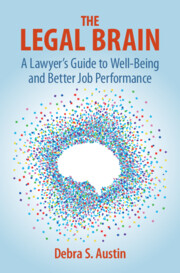
The Legal Brain is an essential guide for legal professionals seeking to understand the impact of chronic stress on their brain and mental health. Drawing on the latest neuroscience and psychology research, the book translates complex scientific concepts into actionable advice for legal professionals looking to enhance their well-being and thrive amidst the demands and stressors of the profession. Chapters cover optimizing cognitive fitness and performance, avoiding or healing cognitive damage, and protecting “the lawyer brain.” Whether you are a law student, practicing lawyer, judge, or leader of a legal organization, this book provides valuable insights and strategies for building resilience, maintaining peak performance, and protecting your most important asset - your brain.
The book concludes with a discussion of the ways that virtue science can influence the discipline of psychology. First, it reiterates that virtue science is off to a good start. The success of virtue science calls the fact–value dichotomy into question because scientifically studying virtues is deeply imbued with value commitments. Virtue science is more interdisciplinary than psychology, and the value of working across disciplinary lines in virtue science recommends greater interdisciplinarity among psychologists. This interdisciplinarity in virtue science has helped to clarify the many philosophical contentions that tend to be ignored by psychologists or just built in as contentious assumptions. The STRIVE-4 Model clarifies how much improved conceptualization can enhance a research area, suggesting that psychology, as a discipline, can benefit from more systematic theory. Virtue science also calls for improved research, especially person-centered research and transcending self-report measures. Finally, virtue science calls for the recognition of the centrality of the aspiration to live well as human beings. Greater attention to this core aim can help psychologists to be much clearer and more direct about their objectives.
The introduction asks the question of why social scientists should study virtues empirically. It offers five reasons: (1) humans are moral animals, (2) moral behavior can be understood as an expression of acquired traits, (3) it is psychologically realistic to think that ordinary humans can acquire and express virtue traits, (4) moral education is valuable, and (5) virtues are often taken to be essential to a good life. The Introduction then addresses three challenges that virtue scientists must face: (1) the absence of empirically oriented virtue theory, (2) the overreliance of simple survey design in psychology, and (3) virtue skeptics. The Introduction concludes with an outline of the chapters of the book and how these chapters comprise the sections of the book.
This chapter discusses the field of moral development and explores what this research field can tell us about virtue development, which is a relatively neglected topic in virtue theory. The chapter is primarily about moral development in children, both because there is substantial scientific interest in this population and because virtue development must begin in childhood. Moral development research illuminates three apparently naturally developing preconditions for virtue development: (1) the ability to choose, (2) an interest in collective welfare, and (3) an interest in ethical normativity. Moral development research is also compatible with the STRIVE-4 Model in that it is primarily quantitative. Moral development generally does not focus on traits, with the exception of some research on moral identity, moral emotions, and moral exemplars. The chapter concludes by exploring how virtue science can contribute to moral development research, including an increased emphasis on (1) person-centered research, (2) the contextualizing of development in situations and roles, (3) flourishing, and (4) practical wisdom.