To save content items to your account,
please confirm that you agree to abide by our usage policies.
If this is the first time you use this feature, you will be asked to authorise Cambridge Core to connect with your account.
Find out more about saving content to .
To save content items to your Kindle, first ensure no-reply@cambridge.org
is added to your Approved Personal Document E-mail List under your Personal Document Settings
on the Manage Your Content and Devices page of your Amazon account. Then enter the ‘name’ part
of your Kindle email address below.
Find out more about saving to your Kindle.
Note you can select to save to either the @free.kindle.com or @kindle.com variations.
‘@free.kindle.com’ emails are free but can only be saved to your device when it is connected to wi-fi.
‘@kindle.com’ emails can be delivered even when you are not connected to wi-fi, but note that service fees apply.
The purpose of this chapter is to examine how Theodoret of Cyrrhus appropriated discourses of Roman masculinity in his Historia religiosa (ca. 440–444 CE), with the purpose of making the monks more acceptable, more marketable, to his would-be readers. Masculinity was a tactical appropriation that signified social worth. The study analyses four discourses related to masculinity in the Historia religiosa, all functioning with the purpose of showcasing the interior struggle between the soul and body of the monk. These discourses are warfare, athletics, slavery and medical discourse (health and illness). All function to show the superiority of the souls of the monks. By proving that the souls of the monks have universally dominated their bodies, they are also qualified to exercise external social, political and religious control. Hence, because of their total inner domination, Theodoret’s masculine monks can show dominance against foreign armies and raiders, generals and governors, and even an emperor. As literary characters, they become quite marketable to more reserved and conservative would-be readers.
In Chapter 1, human well-being is defined and compared globally as inherently relational and creative, based on current research, indicating that the impact of technology is causing societal and individual stress, particularly due to social isolation.
The provision of viable health insurance is inextricably linked to the provision of the human right to health. While Nigeria’s journey toward universal health coverage began with the 2005 insurance scheme, the National Health Insurance Authority (NHIA) Act 2022 fundamentally changed the status quo by making insurance mandatory. Despite this, coverage remains abysmally low. This study analyses the intersection of human rights and health insurance, arguing that Nigeria’s crisis stems not from legislative insufficiency but from a systemic failure to operationalize existing frameworks. By engaging with the justiciability of health under the African Charter and the National Health Act 2014, the study finds that the barrier to health rights is an implementation gap fuelled by institutional dysfunction and fiscal negligence. It recommends prioritizing the enforcement of the NHIA Act and strategic funding of the Basic Healthcare Provision Fund, as opposed to the agitation of further constitutional reforms.
Aristotle had a decisive impact on the development of ancient medicine. He and his followers conducted a dialogue about life and living beings, body and soul, and health and disease with doctors from the Classical period down to late antiquity: interlocutors who included key figures like Galen and the Hippocratic commentator Stephanus of Alexandria. Philip van der Eijk's magisterial and attractively written book describes and analyses this dialogue and argues that Aristotle strategically positioned himself within these discussions while making important and innovative contributions to them. The author further uncovers unpublished evidence showing how Aristotle's philosophy itself – and also the way it was elaborated by its later advocates and exegetes – was influenced by its close engagement with medical theory and practice. This important and much-anticipated book will transform both the study of Aristotle and his followers and that of Greek and Roman medicine.
This article examines a fundamental problem in ancient Greek medical thought, namely, how to conceptualize the variety of human health conditions. Beginning in the Classical period, the notion that health gradually shades into illness stood in tension both with the assumption that these categories are dichotomous and with the definition of health as an exact proportion. After examining how these matters were framed by Aristotle, this article explores two later attempts at solving the tensions. It is shown that Galen of Pergamon used the resources of Peripatetic philosophy to reconcile two of these conflicting intuitions while following certain Herophileans in rejecting the idea that health and illness are dichotomous. This article also offers an interpretation of the largely overlooked position of Asclepiades of Bithynia, that health does not admit of degrees. It is argued that this was a reasonable view within a corpuscular physiology and did not, pace Galen, lead to the ‘doctrine of perpetual suffering’. Asclepiades could have effectively deployed his account in arguments against the Empiricist sect and against humoural theories.
International policy efforts to systematise the consideration of health outcomes across social and economic policy – the ‘Health in All Policies’ (HiAP) approach – have faced practical, relational and political difficulties. Meanwhile, new economic policy agendas focused on ‘inclusive growth’ or ‘wellbeing’ may provide an alternative route to improving population health by acting on upstream determinants. This research uses a frame analysis of thirty social, economic and health policy documents, and semi-structured interviews with thirty-four policy actors, to explore conceptualisations of ‘health’ in two devolved policy bodies in the UK – Greater Manchester Combined Authority and the Scottish Government – with declared interests in these economic agendas. Interviews revealed that social and economic policy actors conceptualised ‘health’ narrowly as biomedical, physical illness, and as shorthand for ‘health policy’. Further, some of these participants expressed resentment about health policy, while interviewees across teams expressed scepticism about HiAP. In contrast, ‘wellbeing’ was widely conceptualised similarly to the social model of health, included mental health, and was supported as a plausible common cause. This research suggests that a clearer conceptual distinction between ‘healthcare’ and ‘wellbeing’ – representing the medical and social models of health respectively – may support policy efforts to promote population health.
Chapter 4 specifies the relevance of international human rights law in the context of the TRIPS at the junction of WTO law and IP law. This chapter explores the possibilities and limits of a coexistence perspective between IP and human rights. Accordingly, human rights are considered an integral part of the interpretative resources required to comprehend the TRIPS-stipulated obligations. This chapter focuses on human rights entailed by the International Covenant on Economic, Social and Cultural Rights (ICESCR), such as the rights to health, food, and education, complementing the rich scholarship on the access modality of these rights (e.g., access to drugs, seeds, and educational material) by focusing on both the right to science and the right to self-determination as interpreted in a republican way. By interfacing with IP law, the right to science highlights the relevance of accessing scientific progress and its benefits while focusing mainly on the importance of a participative and inclusive approach to identifying and defining a population’s needs and priorities.
Discusses the importance of prioritizing evidence from the formerly enslaved, while using a multiplicity of primary evidence, especially when researching highly unequal and complex systems such as slavery. It stresses the dominance, for too long, of the records of powerful enslavers within slavery’s history. Considers how the context of the 1930s influenced the comments of the WPA respondents about cooking and eating while enslaved. Some interviewees had nostalgia for food in the past, while others continued to provision in a manner akin to slavery, conveying longer-run continuities of oppression. Addresses longer-term and rising food inequalities within the United States and their implications, drawing on the writings of other historians and activists. A lack of adequate, nutritious food choices began in slavery. People in poorer neighborhoods more likely to live in “food deserts” and to suffer from poorer health outcomes. Summarizes the book’s interventions into the histories of feminism, slavery’s capitalistic machinations, and how historians can deploy primary evidence in ways that seek to overcome archival absences. Cooks in the quarters, while exploited, should be celebrated.
This article examines the development and transformation of school colonies within the Italian child welfare system between the First World War and the immediate postwar period. Originally conceived as prophylactic institutions aimed at strengthening the bodies of frail and undernourished children, these colonies gradually assumed broader functions, becoming spaces shaped by new political and social imperatives. The article focuses on the impact of wartime mobilisation, the reconfiguration of welfare networks involving public authorities, voluntary organisations, and humanitarian agencies, as well as the growing role of doctors and teachers in structuring the daily life of these institutions. In particular, the text analyses how health prevention practices became intertwined with moral education and forms of political mobilisation. The result is a complex picture that highlights the emergence of a hybrid model which anticipated the subsequent welfare and educational policies of Fascist totalitarian pedagogy.
In this chapter, we first provide an overview of health and mental health outcomes across the different types of street segments studied to assess whether residents of crime hot spots have more adverse health issues compared with residents living on street segments with little or no crime. We find that there are strong relationships between mental and physical health and living in crime hot spots as opposed to non-hot spots. We then examine whether negative health outcomes are a consequence of living in a crime hot spot. We find that hot spots of crime are not simply places with high crime rates; they are also places with strong physical and mental health deficits. After accounting for selection, several physical and mental health problems are found to result from living in a crime hot spot.
Human capital – defined by education, health, and skills – is essential for economic resilience and social cohesion. This chapter analyses how inclusive investment in people drives innovation, reduces inequality, and strengthens institutions. It critiques underinvestment in public services and challenges the idea that human development is a luxury. Drawing on comparative data, the chapter shows that equitable access to quality education and healthcare correlates strongly with long-term growth and democratic stability. Prosperity begins with people.
Chapter 2 turns to the second betrayal. This chapter scales down into the personal accounts of test veterans post-service lives, when emergent illnesses eluded explanation and social recognition, and private shame and debility stalled their lives. I show how unsettled memories and unsettled illnesses coalesced with the slow-moving invisibility of radiation in ways that negatively impacted their families and their well-being. Claim-making thus began as prefigurative struggles driven by delegitimating encounters with medical actors, and the accumulating acts of sharing service memories in veteran spaces. This chapter charts how in these practices test veterans and their family members became claim-makers, a collectivity that produced the possibilities for political and legal action.
This chapter offers readers perspective on ideals and practices that shaped health-related treatment of former service members from the Revolutionary period through the end of the Cold War. Studying how veterans fought for and accessed health services over two centuries offers a compelling view of the wide-ranging impacts of military endeavors on policy and politics and on the individual lives of service members and civilians. It also brings into sharp relief the extent to which norms of civilian society – for example, changing perceptions of how diseases are classified and what constitutes proper care – influence wars and perceptions of them. Broadly, the chapter shows that, while veterans’ care became more bureaucratized and institutionalized over time, some realities were constant: the nature and extent of available services, and the ways people interpreted them, were dictated by former service members’ advocacy, as well as prevailing notions about governmental responsibility, illness and disease, disability, and medical practice. Most broadly, the history of veterans’ experiences related to health care reveals that war and society are inextricably and intricately linked.
Ad hoc coalitions (AHCs) have been a persistent feature of global governance. However, only recently have they become the focus in governance scholarship. Why are they created, and how do they vary in their composition and afterlife? We examine AHCs since 1919 across health and security governance challenges. Our analysis rests on archival material from international organizations (IOs) and national governments. We argue that, in bringing together political rivals, AHCs serve three primary purposes. Firstly, as agenda setters, they address new governance challenges. Secondly, as capacity generators, they reshuffle membership compositions. Finally, as decision accelerators, they enable their members to bypass existing IOs. Beyond these commonalities, notable differences exist that are rooted in relative issue salience. Less salient issues are often led by bureaucrats and experts, glossing over political agendas and mediating between rivals. This set-up often leads to permanent cooperative structures. Issues that decision-makers perceive as highly salient occupy the attention of politicians who want to keep the coalition small. As a result, rivalries can easily come to the fore, leading to short-lived coalitions. Overall, AHCs point to more or less exclusionary action that serves as a testing ground for international cooperation in times of uncertainty and (geo)political crises.
Human flourishing is a fundamental goal of most societies, and various theories have approached this concept, including the International Classification of Functioning, Disability, and Health (ICF), the job demands-resources (JD-R) model, self-determination theory (SDT), and the integrative model of behavioural prediction (IMBP). These theories focus on different aspects of well-being and the factors that influence an individual’s ability to lead a fulfilling life. This chapter aims to explore the capability approach (CA) and examines how it complements and connects with these existing theories. This chapter demonstrates how, by emphasising the importance of individual capabilities and human agency, the CA broadens the applicability of these theories. Unlike classical models that focus primarily on analysing situations, the CA highlights the broader context, aiming to enhance flourishing by considering situational determinants and the impact of contextual factors on an individual’s ability to make meaningful choices. This chapter contributes to a more nuanced understanding of human flourishing by illustrating the synergies between the CA model and other theoretical models. It argues that to be truly comprehensive and effective in the real world, theories must embrace the transformative potential of the CA.
Experiences of healthcare services are an important indicator of quality and health system improvement. In correctional facilities, structural and contextual factors affect experiences of healthcare services and processes for voicing these experiences. This study explores barriers and opportunities for people in custody to voice their experiences of healthcare services in custody. We held four focus groups and one interview with people living in the community who had accessed, or tried to access, healthcare services while incarcerated in a provincial correctional facility in Ontario, Canada in the previous five years. Using template analysis, we developed four interacting themes related to expectations and experiences of healthcare, and of submitting complaints or asking for help: i) the system is not designed for healthcare, ii) gatekeeping and perceptions of ‘deserving’ healthcare, iii) impact of healthcare on other outcomes, and iv) calling the abyss. These factors affected perceptions of the potential efficacy of a patient feedback process, and how people in custody were likely to engage with it. Participants also identified five key features that should be components of any patient feedback processes. This study highlights challenges to patient-reported experiences of care in quality improvement work in restrictive environments and with incarcerated populations.
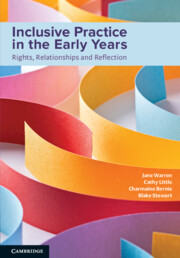
Inclusion is about recognising the rights of every person and ensuring that equitable opportunities exist for all. Inclusive Practice in the Early Years provides pre-service and in-service early childhood teachers and educators with theoretical guidance and practical strategies to allow all children to participate meaningfully in learning. Inclusive Practice in the Early Years focuses on the inclusion of children with disability, developmental delay and neurodivergence from birth to five years. The book also highlights the importance of recognising inclusive principles that apply to a wider range of diversity including Aboriginal and Torres Strait Islander children, refugee and migrant children, children who have experienced trauma and families experiencing disadvantage. Developed by authors with extensive experience across early childhood education, disability, community, and allied health, this text provides valuable information and strategies to support both pre-service and in-service teachers and practitioners to develop an inclusive practice.
Mental health concerns are rising for business school academics who cope with increased expectations about job performance. The multiple and concurrent tasks that academics engage in gives rise to feelings of stress and inadequacy that can lead to mental distress. The changing role of academia has created confusion and as sense of panic surrounding job longevity, which has resulted in increased emphasis on well-being in universities. Whilst universities pride themselves as supposedly good work environments in reality many academics are facing mental health issues. This means the joy once evident in academics in a profession they love has changed due to the increased complexities. In this editorial, I discuss the role mental health plays in an academic’s survival in the global educational environment. The consequences of altering work/life resources are examined with the goal of suggesting ways to alleviate mental health issues whilst respecting the privacy and individualisation of academics.
Between 2010 and 2012, a catastrophic earthquake sequence devastated Christchurch, a colonial city built on Ngāi Tahu ancestral land in Canterbury, New Zealand. This chapter explores how government agencies, including public health services, collaborated with mana whenua (Ngāi Tahu, the local Māori tribe) to rebuild Ōtautahi Christchurch in ways that respect its colonial past while looking to a climate-challenged future. The rebuild sought to integrate natural environmental features and symbolic markers significant to mana whenua, while also promoting health, wellbeing, and a renewed sense of place for all residents. Writing as three Tangata Tiriti (settler-colonial) women, we draw on our professional roles in public health, urban design, landscape architecture, and strategic planning. We reflect on our involvement in planning and policy implementation, considering what worked well, what fell short, and our hopes for a future city that fosters resilience, inclusivity, and belonging.
Southeast Asia is a booming region which is nevertheless among the most vulnerable to climate change. This book assesses how Southeast Asian countries – from the wealthiest to the poorest – are adapting to meet climate change challenges across several key sectors: agriculture and fisheries, conservation, energy, health, and migration. In the broad context of the global system, it celebrates some of the region's remarkable successes, whilst also examining serious adaptive issues. Through a political economy lens, the author describes growing private-sector control over adaptations, shining a light on who benefits and loses from these systems. He untangles the complex interconnectedness of different sectors, examining how adaptations to one can undermine progress in others. This sharply focused volume is a vital reference on a rising global issue for graduate students and researchers, and offers invaluable lessons for policymakers in countries around the world that share similar development challenges.