To save content items to your account,
please confirm that you agree to abide by our usage policies.
If this is the first time you use this feature, you will be asked to authorise Cambridge Core to connect with your account.
Find out more about saving content to .
To save content items to your Kindle, first ensure no-reply@cambridge.org
is added to your Approved Personal Document E-mail List under your Personal Document Settings
on the Manage Your Content and Devices page of your Amazon account. Then enter the ‘name’ part
of your Kindle email address below.
Find out more about saving to your Kindle.
Note you can select to save to either the @free.kindle.com or @kindle.com variations.
‘@free.kindle.com’ emails are free but can only be saved to your device when it is connected to wi-fi.
‘@kindle.com’ emails can be delivered even when you are not connected to wi-fi, but note that service fees apply.
Plants, botanical gardens, and plantations played significant economic and social control roles in British colonial history, establishing monocultures and promoting scientific enquiry. Enslaved Africans, though integral to this system, have been largely erased from the discourse. Assigned marginal lands by British plantations, they cultivated provision grounds known subsequently in Jamaica as kitchen or backyard gardens growing food crops to supplement meagre rations. These spaces fostered food self-sufficiency, community well-being, and anti-colonial resistance. On these grounds, enslaved Africans tended foods brought from Africa, guarded medicinal plant knowledge, and when industrious, grew surpluses to achieve economic independence and escape poverty. Their nutritious, culturally relevant diets contrasted with inadequate plantation rations, now believed to be a contributory factor of non-communicable diseases prevalent in their descendants today. Over centuries, provision grounds evolved into small farms that became mainstays of domestic food production in Jamaica, sowing the roots of food indigeneity. This article traces the growth and economic impact of these grounds, their eventual decline, and their repositioning in Jamaican society. It examines their influence on food security, diets, foodways, health, and livelihoods, arguing that these grounds planted seeds of resilience and harvested hope for later generations.
This article quantifies the economic benefits of an influential early childhood program in a developing country, tracking participants with outcomes measured through age 31 years. Drawing on published experimental data encompassing life-cycle benefits – that rely primarily on available labor-market outcomes – alongside a rigorous cost analysis, we estimate an internal rate of return (IRR) of 10.4–10.7% and benefit–cost ratio of ~8. Even though estimates are not that precise, a variety of sensitivity analyses confirm the robustness of these findings. Notably, we find meaningful gender heterogeneity in returns: females exhibit a higher IRR of 11.5%, compared to their male counterparts (9.6%), suggesting that – in developing countries – early childhood programs may generate disproportionately larger economic gains for women.
Chapter 6 examines the evidence accumulated from CBDCs attempted to date.
The first was the Avant smart card introduced in Finland in 1993, well before modern CBDCs were conceived, and discontinued in 2006. The second was the dinero electrónico (DE) introduced in Ecuador in 2014 but demand was negligible and the DE was withdrawn.
Turning to schemes still in operation, there was the Sand Dollar in the Bahamas, DCash in the countries of the ECCU, and the Jam-Dex in Jamaica, all of which had trivially low adoption rates. The Chinese e-yuan, introduced in 2020, was designed to complement the Chinese Social Credit System and is explicitly intended as a tool of social control. The Nigerian eNaira was launched in 2021; after a slow initial uptake, the Nigerian central bank resorted to a ‘war on cash’ that backfired badly, producing a major cash crisis followed by a subsequent policy reversal and the ousting of the central bank governor.
In all cases, the CBDC was very unpopular and adoption rates by the public were extremely low. It is clear that the public do not want CBDCs.
Chapter 5 addresses how writers defined racial and national difference according to bodily deportment in the context of Atlantic slaveocracy. Historical theorizations of “wanton cruelty” and involuntary motion are crucial to our understanding of the largest forced migration in human history, in which more than twelve million African people were enslaved. The aesthetics of motion also played a crucial role in how whiteness was constructed in opposition to the paradoxical claim that Black and Brown bodies were too antic and yet too languorous. The Woman of Colour reframes racialized movement in terms of “flexibleness,” which is a way of moving through the world that is hyperactive and yet especially vulnerable to being acted upon. Olivia Fairfield’s deportment challenges racialized aesthetics of motion but nevertheless embraces a form of narcissistic amelioration in which deserving white English gentlemen – and not the biracial heroine – ultimately have the capacity to enact social change.
Whereas male poets such as Coleridge and Keats used the figure of the witch to explore the connections between the shapeshifting powers of the female demonic and (male) creativity, the third chapter reveals how women novelists like Charlotte Smith and Maria Edgeworth remapped contemporary cultural anxieties in Britain surrounding witches and transgressive female energies onto the colonial landscape of Jamaica. These two authors position the female practitioners of Obeah as an intriguing alternative to the degradation of women in England and the enslaved populations in the colonies.
This chapter examines the tenure of British Consul William Dougal Christie who sought to settle territorial disputes over the Mosquito Shore with rival Central American republics and attempted to establish unchallenged British authority over the Nicaragua Canal route by shifting the capital of the Mosquito Kingdom to the harbor of San Juan del Norte (renamed Greytown). Nicaraguan officials challenged the British position by arguing that the Mosquito Kingdom was a fiction erected by the British. As the possibility of a Nicaraguan Canal loomed ahead, competing sovereign powers of Britain and Nicaragua converged on the authenticity of the Afro-Indigenous Mosquito Kingdom as the linchpin around which to settle their territorial dispute over the San Juan delta.
This chapter demonstrates how William Earle’s abolitionist novel Obi; or, The History of Three-Fingered Jack (1800) uses interpolated tales, along with other embedded forms, to vocalize multiple perspectives across cultural and racial difference, while acknowledging the vexed ethics of using a print text to speak for populations largely excluded from literacy and the literary marketplace. Interrupting the otherwise epistolary narrative, “Makro and Amri: An African Tale” allows an enslaved mother to transmit her native Feloop culture to her Jamaica-born son, inspiring him to lead the rebellion for which they both die fighting. Thus allying herself with violence and animating the plot, Amri emerges as one of the most powerful female speakers in late eighteenth- and early nineteenth-century fiction. Under this approach, the colonial hierarchy of speaker and spoken for emerges as another lopsided power relation available to be acknowledged, denaturalized, and perhaps undermined once we observe and name the ironic breach between novel and tale.
This chapter opens by establishing the tangible personal connections between writers and intellectuals in Africa and the Caribbean. By way of these networks, African print made its way into Caribbean publications. It then identifies some of the styles and genres of African writing produced in the Caribbean. Next, we use the example of Jamaica to consider the differing networks print media followed into and through the diaspora during the mid-twentieth century. Pan-Africanist textual networks were less neat and more diverse than scholars have generally recognised, and prominently involved the lower socio-economic classes. In a country with a largely illiterate population, Jamaicans both accessed and consumed mainstream newspapers, smaller newsletters and journals in a distinct way. Jamaica had a culture of literature but not a literate culture where the written word intersected with and percolated through oral debates. The travels of African writing, we argue, suggest that conceptually African literatures (versus African literature) encompassed the African diaspora in concrete ways.
This chapter focuses on an alleged rebellion by enslaved people in Jamaica in 1776. A broader global perspective on the American Revolution, one beyond the thirteen rebelling mainland colonies, underlines how freedom and unfreedom intertwined together in complicated, surprising, and sometimes horrific ways in 1776. The chapter argues that calls for liberty on the mainland tightened the noose of slavery in the Caribbean. In Jamaica, the American Revolution gave even more force to already powerful waves of racist fear and violence, making dismal slavery even grimmer. Enslaver anxieties centered on control of arms and violence against white women. Moreover, what happened in Jamaica affected the course and shape of the American Revolution. The events of 1776 in Jamaica also highlight that the Age of Revolutions was equally an age of racism and retrenchment as it was one of liberty and the pursuit of happiness.
In the days leading up to Jamaica’s 1865 Morant Bay rebellion, and in a circulated letter written after the initial violence outside the Morant Bay courthouse on October 11, Black Native Baptist deacon Paul Bogle called on other residents of St. Thomas-in-the-East to join him in fighting for the rights of the parish’s Black residents. He framed the events that were unfolding as a race war and urged others to join the cause, “Skin for skin!” Chapter 2 traces the interpretive history of this slogan, drawn from Job 2:4, and shows how it came to be used within the international anti-slavery movement. In using the phrase, Bogle aimed at a Black alliance that would cut across ethnic, religious, and class lines and that would be willing to meet White violence with a violent Black response. Although the rebellion was crushed, Bogle’s vision has lived on, shaping the experience of race in Jamaica today.
On behalf of the Edinburgh Ladies Emancipation Society, Quaker reformer Eliza Wigham drafted a public letter of condolence to Maria Jane, wife of George William Gordon, who had been executed for his alleged involvement in Jamaica’s 1865 Morant Bay rebellion. Wigham applied Matthew 25:40 – “Inasmuch as ye have done it unto one of the least of these my brethren, ye have done it unto me” – to George William Gordon. Chapter 5 shows how this text reflected a central pillar of the logic of the international anti-slavery movement. As deployed in sermons, speeches at public meetings, and argumentative pamphlets and books, including some penned by Wigham, this biblical text encoded a hierarchy that valued White heroism while delegitimizing Black agency in resisting White power. The chapter thus reckons with the fact that in the years and decades after the rebellion Bogle and other Black Jamaicans who died with him were viewed, even by White liberals, as misguided, or even barbarous.
Chapter 1 recounts some of the main events of Jamaica’s 1865 Morant Bay rebellion. Compared to other historical reconstructions, the chapter emphasizes the influence of the end of the American Civil War and debates about Reconstruction on the rebellion and its coverage in the press. The chapter offers a basic narrative framework within which to understand the arguments presented in Chapters 2 through 6.
Having been found guilty of treason, George William Gordon spent his last hour writing to his wife a letter containing personal goodbyes, business notes, and a firm protestation of innocence. Thanks to the newspaper-savviness of his mother-in-law Ann Shanon and his acquaintance Louis Chamerovzow, the letter was published in dozens of papers around the world. It fell like a thunderclap, helping to turn the tide of public opinion against the Jamaica government and the island’s White English governor, Edward John Eyre. Chapter 3 examines Gordon’s use of biblical language in his final letter. Enslaved at birth on the Cherry Garden estate, and rising to become an elected member of the House of Assembly, the island’s highest legislative body, Gordon invoked 2 Timothy 4:17 – “I have fought a good fight” – to present an alternative to Paul Bogle’s vision of a Black alliance prepared to meet White violence with a violent Black response. For Gordon, Black advancement would come only through what he considered legitimate forms of protest, namely political agitation and the shaping of public opinion in newspapers.
Chapter 6 sets the book’s four detailed case studies within broader patterns of public discourse around Jamaica’s 1865 Morant Bay rebellion. Jamaican Jewish newspaper editor Sydney Levien, White American abolitionist Lydia Maria Child, Black American Baptist missionary Samuel Ward, White English Baptist leader Edward Bean Underhill, Black American abolitionist and physician Sarah Parker Remond, and dozens of others this chapter mentions appealed to biblical slogans as they discussed race relations in Jamaica and their implications for the United States. The chapter illustrates the range of opinions expressed and affirms the importance of the Bible to debates about race relations after emancipation.
Having opposed Jamaica’s largely White plantocracy as an elected member of the House of Assembly, the island’s highest elected legislative body, and as a journalist and publisher, mixed-race Jamaican Robert Alexander Johnson migrated to New York in July 1865, where he joined the editorial staff of the Tribune. Chapter 4 recovers Johnson’s body of writing on Jamaica and the Morant Bay rebellion published in the Nation, the EveningPost, the Tribune, and Hours at Home in 1865–6. Johnson adopted the position that the events of October 11 were a riot, not a planned, organized rebellion. How, then, could Johnson account for the brutal government suppression? He quoted Hebrew 11:4 – “he, being dead, yet speaketh” – which summarizes Cain’s murder of Abel. Johnson, like a long line of Black interpreters this chapter traces, looked to the Cain and Abel story to provide an etiology of the inexplicable savagery of White violence. Johnson warned readers contemplating Reconstruction not to entrust the rights of free Black Americans to their former White enslavers.
The Conclusion summarizes the book’s arguments and contextualizes them within broader patterns of public discourse in which Jamaica was conceptualized as especially revealing about race, and in which biblical slogans were used to encode universal claims about race. The conclusion analyzes a speech given by English lawyer and politician Charles Savile Roundell, who had served as secretary to the Royal Commission of Inquiry appointed to investigate Jamaica’s 1865 Morant Bay rebellion. Addressing the Tenth Annual Meeting of the National Association for the Promotion of Social Science, held in Manchester, England, Roundell proposed taking Jamaica as a crucial instance, a term taken from Francis Bacon’s program for a new scientific method. And he cited the Bible as he made claims about how the races could and should relate to one another.
The Introduction frames the book’s argument by analyzing coverage of Jamaica’s 1865 Morant Bay rebellion in the American Missionary (New York), published by the American Missionary Association. The editors invoked Ecclesiastes 7:7, “Surely oppression maketh a wise man mad,” to blame Jamaica’s largely White plantocracy for pushing Black laborers to breaking point. They drew out the implications of this lesson on race for the United States – White Americans who had participated in the system of slavery should not be entrusted with safeguarding the rights of free Black citizens. This book shows how Jamaicans, Britons, and Americans understood Jamaica as a prime example, a test case that shed light on great questions about race and race relations occupying the Atlantic world at the end of the American Civil War. It argues that they used biblical slogans to encode a wide variety of claims about race and race relations. This Introduction relates the book’s argument to work by historians on Jamaica, the British Empire, and abolitionism, on the one hand, and work by biblical and religious studies scholars on the Bible and race, on the other.
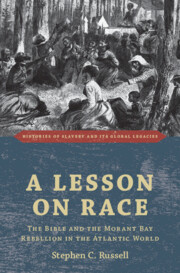
Stephen C. Russell tells the story of the Bible's role in Jamaica's 1865 Morant Bay rebellion and the international debates about race relations then occupying the Atlantic world. With the conclusion of the American Civil War and arguments about reconstruction underway, the Morant Bay rebellion seemed to serve as a cautionary tale about race relations. Through an interdisciplinary lens, the book demonstrates how those participating in the rebellion, and those who discussed it afterward, conceptualized events that transpired in a small town in rural Jamaica as a crucial instance that laid bare universal truths about race that could be applied to America. Russell argues that biblical slogans were used to encode competing claims about race relations. Letters, sermons, newspaper editorials, and legal depositions reveal a world in the grips of racial upheaval as everyone turned their attention to Jamaica. Intimately and accessibly told, the story draws readers into the private and public lives of the rebellion's heroes and villains.
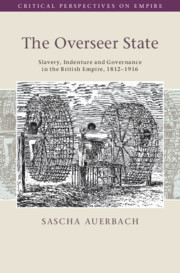
In this compelling work, Sascha Auerbach offers a bold new historical interpretation of late-stage slavery, its long-term legacies, and its entanglement with the development of the modern state. In the wake of abolition, from the Caribbean to southern Africa to Southeast Asia, a fusion of government authority and private industry replaced the iron chains of slavery with equally powerful fetters of law and regulation. This 'overseer-state' helped move, often through deceptive and coercive methods, millions of Indian and Chinese indentured laborers across Britain's imperial possessions. With a perspective that ranges from Parliament to the plantation, the book brings to light the fascinating and terrifying history of the world's first truly global labor system, those who struggled under its heavy yoke, and the bitter legacies left in its wake.
Joe Cleary’s Modernism, Empire, and World Literature critiques Casanova’s theory of World Literature and adapts it to a new model of transatlantic modernism. This review essay recasts Cleary’s theory through a Caribbean perspective by applying it to the poetry and early career of Claude McKay