Refine search
Actions for selected content:
285 results
A maximum problem of stopping time for correlated random walks
-
- Journal:
- Probability in the Engineering and Informational Sciences , First View
- Published online by Cambridge University Press:
- 05 October 2026, pp. 1-9
-
- Article
-
- You have access
- Open access
- HTML
- Export citation
-
Let
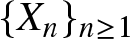 $\{X_n\}_{n \geq 1}$ be a Markov chain taking values in
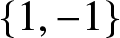 $\{1, -1\}$ with transition probabilities
 \begin{align*} p = P(X_{n+1} = 1 \,\,|\,\, X_n = 1)\ ,\ q = P(X_{n+1} = -1 \,\,|\,\, X_n = -1). \end{align*}
Define a correlated random walk
 $(S_n)_{n\ge0} ,S_0=0$ and
 $S_n=\sum_{i=1}^n X_i,n\ge1$. Let
 $A$ and
 $B$ be positive integers, and define a stopping time
 \begin{equation*} \tau = \inf \{ n \geq 1 : S_n = A \text{ or } S_n = -B \}. \end{equation*}
Using the martingale approach, Pozdnyakov [4] (Martingale approach to gambler’s ruin problem for correlated random walks. Journal of Applied Probability 62(4): 1594–1606.) derived the expected stopping time
 $E(\tau)$.
This study investigates the monotonicity of
 $E(\tau)$ with respect to the parameters
 $p$ and
 $q$ under the condition of symmetric boundaries
 $A = B$. We prove that when
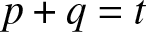 $p + q = t$ is fixed,
 $E(\tau)$ increases as
 $p$ increases from
 $0$ to
 $\frac{t}{2}$, which implies that
 $E(\tau)$ attains its maximum at
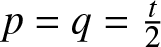 $p = q = \frac{t}{2}$.


Tighter bounds on the expected absorbing time of Ungarian Markov chains
- Part of
-
- Journal:
- Combinatorics, Probability and Computing , First View
- Published online by Cambridge University Press:
- 01 October 2026, pp. 1-41
-
- Article
-
- You have access
- Open access
- HTML
- Export citation
-
In
 $2023$, Defant and Li defined the Ungarian Markov chain
 $\mathbf{U}_L$ associated to a finite lattice
 $L$. This Markov chain has state space
 $L$, and from any state
 $x \in L$ transitions to the meet of
 $\{x\} \cup T$, where
 $T$ is a randomly selected subset of the elements of
 $L$ covered by
 $x$. For any lattice
 $L$, let
 $\mathcal{E}(L)$ be the expected number of steps until the maximal element of
 $L$ transitions into the minimal element in the Ungarian Markov chain. We show that
 $\mathcal{E}(L)$ is linear in
 $n$ when
 $L$ is the weak order on the symmetric group
 $S_n$, and satisfies an
 $n^{1-o(1)}$ lower bound when
 $L$ is the
 $n^{\text{th}}$ Tamari lattice. This completely resolves a conjecture by Defant and Li and partially resolves another.


19 - Random Processes on Networks
- from Part III - Network Models
-
- Book:
- Networks
- Published online:
- 11 June 2026
- Print publication:
- 25 June 2026, pp 570-594
-
- Chapter
- Export citation
20 - Introduction to Reinforcement Learning
- from Part VI - Reinforcement Learning
-
- Book:
- Introduction to Machine Learning
- Published online:
- 05 February 2026
- Print publication:
- 18 December 2025, pp 471-520
-
- Chapter
- Export citation
A necessary and sufficient condition for the unique solution of the Bellman equation for LTL surrogate rewards
-
- Journal:
- Research Directions: Cyber-Physical Systems / Volume 3 / 2025
- Published online by Cambridge University Press:
- 04 November 2025, e6
-
- Article
-
- You have access
- Open access
- HTML
- Export citation
10 - Markov Chains
-
- Book:
- Probability Theory for Quantitative Scientists
- Published online:
- 24 July 2025
- Print publication:
- 14 August 2025, pp 249-288
-
- Chapter
- Export citation
Online matching for the multiclass stochastic block model
- Part of
-
- Journal:
- Journal of Applied Probability / Volume 62 / Issue 4 / December 2025
- Published online by Cambridge University Press:
- 21 July 2025, pp. 1360-1381
- Print publication:
- December 2025
-
- Article
-
- You have access
- HTML
- Export citation
Martingale approach to gambler’s ruin problem for correlated randomwalks
- Part of
-
- Journal:
- Journal of Applied Probability / Volume 62 / Issue 4 / December 2025
- Published online by Cambridge University Press:
- 15 July 2025, pp. 1594-1606
- Print publication:
- December 2025
-
- Article
-
- You have access
- HTML
- Export citation
-
The gambler’s ruin problem for correlated random walks (CRWs), both with and without delays, is addressed using the optional stopping theorem for martingales. We derive closed-form expressions for the ruin probabilities and the expected game duration for CRWs with increments
 $\{1,-1\}$ and for symmetric CRWs with increments
 $\{1,0,-1\}$ (CRWs with delays). Additionally, a martingale technique is developed for general CRWs with delays. The gambler’s ruin probability for a game involving bets on two arbitrary patterns is also examined.


The replicator coalescent
- Part of
-
- Journal:
- Journal of Applied Probability / Volume 62 / Issue 4 / December 2025
- Published online by Cambridge University Press:
- 24 June 2025, pp. 1534-1548
- Print publication:
- December 2025
-
- Article
-
- You have access
- Open access
- HTML
- Export citation
-
We consider a stochastic model, called the replicator coalescent, describing a system of blocks of k different types that undergo pairwise mergers at rates depending on the block types: with rate
 $C_{ij}\geq 0$ blocks of type i and j merge, resulting in a single block of type i. The replicator coalescent can be seen as a generalisation of Kingman’s coalescent death chain in a multi-type setting, although without an underpinning exchangeable partition structure. The name is derived from a remarkable connection between the instantaneous dynamics of this multi-type coalescent when issued from an arbitrarily large number of blocks, and the so-called replicator equations from evolutionary game theory. By dilating time arbitrarily close to zero, we see that initially, on coming down from infinity, the replicator coalescent behaves like the solution to a certain replicator equation. Thereafter, stochastic effects are felt and the process evolves more in the spirit of a multi-type death chain.

17 - Coarse-Graining
-
- Book:
- Stochastic Thermodynamics
- Published online:
- 09 June 2025
- Print publication:
- 19 June 2025, pp 324-337
-
- Chapter
- Export citation
Coupling results and Markovian structures for number representations of continuous random variables
- Part of
-
- Journal:
- Journal of Applied Probability / Volume 62 / Issue 4 / December 2025
- Published online by Cambridge University Press:
- 28 April 2025, pp. 1340-1359
- Print publication:
- December 2025
-
- Article
-
- You have access
- HTML
- Export citation
-
Consider nested subdivisions of a bounded real set into intervals defining the digits
 $X_1,X_2,\ldots$ of a random variable X with a probability density function f. If f is almost everywhere lower semi-continuous, there is a non-negative integer-valued random variable N such that the distribution of
 $R=(X_{N+1},X_{N+2},\ldots)$ conditioned on
 $S=(X_1,\ldots,X_N)$ does not depend on f. If also the lengths of the intervals exhibit a Markovian structure,
 $R\mid S$ becomes a Markov chain of a certain order
 $s\ge0$. If
 $s=0$ then
 $X_{N+1},X_{N+2},\ldots$ are independent and identically distributed with a known distribution. When
 $s>0$ and the Markov chain is uniformly geometric ergodic, there is a random time M such that the chain after time
 $\max\{N,s\}+M-s$ is stationary and M follows a simple known distribution.


Markov Chains with Asymptotically Zero Drift
- Lamperti's Problem
-
- Published online:
- 24 April 2025
- Print publication:
- 08 May 2025
Hitting times on the lollipop graph
-
- Journal:
- Probability in the Engineering and Informational Sciences / Volume 39 / Issue 4 / October 2025
- Published online by Cambridge University Press:
- 07 March 2025, pp. 486-519
-
- Article
-
- You have access
- Open access
- HTML
- Export citation
A non-convex optimization approach of searching algebraic degree phase-type representations for general phase-type distributions
- Part of
-
- Journal:
- Advances in Applied Probability / Volume 57 / Issue 3 / September 2025
- Published online by Cambridge University Press:
- 03 March 2025, pp. 1101-1137
- Print publication:
- September 2025
-
- Article
-
- You have access
- HTML
- Export citation
An Asymptotic Likelihood Ratio Test for a Markov Chain with Bernoullian or Contingent Input
-
- Journal:
- Psychometrika / Volume 33 / Issue 4 / December 1968
- Published online by Cambridge University Press:
- 01 January 2025, pp. 405-422
-
- Article
- Export citation
The Markov chain embedding problem in a one-jump setting
- Part of
-
- Journal:
- Journal of Applied Probability / Volume 62 / Issue 2 / June 2025
- Published online by Cambridge University Press:
- 09 December 2024, pp. 674-696
- Print publication:
- June 2025
-
- Article
-
- You have access
- Open access
- HTML
- Export citation
-
The embedding problem of Markov chains examines whether a stochastic matrix
 $\mathbf{P} $ can arise as the transition matrix from time 0 to time 1 of a continuous-time Markov chain. When the chain is homogeneous, it checks if
 $ \mathbf{P}=\exp{\mathbf{Q}}$ for a rate matrix
 $ \mathbf{Q}$ with zero row sums and non-negative off-diagonal elements, called a Markov generator. It is known that a Markov generator may not always exist or be unique. This paper addresses finding
 $ \mathbf{Q}$, assuming that the process has at most one jump per unit time interval, and focuses on the problem of aligning the conditional one-jump transition matrix from time 0 to time 1 with
 $ \mathbf{P}$. We derive a formula for this matrix in terms of
 $ \mathbf{Q}$ and establish that for any
 $ \mathbf{P}$ with non-zero diagonal entries, a unique
 $ \mathbf{Q}$, called the
 ${\unicode{x1D7D9}}$-generator, exists. We compare the
 ${\unicode{x1D7D9}}$-generator with the one-jump rate matrix from Jarrow, Lando, and Turnbull (1997), showing which is a better approximate Markov generator of
 $ \mathbf{P}$ in some practical cases.


QUASI-ERGODICITY OF COMPACT STRONG FELLER SEMIGROUPS ON
 $L^2$
- Part of
-
- Journal:
- Journal of the Institute of Mathematics of Jussieu / Volume 24 / Issue 2 / March 2025
- Published online by Cambridge University Press:
- 14 November 2024, pp. 541-584
- Print publication:
- March 2025
-
- Article
-
- You have access
- Open access
- HTML
- Export citation
-
We study the quasi-ergodicity of compact strong Feller semigroups
 $U_t$,
 $t> 0$, on
 $L^2(M,\mu )$; we assume that M is a locally compact Polish space equipped with a locally finite Borel measue
 $\mu $. The operators
 $U_t$ are ultracontractive and positivity preserving, but not necessarily self-adjoint or normal. We are mainly interested in those cases where the measure
 $\mu $ is infinite and the semigroup is not intrinsically ultracontractive. We relate quasi-ergodicity on
 $L^p(M,\mu )$ and uniqueness of the quasi-stationary measure with the finiteness of the heat content of the semigroup (for large values of t) and with the progressive uniform ground state domination property. The latter property is equivalent to a variant of quasi-ergodicity which progressively propagates in space as
 $t \uparrow \infty $; the propagation rate is determined by the decay of
 . We discuss several applications and illustrate our results with examples. This includes a complete description of quasi-ergodicity for a large class of semigroups corresponding to non-local Schrödinger operators with confining potentials.


 . We discuss several applications and illustrate our results with examples. This includes a complete description of quasi-ergodicity for a large class of semigroups corresponding to non-local Schrödinger operators with confining potentials.
Efficiency of reversible MCMC methods: elementary derivations and applications to composite methods
- Part of
-
- Journal:
- Journal of Applied Probability / Volume 62 / Issue 1 / March 2025
- Published online by Cambridge University Press:
- 18 September 2024, pp. 188-208
- Print publication:
- March 2025
-
- Article
-
- You have access
- HTML
- Export citation
-
We review criteria for comparing the efficiency of Markov chain Monte Carlo (MCMC) methods with respect to the asymptotic variance of estimates of expectations of functions of state, and show how such criteria can justify ways of combining improvements to MCMC methods. We say that a chain on a finite state space with transition matrix P efficiency-dominates one with transition matrix Q if for every function of state it has lower (or equal) asymptotic variance. We give elementary proofs of some previous results regarding efficiency dominance, leading to a self-contained demonstration that a reversible chain with transition matrix P efficiency-dominates a reversible chain with transition matrix Q if and only if none of the eigenvalues of
 $Q-P$ are negative. This allows us to conclude that modifying a reversible MCMC method to improve its efficiency will also improve the efficiency of a method that randomly chooses either this or some other reversible method, and to conclude that improving the efficiency of a reversible update for one component of state (as in Gibbs sampling) will improve the overall efficiency of a reversible method that combines this and other updates. It also explains how antithetic MCMC can be more efficient than independent and identically distributed sampling. We also establish conditions that can guarantee that a method is not efficiency-dominated by any other method.

1 - Topics in representation theory of finite groups
-
-
- Book:
- Groups and Graphs, Designs and Dynamics
- Published online:
- 11 May 2024
- Print publication:
- 30 May 2024, pp 1-86
-
- Chapter
- Export citation
29 - Coupled Systems and Diagonalisation
-
- Book:
- Mathematics for Economics and Finance
- Published online:
- 24 May 2024
- Print publication:
- 30 May 2024, pp 334-346
-
- Chapter
- Export citation
