To save content items to your account,
please confirm that you agree to abide by our usage policies.
If this is the first time you use this feature, you will be asked to authorise Cambridge Core to connect with your account.
Find out more about saving content to .
To save content items to your Kindle, first ensure no-reply@cambridge.org
is added to your Approved Personal Document E-mail List under your Personal Document Settings
on the Manage Your Content and Devices page of your Amazon account. Then enter the ‘name’ part
of your Kindle email address below.
Find out more about saving to your Kindle.
Note you can select to save to either the @free.kindle.com or @kindle.com variations.
‘@free.kindle.com’ emails are free but can only be saved to your device when it is connected to wi-fi.
‘@kindle.com’ emails can be delivered even when you are not connected to wi-fi, but note that service fees apply.
In the third book of his Annals, Tacitus interrupts his account of Tiberius’ reign to present an extensive digression on Roman legal history, beginning with humanity’s earliest days during the proverbial ‘Golden Age’, and ending in the Early Principate. This article posits that the passage is central to our understanding of Tacitus’ legal thinking, and suggests that his handling of existing narrative traditions allows him to present a notably sceptical approach to the law. By comparing Tacitus’ account of Roman legal history to that of other authors, and placing it within the wider context of legal themes within his work, it becomes clear that he presents the law not as an inherently civilizing force but rather as a potential tool for oppression. However, this does not mean that the legal excursus amounts to little more than a straightforward narrative of legal decline: Tacitus introduces a number of strategic ‘bright spots’, suggesting that, while the law is always in danger of becoming repressive, it can in fact be used for good—although this beneficial use is aspirational rather than self-evident, and is in danger of being undermined by many different parts of Roman society.
This chapter reframes veneficium not as a form of magic but as a Roman category for theorizing causation at a distance, tracing how philosophers, jurists, and poets grappled with the conditions under which harm could occur without observable contact. By treating “witchcraft” as a comparative prompt rather than an emic term, the chapter shows that debates over veneficium reveal Roman efforts to manage uncertainty about agency, efficacy, and the mechanics of harm.
This chapter overturns the standard narrative of Roman law’s criminalization of magic, showing that magia never operated as a coherent legal category but as a flexible, improvisational placeholder invoked in moments of political anxiety and elite rivalry. Drawing on late antique codes, the Sententiae of Paulus, Tacitus, and Apuleius, it argues that legal ambiguity – not codification – was the primary mechanism by which accusations of magia functioned in Roman governance.
The Latin slogan iudex non calculat is on the rise. It appears in well over thirty English-language journals and a federal court decision in the United States; in Germany, more than sixty law journal articles mention the phrase in their titles alone, and German members of parliament have used it more frequently in the years 2020–2023 than in most previous decades combined. The phrase gets invoked as an “ancient”, “antique”, or “Roman” maxim of legal and political practice in Europe and the U.S. alike. Does this show how shared history unites even dissimilar legal systems? Hardly so. There is no general understanding of what the maxim is supposed to mean, or where it actually originated, or what rhetorical effect it serves. An exploration of these questions reveals a fascinating story of intellectual export across the Atlantic: The phrase is not, as commonly assumed, of Roman or antique origin, although it must be considerably older than 1850. It must have originated in Germany, where we find the oldest occurrences and whose authors, topics, and journals clearly drive its international propagation since 1947. There are at least four different interpretations of the maxim, each with opposing connotations, making it a versatile tool in lawyers’ rhetorical kit. While academics seem to use it mostly to produce an aura of erudition and epistemological authority, politicians employ it as an offensive or defensive quip mostly among male conservatives. Among German law students, it is by far the best-known principle, maxim or proverb related to law and numbers, although students, too, disagree about its exact meaning. While they acknowledge that the maxim has become part of German lawyers’ professional identity, many wish it were otherwise.
In this chapter, we set out a very brief history of English and Australian law in order to provide you, in broad strokes, with an outline of the historical background against which our modern law has developed. You should not consider this chapter merely a brief outline of old stories. Ask yourself, each step of the way: how did this era help to set up our current era? What aspects of modern life can be said to be affected by these aspects of our history? What should we be learning from this history? What should be preserved? And what should we ensure never happens again?
Chapter 4 discusses the life and thought of Samuel Eisenstadt, one of the founders of the Tel Aviv School of Law and Economics. Eisenstadt was a Russian-born Jewish legal scholar. His career spanned pre-revolutionary Russia, the Soviet Union, Mandatory Palestine, and Israel. His legal scholarship drew on the German Historical School, which viewed law as a historical and cultural phenomenon, and on Marxist legal theory, which described law as an instrument of class struggle. Eisenstadt sought to show the superiority of Jewish law, for example, by arguing that traditional institutions of Jewish legal education were better than Western ones because of their non-elitist and non-materialist nature, or by arguing for a genealogy of labor and international law which located its origins in the Bible. Eisenstadt was also engaged in apologetic efforts to defend the more problematic aspects of Jewish law, such as its treatment of slaves and women. Eisenstadt’s legal thought provides an example of the intersection of legal nationalism and socialism, and the attempt to reconcile Jewish traditions with progressive ideology.
Beyond Magic in the Roman World reconsiders how Romans understood ritual, deviance, and alterity by moving past the modern category of 'magic.' Instead of treating magic as a single system, Andrew Durdin reveals how Roman authors used labels of ritual deviance to negotiate cultural diversity, social tension, and political authority. Drawing on texts from the late Roman Republic through the Principate, and written by Cicero, Lucan, Pliny, Tacitus, and Apuleius, he offers clear, engaging explanations as to how Romans classified the unfamiliar. The result is a vivid portrait of a society using language, accusation, and imagination to make sense of an expanding world. Durdin's book equips readers with the tools to recognize how scholarly categories – especially 'magic' – carry colonial and imperial legacies that shape interpretation. Accessible and compelling, his study will appeal to readers of Roman history, ancient religion, and anyone curious about how cultures create – and contest – categories of difference.
This chapter explores the concepts of territory and jurisdiction in the Greek and Roman worlds, challenging modern assumptions rooted in the state-centric, post-Westphalian model of international law. It argues that ancient understandings of space, sovereignty and legal authority were fluid, overlapping and shaped by networks of cities, trade routes and personal affiliations rather than fixed territorial boundaries. The chapter examines how jurisdiction operated through principles of personality and polity, with legal pluralism prevailing across empires. Roman legal innovations, such as the concept of jus gentium and the universal jurisdiction of emperors, are analysed as early forms of supranational legal authority. The chapter also addresses the limits of jurisdiction, including the treatment of pirates and the emergence of humanistic legal protections. By tracing the evolution of spatial and legal thought from the polis to the Roman Empire and into late Antiquity, the chapter reveals how ancient practices laid conceptual foundations for modern international law while remaining distinct in form and function.
This chapter charts the origins of the classical law of civil war. It observes the doctrine’s roots in the old Roman ius gentium and argues that the classical doctrine itself was born in the early modern period alongside the European colonial empires and the Westphalian understanding of the law of nations. The chapter then illustrates this process by examining in detail the impact of insurgent prize jurisdictions and belligerent counter-revolutionary actions on foreign diplomacy during the Dutch Revolt (1566–1648) and the English Civil War (1642–1651).In light of these events, the chapter summarises the key doctrinal developments of the law of civil war in the writings of Grotius, Gentili, and their contemporaries, and the crystallisation of the classical doctrine of civil war in Emer de Vattel’s Droit des gens. The chapter concludes here, having set the scene for the legal debates of the age of revolutions.
Roman law is justly famous, but what was its relationship to governing an empire? In this book, Ari Z. Bryen argues that law, as the learned practice that we know today, emerged from the challenge of governing a diverse and fractious set of imperial subjects. Through analysis of these subjects' political and legal ideologies, Bryen reveals how law became the central topic of political contest in the Roman Empire. Law offered a means of testing legitimacy and evaluating government, as well as a language for asking fundamental political questions. But these political claims did not go unchallenged. Elites resisted them, and jurists, in collaboration with emperors, reimagined law as a system that excluded the voices of the governed. The result was to separate, for the first time, 'law' from 'society' more broadly, and to define law as a primarily literate and learned practice, rather than the stuff of everyday life.
How do the property rights that are explored in this volume compare with those of women in the different world of ‘modern’ Europe. Welch and Scott examine several situations, including pre-1870 England, Scotland, revolutionary and post-revolutionary France and the states that would go to make up Germany after unification. Each of these contexts was different in itself, but none offered to women the same potential for agency as did ancient Rome, even though even in Rome gender circumscribed that agency in many important ways. Moreover, a significant divergence can be seen between legal systems that favoured English/Norman notions of coverture (whereby a married woman was largely denied legal personhood) and those that maintained a relationship with the Roman past. The conclusions that can be drawn from a necessarily brief and selective survey are significant. Some of the rights at law that Roman women enjoyed were denied to many European women until well into the lifetime of the authors of this chapter and are still denied to many others alive today. There is no doubt that Roman women of different social levels and over different historical situations suffered in different ways under the weight of gender expectations but the law did not stand in their way as it did in other contexts. Even more importantly, the industrial revolution had a profound impact on the economic roles of (especially) middle-class women in the nineteenth century, resulting in a new belief that a respectable married woman stayed at home and ran the house. When male writers of Roman history wrote their narratives, they wrote about Roman women in ways that reflected their own prejudices and attitudes towards a ‘woman’s place’. No history runs in a straight line, including the history of women. An awareness of the variability of contexts for women allows us to appreciate what was different about Rome as well as the way things both change and remain the same.
This chapter explores the relationships between regulations (laws, senatorial decrees) and female visibility in Republican Rome. The focus is on the earliest epigraphic and literary evidence for regulations mentioning women, citizen and non-citizen. Key examples include the senatus consultum de Bacchanalibus (186 BCE), one of the Clusium Fragments (late second to early first century BCE), the lex Osca Tabulae Bantinae (100–91 BCE), the Tabula Heracleensis (post-Social War), the lex Coloniae Genetivae (59 to 44 BCE), as well as Cicero’s references to a lex on female mourning from the XII Tabulae (Twelve Tables), the lex Voconia of 169 BCE and the pontifical responsum and senatus consultum on the Vestal Licinia in 123 BCE. These are compared with Republican regulations attested in later sources. This chapter argues that these regulations rendered some women visible, both physically and symbolically, and that they offer us valuable insight into women’s agency, authority and property in the Roman Republic.
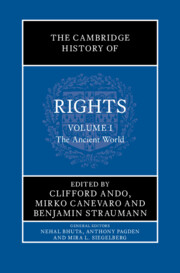
The ancient world existed before the modern conceptual and linguistic apparatus of rights, and any attempts to understand its place in history must be undertaken with care. This volume covers not only Greco-Roman antiquity, but ranges from the ancient Near East to early Confucian China; Deuteronomic Judaism to Ptolemaic Egypt; and rabbinic Judaism to Sasanian law. It describes ancient normative conceptions of personhood and practices of law in a way that respects their historical and linguistic particularity, appreciating the distinctiveness of the cultures under study whilst clarifying their salience for comparative study. Through thirteen expertly researched essays, volume one of The Cambridge History of Rights is a comprehensive and authoritative reference for the history of rights in the global ancient world and highlights societies that the field has long neglected.
The purpose of this Element is to introduce the study of later Roman law (Byzantine law) to a wider academic audience. Currently a great deal of specialized knowledge is necessary to approach the field of Byzantine law. This Element works to break down the barriers to this fascinating subject by providing a brief, clear introduction to the topic. It makes a scholarly contribution by placing Byzantine law in a broader perspective and by reconsidering some of the aspects of the study of Byzantine law. The Element places Byzantine law outside of the box by comparing, for example, Byzantine law to the European legal tradition and highlighting the role that Byzantine law can have in unravelling the common legal past of Europe. It gives also information on the status of Byzantine legal studies and makes suggestions on how to study Byzantine law and why.
For Sultan Alau’ddin, the ruler of Gowa on South Sulawesi between 1596 and 1639, the freedom of the seas was paramount. His kingdom, centred on the city of Makassar, was ideally situated as a maritime crossroads between the Java Sea and the spice islands of Maluku. International traders, including Chinese, Malay, and European ships, frequented Makassar’s harbour, profiting from the policies of open navigation sanctioned by the sultan. Yet in 1615, another maritime power that recently had become active in the area, the Dutch East India Company (VOC), sought to undermine Makassar’s position by establishing a monopoly on the spice trade. When the conflict escalated, Sultan Alau’ddin sent a message to the Company’s governor-general and strongly repudiated Dutch attempts to restrict navigation and trade in the area: ‘God made the land and the sea; the land He divided among men and the sea He gave in common.
There are many reasons why Roman law probably shouldn’t be included in a study tracing the origin of rights. Roman law, first of all, was the law of an ancient slaveholding civilization, built on a ruthless legacy of war and conquest. As any student of Roman law will know, slavery was interwoven into the fabric of Roman law, making it impossible to understand fully how the Roman legal system operated without recognizing the everyday legal reality of Roman slavery. Practically every aspect of Roman law depended on whether those subject to it were legally free or slave. Given this illiberal legacy of slavery and the basic inequality of status encoded into Roman law, it’s difficult to see how Roman law could plausibly serve as a model for theorizing rights.
This chapter addresses the profound indebtedness of the Spanish Inquisition to its medieval predecessor. Both were grounded in the procedures and priorities of ancient Roman law. The text explains the concept of “heresy” within Christianity, as well as the ways in which medieval European rulers -- popes and monarchs -- worked together in an attempt to stamp out public, persistent, and intentional religious dissent. The essay charts the structural formation of the Spanish Inquisition after 1478, and examines the processes that were eventually standardized. It addresses questions of proof and legal discretion, as well as potential defense maneuvers by suspects. It raises the frequency of torture and describes more and less typical punishments, which Spanish inquisitors called “penances” in accordance with their overarching pastoral goals. Finally, this essay addresses the pivotal question of support for the Inquisition from below, namely, from ordinary Spaniards.
Founded in 1478 and not permanently abolished until 1834, the Spanish Inquisition has always been a notorious institution in history as an engine of religious and racial persecution. Yet, Spaniards themselves did not create its legal processes or its theoretical mission, which was to reconcile heretics to the Catholic Church. In this volume, leading international scholars assess the origins, legal practices, victims, reach, and failures of Spanish inquisitors across centuries and geographies. Grounded in recent scholarship and archival research, the chapters explore the Inquisition's medieval precedents as well as its turbulent foundation and eradication. The volume examines how inquisitors changed their targets over time, and how literal physical settings could affect their investigations and prosecutions. Contributors also demonstrate how deeply Spanish inquisitors cared about social status and legal privilege, and explore the scandals that could envelop inquisitors and their employees. In doing so, this volume offers a nuanced, contextual understanding of the Spanish Inquisition as a historical phenomenon.
In Latin ius (like droit in French, diritto in Italian, Recht in German) can mean a whole body of normative rules, a legal order, as well as “right,” in the many senses of the English word. Early in the last century, Wesley Newcomb Hohfeld proposed that English speakers resolve the ambiguity about the meaning of “right,” at least in precise legal language, by using the word “right” only where there was a correlative “duty” in another or others. If there was no correlative duty, but simply an absence of right in someone else (a “no-right”), Hohfeld preferred to say that the subject had a “privilege.” Hohfeld also proposed four other “fundamental legal categories”: “power” (another word that is sometimes encompassed in “right”), “immunity” (also sometimes encompassed in “right”), “liability,” and “disability,” categories that referred to the subject’s ability or lack thereof to change the first set of categories.
The concept of rights as the bedrock of legal systems arose in modernity. This fact derives from a variety of contingent circumstances, some historical, others epistemological. Yet the building blocks from which the edifice of rights discourse is constructed were assembled and shaped in premodernity. The oldest strata in the quarry from which legal rights derive is surely classical, insights and postulates explored first by the Greeks beginning in the fifth century bce and incorporated into legal praxis through Roman law, particularly in the high imperial centuries. They were then kept alive and further developed in the late Middle Ages when the twelfth- and thirteenth-century glossators and in turn the fourteenth-century nominalist William of Ockham first articulated most of the principles out of which the sixteenth-century Spanish scholastics, seventeenth-century humanists, and eighteenth-century social contract theorists would develop full-fledged elaborations of rights-based law.