To save content items to your account,
please confirm that you agree to abide by our usage policies.
If this is the first time you use this feature, you will be asked to authorise Cambridge Core to connect with your account.
Find out more about saving content to .
To save content items to your Kindle, first ensure no-reply@cambridge.org
is added to your Approved Personal Document E-mail List under your Personal Document Settings
on the Manage Your Content and Devices page of your Amazon account. Then enter the ‘name’ part
of your Kindle email address below.
Find out more about saving to your Kindle.
Note you can select to save to either the @free.kindle.com or @kindle.com variations.
‘@free.kindle.com’ emails are free but can only be saved to your device when it is connected to wi-fi.
‘@kindle.com’ emails can be delivered even when you are not connected to wi-fi, but note that service fees apply.
The place of hippocamps in the Graeco-Roman cultural imagination was highly uneven, as they appeared prominently in visual media, but were exceedingly rare in ancient literary sources. Hippocamps can be demonstrated to be a mythological creature wholly derived from art, but which never prominently made a transition into narrative storytelling. These half-horse, half-marine animals were, then, accompanied, from the Hellenistic period onwards, by a series of other marine Mischwesen (‘mixed beings’), a grouping that I demonstrate to be related to the sea monster of the ancient world, the κῆτος (pl. κήτη). This article further examines this grouping of imaginary animals as a case study to consider the imaginative construction of such figures as a result of cultural assumptions about nature, rather than mere misapprehensions of real animals alone. In this case, it is the notion that the undersea world was essentially reflective of the terrestrial world, containing such ‘sea versions’ of land mammals.
With her politically engaged writing and innovative adaptations, Stef Smith is one of the most distinctive voices in contemporary British theatre. She first gained recognition in 2010 for Roadkill, which won an Olivier Award, and her later plays, such as Swallow (2015), Girl in the Machine (2017), and Enough (2019), have been staged internationally. While each of these pieces attests to the playwright’s ability to confront such urgent social issues as technology, gender, and identity, the focus of her 2016 play Human Animals is on humans’ fragile relationship with animals and the wider environment. By foregrounding animals as literal and symbolic agents, the play challenges its audiences to reconsider the boundaries between human and non-human animals, and the ethical implications of survival. In this interview, conducted in December 2025, Tuğba Aygan talks to Stef Smith about Human Animals. Their discussion highlights Smith’s creative process, thematic concerns, and her insights into our relationship with non-human animals.
This chapter asserts that J. M. Coetzee’s ostensibly surprising turn to questions of religion in “The Jesus Novels” should have been anticipated from his trajectory of concerns since the novels of the late 1990s. Through a genetic reading of Disgrace that extensively uses Coetzee’s notebooks and drafts for the novel, I show how this work posits the reality of souls, human and nonhuman, and imagines how that reality can reorient the self away from abusive uses of others and toward practices of care. This reading of Disgrace traces how Coetzee dismantles previous forms of Western perception through an anti-epiphany, opening the way for belief in souls to produce a better form of life and seeing others. The chapter closes by considering how the Jesus novels further develop the life of spiritual contemplation that Coetzee’s late style explores.
How are insects both visible and invisible? To return to the eighteenth century is to see the moment when they were assigned to entomological science but not to literary forms like the realist novel. The results of this dual movement include the separation of man from animal and human from non-human, leading us to think of ourselves as distinct from the natural world. This book addresses how the rise of the novel, contemporaneous with emerging entomology, shaped a sense of the “real,” as well as the “real” human conditions of terrestrial existence. The theoretical underpinnings for the argument include animal studies, material ecocriticism, and critical insect studies, with recourse to critics such as Jane Bennett. Key concepts include horizontal thinking, vibrant materiality, entanglement, symbiosis, and holobiont. The chapter closes with the words of Ed Yong, acknowledging the vital natural networks in which we find ourselves.
Following a brief historical overview of the birth of the organised movement, Chapter 1 introduces literary figures and texts promoted by antivivisection periodicals such as the Zoophilist, the Home Chronicler, and the Animals Guardian. Adopting a literary-critical approach offers a fresh perspective on the movement’s association pamphlets and periodicals which have, thus far, largely been examined as historical documents. Poems, stories, and ‘humane words’ from notable writers were sourced and deployed to shape a common antivivisectionist identity, articulate the movement’s ideology, and mobilise activists. Analysis of antivivisection poems by Christina Rossetti, Robert Browning, Alfred Tennyson, and Robert Buchanan is complemented by attention to the framing and reception of these works in antivivisection publications and the wider press.
This is the third in a trilogy of articles for NTQ addressed to the ‘noises off’ supplied by Shakespeare’s earliest co-stars: the baited bears that competed for trade, fame, and patronage for the duration of his career as an actor-playwright. ‘Shakespeare and the Three Bears’ (NTQ 106, May 2011) sketched this context, exposing as a canard, via a mistakenly omitted comma, that there ever was a bear named Harry Hunks. ‘Shakespeare and the Naming of Bears’ (NTQ 135, August 2018) examined the influence of these rival entertainments on the structure and detail of Romeo and Juliet. ‘Shakespeare’s Polar Bears’ now expands that investigation by seeking to offer a long view of the dramatist’s association with, and attention to, such foul animal ‘sports’, and to supply a comprehensive context for the most famous stage direction in theatre history.
This chapter offers an overview of historians’ writings about scale and their debates on micro- and macrohistory in the past half century. It is argued that the complex debates between followers of Italian microstoria, members of the Annales school, and social and cultural historians in the Anglo-American world need to be considered in the context of similar discussions and experiments with scale in literary writings, in artworks and especially in the scholarship in human geography. The chapter claims that, in an era of human-made climate crisis, we should reconsider how we conceptualise the role of particles, microbes, parasites, worms, and other animals in historical writing, going beyond the dichotomy of micro- and macrohistory. It is proposed that the geographer Neil Smith’s concept of ‘jumping scales’ is an especially productive way of discussing how hierarchical power structures are established and disrupted by agents operating at levels that range from the microscopical to the global.
The Xuanquan postal station is to date the most well-documented example of a working postal station from the Han period. This paper presents a corpus of 115 excavated horse names recorded in Xuanquan administrative documents. Analysis of these names not only clarifies what tasks these horses were expected to perform at the station, but two unique naming conventions further articulate the complex relationships forged between humans and horses at this frontier site: giving horses human surnames and venerating aged horses. This article thus centers the act of naming individual animals as being of significant importance for future studies of human-animal interactions.
Through close analyses of a wide range of Minoan animalian things, we have explored the specificity of their involvements in the experiences of people, and how those engagements contributed to the unique character of sociocultural life in the Aegean, on various levels. Here we draw out key points from across the foregoing analyses. Special attention has come to the objects’ inter-corporeal relationships with living humans and the connections that would have been realized through the objects’ particular qualities—connections with other animals, things, and spaces. Such relations were afforded through different dynamics, including bodily juxtaposition, cultivation of formal assonance, the sharing of specific features (e.g., a forward gaze), and embodiment with the same substances, as well as through similarities in size, composition (e.g., in friezes), and contextualization. Moreover, by working beyond an implicit focus on the design of the objects, to instead emphasize people’s actual experiences with them, we have opened the space for appreciating how both intended and unintended associations involving these complex things were in play together. We should view these not as alternative lenses on the objects, but as forces working concurrently, and upon one another, in the creative realizations that the animalian objects were.
The introduction provides an overview of current theoretical concepts in animal and environmental studies for examining historical equine-human relations and previews the book chapters. The author argues that the embodied experiences of historical horses created real-world entanglements with the political and social structures that aimed to define or control them. This animal imprint, made visible in governance structures, was one way that animals participated in early modern social relations and imperial ecologies, and also gave rise to numerous possibilities for feral or counter-intentional responses within an expanding early modern empire.
The sociocultural spaces of the “Minoan” Aegean were teeming with animal bodies. Many of these animals were alive, but many were not—and never had been; the latter are our focus here. Realized across a range of media, such as zoomorphic vessels, frescoes, and seal stones, animals’ bodies took on a rich diversity of material and spatial qualities that could afford distinctive interactive experiences that the notion of “representations” fails to capture. By recognizing both biological and fabricated entities as real embodiments of animals, which could coexist and interact in Aegean spaces, the nature of our discussion changes. We see that the dynamics of representation were caught up in a much wider field of relationships involving these crafted bodies, which characterized their engagements with people. Doing so moves us beyond questions of signification and intentional design, and toward a fuller recognition of people’s actual experiences of animalian bodies. Looking closely at a variety of venues, ranging from palatial courts to a modest house bench, our focus thus can turn to how the world of animalian things was a crucial part of social life in Aegean spaces, and how direct interactions with these other animal bodies were central, yet often overlooked and minimized, components of human relations with nonhuman beasts.
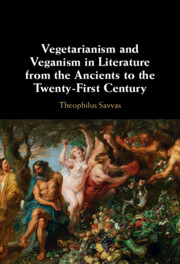
Vegetarianism and Veganism in Literature from the Ancients to the Twenty-First Century re-assesses both canonical and less well-known literary texts to illuminate how vegetarianism and veganism can be understood as literary phenomena, as well as dietary and cultural practices. It offers a broad historical span ranging from ancient thinkers and writers, such as Pythagoras and Ovid, to contemporary novelists, including Ruth L. Ozeki and Jonathan Franzen. The expansive historical scope is complemented by a cross-cultural focus which emphasises that the philosophy behind these diets has developed through a dialogic relationship between east and west. The book demonstrates, also, the way in which carnivorism has functioned as an ideology, one which has underpinned actions harmful to both human and non-human animals.
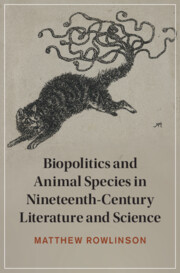
Michel Foucault argued that in the nineteenth century, the species became a population and became subject to political management. Foucault’s claim defines the political stakes of this book, whose point of departure is the loss of a theological ground for the species concept. As species become targets of political power, they become mutable and historically contingent. The book argues that a result is that species come to be identified with aesthetic categories and with symptomatic or unmotivated behaviors.
Principles of species taxonomy were contested ground throughout the nineteenth century, including those governing the classification of humans. Matthew Rowlinson shows that taxonomy was a literary and cultural project as much as a scientific one. His investigation explores animal species in Romantic writers including Gilbert White and Keats, taxonomies in Victorian lyrics and the nonsense botanies and alphabets of Edward Lear, and species, race, and other forms of aggregated life in Darwin's writing, showing how the latter views these as shaped by unconscious agency. Engaging with theoretical debates at the intersection of animal studies and psychoanalysis, and covering a wide range of science writing, poetry, and prose fiction, this study shows the political and psychic stakes of questions about species identity and management. This title is part of the Flip it Open Programme and may also be available Open Access. Check our website Cambridge Core for details.
This article examines the dog-like aspects and associations of two marine monsters of Graeco-Roman antiquity: Scylla and the κῆτος. Both harbour recognizably canine features in their depictions in ancient art, as well as being referenced as dogs or possessing dog-like attributes in ancient texts. The article argues that such distinctly canine elements are related to, and probably an extension of, the conceptualization of certain marine animals, most prominently sharks, as ‘sea dogs’. Accordingly, we should understand these two sea monsters and the sea dogs as being interrelated in the ancient imagination. Such a canine resonance to certain sea creatures offers a valuable insight into the Graeco-Roman imagination of the marine element as being the abode of creatures reminiscent of terrestrial dogs.
This chapter addresses a topic – health – that has come to light in the context of the Covid-19 pandemic. Bringing together animal studies and the medical humanities, the chapter examines key texts from Leo Africanus, William Shakespeare, Daniel Defoe, and others to trace close historical and discursive relationships between human and animal health. Focusing largely on diseases thought to be what we would now call zoonotic, or transferable from nonhuman animals to humans, the chapter seeks to make apparent the significance of cross-species infections that, before antibiotics and most vaccines, helped shape literature, trade, health, and imperial order. Although rabies provided the most recognizable model of cross-species infection, the chapter begins with locust swarms, which offered many Christian writers a model for articulating global connections between pests and pestilence, then turns to shipboard rats, which, even before germ theory, were thought by many early moderns to function as harbingers of death and disease. Having demonstrated how deeply cross-species contagion was entangled with theological definitions about what it is be human, the chapter ends by exploring a little known topic – early modern and eighteenth-century cattle plague – and its implications for reimagining a multispecies medical posthumanities.
The introduction charts the ways in which literary studies and animal studies have formed a mutually enriching dialogue. Starting with a selection of contemporary short stories, and exploring questions of exploitation, anthropomorphism, and metaphor, it demonstrates how animals alter the way we think about, write, and read literature. The introduction includes a summary of the chapters contained in the book.
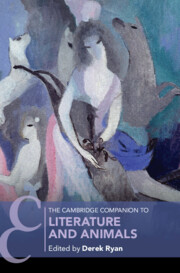
The Cambridge Companion to Literature and Animals surveys the role of animals across literary history and opens conversations on what literature can teach us about more-than-human life. Leading international scholars comprehensively explore how engaging with creatures of various kinds alters our understanding of what it means to write and read, and why this is important for thinking about a series of cultural, ethical, political, and scientific developments and controversies. The first part of the book offers historically rooted arguments about medieval metamorphosis, early modern fleshiness, eighteenth-century imperialism, Romantic sympathy, Victorian racial politics, modernist otherness and contemporary forms. The second part poses questions that cut across periods, concerning habitat and extinction, captivity and spectatorship, race and (post-)coloniality, sexuality and gender, religion and law, health and wealth. In doing so, this companion places animals at the centre of literary studies and literature at the heart of urgent debates in the growing field of animal studies.
Edited by
Deepak Cyril D'Souza, Staff Psychiatrist, VA Connecticut Healthcare System; Professor of Psychiatry, Yale University School of Medicine,David Castle, University of Tasmania, Australia,Sir Robin Murray, Honorary Consultant Psychiatrist, Psychosis Service at the South London and Maudsley NHS Trust; Professor of Psychiatric Research at the Institute of Psychiatry
Schizophrenia spectrum disorders are psychiatric conditions that express by a wide range of symptoms. Current treatments are effective in controlling so-called positive symptoms (e.g., delusions or hallucinations) but are often less effective for negative symptoms (e.g., blunted affect and passive social withdrawal) as well as for cognitive impairments. Further, current anti-psychotics may induce several side-effects that limit use and patient adherence. Therefore, mechanistically novel anti-psychotics are urgently needed. Cannabidiol, a major cannabinoid of Cannabis sativa, has been investigated in both animal models for aspects of schizophrenia, clinical studies, and controlled trials. Animal studies have raised substantial evidence for cannabidiol’s anti-psychotic effects. While controlled clinical trials have shown mixed results, studies using cannabidiol at higher dosages have demonstrated its ability to ameliorate psychotic symptoms while showing a relatively benign side-effect profile. Although the currently available data is short of any proof justifying the registration of cannabidiol as an anti-psychotic at present, the data from phase II clinical trials justify further study of cannabidiol’s antipsychotic properties in controlled clinical trials to clarify its therapeutic value and safety profile, notably in long-term treatment. In addition, more insight into its mechanisms of action may broaden our understanding of new targets for treatment.
Dogs have played a vital and varied role in the social history of early China. Whether used as a source of food, a hunting-aid, or a sacrificial victim, dogs were intimately connected with human life and death. The placement and significance of dismembered and slaughtered dogs in human tombs have been a source of scholarly interest across the twentieth and twenty-first centuries. However, less attention has been paid to sources which present us with a spectrum of concerns surrounding the treatment of dogs after their death. Should they be consumed, discarded, or buried? Which dogs were deserving of burial, and how were such burials viewed by human commentators? By analysing textual, archaeological, and material sources, this article explores the changing conceptualisation of dogs in life and in death through the medium of the tomb, showing how the transition from tomb-keeper to tomb-occupant reflects an increasingly anthropomorphic view of canine potential and moral fibre by the early medieval period.