To save content items to your account,
please confirm that you agree to abide by our usage policies.
If this is the first time you use this feature, you will be asked to authorise Cambridge Core to connect with your account.
Find out more about saving content to .
To save content items to your Kindle, first ensure no-reply@cambridge.org
is added to your Approved Personal Document E-mail List under your Personal Document Settings
on the Manage Your Content and Devices page of your Amazon account. Then enter the ‘name’ part
of your Kindle email address below.
Find out more about saving to your Kindle.
Note you can select to save to either the @free.kindle.com or @kindle.com variations.
‘@free.kindle.com’ emails are free but can only be saved to your device when it is connected to wi-fi.
‘@kindle.com’ emails can be delivered even when you are not connected to wi-fi, but note that service fees apply.
This chapter traces the maturation of Palermo’s architectural idiom across a network of local churches in the Kalsa and Loggia districts. Designed in collaboration with itinerant architects from southeastern Sicily and the Iberian Mediterranean, these early sixteenth-century monuments bear the mark of local builders and craftsmen fluent in ornamental and structural solutions inherited from the Normans. In Palermo’s contested cultural environment, building sites became laboratories for the development of a speculative architecture that tested the limits of architectural revivalism. Local practices of vernacularization and historicization developed against the backdrop of the city’s rich humanistic tradition, which creatively reimagined Palermo’s proximate and distant pasts.
In 2025, the Chinese National Museum of Ethnology commissioned newly stitched Dragon Boat Festival toys from state-certified intangible cultural heritage practitioners. The toys sat behind glass reserved for fragile antiquities and remained in storage after the exhibition closed, yet they were never accessioned as state-protected cultural property. Why would the museum not recognise as collectable an object it had commissioned, displayed, and preserved? An official and popular image of China as a continuous civilisation might read this hesitation as the cultural authority of antiquity at work. Drawing on 10 months of embedded fieldwork, we reverse this explanation. Following the toys from acquisition proposal to display case, we show that each stage produced decisions defensible under existing documents, rules, or display conventions. These decisions aligned with a grading habit that recognises value only where age or scarcity can already be claimed, so the toys’ newness and reproducibility predetermined their exclusion. What looks like a cultural disposition is therefore better understood as a set of museum policies and practices that we term the “gravity of antiquity”: the pull towards the old that a museum’s collection and the instruments calibrated to it exert on whatever arrives next, producing an exclusion no single decision intends but all cumulatively uphold.
At least ninety symphonies were written by English composers between c. 1920 and 1945. Given the number of compositions and composers, this chapter provides a broad overview of the range of symphonies, including general influences and trends. It is divided into three sections representing predominant approaches to the symphony and focuses on three case studies: choral symphonies (Gustav Holst’s First Choral Symphony), symphonies inspired by landscape (Granville Bantock’s Pagan Symphony) and ‘traditional’ symphonies (Arthur Bliss’s A Colour Symphony). All English symphonies composed during this time embrace experimentation and exploration, whether it be playing with late romanticism or exploiting new techniques and approaches. Some composers sought to create an English symphonic tradition, whereas others simply wanted to make their own mark on the genre. It is argued that given the number of symphonies composed during this time, coupled with the breadth of approaches, English symphonic writing not only endured but actively flourished during this period; furthermore, this body of work deserves to be more rigorously and carefully considered in scholarship.
This chapter critically examines the existence and conceptualisation of ‘international law’ in the Greek and Roman world from 600 BC to AD 650. It challenges traditional minimalist views that exclude antiquity from the history of international law and proposes a recalibrated approach grounded in conceptual history. By analysing legal practices, treaties and philosophical notions such as jus gentium and dikaion koinon, the chapter explores how ancient societies regulated interpolity relations. It introduces eight analytical dichotomies – such as inside/outside, city state/empire, and law/non-law – to frame the discussion. Through case studies on war, diplomacy, trade and dispute resolution, the chapter argues that while ancient international law did not exist in a modern sense, it functioned as a prototype for legal norms governing relations between autonomous entities. The chapter concludes that international law in antiquity was not merely a precursor but a meaningful legal system in its own right, shaped by the need to structure a complex and often hostile world.
Chapter 1 opens the book’s section on “Catholic antiquities,” which addresses Borromeo’s interactions with the diverse images he encountered in the churches of the Milanese diocese. It examines archival records of Borromeo’s church inspections, or visitations, to show that his reform of the church interior focused on the physical integrity of the images he encountered, sacred by virtue of their objecthood as well as their representational value. His emphasis on the sacred objecthood of images had implications for their perceived historicity. Borromeo folded Renaissance Raphaels, miraculous medieval mosaics, and contemporary artworks into the same long arc of ancient custom. If Giorgio Vasari wrote in his 1568 Lives of the Artists that antiquity ended with the fourth-century reign of Constantine, Borromeo’s definition of antiquity was far more flexible in its parameters. Borromeo’s views on the history of sacred images coalesced in a time of intense confessional debate, offering a decidedly Catholic understanding of the image’s antique authority.
This paper discusses the teaching of Ancient History in Brazil through the experience of Projeto Vocabulário Político da Antiguidade (Political Vocabulary of Antiquity Project). This project has been developed at the Federal University of Paraíba in João Pessoa, Brazil, since 2016, with a team consisting of professors and students from undergraduate History and Classics programs. The project’s main goal is to create didactical materials that facilitate the teaching of politics and Antiquity to students aged 11 to 17, based on the translation of Greek and Latin texts. This paper will present two educational games developed by this project to teach the theory of forms of government in an engaging and enjoyable way. The positive results of the project highlight the importance of modernizing the teaching of forms of government regbased on the works of authors such as Herodotus, Aristotle, Polybius and Cicero. Furthermore, it demonstrates that the study of Antiquity can effectively contribute to the political awareness of young citizens.
This chapter describes and analyzes the role that medicine has historically played in relation to broader cultural attachments to the idea of progress. It offers a historical overview of how the interest – or disinterest – in progress is entangled with contemporary understandings of what it means to be healthy or ill and the medical priorities of the time. Improved medical care had very different meanings depending on the respective value ascribed to individual and societal well-being, attitudes toward death, and the role of physicians. While contemporary ideas about medical progress rest on very different understandings of the human from other cultural and historical contexts, their emergence from a combination of scientific knowledge and ethical preoccupations recurs throughout history. Even as the capacity and desire to intervene in the human body with technological means has increased, both utopian and modest visions of progress in medicine have historical antecedents. The historical overview that follows is crucial for understanding how answers to the question “What is progress in medicine?” have always been contested and historically contingent.
In this book, Jonathan Valk asks a deceptively simple question: What did it mean to be Assyrian in the second millennium bce? Extraordinary evidence from Assyrian society across this millennium enables an answer to this question. The evidence includes tens of thousands of letters and legal texts from an Assyrian merchant diaspora in what is now modern Turkey, as well as thousands of administrative documents and bombastic royal inscriptions associated with the Assyrian state. Valk develops a new theory of social categories that facilitates an understanding of how collective identities work. Applying this theoretical framework to the so-called Old and Middle Assyrian periods, he pieces together the contours of Assyrian society in each period, as revealed in the abundance of primary evidence, and explores the evolving construction of Assyrian identity as well. Valk's study demonstrates how changing historical circumstances condition identity and society, and that the meaning we assign to identities is ever in flux.
This article examines the 19th-century ‘antiquities rush’ – the frenzy of archaeological digging, scientific expeditions, and straightforward looting of artefacts in the broader Mediterranean – through the framework of international status competition. To do this, I first situate material culture at the foundation of international status-seeking and demonstrate the importance of cultural objects as status symbols for states. I then elaborate two logics of status-seeking that explain why states engaged in massive cultural extraction practices in the early 19th century. The first logic is that of cultural custodianship, where states pursued status as guardians of the cultural heritage of humankind. The second logic is a claim to cultural descendance, where states sought recognition as cultural heirs of classical civilisations. Cultural extraction, therefore, was critical in the establishment of the 19th-century international cultural hierarchy. Echoes of these arguments reverberate today in the competing claims of ownership and restitution of these antiquities. To illustrate these arguments, the article focuses on the international competition between France and Great Britain over the extraction of antiquities, examining in detail the removal of the Parthenon Marbles from Athens at the turn of the 19th century.
The 1970s saw the rise of two unrelated and yet affine historical concepts: Late Antiquity (Brown 1971) and Post-Modernism (Lyotard 1979). It is almost as if the breakdown of Antiquity in the way it had been traditionally understood, clearly delineated from the Middle Ages and the Byzantine Empire, heralded the dissolution of the Modern Western self-understanding and everything that went with it. For Byzantine studies, it came with a flora of textual rediscoveries; but the gate that had opened onto the spiritual meadows of Late Antiquity could also be used to approach and contextualize Islam in a new way.
This chapter reviews the ancient Greek, Roman and Jewish evidence to discern the marriage practices the early Christians would have known. It lays the foundation for tracing the antiquity of customs attested in the later Byzantine sources. In addition to ancient texts, this chapter examines Roman artistic depiction of marriage in frescoes and funerary art.
Chapter 3 begins the conceptual history of the nation where our current vocabulary originates, in classical Greece and Rome. It examines the conception of cultural-linguistic communities in the context of the two principal alternatives to the nation-state – city-state and empire. The chapter moves from Greek conceptions of ethnicity as depicted in Herodotus’ Histories to Cicero’s reflections on the relationship between national and political communities in the Roman Empire and concludes with an examination of the idea of the nation in the Vulgate, the late fourth-century translation of the Bible. The analysis shows that ethnos, gens, and natio referred to communities defined by descent, language, and geographical homeland but were not understood in a political sense. Moreover, Roman thinkers were not only acutely aware of the twofold loyalties to nation and polity; they also sought practical arrangements for accommodating diverse national groups within a single political order. The chapter discusses Roman ideas on citizenship, administrative subsidiarity, and legal pluralism.
In premodernity, a time when human milk was the only safe means of infant nutrition, and in societies, such as those of classical antiquity and early Byzantium, where breastfeeding was considered servile work, wet-nursing was both a necessary and widespread occupation. Despite the social demand for the profession, public discourses around wet nurses were mostly negative, while their work was treated with both admiration and scorn. In an attempt to understand ancient and early Byzantine approaches to the wet nurse, this article takes a matricentric perspective. It investigates various discourses (rhetorical, moralist, philosophical, theological, hagiographical, medical and contractual) which establish the wet nurse as an essential part of the institution of motherhood, as a social and moral category whose work, way of life and behaviour are constantly defined, controlled and regulated. These discourses nevertheless tell us much more about the anxieties and preoccupations of the societies that produced them and much less about actual contemporary wet nurses. The choice of an investigation encompassing antiquity up to early Byzantium, an extension rarely seen in existing studies, further illuminates the mechanics and dynamics of the ideologies around the wet nurse, as these are preserved or evolve in time.
Chapter 13 examines the development of Weimar Classicism, from the impact of Goethe’s own experiences in Italy to his collaboration with Friedrich Schiller. A crucial factor in any classicism, including that of Goethe and Schiller, is the absence of the ancients, and the chapter argues that Weimar Classicism was far from the settled, canonical project for which it is often taken. Rather, it emerged from historical crisis, above all the French Revolution, and it is characterised by internal tensions, between antiquity and modernity, desire and restraint.
This chapter explores Michel Foucault’s impact on the history of sexuality by emphasizing the disparate and evolving nature of his work and its often-controversial influence on the history of sexuality as a field. The essay begins by summarizing the arguments of the four volumes of Foucault’s History of Sexuality, while recalling the project’s turbulent history. The first volume maintained that sexuality’s history in the West was characterized by an “incitement to discourse” (rather than repression) which sealed the “Faustian pact” between sexuality and the pursuit of truth, while also drawing sexuality into power relations. Yet Foucault’s interest in early Christian sexual practices led him to reorient his project towards an exploration of classical antiquity and the role played by sexuality in practices of subjectivity. The essay’s second part examines how historians of sexuality have drawn on Foucault’s insights, focusing on the divergences between historians influenced by Foucault’s first volume (dealing with knowledge and power) and those inspired by the latter volumes (prioritizing subjectivity). After examining Foucault’s impact on feminism and queer theory, the essay concludes by noting that many historians of sexuality have made productive use of Foucault’s work without concurring with his philosophical conclusions.
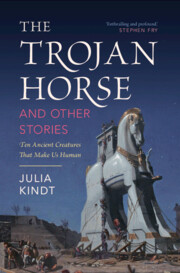
What makes us human? What, if anything, sets us apart from all other creatures? Ever since Charles Darwin's theory of evolution, the answer to these questions has pointed to our own intrinsic animal nature. Yet the idea that, in one way or another, our humanity is entangled with the non-human has a much longer and more venerable history. In the West, it goes all the way back to classical antiquity. This grippingly written and provocative book boldly reveals how the ancient world mobilised concepts of 'the animal' and 'animality' to conceive of the human in a variety of illuminating ways. Through ten stories about marvelous mythical beings – from the Trojan Horse to the Cyclops, and from Androcles' lion to the Minotaur – Julia Kindt unlocks fresh ways of thinking about humanity that extend from antiquity to the present and that ultimately challenge our understanding of who we really are.
This chapter looks into the constitutions of Antiquity, notably those of the Greek city states - the (old) constitution of Dreros and Athens (the Draconian and Solonian constitutions), and Rome - the twelve tables. Aristotle claims to have had access to 158 city state constitutions: every respectable city state had on. For the first time in history we see evidence that communities (cities) try to learn from examples set by other city-states. Rome, for example, sends out envoys to learn from (and copy) the Athenian constitution before enacting the laws in their own Twelve Tables
Victorian sculpture is less well-served by the scholarship than Victorian painting, and biblical sculpture ignored comparative to pieces inspired by Greco-Roman mythology. Rather than treat these as two separate strands, or, alternatively, assume that statues of Old Testament figures such as Eve and Rebecca were interchangeable with those of Venus and Psyche, this chapter thinks harder about how they relate. Looking first at free-standing sculpture, then at religious works in the private house, and finally at sculpture in the church, it hones in on affect to determine how the classical and biblical and the interactions and discrepancies between the two spoke to nineteenth-century British society, gender, belief and so on. As well as revisiting artists such as Thomas Woolner and John Gibson, it puts an emphasis too on women sculptors such as Emmeline Halse and on female representation, patronage and response to show that sculpture was as important in sermon-making as pictures.
This introductory article sets out the global historical approach adopted by the articles in this special issue, focusing on the circulations of goods, peoples, and ideas in ancient Afro-Eurasia (300 BCE-700 CE). Special attention is given to the overland Silk Road and Indo-Pacific networks of maritime exchange. Our aims are to apply globalization thinking to a wider (macro) frame than has arguably been done in existing ancient world studies, to ensure that sufficient focus is maintained on how the local and global intersect, and to demonstrate the analytical utility of concepts connected to globalization and glocalization. Ultimately, we seek to go beyond merely applying theories of globalization to new data, but to use these data to offer an alternative approach to the study of global Antiquity.
Why, when, and how did speakers of ancient Greek borrow words from Latin? Which words did they borrow? Who used Latin loanwords, and how? Who avoided them, and why? How many words were borrowed, and what kind of word? How long did the loanwords survive? Until now, attempts to answer such questions have been based on incomplete and often misleading evidence, but this study offers the first comprehensive collection of evidence from papyri, inscriptions, and literature from the fifth century BC to the sixth century AD. That collection – included in the book as a lexicon of Latin loanwords – is examined using insights from linguistic work on modern languages to provide new answers that often differ strikingly from earlier ones. The analysis is accessibly presented, and the lexicon offers a firm foundation for future work in this area.