To save content items to your account,
please confirm that you agree to abide by our usage policies.
If this is the first time you use this feature, you will be asked to authorise Cambridge Core to connect with your account.
Find out more about saving content to .
To save content items to your Kindle, first ensure no-reply@cambridge.org
is added to your Approved Personal Document E-mail List under your Personal Document Settings
on the Manage Your Content and Devices page of your Amazon account. Then enter the ‘name’ part
of your Kindle email address below.
Find out more about saving to your Kindle.
Note you can select to save to either the @free.kindle.com or @kindle.com variations.
‘@free.kindle.com’ emails are free but can only be saved to your device when it is connected to wi-fi.
‘@kindle.com’ emails can be delivered even when you are not connected to wi-fi, but note that service fees apply.
Craftworkers throughout history have nearly always worked anonymously, often as valuable assistants in the service of famed artisans but typically without proper credit or recognition. However, an unsigned piece can nevertheless reveal a world. While these craftworkers' names may be lost to history, their contributions can be properly acknowledged and their working realities in large part reconstructed through fresh methodological approaches to architectural, artefactual and epigraphic evidence and other sources. In this book, which will interest scholars in a wide range of fields, Hallie Meredith sheds new light on the crucially important but largely neglected work of fourth- to sixth-century Roman artists in traditional craft materials and processes, such as glass, ivory and marble carving. She uses these case studies to provide insights not just into the past but also into the continuing realities of uncredited creative labourers today.
The group portrait The Arctic Council planning a search for Sir John Franklin (1851) by Stephen Pearce is one of the best-known images associated with the Franklin expedition. However, the painting’s meaning and purpose have often been misunderstood from the beginning. Although it was a private commission from John Barrow, the Admiralty’s Keeper of the Records, the painting took on a public role as soon as it was completed, serving as a propaganda tool to garner support for the search for the missing Franklin expedition, in which Barrow had a strong personal interest. This article provides an exhibition and reception history of The Arctic Council, illustrating that it served as a propaganda tool at key moments during the search for Franklin and again assumed a propaganda role in the late 19th century, when British interest shifted to Antarctic exploration.
This chapter focuses on how Pater looked at the natural world and art. It discusses how he practiced and thought about the very act of looking. For him, this was both an acutely personal act, and something demanding recognition that the object being looked at has its own specificity – material, historical, and contextual. This chapter asks what qualities he retained as visual touchstones across the broad historical timespan, from the Greeks to the present day, that he addressed; and through the variety of different modes in which he captured the objects of sight – essays, reviews, fiction, and imaginary ‘portraits’ of figures from the past. It shows that all are unified by Pater’s habits of looking, including how he saw colour, and by the process of translation into verbal language, with attention to works including ‘Emerald Uthwart’ and Marius the Epicurean.
This chapter focuses on Pater’s most famous work, Studies in the History of the Renaissance, to provide an expansive context in which to understand its significance in intellectual, literary and art history. It begins by locating it: explaining the concept behind Pater’s collection of eleven essays in terms of publication history and the periodical press, and exploring the ways in which these essays combine silent citation with originality. Its sections concentrate on: (1) how and why Pater redefines the ‘renaissance’ from the ways in which it was conceived in the nineteenth century; (2) Pater’s definition of subjective aesthetic criticism, which reverses Matthew Arnold’s critical position, with particular attention to the Preface and Conclusion; (3) the centrality of desire and passion in text; (4) Pater’s subject-positioning between the ‘Old Masters’, modernity and his reader.
Although clinically framed as a public health concern, the meanings of suicide are fundamentally shaped by cultural narratives and visual representations.
Aims
To examine the evolution of sculptural representations of suicide from antiquity to the present, and to interpret these works through psychiatric and sociological lenses relevant to contemporary clinical and public health discourse.
Method
A structured search across PubMed, Scopus and Web of Science (up to August 2025) was integrated with museum archives and art-historical catalogues. Selected sculptural works were analysed as interpretive case studies using iconographic, semiotic and contextual approaches. Interpretation focused on affective and relational processes such as psychological pain (psychache), shame, entrapment and social disconnection prioritising cultural formulation over retrospective diagnostic attribution in historical cases.
Results
Sculptural representations frame suicide through shifting moral and social logics: from honour-bound self-death in antiquity and virtue-coded narratives in the early-modern period to interiority and estrangement in modernity. Contemporary public installations shift this focus towards visibility, urban space and prevention. These works externalise private suffering and structural conditions (e.g. isolation, stigma), actively shaping collective imaginaries of self-destruction.
Conclusions
Sculpture provides a unique medium for the translation of individual suffering and the collective meanings of suicide into public form. An interdisciplinary reading of these works supports culturally informed clinical reflection and contributes to ethically attentive public communication and prevention strategies.
Representations of martyrs are rare in early Christian art and largely render their pain and deaths invisible. Art’s unwillingness to confront devotees with images of violence and suffering contrasts with the visceral descriptions of martyrdoms in contemporaneous texts. These ekphrastic texts, some of which purport to describe violent paintings depicting the torture of saints, encouraged these same devotees to visualize and participatorily reperform the violence of these martyrdoms in their imaginations—spaces free from the dangerous interactivity and immediacy of physical vision. An examination of how these texts conceive of the (material) images they describe and the (mental) images they conjure demonstrates that representations of martyrdom varied fundamentally across text and image, as ekphrastic texts guided listeners to see beyond the literal in response to challenging physical sights. Martyrdoms were, at first, spectacles to be seen with the “eyes of the mind” and not the eyes of the body.
This chapter tests those Indigenous directions and artistic visions of learning environments with close readings of local-level expressions of religious and cultural learning. Anchored in Huejotzingo and Calpan, but contextualized with valley-wide initiatives, the chapter exposees Indigenous contributions to learning environments in ethno-spatial analysis. Artwork and architecture developments from 1550s are exemplified as local interpretations of Christianity and local traditions beyond European prescriptions. The chapter argues for a multicultural reading of the lessons imparted in church courtyards, showing how place-based pedagogy and preexisting modes of learning could have informed convent-goers’ takeaways. Instead of wholly Christian convents were partial and un-wholistic pedagogical expressions, ripe for Burkhart’s slippages. Practice and place-based observances could cause a survivance of local history and Indigenous knowledge to persist, working effectively alongside the dogmatic reading of church art. Here, the overarching vision of learning emerges with critical visual and material culture studies of biblical figures, placements, enjambments, and reassessments of Indigenous sources that may have offered some friction in design choices of architects of the perfect classrooms of colonialism.
Positioning Indian and Iranian elite tourists to the Tokugawa pilgrimage town of Nikko in relation to their European and American counterparts, this article shows how Meiji-era modern hotels served as mechanisms for an informal and amateur mode of learning about Japanese culture. What enabled Nawwab Hamid Ali Khan, Maharajah Jagatjit Singh, Mehdi Qoli Hedayat, and Ali Asghar Khan to visit the inland shrine town was its integration into the modern tourist infrastructure of the Meiji period by way of the rail connection to Tokyo; the construction of the Kanaya Hotel; and the availability of guides and guidebooks. Consequently, Nikko—and the Kanaya Hotel in particular—functioned as venues for pioneering Indian and Middle Eastern encounters with ‘authentic’ Japanese culture, subsequently published in Urdu and Persian. Japan’s ties to a global tourist system of hotels, restaurants, guides, guidebooks, postcards, photographs, and souvenirs thus contributed not only to Euro-American Japonisme, but also to nascent Indian and Middle Eastern appreciations of Japanese culture.
How did the living world – bodies, time, motion, and natural environment – frame the art of early medieval Britain and Ireland? In this study, Heather Pulliam investigates how the early medieval art produced in Britain and Ireland enabled Christian audiences to unite with and be 'dissolved' in an intangible divinity. Using phenomenological and eco-critical methodologies, she probes intersections between art objects, the living world, and the embodied eye. Pulliam analyses a range of objects that vary in scale, form, and function, including book shrines, brooches worn on the body, and reliquaries suspended in satchels. Today, such objects are discussed, displayed, and illustrated as static rather than mobile objects that human bodies wore and that accompanied them as they travelled through landscapes animated by changing weather, seasons, and time. Using the frame as a heuristic device, she questions how art historical studies approach medieval art and offers a new paradigm for understanding the role of sacred objects in popular devotion.
The book’s introductory chapter opens with a discourse on the power of images, arguing that long-standing practices of image use and veneration came under increased scrutiny during the religious reforms that followed the Council of Trent, broadly considered the Catholic response to the Protestant Reformation. It introduces the reader to the book’s argument, namely, that the pressures of Catholic reform increased the power of images, in contrast to stereotypes of late sixteenth-century art as stylistically regressive. It spends time elaborating on the book’s guide, the cardinal-archbishop Carlo Borromeo, arguing that this stodgy reformer is the best way to tell this story about the power of images after Trent.
This chapter examines the fictions of nautch dancers painted by local artists (patuas) in nineteenth-century Kalighat paintings from Bengal. Part I, ‘Bazaar Art, Bazaari Women’, highlights key features and techniques of Kalighat paintings in representing the female/courtesan figure (or Bibi). Part II, ‘Patuas and Performance’, discusses the intimacy between visual and performance worlds in Kalighat paintings, noticing how patuas borrowed gestures and bodies from Bengal’s performance forms such as jatra and khemta. Through contemporary social satires and reviews produced by caste-privileged, Bengali male authors, the chapter tracks a growing anti-nautch narrative targeting the baiji and khemta dancers of Bengal whilst popular circulation of their imagery through Kalighat paintings flourished. Part III, ‘Murdering Dance’, examines two real murders: the 1873 Tarakeshwar case, a sensational event that rocked Calcutta and was captured in several notable Kalighat paintings, and the 1875 Sonagachi murder case of Golap, a sex worker in Calcutta. Visual traces of these two murders are read as part of an anti-nautch discourse in which colonial law and native patriarchy centred violence against a dancer’s body within debates on female sexual desire and deviance, and against which subaltern women performed their insurgent gestures of refusal.
Chapter 3 observes the stark contrast between long-standing practices of market opacity and secrecy in the field of cultural property and current legal, professional, reputational, and ethical trends that promote a requirement to engage in due diligence in dealing with cultural property. It then highlights the changing role and scope of provenance research, which has evolved from a highly selective focus on an object’s “career highlights” to promote its value to the task of identifying potential “dark holes” in the chain of title and possession of an item since its creation or discovery. This changing paradigm can be largely attributed to the renewed interest, as of the 1990s, in the history of items that may have been involuntarily lost by their Jewish owners during the Nazi era. This chapter shows how the professionalization and systematization of provenance research, while taking different forms across various jurisdictions in Europe and beyond, may prove essential for promoting provenance research on the history of other cultural items, such as colonial-era objects.
Katharine Bradley and Edith Cooper caught the new enthusiasm for Renaissance Italy among writers, artists, critics, and historians that was so prominent a feature of British culture in the second half of the nineteenth century. Particularly influential was Walter Pater’s Studies in the History of the Renaissance (1873), which celebrates the multiple temporalities of the Renaissance, its reconciliation of pagan and Christian, and its capacious embrace of the ancient past and a dynamically conceived modernity. Michael Field’s collection of ekphrastic lyrics Sight and Song (1892) is dominated by the Renaissance art that inspired the art and writing of many in the poets’ circle, including Pater himself, Ruskin, Browning, Rossetti, Swinburne, the Berensons, Vernon Lee, Ricketts, Shannon, Beardsley, and Wilde. This chapter argues that it was these artists and writers, all drawn to fifteenth- and sixteenth-century Italy, who collectively established the most significant context for Michael Field’s creative engagement with the Renaissance.
AI and Image illustrates the importance of critical perspectives in the study of AI and its application to image collections in the art and heritage sector. The authors' approach is that such entanglements of image and AI are neither dystopian or utopian but may amplify, reduce or condense existing societal inequalities depending on how they may be implemented in relation to human expertise and sensibility in terms of diversity and inclusion. The Element further discusses regulations around the use of AI for such cultural datasets as they touch upon legalities, regulations and ethics. In the conclusion they emphasise the importance of the professional expert factor in the entanglements of AI and images and advocate for a continuous and renegotiating professional symbiosis between human and machines. This title is also available as Open Access on Cambridge Core.
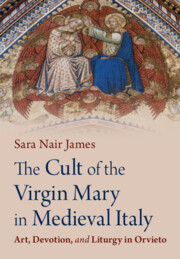
Late medieval Italy witnessed the widespread rise of the cult of the Virgin, as reflected in the profusion of paintings, sculptures, and fresco cycles created in her honor during this period. The cathedral of papal Orvieto especially reflects the strong Marian tradition through its fresco and stained-glass window narrative cycles. In this study, Sara James explores its complex narrative programs. She demonstrates how a papal plan for the cathedral to emulate the basilica of S. Maria Maggiore in Rome, together with Dominican and Franciscan texts, determined the choices and arrangement of scenes. The result is a tour de force of Marian devotion, superior artistry, and compelling story-telling. James also shows how the narratives promoted agendas tied to the city's history and principal religious feasts. Not only are these works more interesting, sophisticated, and theologically rich than previously realized, but, as James argues, each represents the acme in their respective media of their generation in central Italy.
Abstract: Anne attended Vassar College as an undergrad. In college, Anne played basketball, field hockey and lacrosse. After winter break, she no longer felt like herself, stayed in her room listening to the Rubber Soul album on repeat, and had violent thoughts. One morning, overcome by a panic, Anne ran outside screaming. Her friends raced after her and forced her to go to the little health center on campus. After a while, a psychiatrist asked Anne about the problem. She said nothing, but after a few days, it was clear she would not be let out until she talked. She told the psychiatrist she wanted to kill people. He asked Anne what she wanted to do in life, and she told him she wanted to be a doctor. He said it was a bad idea; she should take some time off from school. Eventually, her depression, which lasted for months, stopped on its own, but it was not the last time she would be depressed. Anne spent summers in Chicago working at local hospitals. Anne got good grades. She was a chemistry major and philosophy and art history minor. Anne’s pediatrician suggested she apply to institutions offering a combined MD/PhD program so she could work in the lab and/or with patients. She graduated summa cum laude in chemistry and thirteenth in the 1969 class of 400.
Chapter 14 presents a dynamic model of long-term, art historical trends and shows the complexity of overlapping styles and movements. It is based on a modification af a dynamic model of development on the timescale of the human life course. The basic evolution rules are those of simultaneously operating processes of consolidation of the status quo and processes of innovation driven by a familiarity-novelty optimum. The simulation explores different scenarios, one of which generates the typical art-historical pattern of overlapping continuous as well as discontinuous processes.
Chapter 10 focuses on the time scale of art history, which spans centuries or even millennia. It begins by showing how art historical processes can be interpreted in terms of complex dynamic systems. It then discusses patterns of art historical change, from linear to stepwise to metastable change. The chapter addresses the question of continuity and discontinuity in art history from both quantitative and qualitative perspectives. Finally, it discusses how the concepts and methods of network theory can help us to understand the complex dynamics of artworlds.
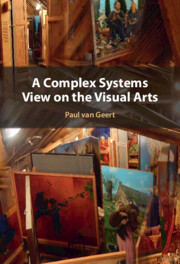
This book presents a comprehensive and unexpected approach to the visual arts, grounded in the theories of complexity and dynamical systems. Paul van Geert shows how complexity and dynamical systems theories, originally developed in mathematics and physics, offer a novel perspective through which to view the visual arts. Diverse aspects of visual arts as a practice, profession, and historical framework are covered. A key focus lies in the unique characteristics of complex systems: feedback loops bridging short- to long-term temporal scales, self-organizing into creative emergent properties; dynamics which may be applied to a wide range of topics. By synthesizing theory and empirical evidence from diverse fields including philosophy, psychology, sociology, art history, and economics, this pioneering work demonstrates the utility of simulation models in deciphering a surprisingly wide range of phenomena such as artistic (super)stardom and shifts within art historical paradigms.
Political monuments are characterized by visual materiality that allows for and indeed invites engagement; the claim for permanence; and the force of visual presence. Caesar’s monuments, especially on the Capitol, signalled a decidedly new quality of presence irreconcilable with the fine balance of individual achievement and public recognition. The rules behind this balance were flexible, but collective consensus always retained the upper hand. The balance tipped only with Pompey’s enormous theatre complex on the Campus Martius. The complex created a new type of public space, and it set the precedent for Caesar, who took on the challenge of competition with his own Forum project. Such an omnipresent dynamic of increase provoked heavy polemics and fierce conflict, but this violence was not only tolerated but reckoned with as a possibility from the very start. It appeared more appropriate to accept repeated violation of tradition while still affirming it than to develop a fundamentally different, new ‘system’ of norms and behaviours. The mode of permanent transgression was indicative not only of a political culture in crisis but also of a culture of crisis.