To save content items to your account,
please confirm that you agree to abide by our usage policies.
If this is the first time you use this feature, you will be asked to authorise Cambridge Core to connect with your account.
Find out more about saving content to .
To save content items to your Kindle, first ensure no-reply@cambridge.org
is added to your Approved Personal Document E-mail List under your Personal Document Settings
on the Manage Your Content and Devices page of your Amazon account. Then enter the ‘name’ part
of your Kindle email address below.
Find out more about saving to your Kindle.
Note you can select to save to either the @free.kindle.com or @kindle.com variations.
‘@free.kindle.com’ emails are free but can only be saved to your device when it is connected to wi-fi.
‘@kindle.com’ emails can be delivered even when you are not connected to wi-fi, but note that service fees apply.
This chapter explores the chamber music of Maconchy, delving into her creative process, influences, and the socio-political context in which she worked and highlighting her commitment to chamber music – especially the string quartet – as a medium for personal expression and intellectual discourse. The paper situates her work within the broader landscape, drawing connections to Bartók and Brahms. It discusses the challenges Maconchy faced as a woman in a male-dominated field, including limited performance opportunities and the perception of her music as elitist. Through case studies of key works, such as her Oboe and String Quintet and Fourth String Quartet, it illustrates her innovative use of instrumentation and thematic development. Ultimately, it argues that Maconchy’s chamber music is a vital contribution to the cultural and political dialogues of her time and calls for a re-evaluation of her music in light of its technical rigour and expressive depth.
The chapter provides an overview of the genre landscape of Maconchy’s work. Taking as its starting point the string quartets that have historically been the focus of interest in Maconchy, it traverses that landscape across the range of other chamber (and few keyboard works), her orchestral music, works for music theatre and vocal music, both solo and choral. The chapter points out noteworthy features of her oeuvre: her proclivity for works with a concertante element, in chamber as in orchestral music; works straddling the line between chamber and orchestral music; the increasing individuation of titles in her later work; the many works with a diminution in the title. It also briefly touches upon the uneven treatment of her works by the record industry and scholarship, with the string quartets and, to a lesser degree, other chamber music at one end and the many vocal works at the other.
This chapter discusses the standards of form Price established in her Piano Concerto, Violin Concerto No. 1 in D Major, and her chamber works created through incorporation of African American forms, procedures, and harmonies. Contextualized within what the author calls New Negro modernism, Price’s concertos and chamber works reinforce our understanding of her style and introduce us to her unique approach to conversational balance, form, virtuosity, and orchestration within these genres.
This chapter explores the understudied role of music in Dutch private social life during the long nineteenth century. Examining a wide variety of cases and sources, it reveals that many of the country’s diversified early modern private musical practices persisted until the outbreak of the First World War. The chapter shows how music functioned as social and cultural capital in the way it shaped the agendas and identities of both hosts and guests. By tracing contemporaries’ expectations and experiences related to the social functions of music, the study highlights how they internalized intersecting societal ideas with regards to social groups. It shows that the Dutch were divided into various emotional-musical communities that shared emotional as well as musical norms, preferences, and behaviors. Uncovering processes of social exclusion as a key characteristic of Dutch private music sociability, the chapter concludes that “salons” were not as harmless as often assumed.
Fanny Hensel inherited a tradition of powerful salonnières and redefined it for her time. She navigated gendered constraints on her music career via her Sonntagsmusiken, which were private yet highly curated performances that prioritized music just as much as conversation. Hensel’s social and religious concerns shaped many of her choices, initially confining her to informal settings and to a secondary role as her parents launched her brother’s career. However, her early exposure to Berlin’s elite musical circles allowed her to analyze areas for improvement in Berlin’s musical culture, and she embarked on a mission to raise the level of musical excellence and taste in her circle. This study examines key milestones in Hensel’s journey, highlighting shifts in the number of performers, performance formats, genres, and complexity. Hensel’s evolving approach to musical gatherings reflected broader nineteenth-century tensions between domesticity and professionalization, and shaped her eventual legacy far beyond her Berlin salon.
This chapter explores the rich yet understudied tradition of salon music making in Vienna around 1800, positioning it as a crucial counterpart to the emerging public concert culture. While historical narratives have emphasized the establishment of the classical canon in public performance spaces, this chapter highlights the private and semiprivate salon gatherings that flourished in response to sociopolitical constraints, including censorship and war. By examining memoirs, publishing catalogues, and iconography, the study reveals how salons sustained an abiding taste for operatic arrangements in intimate settings. Viennese salons, while influenced by French traditions, developed distinct characteristics, particularly in their emphasis on men’s leadership, class exclusivity, and music’s centrality. The chapter also considers gendered performance practices, the impact of sociopolitical shifts post-1815, and the evolution of salon repertoire. By tracing the adaptation of public works for private settings, this study repositions salons as vital spaces of musical engagement and cultural continuity.
This chapter reappraises Debussy’s Piano Trio of 1880 and his two substantial cello pieces of 1882, in the light of having edited them for the Œuvres complètes de Claude Debussy. Surviving documentation suggests that Debussy, while working for Nadezhda von Meck in summer 1880, aimed at producing a Trio in Russian character, one that may even have played a part in prompting Tchaikovsky’s Trio of two years later. The structural cohesion and character of the work are also reassessed, including the editorial challenge of completing a passage for which only a cello part survives. Similar reappraisal is applied to Debussy’s two cello pieces of 1882, and clarification offered of the titling of one of the pieces, which has long been labelled Nocturne et Scherzo (despite being neither): that title appears to have been mistakenly carried over from a pair of entirely different violin pieces now lost.
As well as being a virtuoso pianist, Louise Farrenc became the first woman to hold a permanent position as Professor at the Paris Conservatoire while continuing to compose symphonic and chamber music. This handbook introduces readers to Farrenc and her contemporaries with a focus on professional women musicians in nineteenth-century Paris. Farrenc's music was much admired by her contemporaries including Robert Schumann and Hector Berlioz. The acclaimed Nonet (1849) incorporated playful dialogue within the ensemble, virtuosic display, and an artful balance of newer and older compositional methods, garnering critical and artistic success and official recognition for the composer. Its performance history shows how musicians managed the logistics of professional life: forming and sustaining relationships, organizing concerts and tours, and promoting their work in the musical press. The book's nuanced analytical approach and historical insights will allow students, performers and listeners a fresh appreciation of Farrenc's work.
Farrenc worked within a network of musicians devoted to chamber music, including a dozen or more women pianists who specialized in the Classical repertoire. In the early decades of the nineteenth century, violinists like Pierre Baillot and Jean-Delphin Alard established chamber music concerts that created a culture of enthusiasm for string quartets and quintets, piano trios, and large ensemble music. Pianists like Farrenc, Thérèse Wartel, Sophie Pierson-Bodin, and Clara Loveday specialized in the performance of chamber music in the 1830s–50s, which allowed them to establish professional careers within a social environment that placed strict limits on “respectable” women and their activities in public spaces. Wartel established the Society for Classical Music, which presented septets, octets, and nonets for winds and strings to the Paris public for the first time. Farrenc composed her Nonet for the members of this group of virtuoso wind and string players, who performed it together in her solo concert in 1850.
A stylistic shibboleth of musical romanticism and early modernism, the breakthrough figures as a salient expressive device in many of Webern’s tonal compositions. This chapter sheds light on the aesthetic function that energetic thresholds fulfil in Webern’s early work, through a close analysis of the Piano Quintet (1907). Described by Theodor W. Adorno as an ‘amalgamation of Brahmsian with Wagnerian elements’, the quintet engages a complex dialectic between ‘formal’ and ‘material’ meaning strata. Linking this dialectic to what is termed the ‘agitating impulse’, a motivic idea set up in the opening bars that adamantly strives towards its resolution yet which is consistently frustrated, this chapter construes the various waves pervading the work not as emancipatory gestures but corporeal manifestations of a subcutaneous anxiety. As such, it is suggested that the quintet offers an original contribution to ‘Romantic’ sonata form practices, and a novel interpretation of the breakthrough.
Although the guitar was primarily used to accompany singing in Victorian England sophisticated chamber arrangements of music by Beethoven and Mozart were circulating in manuscript during the first decades of Victoria’s reign. This repertoire is almost entirely unknown and is discussed here for the first time. Duets for guitar and pianoforte were also fairly abundant into the 1840s. There was also a clear sense, especially among music publishers with a vested interest in the notion, that a ‘classical’ solo repertoire of guitar music had emerged during the first third of the century when the instrument was in fashion. Yet although there were still notable solo players towards mid-century, such as Joseph Anelli, making a career as a ‘serious’ guitar player, which had always been a precarious business was by 1850 virtually impossible, at least in Britain. Even Anelli’s concert programmes started to show the influence of the many popular entertainers who had begun to use the guitar, explored in the next chapter.
More than half of Schubert’s chamber works from 1824 to 1828 feature his preferred instrument, the piano. Yet in none of them does it function as an instrumental accompaniment, being instead an equal participant in a duo or trio chamber format. Especially in solo chamber works written for performance in recitals by befriended virtuoso instrumentalists, Schubert was perfectly willing to adapt the style brillant that flourished between 1820 and 1830. Based on the assumption that Schubert applied the style brillant solely for reasons of economy, his virtuoso chamber music has previously been considered to be of lesser value, mentioned only in passing. More recently, however, his turn to extroverted forms of expression has been described as a deliberate counterfoil to the introverted sublimation of his other ‘late’ works. This chapter considers the Fantasy in C Major (D934) and Variations in E Minor on ‘Trockne Blumen’ (D802) to show how Schubert discovered the sophisticated and outgoing mannerisms of the style brillant; it also discusses the development of ornamented variation techniques as an alternative to thematic development, and how this shift of emphasis between musical substance and figuration seems to anticipate the aesthetics of the Romantic arabesque.
This chapter gives a practical overview of writing for a variety of chamber music scenarios, from the traditional (e.g. string quartet) to the unusual (e.g. tuba trio). It describes how to respond to the existing canon of music for ensemble, as well as being creatively inspired by performers in rehearsal situations.
Exploring the many dimensions of Debussy's historical significance, this volume provides new perspectives on the life and work of a much-loved composer and considers how social and political contexts shape the way we approach and perform his works today. In short, focused chapters building on recent research, contributors chart the influences, relationships and performances that shaped Debussy's creativity, and the ways he negotiated the complex social and professional networks of music, literature, art, and performance (on and off the stage) in Belle Époque Paris. It probes Debussy's relationship with some of the most influential '-isms' of his time, including his fascination with early music and with the 'exotic', and assesses his status as a pioneer of musical modernism and his continuing popularity with performers and listeners alike.
Unlike operatic and orchestral music, chamber music, in common with song, thrived in the salons and the Société nationale. It was a rich period for chamber-music composition, with many works establishing a distinctively French style for genres like the string quartet (just as the French symphony came to distinguish itself from German models). Debussy was at his least idiosyncratic in his one published string quartet, which may be seen as an attempt to conform to expectations, at least in some aspects of the genre. Late in life he chose to distil the most personal features of his style in six chamber works, which pay tribute to remote French traditions, even though only three of these works were completed. The chapter concludes with a consideration of some of the attempts to complete Debussy’s incomplete set of six sonatas, of which he lived to complete only three.
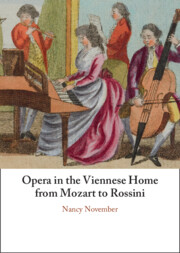
Domestic musical arrangements of opera provide a unique window on the world of nineteenth-century amateur music-making. These arrangements flourished in especially rich variety in early nineteenth-century Vienna. This study reveals ways in which the Viennese culture of musical arrangements opened up opportunities, especially for women, for connoisseurship, education, and sociability in the home, and extended the meanings and reach of public concert life. It takes a novel stance for musicology, prioritising musical arrangements over original compositions, and female amateurs' perspectives over those of composers, and asks: what cultural, musical, and social functions did opera arrangements serve in Vienna c.1790–1830? Multivalent musical analyses explore ways Viennese arrangers tailored large-scale operatic works to the demands and values of domestic consumers. Documentary analysis, using little-studied evidence of private and semi-private music-making, investigates the agency of musical amateurs and reinstates the central importance of women's roles.
The brief introduction situates Hensel’s String Quartet within the course of her compositional development, showing its significance here and its implications for understanding her modern reception. The string quartet genre held an enormous prestige in Hensel’s time, and the creation of this composition was implicitly a gesture showcasing her worth outside the ‘feminine’ sphere of solo lied and piano miniature. I also explain the position of this book within current, developing positions in the discussion of the music of female composers. This issue is especially pointed in this instance given the intimate relation and two-way interaction between the music of Fanny Hensel and her younger brother, Felix Mendelssohn. Hensel’s quartet makes an intriguing case study: its absence of significant reception history forces us to concentrate more on the actual music rather than what has been said about it.
If relatively modest in quantity, the chamber music of Amy Beach comprises a significant body of work that confronts meaningfully the churning countercurrents of her musical style. Chronologically, this repertoire falls into three groups, of which the first concentrates on works for violin and piano, culminating in the Violin Sonata, while in the second Beach explores a variety of other genres, including the piano quintet. The third and final group adds two late works, for piano trio and wind quintet. If this repertoire betrays clear enough references to Austro-Germanic traditions of chamber music, in particular to the music of Brahms (for example, Beach’s piano quintet exhibits examples of modeling from Brahms’s op. 34), it also reflects Beach’s ongoing efforts to expand the idea of American music, in part in answer to Dvorák’s “challenge” laid down in the “New World” Symphony. For Beach, the diversity of American music encouraged her to incorporate various popular sources, including Irish folk music and native Inuit music, into her own eclectic stylistic mixtures.
This Element considers the art and culture of arranging music in Europe in the period 1780–1830, using Haydn's London symphonies and Mozart's operas as its principal examples. The degree to which musical arrangements shaped the social, musical, and ideological landscape in this era deserves further attention. This Element focuses on Vienna, and an important era in the culture of arrangements in which they were widely and variously cultivated, and in which canon formation and the conception of musical works underwent crucial development. Piano transcriptions (for two hands, four hands, and two pianos) became ever more prominent, completely taking over the field after 1850. For various reasons, principal composers of the era under consideration, including Haydn, Mozart, and Beethoven, participated directly in the practice of arrangement. Motivations to produce arrangements included learning the art of composition, getting one's name known more widely, financial gain, and pedagogical aims.
Chapter 2 focuses on Hans Pfitzner’s Symphony in C♯ minor, a reworking of his 1925 String Quartet Op. 25, at its Berlin premiere in March 1933. This case study illuminates how National Socialist values, particularly to do with monumentality, gained traction within symphonic aesthetics. Liberal sociological theorisations of the symphony such as Paul Bekker’s (1918) seemed increasingly absurd as politics shifted and Enlightenment narratives about sovereignty reached breaking point. For instance, due to Nazi threats of violence, just days before the Berlin performance of Pfitzner’s new symphony the Philharmonie had seen the cancellation of Walter’s regular concert, precipitating his political exile. I read the Pfitzner concert’s critical reception in parallel with both Bekker’s symphonic utopianism and emerging Nazi symphonic aesthetics, exploring Pfitzner’s symphony as caught between these two symphonic poles. I pay attention to how discourses of public and private space associated with the symphony and chamber music allow a clear view of fascist reformulations of subjectivity and space in this context marked by Walter’s persecution.