To save content items to your account,
please confirm that you agree to abide by our usage policies.
If this is the first time you use this feature, you will be asked to authorise Cambridge Core to connect with your account.
Find out more about saving content to .
To save content items to your Kindle, first ensure no-reply@cambridge.org
is added to your Approved Personal Document E-mail List under your Personal Document Settings
on the Manage Your Content and Devices page of your Amazon account. Then enter the ‘name’ part
of your Kindle email address below.
Find out more about saving to your Kindle.
Note you can select to save to either the @free.kindle.com or @kindle.com variations.
‘@free.kindle.com’ emails are free but can only be saved to your device when it is connected to wi-fi.
‘@kindle.com’ emails can be delivered even when you are not connected to wi-fi, but note that service fees apply.
Antimicrobial resistance (AMR) impacts populations unequally, with high-income countries showing inequalities in infection rates, antimicrobial-resistant infection and antimicrobial exposure. This article describes the process used to propose national health inequalities targets and commitments for the 2024-2029 UK AMR National Action Plan (NAP) alongside a case study highlighting the progress made toward meeting its commitments. NAPs published in or before 2023 by the Organisation for Economic Co-operation and Development countries were searched for references to health inequalities. A modified, four-stage Delphi process was used to reach consensus on health inequalities targets and commitments for inclusion in the second UK NAP. Following the NAP publication, a progress review assessed the UK Health Security Agency’s (UKHSA) (England’s national public health institution responsible for AMR surveillance) performance against health inequalities commitments. Twenty-three NAPs met the eligibility criteria and four NAPs (17%) from Canada, New Zealand and the United Kingdom referenced health inequalities. Consensus-based commitments focused on improving reporting of health inequalities data, developing tools to identify and address inequalities, and implementing and evaluating interventions. Following the first year of the 2024-29 NAP, a gap analysis of the UKHSA surveillance data demonstrated consistent reporting of health inequalities data across routine healthcare-associated infection and AMR outputs, a health inequalities toolkit is in development and scoping reviews have commenced to inform intervention development.
Requests for assessment and treatment of attention-deficit hyperactivity disorder (ADHD) in adults have increased substantially in many countries. This trend appears to reflect increased recognition, greater public awareness and changing patterns of help-seeking, rather than a true increase in prevalence. As demand for services grows, concerns have emerged regarding access to care, long waiting times, variation in service provision and inequities in diagnosis and treatment. This article examines ADHD in adults from a public mental health perspective, reviewing epidemiology, associated comorbidities, functional and economic burdens, and adverse outcomes, including evidence of reduced life expectancy. It considers inequities in recognition, diagnosis and treatment, including those related to sex/gender and race/ethnicity. Finally, it explores how adult ADHD services are organised in different countries and reviews recent recommendations for service development from NHS England. Adult ADHD has implications that extend beyond its core symptoms, and psychiatrists have an important role in improving recognition, addressing inequities in access to care and leading the development of services that improve outcomes and reduce preventable harm.
The Color of Social Security traces the myriad ways and interconnected social systems in which racism has been embedded into American social security programs. Drawing on American history, Jon Dubin exposes institutionalized processes undermining racially equitable receipt of retirement and disability benefits. Examples include the 1935 Social Security Act, which excluded Black agricultural and domestic workers in order to protect the postbellum Southern racial economic and political order; the 1972 Supplemental Security Income program's exclusion of persons of color in the U.S. territories, with genesis in 125 years of racialized colonial domination; 1980s criminal justice system restrictions; systemic racial bias in disability decisions in the 1990s; disability eligibility obstacles from “race-norming” in the 2000s; and the misevaluation of Black claimants with sickle cell disease under Social Security Administration regulations since 2015. While exploring these histories, Dubin offers concrete solutions to address racial inequity and create a more equitable future.
Food insecurity (FI) prevalence has increased globally, including in the USA, and disproportionately affects certain subgroups (e.g. women). Both food-related and non-food-related sociopolitical indicators may impact FI rates; however, these associations are underexplored. This study assessed select state-level sociopolitical indicators among states with higher and lower FI rates compared to the national average.
Design:
Cross-sectional
Setting:
US
Participants:
We identified twenty-five states representing lower (n 18) and higher (n 7) FI prevalence compared to the 2021–2023 US average (12·2 %) and used national data sources to characterise sixteen sociopolitical indicators (selected via prior review) across three categories: (1) proximal to FI (related to food access/income/resources), (2) inequality (contributing to disparities) and (3) tobacco/alcohol/cannabis regulation (may exacerbate/perpetuate financial constraints). We described each indicator and explored their associations (using t tests or Fisher’s tests) with state FI status (high v. low).
Results:
For proximal indicators, low-FI (v. high-FI) states had greater food environment scores, nutrition assistance programme participation, minimum wage and insured individuals. For inequality indicators, low-FI (v. high-FI) states had narrower gender wage gaps, greater racial equity and more protective policies for sexual/gender minority populations and abortion rights. For substance-related indicators, low-FI (v. high-FI) states had higher cigarette taxes and were more likely to have comprehensive smoke-free laws, legalised non-medical cannabis and provisions for expunging/pardoning prior cannabis-related convictions.
Conclusion:
Low-FI states had more sociopolitical indicators aimed at improving food access, financial resources, equality and substance use-related regulations. Findings highlight the importance of adopting a holistic, sustainable, multilevel approach to effectively address the broader determinants of FI.
Universalism has long been the cornerstone of long-term care (LTC) provision in Nordic welfare states. However, population ageing has led to a decline in public care services, prompting some service users to seek support from alternative sources, such as privately financed and informal care. This raises concerns about increasing inequities between those with access to financial and social resources and those without. We take a novel approach to examine whether reductions in public care have exacerbated inequities in a central care outcome: Social Care-Related Quality of Life (SCRQoL), assessed via the Adult Social Care Outcomes Toolkit (ASCOT). Drawing on comprehensive registry and survey data, we explore the relationship between service users’ social and financial resources and their SCRQoL. Specifically, we investigate whether disparities in SCRQoL between service users with and without resources have grown over time. Our findings reveal limited evidence for social and financial resources contributing to service users’ SCRQoL and no evidence of increasing inequity over time. These findings suggest that service users do not mobilize financial assets or family networks to compensate for retrenchment in public services. Instead, our results underline that physical functioning and social participation are crucial for sustaining SCRQoL. As pressure on public LTC services is expected to intensify over the next two decades, resource-related disparities in SCRQoL may become more pronounced, meaning that preserving and enhancing older adults’ functioning and SCRQoL through preventive strategies and reablement interventions should remain a key policy priority.
Tuberculosis (TB) remains a serious health threat and strains of TB resistant to first-line therapies account for significant TB-related morbidity and mortality. Widely recognized as a disease of poverty concentrated in low- and middle-income countries, drug-resistant tuberculosis (DR-TB) is a result of deep-seated deprivation and the shortcomings of under-resourced health systems. Traditionally, the response to TB, and particularly DR-TB, has been focused on dealing with the infection and preventing onward transmission, for example, through isolating people with TB in sanatoria or specialized hospital wards. Recently, activists and policy makers have recognized the need to put people affected by the disease at the center of TB programs, but this is just the beginning of the necessary “just” transition from inequitable and unsustainable approaches to addressing TB to ones that are inclusive, community-centered, and resilient. In this article, we examine antimicrobial resistance in TB and highlight the need for a multisectoral, justice-oriented approach that goes beyond biomedical paradigms—we propose a “just” transition that addresses the unequal burden of human suffering and injustices that have become systemic in TB programs. We see a “just transition” as involving long-term structural changes to technologies, policy, infrastructure, scientific knowledge, and practice.
The prevalence of female genital schistosomiasis (FGS) and male genital schistosomiasis (MGS) remains high in many low-to-medium-income countries, and each has sex-specific disease sequelae with wider detrimental gender and health impacts. Social science research studies on the former outnumber those on the latter. Indeed, in many countries across sub-Saharan Africa (SSA), MGS (as with male reproductive and sexual health issues in general) is overlooked, underappreciated, and broadly orphaned within urogenital and intestinal schistosomiasis research and control. Similarly, in those countries where MGS has been reported formally, its psychosocial dimensions and effects remain poorly understood, especially in terms of context-specific cultural and societal factors. In this scoping review, we attempt to better contextualize MGS within men’s sexual and reproductive health and rights (SRHR) and general wellbeing, as it often draws parallels with social science research in FGS. We discuss common psychosocial determinants, highlighting why current surveillance of MGS is particularly poor and the primary health care response to mitigate it is bottlenecked and largely stalled within the wider health system, from both top-down and bottom-up perspectives. Our specific approach remains cognisant of the context of infected households where all members could be suffering from urogenital and/or intestinal schistosomiasis. Looking ahead, we develop and frame a pragmatic social science research agenda to encourage and better explore and assess the detrimental impact of MGS on infected men and boys, considering appropriate ameliorations more holistically within primary care.
The barefoot-doctor scheme in rural China during the Cultural Revolution of 1966–76 was a synonym for social medicine in the People’s Republic of China. This chapter examines how sociopolitical, disease, and economic factors contributed to the development of the barefoot-doctor program and shaped the unique path of social medicine in China. It analyzes how the government clarified and addressed the dilemma between ideological equity and structural inequity. Furthermore, it discusses how disease models both facilitated and challenged the barefoot-doctor program and impacted on social medicine, and investigates how the changing roles and function of barefoot doctors has impacted social medicine in the evolution of community medicine. The barefoot doctors echoed the themes of social medicine in developing and developed countries and left its inspirations and legacies. By revisiting the state’s role in the barefoot-doctor program, the chapter provides a new understanding of the global history of social medicine in the twentieth century and beyond.
We explore the efficiency and distributive implications of a multilateral bargaining model with endogenous production of the surplus under two different timings: ex ante and ex post bargaining. Both timings are commonly observed in business partnerships and alliance formations. The theoretical predictions confirm an intuitive economic tenet: in ex post bargaining, effort is considered sunk and opportunistic bargaining behavior will dissuade players from producing. On the other hand, ex ante bargaining entails an allocation of ownership shares that induces at least certain members to invest in the common fund because their return is guaranteed. Experiments show opposite results: ex post bargaining yields almost fully efficient outcomes while the reverse timing entails near zero efficiency. The psychological theory of inequity is useful in reconciling these divergent results.
This article critically examines the inequities in the access to COVID-19 vaccine and the lessons for global health law. Despite the rapid development and approval of COVID-19 vaccines, the rollout exposed severe systemic failures rooted in preexisting economic distortions and market inefficiencies. The article argues that addressing vaccine inequity requires more than improved distribution and solidarity, but effective reinvention of the global vaccine supply chain through evidence-based and meaningful market-shaping measures. It calls for a transformative approach to global health governance, emphasising the need for a comprehensive, human rights-compliant policy framework to correct structural problems in international markets, moving beyond superficial exhortations to equity.
Many contemporary scholars have described the gendered dimensions of DOHaD research and their consequences, particularly for women and mothers. In this chapter, we further these discussions by highlighting the need for a critical gendered analysis of DOHaD. This approach requires attending to both gender and racism as relations of power that are mutually constituted and shape the practices and unequal impacts of DOHaD. Examining DOHaD through a feminist and critical race lens, we provide an overview of feminist science studies of gender and DOHaD, introduce the intersections of biopolitics, medicalisation, and the politics of reproduction, and discuss the impacts of DOHaD studies that provide little attention to racism. Our analysis draws attention to how gender and racism unequally survey and manage the living conditions and behaviours of certain bodies, highlights the disparate impacts of DOHaD research, and reflects the need for what we call critical gender analyses of DOHaD and other postgenomic sciences. We conclude by considering the effects of DOHaD research on Black, Brown, and Indigenous people and the need for ongoing attention to the impacts of gender and racism in DOHaD science today.
Illness and mortality have social origins, and infants and children are especially susceptible to the impacts of adverse social experiences. Early-life stress (ELS) – physiological disruptions suffered by a developing organism – is incorporated into human biology through embodiment. This paper examines whether children who lived and died in New Mexico (2011–2019) embodied social determinants of health. Data were collected from 780 postmortem computed tomography scans in conjunction with data from field notes and autopsy reports for individuals aged 0.5–20.99 years from New Mexico. Variables included in linear/logistic regressions are the per cent of families in poverty by ZIP code and year, housing type (trailer/mobile home, apartment, house), rural/urban residence areas, and race/ethnicity. Health outcome variables are age at death, respiratory conditions, growth stunting and arrest, and porous cranial lesions. Intersections of poverty, housing disparities, and race/ethnicity are examined to understand whether children from New Mexico incorporated ELS into their biology.
Results
Hispanic children have higher odds of growth stunting than non-Hispanic White children. Native American children die younger and have higher odds of respiratory diseases and porous lesions than Hispanic and non-Hispanic Whites. Rural/urban location does not significantly impact age at death, but housing type does. Individuals who lived in trailers/mobile homes had earlier ages at death. When intersections between housing type and housing location are considered, children who were poor and from impoverished areas lived longer than those who were poor from relatively well-off areas.
Conclusions
Children’s health is shaped by factors outside their control. The children included in this study embodied experiences of social and ELS and did not survive to adulthood. They provide the most sobering example of the harm that social factors (structural racism/discrimination, socioeconomic, and political structures) can inflict.
Ressler introduces a sociological theory of transformative symbolic reality to illuminate a specific, but often overlooked, impact of the nonprofit sector that is directly tied to improving the quality of life for individuals and groups within society. Grounded in the sociology of communities and nonprofit theory, transformative symbolic reality states that society reproduces itself or changes through social reality, and that social reality can be purposefully manipulated to challenge the forces of inequity. Specifically, individuals or organizations can create both the physical and metaphysical spaces in which people manifest and manipulate social norms, expectations, and behaviors in an inter-relational way that generates transformative social capital. Through the lens of transformative symbolic reality, the chapter conceptualizes the nonprofit sector as a wellspring of this overlooked public good and argues that it is this transformative aspect of the nonprofit sector that undergirds connections between nonprofit organizations and any long-term social impact.
That differences in health outcomes exist between groups is unsurprising and, in some cases, seems subject to ‘natural law’. Such ‘common sense’, arguably unavoidable differences are termed ‘health disparities’ – a term usually understood to be value-neutral. By contrast, more complex differences in health outcomes which seem to derive from differences in opportunities or systemic bias are deemed ‘unfair’ and are referred to as ‘health inequalities’ or ‘health inequities’.
This chapter delves further into how we describe health inequalities and different measures and data that illustrate these differences. Causes and mechanisms of inequality are explored, followed by examples of inequality across groups with certain population characteristics, including ethnicity; gender, sexual orientation and gender identity; disability; and socially excluded groups. Finally, approaches and strategies for reducing health inequalities are presented, with potential actions described at the micro-, meso- and macro-levels.
The UK and USA currently report their highest number of drug-related deaths since records began, with higher rates among individuals experiencing homelessness.
Aims
Given that overdose prevention in homeless populations may require unique strategies, we evaluated whether substances implicated in death differed between (a) housed decedents and those experiencing homelessness and (b) between US and UK homeless populations.
Method
We conducted an internationally comparative retrospective cohort study utilising multilevel multinomial regression modelling of coronial/medical examiner-verified drug-related deaths from 1 January 2012 to 31 December 2021. UK data were available for England, Wales and Northern Ireland; US data were collated from eight county jurisdictions. Data were available on decedent age, sex, ethnicity, housing status and substances implicated in death.
Results
Homeless individuals accounted for 16.3% of US decedents versus 3.4% in the UK. Opioids were implicated in 66.3 and 50.4% of all studied drug-related deaths in the UK and the USA respectively. UK homeless decedents had a significantly increased risk of having only opioids implicated in death compared with only non-opioids implicated (relative risk ratio RRR = 1.87, 95% CI 1.76–1.98, P < 0.001); conversely, US homeless decedents had a significantly decreased risk (RRR = 0.37, 95% CI 0.29–0.48, P < 0.001). Methamphetamine was implicated in two-thirds (66.7%) of deaths among US homeless decedents compared with 0.4% in the UK.
Conclusions
Both the rate and type of drug-related deaths differ significantly between homeless and housed populations in the UK and USA. The two countries also differ in drugs implicated in death. Targeted programmes for country-specific implicated drug profiles appear warranted.
To explore nurses’ experiences with, and barriers to, obesity healthcare in rural general practice.
Background:
Obesity is a significant health risk worldwide, which can lead to many other physical and psychosocial health issues that contribute to a poor quality of life. Primary care is considered the most suitable context to deliver obesity management healthcare across the world, including New Zealand, which reportedly has 34% of all adults (and 51% Indigenous Māori) classed as obese. Nurses in primary care have a significant role in the multidisciplinary team and deliver obesity healthcare in general practice contexts. Yet, there is little focus on the nurse perspective of weight management, specifically in rural areas where medical staff and resources are limited, and obesity rates are high.
Methods:
This was a qualitative research design. Semi-structured interviews with 10 rural nurses from indigenous and non-indigenous health providers were analyzed guided by Braun and Clarke (2006) approach to thematic analysis.
Findings:
Three themes were identified: limitations of a nurse role; patient-level barriers; and cultural barriers. Nurses reported experiencing significant barriers to delivering effective weight management in their practice due to factors outside the scope of their practice such as patient-level factors, social determinants of health, rural locality restrictions, and limitations to their role. While this study highlights that practice nurses are versatile with an invaluable skill repertoire, it also demonstrates the near impossibility for rural nurses to meet their rural patient’s complex weight management needs, as there are many social determinants of health, sociocultural, and rural locality factors acting as barriers to effective weight management. Nurses experienced a lack of systemic support in the form of time, resources, funding, and effective weight management referral options. Future investigation should look to address the unique rural weight management healthcare needs that experience many barriers.
The concluding chapter highlights the contributions of this edited volume’s chapters in terms of advancing and expanding critical consciousness theory and measurement. We recap the two parts of the volume – one focused on issues relevant to theory and the other focused on issues relevant to measurement – and briefly review the ways in which each chapter appearing in the volume addresses key issues related to theory and measurement.
This introduction chapter provides an introduction to critical consciousness and articulates the rationale for why an edited volume on critical consciousness theory and measurement is needed. We highlight the structure of the book, which has two parts: one focused on issues relevant to theory and the other focused on issues relevant to measurement. A brief review of each of the chapters appearing in the volume’s two sections is provided. This chapter concludes with the presentation of a "schema" we provide to support navigating the contents of this volume – and other critical consciousness scholarship– and explicate how this schema represents some of the most complex and challenging issues faced by scholars working in critical consciousness theory and measurement today.
In this chapter, we briefly introduce critical consciousness and social empathy frameworks, which have both been used to analyze and address inequitable societal conditions, structural disparities, marginalization, and oppression. We then present an integrated framework that brings the two together. After introducing the integrated critical consciousness–social empathy framework – which may elucidate one means by which critical reflection–action–motivation praxis is enhanced or augmented – we present results from an exploratory study testing the framework with data drawn from a US national sample of adults. Study results suggest social empathy may moderate associations between critical consciousness dimensions, or at least the pathway between critical reflection and critical motivation, as tested here. We conclude by considering some implications of this new framework for future research and practice.
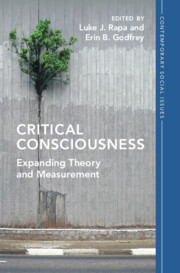
Critical consciousness represents the analysis of inequitable social conditions, the motivation to effect change, and the action taken to redress perceived inequities. Scholarship and practice in the last two decades have highlighted critical consciousness as a key developmental competency for those experiencing marginalization and as a pathway for navigating and resisting oppression. This competency is more urgent than ever given the current sociopolitical moment, in which longstanding inequity, bias, discrimination, and competing ideologies are amplified. This volume assembles leading scholars to address some of the field's most urgent questions: How does critical consciousness develop? What theories can be used to complement and enrich our understanding of the operation of critical consciousness? How might new directions in theory and measurement further enhance what is known about critical consciousness? It offers cutting-edge ideas and answers to these questions that are of critical importance to deepen our critical consciousness theory and measurement.