To save content items to your account,
please confirm that you agree to abide by our usage policies.
If this is the first time you use this feature, you will be asked to authorise Cambridge Core to connect with your account.
Find out more about saving content to .
To save content items to your Kindle, first ensure no-reply@cambridge.org
is added to your Approved Personal Document E-mail List under your Personal Document Settings
on the Manage Your Content and Devices page of your Amazon account. Then enter the ‘name’ part
of your Kindle email address below.
Find out more about saving to your Kindle.
Note you can select to save to either the @free.kindle.com or @kindle.com variations.
‘@free.kindle.com’ emails are free but can only be saved to your device when it is connected to wi-fi.
‘@kindle.com’ emails can be delivered even when you are not connected to wi-fi, but note that service fees apply.
This article examines how Uzbek migrants become incorporated into Russian society under conditions of legal precarity, discretionary enforcement and pervasive informality. Drawing on multisited ethnographic fieldwork conducted between 2014 and 2026 among Uzbek migrants in Russia and their families and communities in Uzbekistan, it develops the concept of shadow legal integration to explain how social and economic incorporation can deepen without a corresponding movement towards legal security. The article argues that repeated encounters with migration authorities, police, employers, intermediaries and migrant networks generate practical legal knowledge that migrants test, revise and circulate over time. This process of legal adaptation enables migrants to navigate the interaction between formal rules and informal practices while rem aining vulnerable to detention, deportation and administrative uncertainty. Ethnographic analysis of deportation, migration bureaucracy, legal brokerage, document economies and changing migration governance after 2022 further demonstrates that such competence is not a fixed repertoire but requires continual recalibration as legal and enforcement environments change. Shadow legal integration thus identifies how learning to navigate the intersection of formal and informal practices can itself become a mode of incorporation. The article contributes to migration and socio-legal scholarship by showing that migrant integration and legal security need not develop in parallel.
Even if a state is democratic, it will fail its citizens if it cannot raise sufficient revenue or distribute public goods effectively. Keeping the State Weak points to widespread economic informality as a key feature that keeps poor democracies unstable. Jessica Gottlieb traces the colonial roots of this pernicious type of embedded informality and theorizes how it impacts both state citizens and state actors. Quantitative and qualitative evidence shows how widespread informality prevents a would-be middle class from coordinating programmatic claims on the state and how informal intermediaries who benefit from their status resist attempts at formal state-building. The book concludes with a sobering perspective on the potential for formalization campaigns to initiate socio-political transitions and more optimistic suggestions for where a programmatic transition might originate.
This paper tells the story of Felipe Pescador, a neighbourhood born of an occupation of railway lands by railway employees in Mexico City’s industrial corridor. Across disciplines, a rich literature on Latin America has critically examined housing struggles among marginalised and working-class people. But attention to individual, self-built settlements has remained a less common approach to the issue. Focused study provides an opportunity to critically examine how changes in the city’s political economy gradually shifted strategies to obtain shelter. As the heft of organised labour waned and the institutionalisation of housing demands increased, residents ultimately legitimated a pragmatic political practice – sometimes at odds with the policies of the official party, the PRI – and put property rights at the centre of their struggle. Historicising ties between property, law and politics thus complicates visions of informal housing struggles as necessarily progressive initiatives, as well as accounts of informal settlements as places of grassroots entrepreneurship.
The theory posits an indirect negative consequence of informality on economic development. I first identify the type of informality that will have this effect and then argue that embedded informality slows the development of state capacity, mediated by politics. Two distinct accountability-capacity equilibria – a non-programmatic, weak state and a programmatic, strong state – support this logic. When given the choice, voters in a weak state will discipline politicians along particularistic rather than programmatic criteria, but only the latter generates incentives for politicians to invest in state capacity. In non-programmatic elections, informality instead creates incentives not to invest in the state or even quash such investments, keeping the state weak. First, large-scale economic informality reduces expectations that the state can deliver on programmatic promises and the likelihood that a majority of voters will coordinate around programmatic claims. Second, a constituency opposed to state-building is more likely to form where contact with the state is frequently facilitated by intermediaries who benefit from their role in discretionary politics.
This chapter examines what judges can do to protect the judiciary and make their judgments more effective using off-bench tools and by relying on their social networks. It discusses four sets of tools. The first is relation-building. This chapter examines how alliances can be forged through two kinds of off-bench engagement - public relations and judicial diplomacy – and with eight potential allies of a committed court: (1) lawyers, (2) legal academics, (3) the media, (4) civil servants, (5) international organizations, (6) businesses, (7) the general public, and (8) fellow judges. The chapter then proceeds to explore a second set of tools: that on establishing diplomatic connections with hostile groups. Drawing on the concept of backchanneling, the chapter theorizes the potential dangers and benefits of clandestine engagement with hostile parties. The third and fourth tools to be discussed are protest and mobilization. The chapter ends with reflections on the option of resignation and argues that resigning should only be considered as a last resort.
Parliamentary Hansard records are texts that stand at an intersection between the representation of spoken discourse and the application of standardised written norms.While they are categorised as ‘verbatim’ accounts of what is said during parliamentary proceedings, they are also edited, official government publications, and are therefore likely to represent a normative, formalised version of the language that was used. Add to this the factors of changing standards over time, different varieties of English and evolving reporting methods, and they become a valuable historical record for charting shifting attitudes towards language prescription. This chapter analyses data from Australian and British Hansard, from 1901 to the present, to assess the degree to which prescriptive practices have been applied to the originally spoken text. It looks at language features that have been identified as being indicative of spoken or written style. These include use of contractions, split infinitives and singular agreement with plural nouns. The data show generally more acceptance of the informal option in Australia in recent times, but also in the early part of the twentieth century.
Learn to program more effectively, faster, with better results… and enjoy both the learning experience and the benefits it ultimately brings. While this undergraduate-level textbook is motivated by formal methods, so encouraging habits that lead to correct and concise computer programs, its informal presentation sidesteps any rigid reliance on formal logic which programmers are sometimes led to believe is required. Instead, a straightforward and intuitive use of simple 'What's true here?' comments encourages precision of thought without prescription of notation. Drawing on decades of the author's experience in teaching/industry, the text's careful presentation concentrates on key principles of structuring and reasoning about programs, applying them first to small, understandable algorithms. Then students can concentrate on turning those reliably into their corresponding – and correct – program source codes. The text includes over 200 exercises, for many of which full solutions are provided. A set of all solutions is available for instructors' use.
Globally, states use rural-to-urban resettlement to fuel development, yet this formal process consistently generates its own informalities. Using a comparative case study of China—contrasting its affluent coast with its poorer hinterland—this book reveals how informality not only persists after resettlement but performs essential functions, critically challenging the effectiveness of prevailing policies. Theoretically, the study leverages the innovative Credibility Thesis, applying its Formal, Actual, and Targeted (FAT) Institutional Framework and Credibility Scales and Intervention (CSI) Checklist to explain the emergence and evolution of post-resettlement informality. The findings offer powerful, empirically grounded recommendations for integrating informal realities into urban planning, with profound implications for understanding institutional credibility and the functional role of informality in development.
This article brings Cotterrell’s legal concept of community based on trust-based interactions in social life to expand the critical horizons of economic sociology of law (ESL) in its analytical, normative and empirical aspects for law and development in Africa. Dominant law and economics approaches sometimes see informal economic activity as an aberration and/or an obstacle in development. This article proposes an alternative way of looking at informality in development in Africa through the lens of ESL. As part of wider social life, economic life is about social interactions in production, exchange, distribution and consumption while legal life is about social relations in and under the law. Furthermore, ‘legal and economic life shape and are shaped by each other, as well as by the wider social, and more-than-human, world’. This calls for a framework that reconceptualises law in ways that are inclusive of the many state, social, economic and other normative orders such as informal economic activity in African societies that are continually interacting as part of wider social life.
Labor history has for a long time struggled with so-called “informal” labor, which is situated outside of regularised labor relations, but is widespread in many regions of the globe. The essay reviews five recent books from different fields on transport and labor in Africa, which explore the question of informality, everyday labor, labor organisation, and the infrastructure and technology of mobility. It develops an approach to informal labor that emphasizes historicity and a dialectical model between the stability of the transport infrastructure and the precarity of the workers that uphold it.
This paper presents an analysis of nonprofit organizations—the organizational infrastructure of civil society—in East Central Europe, from one important respect: by placing them in the context of the comparative historical sociology of the region’s widespread informality. This involves two steps: (1) summarizing an argument about the role of informality in East Central European capitalism today in order to (2) outline its implications for the study of post-state-socialist nonprofits. Most of the empirical examples come from Hungary. These examples serve illustrative purposes and are intended as devices to provoke new analysis. They are meant to open, rather than close, discussion.
This article addresses critical gaps in the literature on crisis-driven policy change in international organisations. While existing studies focus on elite decision-making and institutional resilience, the role of frontline crisis managers remains under-explored in International Relations. Using the European migration and refugee crisis as a case study and drawing on insights from organisation studies and the sociology of the professions, the article introduces a novel theoretical framework that foregrounds improvisation by first responders and the ex-post stabilisation of their spontaneous policy solutions at headquarters. In addition to reconstructing and illustrating the mechanisms that link frontline action to changed policies, the article identifies theoretical conditions shaping the likelihood and direction of informal policy change from the ground up. By highlighting bottom-up dynamics in crises, it not only advances theoretical debates on crisis politics, but also proposes a new research agenda for analysing the transformative role of field-level practices in global politics.
Will rising temperatures from climate change affect labour markets? This paper examines the impact of temperature on hours worked, using panel data from Peru covering the period from 2007 to 2015. We combine information on hours worked from household surveys with weather reanalysis data. Our findings show that high temperatures reduce hours worked, with the effect concentrated in informal jobs rather than in weather-exposed industries. These results suggest that labour market segmentation may shape how climate change affects labour outcomes in developing countries.
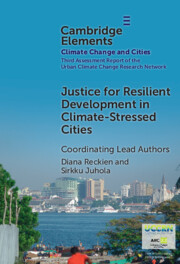
Climate impacts and risk, within and across cities, are distributed highly unequally. Cities located in low latitudes are more vulnerable to climate risk and impacts than in high latitudes, due to the large proportion of informal settlements relative to the housing stock and more frequent extremes. According to EM-DAT, about 60% of environmental disasters in cities relate to riverine floods. Riverine floods and heatwaves cause about 33% of deaths in cities. However, cold-waves and droughts impact most people in cities (42% and 39% of all people, respectively). Human vulnerability intersects with hazardous, underserved communities. Frequently affected groups include women, single parents, and low-income elderly. Responses to climatic events are conditioned by the informality of social fabric and institutions, and by inequitable distribution of impacts, decision-making, and outcomes. To ensure climate-resilient development, adaptation and mitigation actions must include the broader urban context of informality and equity and justice principles. This title is also available as open access on Cambridge Core.
This article examines the impact of informal intergovernmental relations on the Kenyan government’s handling of the COVID-19 pandemic. It argues that although informality in governance has been perceived negatively by many governance scholars, it nevertheless has the capacity to enhance the effectiveness and legitimacy of government. By virtue of informality’s adaptability and recognition of the centrality of context, it can enhance efficacy particularly in unpredictable circumstances as occurred in the pandemic. Notwithstanding this reality, until recently, literature on informality, mainly informed by Eurocentric colonial perspectives on governance, has focussed on its negative elements, criticizing it for diverse governance ailments. Through the prism of the negotiated order theory, this article challenges this dominant narrative using an analysis of informal intergovernmental relations during the COVID-19 pandemic in Kenya. It argues that though informality was at times applied negatively, overall, it ensured vibrant intergovernmental relations, thus positively impacting health service delivery and enhancing the government’s legitimacy in the management of the pandemic.
While most scholars of criminalized governance in Rio de Janeiro attribute its origins to the prison-based factions which formed during the military dictatorship (1964–85), this chapter argues that these arrangements emerged before, in the homes and on the streets and alleyways of the city’s favelas and housing projects. This chapter investigates these origins by focusing on the first embryonic gangs in Complexo da Maré in the 1970s. Combining archival research with oral histories of longtime residents, the chapter documents the emergence of Maré’s gangs after a variety of other non-state actors that had previously provided governance were increasingly marginalized during Brazil’s military dictatorship and as the abusive practices of police became more widespread. Maré’s incipient gang networks quickly began to compete over valuable drug-selling turf and, as the more successful ones consolidated territorial control, they expanded their organizations and governance activities. The chapter concludes with a description of the history of Rio’s prison-based factions and the marriage between these two organizational forms as the favela-based gangs integrated into these citywide networks.
This chapter focuses on the governance practices of the Comando Vermelho gang that has controlled Complexo da Maré’s most populous favela, Parque União, for more than three decades. Like their CVNH allies, CVPU has been part of the CV faction for this entire period. And yet, their governance styles have diverged considerably. CVPU evinces a less chaotic evolution as they have remained, aside from several years at the turn of the millennium, a social bandit regime. Overall, the absence of an active rival threat has produced a gang that employs far lower levels of coercion than their counterparts while active enforcement has incentivized CVPU to provide significant benefits to residents. This chapter traces the evolution of these dynamics through a combination of oral histories with residents and gang members, analysis of newspaper archives and anonymous denunciations, as well as participant observation during the author’s time living in Maré.
The third of Maré’s gangs, Terceiro Comando Puro (TCP), controls an enormous territory, encompassing ten contiguous neighborhoods with an estimated population of 68,000 residents, more than twice that of Maré’s Comando Vermelho-connected gangs. Moreover, TCP’s turf has changed significantly over time as the gang has lost and won territory through violent battles with several rivals, which have had horrifying consequences for both gang members and residents. This chapter also shows how the nature of enforcement against gangs can shift radically as TCP developed highly collaborative relations with the police especially after 2009. The chapter traces these developments in TCP’s historic territories as well as the housing projects that they would control from the mid-1990s until 2002 and again after 2009. This chapter interweaves multiple types of data, including eighteen months participant observation, dozens of interviews with current and former gang members and residents, as well as journalistic accounts and denunciations to an anonymous hotline, to trace how TCP’s shifting security environment has shaped their governance practices over time.
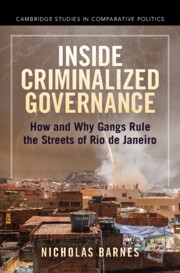
For over four decades, drug trafficking gangs have monopolized violence and engaged in various forms of governance across hundreds of informal neighborhoods known as favelas in Rio de Janeiro. Drawing on three years of ethnographic fieldwork, over 200 interviews with gang members and residents, 400 archival documents, and 20,000 anonymous hotline denunciations of gang members, this book provides a comprehensive examination of the causes and consequences of these governance arrangements. The book documents the variation in gang-resident relationships – from responsive relations in which gangs provide a reliable form of order and stimulate the local economy, to coercive and unresponsive relations in which gangs offers residents few benefits – then identifies the factors that account for this variation. The result is an unprecedented ethnographic study that provides readers a unique, in-depth insight into the evolution of Rio de Janeiro's drug trafficking gangs from their emergence in the 1970s to the present day.
This Element analyses a fundamentally new regional configuration of the garment sector, covering much of South America. Based on ethnographic fieldwork and in-depth interviews with a wide range of actors, it examines two major circuits of informal production and distribution of affordable garments, both of which have emerged around the urban marketplaces of La Salada (Buenos Aires) and Feira da Madrugada (São Paulo). This Element examines a configuration characterized by (1) manufacturers who interact with customer preferences to produce low-cost fashion, (2) marketplaces that function as large garment distribution hubs, and (3) extensive distribution routes with regional reach. This Element discusses the role of creativity in informal production processes, reflects on the implications of both cases for our understanding of global value chains and informality, and provides empirical evidence on forbearance as an explanatory element for the emergence of this phenomenon.