To save content items to your account,
please confirm that you agree to abide by our usage policies.
If this is the first time you use this feature, you will be asked to authorise Cambridge Core to connect with your account.
Find out more about saving content to .
To save content items to your Kindle, first ensure no-reply@cambridge.org
is added to your Approved Personal Document E-mail List under your Personal Document Settings
on the Manage Your Content and Devices page of your Amazon account. Then enter the ‘name’ part
of your Kindle email address below.
Find out more about saving to your Kindle.
Note you can select to save to either the @free.kindle.com or @kindle.com variations.
‘@free.kindle.com’ emails are free but can only be saved to your device when it is connected to wi-fi.
‘@kindle.com’ emails can be delivered even when you are not connected to wi-fi, but note that service fees apply.
The climate crisis is urgent, yet public support for fossil fuel taxation remains low. Existing research attributes this to material interests, particularly concerns about the regressive nature of consumption taxes. This connects to the literature on the emerging “eco-social divide,” which emphasizes tensions between environmental and equity concerns while leaving potential synergies understudied. Drawing on policy feedback theory, we argue that satisfaction with existing social policies shapes how individuals perceive the risks of carbon taxation. Using original survey data from seven European countries (n = 10,968), we find that income difficulty and dissatisfaction with social policies reduce support for fossil fuel taxation. Perceived employment risk, contrary to expectations, is positively associated with support, and this relationship is amplified by social policy satisfaction. Confidence in welfare institutions therefore appears to facilitate support for climate policy, pointing to social protection and policy feedback as central to building coalitions for the green transition.
Public policies are shaped not only by institutions and interests but also by interactions between policy construction and ideology, which define social problems, determine who is deserving, and set the boundaries of legitimate public provision. This study examines how these dynamics shape support for contested health services, asking how medicalization and social constructions of deservingness influence public attitudes. Using a survey experiment with 2,000 respondents in Canada, the analysis examines support for IVF, abortion, gender-affirming care, and HPV vaccination. Findings suggest that medicalization significantly increases support for public funding for select services, while constructions of deservingness mediate these effects. Policy feedback operates not only through institutional arrangements but also through how citizens perceive the boundaries of healthcare and the deservingness of recipients. The study advances research on policy feedback and health politics by showing how medicalization and social constructions shape public opinion and debates over medical necessity.
Michael Howlett, Simon Fraser University, British Columbia,M Ramesh, National University of Singapore,Anthony Perl, Simon Fraser University, British Columbia
Chapter 10 explores the temporal dimension of public policymaking, analyzing the dynamics of policy stability and change. It introduces key concepts such as policy trajectories, path dependency, feedback mechanisms, lock-in, policy regimes, and policy styles. The chapter distinguishes between “normal” incremental change (layering, drift, conversion) and less frequent, disruptive “atypical” change (paradigm shifts, punctuations) often triggered by critical junctures or external shocks. It discusses the role of feedback, anomalous events, subsystem spillovers, venue-shifting, and policy learning in driving change. The chapter draws on punctuated equilibrium models to explain how long periods of stability are interrupted by episodes of rapid, nonlinear transformation. By situating policy change within broader institutional, ideational, and actor-driven frameworks, the chapter provides tools for understanding and analyzing both continuity and transformation in policy processes.
While the abolition of secondary school fees has expanded educational access across low-income countries, empirical research has focused predominantly on student outcomes and institutional or elite perspectives, overlooking how ordinary citizens perceive such reforms or the factors shaping those perceptions. This gap is especially salient in Ghana, where the Free SHS policy, arguably the most comprehensive in Sub-Saharan Africa, is both nationally lauded and politically contested. Drawing on policy feedback theory and deservingness heuristics, this article explores how Ghanaians interpret the policy’s goals, trade-offs, and implementation using a nationally representative sample of 1915 respondents. Latent Class Analysis reveals five classes, from Universal Access Champions down to Ambivalent Observers. A follow-up multinomial logistic regression shows that partisanship, education, civic engagement, and economic outlook significantly predict class membership. These findings highlight that sustaining support for large-scale reforms requires not just expanded access, but also public trust in their fairness and responsiveness.
We examine whether exposure to government assistance can generate positive policy feedback effects among constituencies not traditionally supportive of the welfare state. Focusing on the U.S. Paycheck Protection Program (PPP), a small business bailout enacted during the COVID-19 pandemic, we study how making government assistance salient affects attitudes toward social assistance programs among a typically Republican-leaning and relatively affluent group. Leveraging a bespoke survey of verified program recipients and an embedded experimental manipulation, we find that reminding PPP recipients of program participation increases support for government spending on healthcare, nutritional assistance, and unemployment benefits by an average of 6.9 percentage points—equivalent to roughly 16 percent of the partisan divide on these issues. The findings provide novel causal evidence that making the receipt of government assistance salient increases support for anti-poverty programs among well-off people, even when those programs do not directly benefit them.
Several U.S. states expanded vote-by-mail in 2020, while other states made no changes. This uneven expansion occurred in a highly racialized policy context. We explore how the United States’ history of race-based disenfranchisement, racialized elite rhetoric, and the uneven policy expansion interact to shape voting methods and trust in government across racial groups. Using data from three national surveys and coarsened exact matching, we compare the behavior of voters across adopting and non-adopting states. We find that adopting no-excuse absentee voting and universal vote-by-mail in 2020 is associated with increased mail voting across racial groups, despite Black Americans’ historically rooted mistrust in new forms of voting. We also find that expanding mail voting was associated with increases in government trust in some cases. While prior work finds modest short-term increases in turnout, vote-by-mail may also affect perceptions of government, which can help close racial turnout gaps in the long term.
Distributive justice preferences are important because they can influence the policy orientations of political actors and can help create conditions conducive to policy change. Yet, these preferences have received relatively little scholarly attention in countries that are not included in major cross-country surveys such as Turkey. This article examines Turkish distributive justice preferences across four key social policy sectors: education; healthcare; old-age pensions; and unemployment insurance. The analysis draws on 2019 data from an original nationwide survey (n = 2,272), designed by a research team including the authors and implemented by a professional survey firm using multistage stratified random sampling. Our findings confirm that, as in mature welfare states, distributive justice preferences vary across social policy sectors in the Turkish case. However, the equality principle is strongly favored in three of the four areas, while equity is preferred only in old-age pensions, possibly reflecting policy feedback effects. In the context of high inequality and low social and institutional trust, we introduce distrustful egalitarianism as a concept to capture egalitarian preferences driven more by distrust of official allocation mechanisms than by purely ideological commitments to equality. These findings highlight the need for further research in middle-income countries with less mature welfare systems.
Social investment policies have introduced a shift in the normative underpinnings of European welfare states but are layered into compensatory and workfarist policies. This article questions the normative outcomes of social investment from a citizen perspective, asking how hybrid active labour market policies (ALMPs) shape citizen-level norms of social solidarity. Building on normative feedback theory, we conduct a comparative qualitative secondary analysis of focus-group datasets from France and Belgium (2006; 2019), where enabling instruments were gradually introduced between observation points. Based on a two-fold operationalization of citizen-level norms, we report that compensatory and workfarist cues dominate discussions with scarce reference to capacitation. The frames participants rely on feature normative tensions, particularly the ambivalent coexistence of compensation and individual responsibility. The normative feedback of ALMPs takes the form of a dilemma between generous-yet-stringent solidarity. Social investment policy norms have not (yet) reshaped citizen-level norms of social solidarity.
The introduction critically examines current understandings of climate mitigation politics and makes a case for thinking politically and proactively about mitigation. This is contrasted with approaches that explicitly seek to draw narrow boundaries around mitigation politics and/or to avoid it. It sets out the overall approach to the book, how it relates to existing research on mitigation politics, and introduces the four ‘phases’ of climate politics that form the historical analysis in the book.
Chapter 3 constructs the broad and historicised conceptualisation of mitigation politics by building on, critiquing and combining insights from constructivist political economy; climate policy, political economy of transitions; and socio-technical transitions research. The aim of this chapter is to present a perspective on mitigation politics that at once allows for analysis of different phases of climate mitigation policymaking and politics over time, recognises and incorporates mitigation-related constraints and opportunities, and takes account of a wide range of features of politics – collective choice, agency and capacity, deliberation, and social interaction. Doing so also offers up a more nuanced and detailed account of different but related varieties of politicisation – and how they interact with one another. The following four chapters apply this broad, inclusive, and historicised framing to explore and interpret different phases of constructing mitigation policies that have emerged over the past 40 years or so.
By exploring the dynamic relationships between politics, policymaking, and policy over time, this book aims to explain why climate change mitigation is so political, and why politics is also indispensable in enacting real change. It argues that politics is poorly understood and often sidelined in research and policy circles, which is an omission that must be rectified, because the policies that we rely on to drive down greenhouse gas emissions are deeply inter-connected with political and social contexts. Incorporating insights from political economy, socio-technical transitions, and public policy, this book provides a framework for understanding the role of specific ideas, interests, and institutions in shaping and driving sustainable change. The chapters present examples at global, national, and local scales, spanning from the 1990s to 2020s. This volume will prove valuable for graduate students, researchers, and policymakers interested in the politics and policy of climate change. This title is also available as Open Access on Cambridge Core.
While public support is central to the problem‐solving capacity of the European Union, we know little about when and why the EU can increase its citizens’ support through spending. Extensive research finds that citizens living in countries that are net beneficiaries of the EU budget are more supportive of the EU, assuming that citizens care equally about all forms of spending. It is argued in this article, however, that the amount of spending is only part of the story. Understanding the effects of spending on support requires a consideration of how transfers are spent. Drawing on policy feedback theories in comparative politics, it is shown that support for the EU is a function of the fit between the spending area and economic need in individuals’ immediate living context. Results from a statistical analysis of EU spending on human capital, infrastructure, agriculture, energy and environmental protection in 127 EU regions over the period 2001–2011 corroborate this argument. As the EU and other international organisations become increasingly publicly contested, the organisations themselves may increasingly try to shore up public support through spending, but they will only be successful under specific conditions.
Many studies have shown that individuals who interact with government programs subsequently participate in politics at levels different from before, whether higher or lower. While most prior work examines the effect of policy recipiency, or program administration in one geographic location or at one snapshot in time, I study how the administration of Medicaid, a federal program administered by states, varies over time and by place, and how its variation in administration affects mass-level voter turnout. I argue that there are two highly salient sites of contact with the administrative state when considering effects on voter turnout: government programs and elections. I theorize that administrative burden from these sites creates interpretive effects on both those with direct public program experience and those whose experience is indirect, which shapes the likelihood of voting. Using a generalized differences-in-differences design and applying my separate, original measures of Medicaid and electoral burdens, I find that having a higher level of Medicaid burden resulted in a small but significant decrease in county-level turnout in recent national elections, net of Medicaid expansion status, burdens associated with registering to vote and voting, and other factors. These results imply that contact with the administrative state, via government program administration and elections, is a critical way in which policies shape mass-level political participation.
A growing body of evidence suggests that conditional cash transfers (CCTs) can shift voters’ electoral choices. Yet there remains a mismatch between reliance on aggregated municipal data and individual-level theories focused on retrospective rewards or reduced vulnerability to clientelism. Since CCTs also produce plausible spillovers on nonbeneficiaries, verifying who reacts, and how, is crucial to understanding their electoral effects. To empirically unbundle individual and spillover effects, the analysis exploits plausibly exogenous variation between beneficiaries of Brazil’s Bolsa Família and those on the waiting list. The evidence suggests that CCTs strengthen beneficiaries’ attitudes against clientelism, but they vote no differently than nonbeneficiaries. However, spillovers are strong: As CCT coverage expands, both beneficiaries and nonbeneficiaries turn against local incumbents. This pattern is inconsistent with existing theory, which relies on either polarization or positive spillovers. Instead, I propose a theory of collective confidence derived from strategic voting incentives in which CCT expansion fortifies all voters in resisting clientelism.
Housing is a defining issue of our time, driving a persistent affordability crisis, financial instability, and economic inequality. Through the Roof examines the crucial role of the state in shaping the housing markets of two economic powerhouses – the United States and Germany. The book starts with a puzzle: Free-market America has vigorously supported homeownership markets with generous government programs, while social-market Germany has slashed policy support for both homeownership and rental markets throughout the past century. The book explains why the two nations have adopted such radically different and unexpected housing policy approaches. Drawing on extensive archival material and interviews with policymakers, it argues that contrasting forms of capitalism – demand-led in the United States and export-oriented in Germany – resulted in divergent housing policies. In both countries, these policies have subsequently transformed capitalism itself.
This study explores the link between receiving basic income support (BIS) and political alienation in Germany, with a focus on political trust and satisfaction with democracy. We argue that receiving BIS is associated with experiences of material and social exclusion and impairs subjective social integration. Against the background of major structural welfare reforms in recent decades, we assume that BIS recipients are likely to attribute responsibility for their socio-economic disadvantages to the wider political system. We use data from the Panel Study Labour Market and Social Security (PASS) for the years 2019–2021 and employ multivariate regression analysis. We find that political alienation is more likely to occur among recipients of BIS, especially long-term recipients, than among non-recipients. Social exclusion is an important mechanism: With a higher risk of material deprivation and fewer opportunities for social participation and civic engagement than non-recipients, BIS recipients are more likely to experience subjective social exclusion, which, in turn, contributes to their political alienation. Moreover, our study offers indications that trustful and supportive interactions with welfare authorities can mitigate tendencies of political alienation among BIS recipients.
The ways in which welfare state programs structure people’s lives have been a central focus of research on policy feedback. While there is rich literature in the USA about racialized experiences with the state, we know little about how immigration history intersects with racial background in moderating experiences with the state nor have there been many studies in other liberal welfare regimes outside the USA. Our study aims to fill this gap by exploring how citizenship status over generations intersects with racial background in structuring interactions with welfare state programs in Canada. Analyzing data from Democracy Checkup surveys spanning from 2020 to 2023, we focus on how needs, capabilities, and experiences may structure government contact and the extent to which these factors explain differences across citizenship and racial categories. We document a recurring difference in the amount of contact among racialized respondents—non-citizens and third-generation citizens—that cannot be explained by either need or capability. Interestingly, our findings suggest that while the greater contact among racialized non-citizens is evaluated more positively in terms of procedure, third-generation racialized citizens generally evaluate their higher contact more poorly. These findings point to the importance of understanding racialized experiences with the state through the lens of citizenship.
Why does the supply of mental health care vary across countries? Moreover, why would the state supply services to those who cannot demand them? This chapter introduces how a comparative, political-economic, and historical perspective can explain mental health care outcomes, as well as how studying mental health can inform comparative political economy. It then turns to the theoretical argument, explaining why and how public sector managers and workers – the “strange bedfellows” of the “welfare workforce” – shape the supply of public social services. The chapter closes with a sketch of the book’s research design and how it structures the following chapters
This concluding chapter reviews the core findings about psychiatric deinstitutionalization and mental health care and lays out the argument’s theoretical implications for social policy scholarship more generally. It highlights that the political logic of social services (e.g., health, education, and care) is distinct from that of cash transfers (e.g., pensions, unemployment, and disability benefits). The key difference: the welfare workforce. I also discuss the complex policy implications of this trend (especially as the contours of the welfare workforce become less clear) and close by considering how to harness the power of welfare workers in contemporary welfare capitalism.
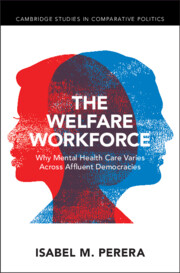
The Welfare Workforce is a thought-provoking exploration of mental health care in the United States and beyond. Although all the affluent democracies pursued deinstitutionalization, some failed to provide adequate services, while others overcame challenges of stigma and limited resources and successfully expanded care. Isabel M. Perera examines the role of the “welfare workforce” in providing social services to those who cannot demand them. Drawing on extensive research in four countries – the United States, France, Norway, and Sweden – Perera sheds light on post-industrial politics and the critical part played by those who work for the welfare state. A must-read for anyone interested in mental health care, social services, and the politics of welfare, The Welfare Workforce challenges conventional wisdom and offers new insights into the complex factors that contribute to the success or failure of mental health care systems. This title is also available as Open Access on Cambridge Core.