A series of monographs on all aspects of classical learning: literature, philosophy, history and archaeology. Most of the books arise from work done at Cambridge University.
General Editors:
J. P. T. Clackson, University of Cambridge,
G. Betegh, University of Cambridge,
S. Cuomo, University of Cambridge,
S. P. Oakley, University of Cambridge,
J. C. Quinn, University of Cambridge,
M. J. Squire, University of Cambridge,
C. Vout, University of Cambridge,
T. J. G. Whitmarsh, University of Cambridge
To save content items to your account,
please confirm that you agree to abide by our usage policies.
If this is the first time you use this feature, you will be asked to authorise Cambridge Core to connect with your account.
Find out more about saving content to .
To save content items to your Kindle, first ensure no-reply@cambridge.org
is added to your Approved Personal Document E-mail List under your Personal Document Settings
on the Manage Your Content and Devices page of your Amazon account. Then enter the ‘name’ part
of your Kindle email address below.
Find out more about saving to your Kindle.
Note you can select to save to either the @free.kindle.com or @kindle.com variations.
‘@free.kindle.com’ emails are free but can only be saved to your device when it is connected to wi-fi.
‘@kindle.com’ emails can be delivered even when you are not connected to wi-fi, but note that service fees apply.
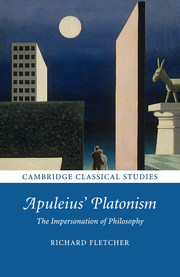
Apuleius of Madauros, writing in the latter half of the second century CE in Roman North Africa, is best known to us today for his Latin fiction, the Metamorphoses aka The Golden Ass, about a man who turned into a donkey and back again. However, he was also a Platonic philosopher, who, even though many of his writings are lost, wrote a range of rhetorical and philosophical works which survive to this day. This book examines these works to reveal how Apuleius' Platonism is a result of his 'impersonation of philosophy', that is, a rhetorically powerful methodological tool that allows him to 'speak' on behalf of Plato and his philosophy. This book is the first exploration of the full scope of his idiosyncratic brand of Platonism across his multifarious literary corpus and is a major contribution to the study of the dynamic between literature and philosophy in antiquity and beyond.
How did Ancient Greek express that an event occurred at a particular time, for a certain duration, or within a given time frame? The answer to these questions depends on a variety of conditions - the nature of the time noun, the tense and aspect of the verb, the particular historical period of Greek during which the author lived - that existing studies of the language do not take sufficiently into account. This book accordingly examines the circumstances that govern the use of the genitive, dative, and accusative of time, as well as the relevant prepositional constructions, primarily in Greek prose of the fifth century BC through the second century AD, but also in Homer. While the focus is on developments in Greek, translations of the examples, as well as a fully glossed summary chapter, make it accessible to linguists interested in the expression of time generally.
Through a series of interdisciplinary studies this book argues that the Athenians themselves invented the notion of 'classical' tragedy just a few generations after the city's defeat in the Peloponnesian War. In the third quarter of the fourth century BC, and specifically during the 'Lycurgan Era' (338–322 BC), a number of measures were taken in Athens to affirm to the Greek world that the achievement of tragedy was owed to the unique character of the city. By means of rhetoric, architecture, inscriptions, statues, archives and even legislation, the 'classical' tragedians (Aeschylus, Sophocles and Euripides) and their plays came to be presented as both the products and vital embodiments of an idealised Athenian past. This study marks the first account of Athens' invention of its own theatrical heritage and sheds new light upon the interaction between the city's literary and political history.
The economics of imperialism, its political background and institutional frameworks, the material benefits it conferred, the ideologies of ruler and ruled - these are some of the more important aspects of imperialism discussed in this volume. In presenting the evidence for ancient imperialims and suggesting concepts and methods of interpretation these articles, which are the work of the Cambridge University Research Seminar in Ancient History, range from New Kingdom Egypt and Carthage, through the classical Greek world of Athens and Sparta, to Macedonia and Rome. This book will be particularly useful to ancient historians but should also interest historian of other periods as well as students of politics.
Professor Shipp's purpose in the first edition of this book (published in 1953) was 'to examine in as much detail as possible the development of the language of the Iliad in some of its typical features, with careful attention to the spoken dialects involved and to the influence of metre'. In the second edition he widens the scope of his work to examine the Odyssey as well as the Iliad, and he extends its detail to include syntax as well as grammatical forms and to cover questions of vocabulary more comprehensively. The author's earlier conclusions are shown to be confirmed, and an important further result for the Odyssey has been to show the typical lateness of the language of moralizing passages.
This 1983 book provides a serious modern literary treatment of perhaps the best known of all surviving works of ancient Greek fiction. Dr Hunter demonstrates the sophistication of this pastoral romance, a sophistication which he maintains has often been assumed but never properly discussed. Evidence for the identity of the author and the date of composition are also considered.
This book examines the role and character of Homer's people, laoi, in Homeric story-telling, arguing that Homeric poetry is crucially concerned with the people as a basis for communal life. Both The Iliad and The Odyssey are read as sustained meditations on the processes involved in protecting and destroying the people. The investigation draws on a wide range of approaches from formulaic analysis to the study of early performance contexts. From a close reading of the Homeric epics, Homer's people emerge as a community without effective social structures. When this is viewed from the perspective of Homeric performances in the polis, a contrast between Homer's laoi and the founding people of ritual emerges. While the former typically perish, the survival of the latter is secured by the establishment of successful institutions.
Plato's later dialogue, the Sophist, is deemed one of the greatest works in the history of philosophy, but scholars have been shy of confronting the central problem of the dialogue. For Plato, defining the sophist is the basic philosophical problem: any inquirer must face the 'sophist within us' in order to secure the very possibility of dialogue, and of philosophy, against sophistic counterattack. Examining the connection between the large and difficult philosophical issues discussed in the Sophist (appearance, image, falsehood, and 'what is not') in relation to the basic problem of defining the sophist, Dr Notomi shows how Plato struggles with and solves all these problems in a single line of inquiry. His interpretation of the whole dialogue finally reveals how the philosopher should differ from the sophist.
A critical study of Persius' poetic aims, aversions and techniques, based mainly on an extended analysis of Satires I. John Bramble shows how Persius' discontent with conventional literary language led him to compress the existing satiric idiom and create a powerful individual style. The author situates Persius' work in the tradition of Roman satire, and shows how he takes the concepts and metaphors of literary criticism back to their physical origins, to indict moral and literary decadence through a series of images connected with, for example, gluttony and sexual excess. This is a model study of a classical text, which makes consistent sense of a difficult and subtle manner, and answers questions posed by the potentially constricting nature of Roman poetic form. It also reconstructs the referential framework of ideas and associations upon which a sophisticated writer addressing a discriminating audience could draw.
Bucchero is a very common type of fine pottery that was made by the Etruscans when their civilization was at its height, from the seventh to the fourth century BC. This study concentrates on the products of South Etruria, where the earliest and finest bucchero was made, and where the tradition lasts longest. Until recently bucchero has been little studied, and the aim of this book is to present a sequence of pottery from archaeological contexts, so that the development of the ware can be seen as a whole within a chronological framework. Many of the tomb-groups catalogued are published here for the first time. In studying the shapes careful consideration is given to the affinities with Greek and with other Etruscan wares. A full survey of the decorative techniques is included, and the pattern of distribution both within Etruria and further afield is discussed. An important feature of the book is a series of sixty pages of drawings of the profiles of every shape of bucchero pot studied. Bucchero is of considerable importance as a dating tool, and although the book is directed primarily at specialists, it will also be of interest to anyone who is curious about Etruscan art and archaeology.
The actual practice of the Romans with regard to property and investment must be distinguished from the formal rules of the emperors and the moralistic generalizations of the ancient writers. With this in mind the Cambridge Research Seminar in Ancient History spent two years examining various aspects of Roman property, investigating individual topics in greater detail than has been attempted before. The studies which make up this volume deal with Roman investment in property - scale and concentration of holdings, rural and urban property, methods of exploitation and how this was organized, and the extent of marginal lands. The editor has formed the volume into a coherent unit by eliminating excessive duplication and overlapping between chapters. The book is of particular value to specialists in ancient history, economic and social history and in Roman law, but also contains materials of interest to medieval and agrarian historians.
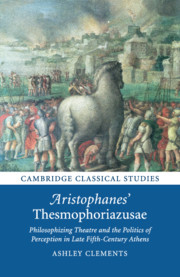
Aristophanes' comic masterpiece Thesmophoriazusae has long been recognized amongst the plays of Old Comedy for its deconstruction of tragic theatricality. This book reveals that this deconstruction is grounded not simply in Aristophanes' wider engagement with tragic realism. Rather, it demonstrates that from its outset Aristophanes' play draws upon Parmenides' philosophical revelations concerning reality and illusion, employing Eleatic strictures and imagery to philosophize the theatrical situation, criticize Aristophanes' poetic rival Euripides as promulgator of harmful deceptions, expose the dangerous complicity of Athenian theatre audiences in tragic illusion, and articulate political advice to an audience negotiating a period of political turmoil characterized by deception and uncertainty (the months before the oligarchic coup of 411 BC). The book thereby restores Thesmophoriazusae to its proper status as a philosophical comedy and reveals hitherto unrecognized evidence of Aristophanes' political use of Eleatic ideas during the late fifth century BC.
Cicero's letters are saturated with learned philosophical allusions and arguments. This innovative study shows just how fundamental these are for understanding Cicero's philosophical activities and for explaining the enduring interest of his ethical and political thought. Dr McConnell draws particular attention to Cicero's treatment of Plato's Seventh Letter and his views on the relationship between philosophy and politics. He also illustrates the various ways in which Cicero finds philosophy an appealing and effective mode of self-presentation and a congenial, pointed medium for talking to his peers about ethical and political concerns. The book offers a range of fresh insights into the impressive scope and sophistication of Cicero's epistolary and philosophical practice and the vibrancy of the philosophical environment of the first century BC. A new picture emerges of Cicero the philosopher and philosophy's place in Roman political culture.
This book selects central texts illustrating the literary reception of Hesiod's Works and Days in antiquity and considers how these moments were crucial in fashioning the idea of 'didactic literature'. A central chapter considers the development of ancient ideas about didactic poetry, relying not so much on explicit critical theory as on how Hesiod was read and used from the earliest period of reception onwards. Other chapters consider Hesiodic reception in the archaic poetry of Alcaeus and Simonides, in the classical prose of Plato, Xenophon and Isocrates, in the Aesopic tradition, and in the imperial prose of Dio Chrysostom and Lucian; there is also a groundbreaking study of Plutarch's extensive commentary on the Works and Days and an account of ancient ideas of Hesiod's linguistic style. This is a major and innovative contribution to the study of Hesiod's remarkable poem and to the Greek literary engagement with the past.
After Plato and Aristotle, the Stoics, from the third century BCE onwards, developed the third great classical conception of wisdom. This book offers a reconstruction of this pivotal notion in Stoicism, starting out from the two extant Stoic definitions, 'knowledge of human and divine matters' and 'fitting expertise'. It focuses not only on the question of what they understood by wisdom, but also on how wisdom can be achieved, how difficult it is to become a sage, and how this difficulty can be explained. The answers to these questions are based on a fresh investigation of the evidence, with all central texts offered in the original Greek or Latin, as well as in translation. The Stoic Sage can thus also serve as a source book on Stoic wisdom, which should be invaluable to specialists and to anyone interested in one of the cornerstones of the Graeco-Roman classical tradition.
This pioneering volume approaches the languages and scripts of ancient Cyprus from an interdisciplinary point of view, with a primarily linguistic and epigraphic approach supplemented by a consideration of their historical and cultural context. The focus is on furthering our knowledge of the non-Greek languages/scripts, as well as appreciating their place in relation to the much better understood Greek language on the island. Following on from recent advances in Cypro-Minoan studies, these difficult, mostly Late Bronze Age inscriptions are reassessed from first principles. The same approach is taken for non-Greek languages written in the Cypriot Syllabic script during the first millennium BC, chiefly the one usually referred to as Eteocypriot. The final section is then dedicated to the Phoenician language, which was in use on Cyprus for some hundreds of years. The result is a careful reappraisal of these languages/scripts after more than a century of sometimes controversial scholarship.
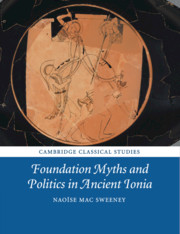
This book examines foundation myths told about the Ionian cities during the archaic and classical periods. It uses these myths to explore the complex and changing ways in which civic identity was constructed in Ionia, relating this to the wider discourses about ethnicity and cultural difference that were current in the Greek world at this time. The Ionian cities seem to have rejected oppositional models of cultural difference which set in contrast East and West, Europe and Asia, Greek and Barbarian, opting instead for a more fluid and nuanced perspective on ethnic and cultural distinctions. The conclusions of this book have far-reaching implications for our understanding of Ionia, but also challenge current models of Greek ethnicity and identity, suggesting that there was a more diverse conception of Greekness in antiquity than has often been assumed.
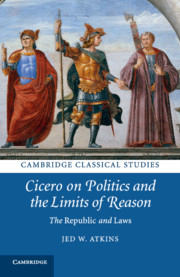
A prolific philosopher who also held Rome's highest political office, Cicero was uniquely qualified to write on political philosophy. In this book Professor Atkins provides a fresh interpretation of Cicero's central political dialogues - the Republic and Laws. Devoting careful attention to form as well as philosophy, Atkins argues that these dialogues together probe the limits of reason in political affairs and explore the resources available to the statesman given these limitations. He shows how Cicero appropriated and transformed Plato's thought to forge original and important works of political philosophy. The book demonstrates that Cicero's Republic and Laws are critical for understanding the history of the concepts of rights, the mixed constitution and natural law. It concludes by comparing Cicero's thought to the modern conservative tradition and argues that Cicero provides a perspective on utopia frequently absent from current philosophical treatments.
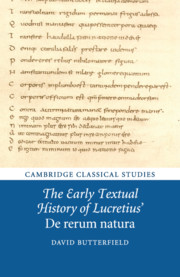
This is the first detailed analysis of the fate of Lucretius' De rerum natura from its composition in the 50s BC to the creation of our earliest extant manuscripts during the Carolingian Age. Close investigation of the knowledge of Lucretius' poem among writers throughout the Roman and medieval world allows fresh insight into the work's readership and reception, and a clear assessment of the indirect tradition's value for editing the poem. The first extended analysis of the 170+ subject headings (capitula) that intersperse the text reveals the close engagement of its Roman readers. A fresh inspection and assignation of marginal hands in the poem's most important manuscript (the Oblongus) provides new evidence about the work of Carolingian correctors and offers the basis for a new Lucretian stemma codicum. Further clarification of the interrelationship of Lucretius' Renaissance manuscripts gives additional evidence of the poem's reception and circulation in fifteenth-century Italy.
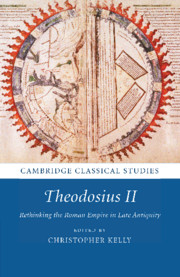
Theodosius II (AD 408–450) was the longest reigning Roman emperor. Ever since Edward Gibbon, he has been dismissed as mediocre and ineffectual. Yet Theodosius ruled an empire which retained its integrity while the West was broken up by barbarian invasions. This book explores Theodosius' challenges and successes. Ten essays by leading scholars of late antiquity provide important new insights into the court at Constantinople, the literary and cultural vitality of the reign, and the presentation of imperial piety and power. Much attention has been directed towards the changes promoted by Constantine at the beginning of the fourth century; much less to their crystallisation under Theodosius II. This volume explores the working out of new conceptions of the Roman Empire - its history, its rulers and its God. A substantial introduction offers a new framework for thinking afresh about the long transition from the classical world to Byzantium.