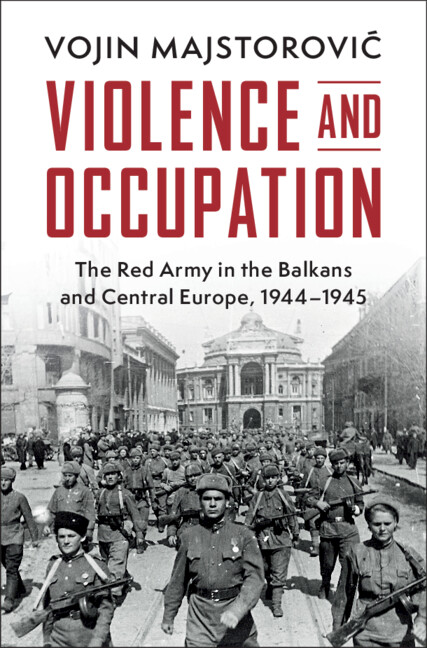
Violence and Occupation

-
Select format
-
- Publisher:
- Cambridge University Press
- Publication date:
- 21 February 2026
- 19 January 2026
- ISBN:
- 9781009652438
- 9781009652445
- Dimensions:
- (229 x 152 mm)
- Weight & Pages:
- 0.682kg, 340 Pages
- Dimensions:
- Weight & Pages:
You may already have access via personal or institutional login
Show more authors 
You may already have access via personal or institutional login
Book description
This groundbreaking history traces the Red Army's advances across central Europe and the Balkans in 1944–1945. It focuses on the 2nd and 3rd Ukrainian Fronts that occupied Romania, Bulgaria, Yugoslavia, Hungary, and Austria. Utilizing material from archives across Russia, Ukraine, and Serbia, alongside diaries, memoirs, and interviews, Vojin Majstorović examines the official policies and troops' behavior in each country and analyzes military violations, from deserting and looting to widespread sexual violence. His findings show that the Red Army was an ill-disciplined force, but that military personnel committed fewer crimes against civilians in 'neutral Bulgaria' and 'friendly' Yugoslavia than in 'enemy' Romania, Hungary, and Austria. To explain the variation in troops' conduct, he stresses the interaction of several continuously evolving factors: Kremlin's policies, the severity of the fighting, the command's policies toward criminals, the official propaganda, and troops' martial masculinity, identity, and views of the local populations.
Reviews
‘This important book offers a fresh and much-needed perspective on the intertwined histories of sexual violence, war crimes, military law and discipline in the Red Army. With its ambitious geographic scope and rich source base—including largely untapped NKVD records—Violence and Occupation will be required reading for historians of the Second World War.’
Ruth Lawlor - co-editor of The Greater Second World War
‘Violence and Occupation: The Red Army in the Balkans and Central Europe, 1944-1945 is a tour de force, the foremost book on the Red Army's move into the Balkans in 1944-1945. Moreover, Majstorovic's comparative approach offers radical new insights into the sexual violence wrought by Soviet troops.’
Matthew Lenoe - author of The Kirov Murder and Soviet History
‘While the actions of the Red Army entering Nazi Germany are well-known, Majstorovic’s masterful account of rapacity, indiscipline, and violence in the Soviet march through Eastern Europe brilliantly fills a glaring gap in the scholarship. A deeply researched and sophisticated analysis of the devastating effects of occupation on Hitler’s erstwhile allies.’
Edward B. Westermann - author of Drunk on Genocide: Alcohol and Mass Murder in Nazi Germany
‘Majstorović contributes a nuanced analysis of the way the modern authoritarian model of Russian governance rapidly expanded throughout Europe in the twentieth century through force, in particular during the Red Army’s advance into the Balkans, Hungary, and Romania in 1944-45, when an ‘Eastern border control’ system was established there. … The book reveals historical roots for collective antagonistic narratives that continue to inform and reinforce patterns of geopolitical confrontation, for example currently in Ukraine.’
Oksana Ermolaeva Source: GlobalEurope
Contents
Contents
Metrics
Altmetric attention score
Full text views
Full text views helpTotal number of HTML views: 0
Total number of PDF views: 0 *
 Loading metrics...
* Views captured on Cambridge Core between #date#. This data will be updated every 24 hours.
Usage data cannot currently be displayed.
Accessibility standard: Missing or limited accessibility features
Why this information is here
This section outlines the accessibility features of this content - including support for screen readers, full keyboard navigation and high-contrast display options. This may not be relevant for you.
Accessibility Information
The HTML of this book is known to have missing or limited accessibility features. We may be reviewing its accessibility for future improvement, but final compliance is not yet assured and may be subject to legal exceptions. If you have any questions, please contact accessibility@cambridge.org.
Content Navigation
Table of contents navigation
Allows you to navigate directly to chapters, sections, or non‐text items through a linked table of contents, reducing the need for extensive scrolling.
Index navigation
Provides an interactive index, letting you go straight to where a term or subject appears in the text without manual searching.
Reading Order and Textual Equivalents
Single logical reading order
You will encounter all content (including footnotes, captions, etc.) in a clear, sequential flow, making it easier to follow with assistive tools like screen readers.
Structural and Technical Features
ARIA roles provided
You gain clarity from ARIA (Accessible Rich Internet Applications) roles and attributes, as they help assistive technologies interpret how each part of the content functions.